Bank Of Jiangsu(600919)

Search documents
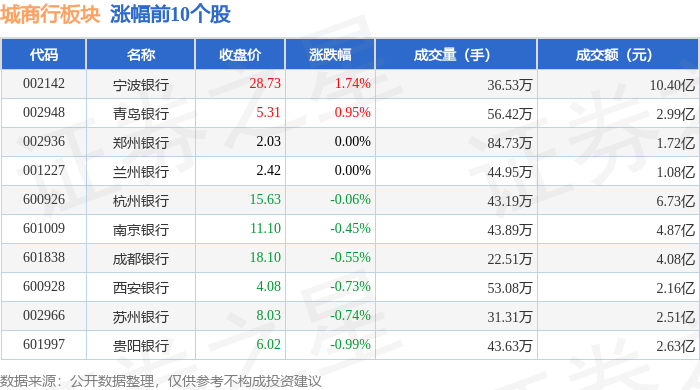
城商行板块9月5日跌0.37%,重庆银行领跌,主力资金净流出2.87亿元
Zheng Xing Xing Ye Ri Bao· 2025-09-05 08:56
Group 1 - The city commercial bank sector experienced a decline of 0.37% on September 5, with Chongqing Bank leading the drop [1] - The Shanghai Composite Index closed at 3812.51, up 1.24%, while the Shenzhen Component Index closed at 12590.56, up 3.89% [1] - Key individual stock performances in the city commercial bank sector included Ningbo Bank rising by 1.74% and Chongqing Bank falling by 1.34% [1][2] Group 2 - The net outflow of main funds from the city commercial bank sector was 287 million yuan, while retail investors saw a net inflow of 141 million yuan [2] - The trading volume for Chongqing Bank was 107,400 shares, with a transaction amount of 103 million yuan [2] - The overall trading activity showed a mixed trend, with some banks experiencing slight declines while others saw minor gains [1][2]


城商行排名生变,北京银行高管调整应对挑战
Guan Cha Zhe Wang· 2025-09-05 07:19
Group 1 - Jiangsu Bank has surpassed Beijing Bank in asset size, performance growth, and market value, becoming the new leader among city commercial banks as of mid-2025 [1] - As of June 30, Jiangsu Bank's total assets reached 4.79 trillion yuan, a year-on-year increase of 21.16%, while Beijing Bank's total assets were 4.75 trillion yuan, growing by 12.53% [1] - In the first half of the year, Jiangsu Bank reported total revenue of 44.864 billion yuan, up 7.78%, and a net profit of 20.238 billion yuan, up 8.05%, compared to Beijing Bank's revenue of 36.218 billion yuan, which grew only 1.02%, and a net profit of 15.053 billion yuan, up 1.12% [1] Group 2 - Beijing Bank has made significant personnel adjustments in response to competitive pressure, with new executives appointed since August [2] - The former chairman of North Silver Financial Leasing, Kong Haitao, has had his information removed from the official website, indicating a leadership change [2] - As of June 30, Beijing Bank's asset size in the Beijing region reached 3.1483 trillion yuan, accounting for nearly 70% of the bank's total assets [2]

A股上市宁企“半年报”全部发布
Nan Jing Ri Bao· 2025-09-05 03:27
Core Viewpoint - The financial performance of A-share listed companies in Nanjing for the first half of the year shows strong growth, particularly in the banking and securities sectors, driven by their focus on serving the real economy and innovation in technology [1][2][3]. Financial Performance - Nanjing's A-share listed companies have a total market capitalization of approximately 1.81 trillion yuan, with Jiangsu Bank, Nanjing Bank, and Huatai Securities leading in net profits of 20.24 billion yuan, 12.62 billion yuan, and 7.55 billion yuan respectively [1][2]. - Jiangsu Bank reported a revenue of 44.86 billion yuan, an increase of 7.78% year-on-year, and a net profit growth of 8.05% [2]. - Nanjing Bank achieved a revenue of 28.48 billion yuan, with a year-on-year growth of 8.64%, and a net profit increase of 8.84% [2]. - Huatai Securities saw a revenue of 16.22 billion yuan, with a significant year-on-year increase of 31.01%, and a net profit growth of 42.16% [2]. Service to Real Economy - Jiangsu Bank's focus on supporting manufacturing and infrastructure projects led to a manufacturing loan balance of 360.6 billion yuan, growing by 18.90% year-on-year, and infrastructure loans reaching 691.2 billion yuan, up by 31% [3]. - Nanjing Bank emphasized service to key industries, with green finance, inclusive small and micro finance, and technology finance loans growing by 27.79%, 12.51%, and 12.42% respectively [3]. - Huatai Securities maintained a strong development trend by innovating its business and service models [3]. Innovation and Technology - Nanjing Steel's half-year report highlighted a net profit of 1.46 billion yuan, with advanced steel material sales contributing significantly to profits [4][5]. - Nanjing Steel's innovation strategy included breakthroughs in advanced steel materials and participation in national key research projects [5]. - Guodian NARI's report showcased its technological advancements, achieving a revenue of 24.24 billion yuan, up by 19.54% year-on-year, and a net profit of 2.95 billion yuan, growing by 8.82% [6]. Globalization Strategy - Companies like Maolai Optical and Nanwei Medical are leveraging globalization for growth, with Maolai Optical reporting a revenue of 319 million yuan, up by 32.26%, and a net profit increase of 110.36% [7][8]. - Nanwei Medical achieved a revenue of 1.565 billion yuan, with overseas revenue accounting for 58% of total income, reflecting its global expansion efforts [9].




万亿低空经济:银行争相布局
3 6 Ke· 2025-09-05 02:52
Core Viewpoint - The low-altitude economy is gaining significant attention from financial institutions, with banks actively embedding themselves into the industry chain to support its development, projected to reach a market size of 1.5 trillion yuan by 2025 and 3.5 trillion yuan by 2035 [1][19]. Group 1: Bank Involvement in Low-Altitude Economy - Multiple banks have begun to establish a presence in the low-altitude economy, which includes activities below 1,000 meters such as drone logistics, low-altitude tourism, and aircraft manufacturing [2][4]. - Banks are providing various financial support mechanisms, including credit loans, special bonds, and asset-backed plans, to facilitate funding for low-altitude manufacturing, infrastructure, and operations [4][5]. - State-owned banks are focusing on infrastructure projects, exemplified by Postal Savings Bank's rapid credit approval for a precision manufacturing company in the aerospace sector [4][5]. Group 2: Financial Products and Innovations - Policy banks are leveraging long-term funding and policy synergies, with Agricultural Development Bank approving 800 million yuan for a drone demonstration base [5][9]. - Joint-stock banks and city commercial banks emphasize service flexibility and product innovation, such as Everbright Bank's online financial products for low-altitude economy enterprises [5][11]. - Jiangsu Bank has introduced a "Low-Altitude Park Treasure" product to support the development of industrial parks in the low-altitude economy [7]. Group 3: Challenges and Opportunities - The low-altitude economy presents banks with new lending and investment opportunities, but also requires enhanced risk management capabilities due to its complexity [14][16]. - Banks are encouraged to develop innovative financing tools tailored to the characteristics of low-altitude enterprises, such as intellectual property pledges and future revenue rights [9][11]. - The evolving regulatory landscape poses challenges, as banks must navigate uncertainties while capitalizing on the growth potential of the low-altitude economy [17][18]. Group 4: Strategic Collaborations - Banks are advised to engage in partnerships with government industry funds and leading enterprises to create a multi-layered financing system [11][19]. - The integration of online and offline service models is crucial for improving efficiency and customer experience in the low-altitude economy [11][14]. - A focus on comprehensive financial support systems, including equity investments and credit services, is essential for meeting the funding needs of low-altitude startups [11][19].


全省9家市值超千亿元企业,南京占4席
Nan Jing Ri Bao· 2025-09-05 00:13
Core Viewpoint - Nanjing has four companies among the nine listed in Jiangsu with a market capitalization exceeding 100 billion yuan, highlighting the city's strong financial performance and contribution to the regional economy [1]. Financial Performance of Nanjing Companies - Nanjing's A-share listed companies reported a total market capitalization of approximately 1.81 trillion yuan, with Jiangsu Bank, Nanjing Bank, and Huatai Securities leading in net profits of 202.38 billion yuan, 126.19 billion yuan, and 75.49 billion yuan respectively [1][2]. - Jiangsu Bank achieved a revenue of 448.64 billion yuan, an increase of 7.78% year-on-year, and a net profit growth of 8.05% [3]. - Nanjing Bank reported a revenue of 284.8 billion yuan, up 8.64%, and a net profit of 126.19 billion yuan, reflecting an 8.84% increase [2]. - Huatai Securities recorded a revenue of 162.19 billion yuan, with a year-on-year increase of 31.01%, and a net profit of 75.49 billion yuan, up 42.16% [2]. Focus on Serving the Real Economy - Jiangsu Bank's focus on supporting the manufacturing sector led to a manufacturing loan balance of 360.6 billion yuan, growing 18.90% year-on-year, and infrastructure loans increased by 31% to 691.2 billion yuan [3]. - Nanjing Bank emphasized service to key industries, with significant growth in green finance, inclusive small and micro finance, and technology finance [3]. - Huatai Securities maintained a strong development trajectory by innovating its business and service models [3]. Innovation and Technology Leadership - Nanjing Steel's report highlighted a 18.63% increase in net profit, driven by advanced steel material sales contributing significantly to profits [4]. - Nanjing Steel's R&D investments focused on overcoming technological bottlenecks in advanced materials, leading to notable achievements in product development [4]. - Guodian Nari's innovations included the development of a domestic complete set of equipment for speed regulation and energy management systems, resulting in a revenue increase of 19.54% [5]. Globalization Strategy - Companies like Maolai Optical have successfully implemented globalization strategies, achieving a revenue of 3.19 billion yuan, a 32.26% increase, and a net profit growth of 110.36% [6][7]. - Nanwei Medical's overseas revenue now accounts for 58% of total income, reflecting its commitment to global expansion [8][9].
“把脉”A股42家上市银行中期资产质量:对公贷款不良率持续向好,零售贷款仍处风险暴露期
Mei Ri Jing Ji Xin Wen· 2025-09-04 14:35
Group 1: Overall Asset Quality - As of August 31, 2023, the asset quality of 42 listed banks in A-shares shows a stable improvement, with some banks experiencing a slight increase in non-performing loan (NPL) ratios compared to the end of the previous year [1] - The overall NPL ratio for commercial banks was 1.49% at the end of Q2 2023, improving by 0.02 percentage points from the end of Q1 [3] - The provision coverage ratio for state-owned banks and rural commercial banks increased to 249.16% and 161.87%, respectively, while the ratios for joint-stock banks and city commercial banks decreased [4] Group 2: Non-Performing Loan Trends - The NPL ratio for corporate loans is improving, while the NPL ratio for retail loans is on the rise, indicating a structural change in asset quality [5][6] - For example, Industrial and Commercial Bank of China (ICBC) reported a decrease in corporate loan NPL ratio from 1.58% to 1.47%, while the personal loan NPL ratio increased from 1.15% to 1.35% [5] - The rise in retail loan NPLs is attributed to factors such as market conditions, increased flexible employment, and changes in industry environments affecting borrower income [6] Group 3: Real Estate Loan Performance - The real estate sector remains a significant source of NPLs, with some banks reporting an increase in real estate loan NPL ratios, while others have seen improvements [7][8] - For instance, Qingnong Commercial Bank's real estate NPL ratio rose to 21.32%, an increase of 14.15 percentage points from the end of the previous year [7] - The overall decline in real estate sales and the high leverage of real estate companies are fundamental reasons for the rising NPL ratios in this sector [8]






城商行板块9月4日涨0.14%,青岛银行领涨,主力资金净流入1.04亿元
Zheng Xing Xing Ye Ri Bao· 2025-09-04 08:48
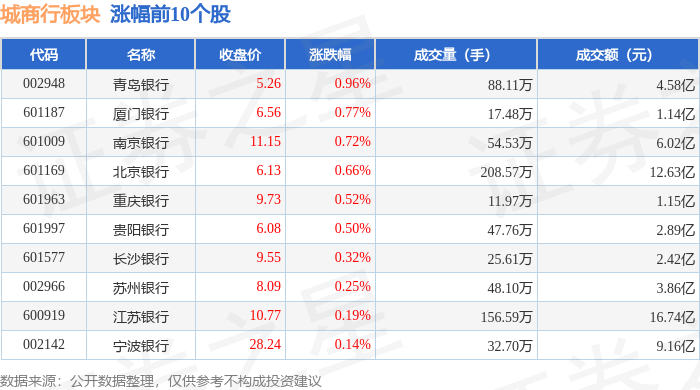
Group 1 - The city commercial bank sector saw a slight increase of 0.14% on September 4, with Qingdao Bank leading the gains [1] - The Shanghai Composite Index closed at 3765.88, down 1.25%, while the Shenzhen Component Index closed at 12118.7, down 2.83% [1] - Key stocks in the city commercial bank sector showed varied performance, with Qingdao Bank closing at 5.26, up 0.96%, and Xiamen Bank at 6.56, up 0.77% [1] Group 2 - The city commercial bank sector experienced a net inflow of 1.04 billion yuan from institutional investors, while retail investors contributed a net inflow of 1.27 billion yuan [2] - The sector saw a net outflow of 2.31 billion yuan from speculative funds [2] - Individual stock performance varied, with Beijing Bank showing a net inflow of 1.52 million yuan from institutional investors, while Xiamen Bank had a net outflow of 730.79 million yuan [3]

机构看好板块价值重估,银行ETF指数(512730)上涨近1%,上市银行上半年营收及利润增速双双转正
Xin Lang Cai Jing· 2025-09-04 07:18
Group 1 - The core viewpoint is that the banking sector is experiencing a recovery in revenue and profit growth, with overall operating income and net profit growth rates for listed banks turning positive [1][2] - The banking sector is expected to benefit from a stable low interest rate environment, leading investors to prefer lower-risk and more predictable return assets [1][2] - The banking sector's price-to-book (PB) ratio is considered undervalued, especially given the systemic risk concerns have been alleviated [1][2] Group 2 - Recent market conditions have led to increased long-term investments in banks by institutional investors, such as insurance funds and asset management companies [2] - The banking sector's asset quality is stable, and the pressure on interest margins is manageable, with expectations for interest margins to stabilize in the coming quarters [2] - The banking sector is anticipated to enter a new phase of stable return on equity (ROE), supported by fiscal stability and risk management from the central bank [2] Group 3 - The CSI Bank Index closely tracks the performance of the banking sector, with the top ten weighted stocks accounting for 65% of the index [3] - The top ten stocks in the CSI Bank Index include major banks such as China Merchants Bank, Industrial and Commercial Bank of China, and Agricultural Bank of China [3]



银行研究框架及25H1业绩综述:营收及利润增速双双转正
GOLDEN SUN SECURITIES· 2025-09-04 06:14
Investment Rating - The report indicates a positive outlook for the banking industry, with overall revenue and net profit growth rates turning positive in the first half of 2025, at 1.0% and 0.8% respectively, showing improvements from the previous quarter [4]. Core Insights - The banking sector's net interest margin for the first half of 2025 is reported at 1.42%, a decrease of 10 basis points compared to the previous year, but the decline is narrowing due to improved cost management on the liability side [5]. - Non-interest income, particularly from fees and commissions, has increased by 3.1% year-on-year, driven by a recovery in wealth management and a more active market environment [5]. - The asset quality remains stable, with a non-performing loan ratio of 1.23% and a provision coverage ratio of 239%, indicating a solid credit environment [5]. Summary by Sections Financial Performance Overview - The overall revenue and net profit growth for listed banks in the first half of 2025 were 1.0% and 0.8%, respectively, with both metrics showing improvement from the first quarter [4][22]. - The total assets of listed banks reached 321.3 trillion yuan, growing by 6.35% year-to-date, with loans and advances totaling 179.4 trillion yuan, accounting for 55.84% of total assets [21][24]. Income Sources - Net interest income decreased by 1.3% year-on-year, but the decline rate has slowed, reflecting better management of funding costs [5]. - Fee and commission income grew by 3.1% year-on-year, benefiting from a recovering market and the gradual impact of regulatory changes [5]. - Other non-interest income saw a significant increase of 10.7%, primarily due to favorable market conditions in the bond market [5]. Asset Quality and Management - The non-performing loan ratio remained stable at 1.23%, with a provision coverage ratio of 239%, indicating a robust asset quality [5]. - The credit cost for the first half of 2025 was 0.81%, a decrease of 5 basis points year-on-year, suggesting manageable credit risks [5]. Loan Growth and Composition - Loan growth was primarily driven by corporate lending, with significant contributions from infrastructure and manufacturing sectors [20]. - Personal loan growth was weaker, with a year-on-year increase of only 3.6%, reflecting a cautious approach to consumer lending amid rising risks [20]. Investment and Market Conditions - The investment asset proportion decreased to 34% as banks adjusted their strategies in response to market volatility [20]. - The overall yield on bonds fluctuated significantly, prompting banks to engage in tactical trading to enhance returns [20].

江苏宁沪高速公路(00177.HK):受江苏银行分红周期变化影响 业绩略低于预期
Ge Long Hui· 2025-09-04 04:04
Core Viewpoint - Ninghu Expressway reported a decline in revenue and net profit for the first half of 2025, primarily due to reduced investment income from joint ventures and adjustments in dividend cycles from Jiangsu Bank [1][2] Financial Performance - The company achieved an operating revenue of 9.406 billion yuan, a year-on-year decrease of 5.6%. Excluding construction revenue, the revenue decline was 0.99%, indicating stable core business operations [1] - The net profit attributable to shareholders was 2.424 billion yuan, down 11.8%, influenced by reduced investment income and changes in the dividend cycle from Jiangsu Bank [1] Toll Revenue - In the first half of 2025, toll revenue reached approximately 4.6 billion yuan, reflecting a year-on-year growth of about 1.65%. The growth rate varied across major routes due to reconstruction and expansion impacts [1] Dividend Adjustments - Jiangsu Bank's dividend cycle adjustment led to a mid-term dividend of approximately 168 million yuan for the first half of 2025, a significant decrease of 54.38% compared to the full-year dividend of 368 million yuan in the same period of 2024 [1] Infrastructure Development - The core road asset expansion and reconstruction are ongoing, with the Ningyang Yangtze River Bridge northern connection project expected to open by the end of 2025, and the southern section of the Xiyi Expressway projected to be operational by June 2026, which is anticipated to significantly improve regional traffic flow [2] Technological Advancements - The company is developing a new ecological model for safe and intelligent management of highway maintenance, integrating real-time drone data with human expertise to enhance rescue efficiency and optimize core network capacity [2] Investment Outlook - Based on the 2025 mid-term report, the company maintains its previous profit forecast, expecting net profits of 5.447 billion yuan, 5.790 billion yuan, and 6.049 billion yuan for 2025E-2027E, with corresponding PE multiples of 8, 7, and 7 [2]