CNOOC(600938)

Search documents
又一无人智能平台在南海东部油田安家
Zhong Guo Xin Wen Wang· 2025-07-15 12:56
Core Insights - China National Offshore Oil Corporation (CNOOC) Shenzhen branch successfully completed the offshore installation of the upper module of the Xijiang 24-7 platform on July 14, marking the beginning of a new phase in joint debugging for the platform [1][2] - The Xijiang 24-7 platform represents a significant advancement in the application of unmanned platform technology, showcasing improvements in digitalization, production processing capacity, operational costs, and safety [1] - The project is part of CNOOC's efforts to drive the digital transformation of offshore oil fields, with the average water depth in the area being approximately 90 meters [1] Project Details - The upper module of the Xijiang 24-7 platform weighs approximately 3,310 tons and consists of a two-layer deck structure, with the main deck measuring 36.3 meters in length and 36.1 meters in width, equivalent to the area of three basketball courts [1] - The platform is designed to utilize multiple digital technologies, enabling functions such as intelligent oil extraction, smart equipment operation, and intelligent security [1] Installation Challenges - The installation occurred during a season prone to severe weather, including typhoons and strong convective conditions, necessitating careful planning and resource management to mitigate the impact of Typhoon 'Danas' [2] - The project team implemented innovative guiding devices and positioning spikes to ensure precision during the installation, achieving an overall alignment error of less than 1 millimeter [2] Production Performance - In the first half of the year, the eastern South China Sea oil fields exceeded production targets for both crude oil and natural gas, focusing on maximizing output and efficiency [2] - New projects adhered to the principle of "land-based support for sea operations" and enhanced resource coordination, with simultaneous construction of multiple platforms in Zhuhai and Qingdao [2]

石油石化行业今日净流入资金9110.01万元,中国石油等7股净流入资金超千万元
Sou Hu Cai Jing· 2025-07-14 09:30
Market Overview - The Shanghai Composite Index rose by 0.27% on July 14, with 21 out of the 28 sectors in the Shenwan classification experiencing gains, led by the machinery equipment and public utilities sectors, which increased by 1.23% and 1.04% respectively [1] - The oil and petrochemical sector saw an increase of 0.86% with a net inflow of 91.1 million yuan in main funds [1] Oil and Petrochemical Sector - Within the oil and petrochemical sector, 28 out of 47 stocks rose, with one stock hitting the daily limit up, while 17 stocks declined [1] - The top three stocks with the highest net inflow of funds were China National Petroleum Corporation (2.55 billion yuan), Sinopec (960.7 million yuan), and China National Offshore Oil Corporation (848.6 million yuan) [1] - The stocks with the largest net outflow included Guanghui Energy (1.11 billion yuan), *ST Xinchao (432.4 million yuan), and Guangju Energy (392.7 million yuan) [1] Fund Flow Analysis - The top stocks by main fund flow in the oil and petrochemical sector included: - China National Petroleum Corporation: +2.66% with a turnover rate of 0.13% and a main fund flow of 254.5 million yuan - Sinopec: +1.05% with a turnover rate of 0.15% and a main fund flow of 96.1 million yuan - China National Offshore Oil Corporation: +0.58% with a turnover rate of 0.98% and a main fund flow of 84.9 million yuan [1] - Several stocks experienced significant net outflows, including: - Guanghui Energy: -1.11 billion yuan - *ST Xinchao: -432.4 million yuan - Guangju Energy: -392.7 million yuan [2]




能源周报(20250707-20250713):美或进一步对俄制裁,本周油价上涨-20250714
Huachuang Securities· 2025-07-14 09:12
Investment Strategy - Crude oil supply is expected to remain limited due to declining global oil and gas capital expenditures, with a significant reduction of nearly 122% from 2014 levels to $351 billion in 2021 [9][30][31] - Geopolitical tensions, particularly the Russia-Ukraine conflict, have exacerbated concerns over energy supply, with the EU planning to reduce oil imports from Russia by 90% by the end of 2022 [10][31] - Brent crude oil prices increased to $71.97 per barrel, up 2.95% week-on-week, while WTI prices rose to $67.93 per barrel, up 2.46% [11][32] Coal Industry - The average market price for Qinhuangdao port thermal coal (Q5500) rose to 628 RMB/ton, a 1.06% increase from the previous week, driven by improved demand and trading conditions [12][13] - Coal production is gradually recovering, with total inventory at ports reported at 26.9 million tons, down 2.46% week-on-week, indicating a tightening supply [12][13] - The domestic coal consumption for key power plants increased to 4.88 million tons per day, a 6.09% rise from the previous week, reflecting higher electricity demand due to ongoing high temperatures [12][13] Coking Coal - Coking coal prices have seen a slight increase, with the price for Shanxi main coking coal at 1,350 RMB/ton, up 9.76% week-on-week, as supply conditions improve [14][15] - The overall supply-demand situation for coking coal is improving, with increased orders from steel mills and a decrease in inventory levels [14][15] Natural Gas - The EIA projects that U.S. natural gas production and consumption will reach record highs in 2025, with expected consumption of 91.4 billion cubic feet per day [16][17] - U.S. natural gas prices decreased to $3.33 per million British thermal units, down 2.9% from the previous week, while European gas prices increased [16][17] - The EU has reached an agreement on a natural gas price cap, which may lead to liquidity issues and potential supply shortages [17] Oilfield Services - The oilfield services sector is experiencing a recovery in demand due to increased capital expenditures from major oil companies, which are projected to reach 581.738 billion RMB in 2023, reflecting a compound annual growth rate of 6% since 2018 [18][19] - The number of active drilling rigs globally decreased to 1,576, with a notable decline in the Middle East and the U.S. [19]



秋季备肥启动,关注钾肥、磷肥投资机会
Tebon Securities· 2025-07-14 07:43
Investment Rating - The report maintains an "Outperform" rating for the basic chemical industry [2] Core Viewpoints - The basic chemical sector has shown better performance than the market, with a year-to-date increase of 8.9%, outperforming the Shanghai Composite Index by 4.2 percentage points [4][16] - The global potash market is characterized by oligopoly, with major producers controlling supply and prices. Recent production cuts by key players are expected to sustain potash market conditions [5][27] - Phosphate supply remains tight, with stable prices and potential improvements in export opportunities as demand increases [5][27] Summary by Sections 1. Core Viewpoints - Policies are expected to improve supply-demand dynamics in the chemical sector, with a focus on cyclical investment opportunities [13] - The chemical industry is entering a new long-term prosperity cycle, driven by improved fundamentals and reduced risks [13][14] 2. Overall Performance of the Chemical Sector - The basic chemical industry index increased by 1.5% during the week, outperforming the Shanghai Composite Index by 0.4 percentage points [16] - Year-to-date, the basic chemical industry index has increased by 8.9%, significantly outperforming both the Shanghai Composite and ChiNext indices [16][18] 3. Individual Stock Performance in the Chemical Sector - Among 424 stocks in the basic chemical sector, 298 stocks rose while 123 fell during the week [25] - The top performers included companies like Shangwei New Materials (+72.9%) and Hongbo New Materials (+24.7%) [25][26] 4. Key News and Company Announcements - The autumn fertilizer preparation has begun, with a focus on investment opportunities in potash and phosphate fertilizers [27] - Major potash producers have announced production cuts, which are expected to tighten supply and support prices [5][27] - Phosphate prices remain stable, with potential for improved export conditions as demand increases [5][27] 5. Product Price Changes - The report highlights significant price increases in various chemical products, with notable gains in dimethylamine (+16.7%) and fatty alcohol (+8.2%) [6] - Conversely, urea prices have seen a significant decline (-15%) [6]





石油化工行业周报:由于库存走高,EIA下调气价预测-20250713
Shenwan Hongyuan Securities· 2025-07-13 14:15
Investment Rating - The report maintains a positive outlook on the petrochemical industry, highlighting potential recovery in polyester and refining sectors [2][14]. Core Insights - The EIA has revised down its natural gas price forecasts due to rising inventories, with the third-quarter price expected at $3.37 per million British thermal units (MMBtu) and the fourth quarter at $3.99 MMBtu [2][3]. - U.S. natural gas inventories reached 30,060 billion cubic feet, significantly above the five-year average, indicating a clear accumulation trend [6]. - Oil prices have shown an upward trend, with Brent crude futures closing at $70.36 per barrel, reflecting a 3.02% increase week-over-week [18]. - The report anticipates a downward adjustment in oil prices due to widening supply-demand dynamics, although OPEC production cuts and shale oil cost support may maintain prices at mid-high levels [2][18]. Summary by Sections Natural Gas Market - The EIA has lowered its natural gas price forecasts for Q3 and Q4 2025, with average prices expected at $3.67 and $4.41 per MMBtu for 2025 and 2026, respectively [2][3]. - U.S. natural gas production reached 11.68 billion cubic feet per day in Q2 2025, a year-on-year increase of 4.7 billion cubic feet per day [6]. - Solar power is increasingly substituting natural gas in electricity generation, with a projected 3% decline in gas-fired generation in 2025 [11]. Upstream Sector - Brent crude oil prices increased to $70.36 per barrel, while WTI prices rose to $68.45 per barrel, with weekly average prices showing gains of 2.34% and 2.44%, respectively [18]. - U.S. commercial crude oil inventories rose to 426 million barrels, with gasoline inventories decreasing to 229 million barrels [19]. - The number of active drilling rigs in the U.S. decreased to 537, down 2 from the previous week and 47 year-on-year [29]. Refining Sector - The Singapore refining margin for major products decreased to $13.70 per barrel, reflecting a decline of $0.31 per barrel week-over-week [50]. - The report notes that refining profitability is expected to improve as oil prices adjust downward, with domestic refining product margins still at low levels [48]. Polyester Sector - The report highlights a recovery expectation in the polyester sector, with improved profitability anticipated as supply-demand dynamics stabilize [14]. - Key companies to watch include Tongkun Co. and Wankai New Materials, which are expected to benefit from this recovery [14]. Investment Recommendations - The report recommends focusing on leading refining companies such as Hengli Petrochemical, Rongsheng Petrochemical, and Sinopec, which are expected to benefit from improved competitive dynamics [14]. - It also suggests monitoring companies in the upstream exploration and production sector, particularly offshore oil service firms like CNOOC Services and Offshore Oil Engineering, which are projected to see performance improvements [14].


原油周报:OPEC+或将在10月暂停增产-20250713
Soochow Securities· 2025-07-13 09:55
1. Report Industry Investment Rating Not provided in the content 2. Core Viewpoints of the Report - This week, the average weekly prices of Brent/WTI crude oil futures were $69.8/$67.9 per barrel, up $1.6/$1.6 from last week [2]. - The total US crude oil inventory, commercial crude oil inventory, strategic crude oil inventory, and Cushing crude oil inventory were 8.3/4.3/4.0/0.2 billion barrels respectively, with a week - on - week increase of 731/707/24/46 thousand barrels [2]. - US crude oil production was 13.39 million barrels per day, a week - on - week decrease of 50 thousand barrels per day. The number of active US crude oil rigs this week was 424, a week - on - week decrease of 1. The number of active US fracturing fleets this week was 176, a week - on - week increase of 4 [2]. - US refinery crude oil processing volume was 17.01 million barrels per day, a week - on - week decrease of 100 thousand barrels per day; the US refinery crude oil utilization rate was 94.7%, a week - on - week decrease of 0.2 percentage points [2]. - US crude oil imports, exports, and net imports were 6.01/2.76/3.26 million barrels per day, with a week - on - week change of - 910 thousand/+450 thousand/ - 1.36 million barrels per day [2]. - The average weekly prices of US gasoline, diesel, and jet fuel were $91/$102/$90 per barrel respectively, with a week - on - week change of +$2.9/+$2.1/ - $4.1. The price spreads with crude oil were $21/$32/$20 per barrel respectively, with a week - on - week change of +$1.2/+$0.4/ - $5.8 [2]. - US gasoline, diesel, and aviation kerosene inventories were 2.3/1.0/0.4 billion barrels respectively, with a week - on - week decrease of 266/83/91 thousand barrels [2]. - US gasoline, diesel, and aviation kerosene production were 9.9/5.09/1.96 million barrels per day respectively, with a week - on - week increase of 280 thousand/60 thousand/40 thousand barrels per day [2]. - US gasoline, diesel, and aviation kerosene consumption were 9.9/5.09/1.96 million barrels per day respectively, with a week - on - week increase of 280 thousand/60 thousand/40 thousand barrels per day [2]. - US gasoline imports, exports, and net exports were 130 thousand/1.04 million/910 thousand barrels per day respectively, with a week - on - week change of - 40 thousand/+260 thousand/+300 thousand barrels per day. US diesel imports, exports, and net exports were 40 thousand/1.59 million/1.54 million barrels per day respectively, with a week - on - week change of - 80 thousand/+230 thousand/+310 thousand barrels per day. US aviation kerosene imports, exports, and net exports were 80 thousand/250 thousand/170 thousand barrels per day respectively, with a week - on - week change of +10 thousand/+80 thousand/+70 thousand barrels per day [2]. - Recommended companies include CNOOC Limited (600938.SH/0883.HK), PetroChina Company Limited (601857.SH/0857.HK), Sinopec Corp. (600028.SH/0386.HK), CNOOC Oilfield Services Limited (601808.SH), Offshore Oil Engineering Co., Ltd. (600583.SH), and CNOOC Energy Technology & Services Limited (600968.SH). Companies to be noted include Sinopec Oilfield Service Corporation (600871.SH/1033.HK), China Petroleum Engineering & Construction Corporation (600339.SH), and Sinopec Mechanical & Electrical Equipment Co., Ltd. (000852.SZ) [3]. 3. Summary by Directory 1. Crude Oil Weekly Data Briefing - Data sources include Bloomberg, WIND, EIA, TSA, Baker Hughes, and Dongwu Securities Research Institute [8][9] 2. This Week's Petroleum and Petrochemical Sector Market Review 2.1 Petroleum and Petrochemical Sector Performance - Information on the performance of the petroleum and petrochemical sector, including the rise and fall of various sub - industries and the trend of the sector and the CSI 300 index, with data sources from WIND and Dongwu Securities Research Institute [11][18] 2.2 Sector Listed Company Performance - The table shows the rise and fall of major upstream companies in the sector, including companies such as CNOOC Limited, PetroChina Company Limited, and Sinopec Corp., with data sources from WIND and Dongwu Securities Research Institute [22][23] - The valuation table of listed companies shows the stock price, total market value, net profit attributable to the parent company, PE, and PB of companies such as CNOOC Limited, PetroChina Company Limited, and Sinopec Corp. from 2024A to 2027E, with data sources from Wind and Dongwu Securities Research Institute [24] 3. Crude Oil Sector Data Tracking 3.1 Crude Oil Price - Analyzes the prices and price spreads of Brent, WTI, Urals, ESPO crude oil, etc., as well as the relationship between the US dollar index, copper price, and WTI crude oil price, with data sources from WIND and Dongwu Securities Research Institute [26][29] 3.2 Crude Oil Inventory - Studies the relationship between US commercial crude oil inventory and oil prices, the weekly destocking speed of US commercial crude oil and the rise and fall of Brent oil, and the inventory of US total crude oil, commercial crude oil, strategic crude oil, and Cushing crude oil, with data sources from WIND and Dongwu Securities Research Institute [44][45] 3.3 Crude Oil Supply - Analyzes US crude oil production, the number of US crude oil rigs, and the number of fracturing fleets and their relationship with oil prices, with data sources from WIND and Dongwu Securities Research Institute [57][58] 3.4 Crude Oil Demand - Analyzes US refinery crude oil processing volume, refinery utilization rate, and Shandong refinery utilization rate, with data sources from WIND and Dongwu Securities Research Institute [61][63] 3.5 Crude Oil Import and Export - Analyzes US crude oil import, export, and net import volume, as well as the import, export, and net import volume of US crude oil and petroleum products, with data sources from WIND and Dongwu Securities Research Institute [66][68] 4. Refined Oil Sector Data Tracking 4.1 Refined Oil Price - Analyzes the prices and price spreads of crude oil and domestic/US/European/Singapore gasoline, diesel, and aviation kerosene, as well as the domestic gasoline and diesel wholesale - retail price spreads, with data sources from WIND and Dongwu Securities Research Institute [73][76] 4.2 Refined Oil Inventory - Analyzes the inventory of US gasoline, diesel, aviation kerosene, and Singapore gasoline and diesel, with data sources from WIND and Dongwu Securities Research Institute [99][100] 4.3 Refined Oil Supply - Analyzes US gasoline, diesel, and aviation kerosene production, with data sources from WIND and Dongwu Securities Research Institute [115][116] 4.4 Refined Oil Demand - Analyzes US gasoline, diesel, and aviation kerosene consumption and the number of US passenger airport security checks, with data sources from WIND and Dongwu Securities Research Institute [117][118] 4.5 Refined Oil Import and Export - Analyzes US gasoline, diesel, and aviation kerosene import, export, and net export volume, with data sources from WIND and Dongwu Securities Research Institute [126][127] 5. Oilfield Services Sector Data Tracking - Analyzes the average daily fees of self - elevating drilling platforms and semi - submersible drilling platforms in the industry, with data sources from WIND and Dongwu Securities Research Institute [139][141]
我国承建24套2000米级国际超深水海洋装备全部交付
Xin Hua Cai Jing· 2025-07-13 09:40
Core Points - China National Offshore Oil Corporation (CNOOC) has successfully delivered 24 sets of 2000-meter deep international suction anchors for the Mero Phase II project in Brazil, marking a significant achievement in deepwater engineering [2] - The suction anchors, which utilize negative pressure to secure marine facilities, are essential for deep-sea energy development and are recognized for their high efficiency, reusability, and load-bearing capacity [2] - The project represents the largest application depth for suction anchors constructed domestically, with a total structural weight of approximately 2674 tons [2] Technical Innovations - The Mero Phase II suction anchors feature a maximum construction height of 21 meters, a diameter of 8 meters, and a wall thickness of only 25 millimeters, presenting substantial construction challenges [3] - The project team pioneered several construction techniques, including horizontal extension and vertical assembly, and employed advanced technologies such as 3D scanning and finite element simulation to address technical difficulties [3] - The quality assurance rate exceeded 99.9%, with dimensional deviations maintained within 1 millimeter per meter, achieving an industry-leading standard [3] Industry Contributions - CNOOC has been enhancing its core technologies in deepwater oil and gas equipment, successfully constructing several significant platforms, including the world's first 100,000-ton semi-submersible production and storage platform [3] - The company has also delivered multiple large-scale floating production storage and offloading units (FPSOs) internationally, contributing to the global deepwater oil and gas equipment market and promoting high-level cooperation in marine energy [3]

国产24套2000米级“定海神针”启运巴西
news flash· 2025-07-13 06:38
Core Viewpoint - The delivery of 24 sets of 2000-meter deep-water suction anchors by China National Offshore Oil Corporation (CNOOC) to Brazil marks a significant achievement in China's deep-sea equipment manufacturing, showcasing international recognition of "Made in China" deep-sea technology [1] Group 1: Company Achievements - CNOOC has successfully constructed and delivered 24 sets of 2000-meter deep-water suction anchors, which are among the largest deep-sea oil and gas equipment exported by China [1] - The suction anchor is a critical piece of equipment for deep-water mooring, functioning like a large suction cup that firmly attaches to the seabed, ensuring efficient fixation of marine facilities [1] Group 2: Industry Impact - The delivery signifies a milestone in the acceptance of Chinese deep-sea equipment in the international mainstream market, indicating a growing competitiveness of China's manufacturing capabilities in the deep-sea energy sector [1] - The suction anchor is referred to as the "stabilizing needle" for deep-sea energy development, highlighting its importance in the industry [1]
石油石化行业今日净流入资金5.25亿元,中国海油等9股净流入资金超千万元
Sou Hu Cai Jing· 2025-07-10 09:45
Core Viewpoint - The Shanghai Composite Index rose by 0.48% on July 10, with 18 out of 28 sectors experiencing gains, particularly in real estate and oil & petrochemicals, which increased by 3.19% and 1.54% respectively [1] Industry Summary - The oil & petrochemical sector saw a 1.54% increase, with a net inflow of 525 million yuan in capital. Out of 48 stocks in this sector, 34 rose, and 1 hit the daily limit up, while 12 declined [1] - The top three stocks with the highest net capital inflow were China National Offshore Oil Corporation (CNOOC) with 440 million yuan, followed by China Petroleum & Chemical Corporation (Sinopec) with 264 million yuan, and China Petroleum with 55.96 million yuan [1] - The stocks with the largest net capital outflow included Guanghui Energy, Yueyang Xingchang, and Zhongman Petroleum, with outflows of 176 million yuan, 36.79 million yuan, and 27.54 million yuan respectively [1] Stock Performance - CNOOC's stock rose by 3.59% with a turnover rate of 3.74% and a main capital flow of 440.40 million yuan [1] - Sinopec's stock increased by 1.41% with a turnover rate of 0.24% and a main capital flow of 264.20 million yuan [1] - China Petroleum's stock saw a 0.93% rise with a turnover rate of 0.08% and a main capital flow of 55.96 million yuan [1]
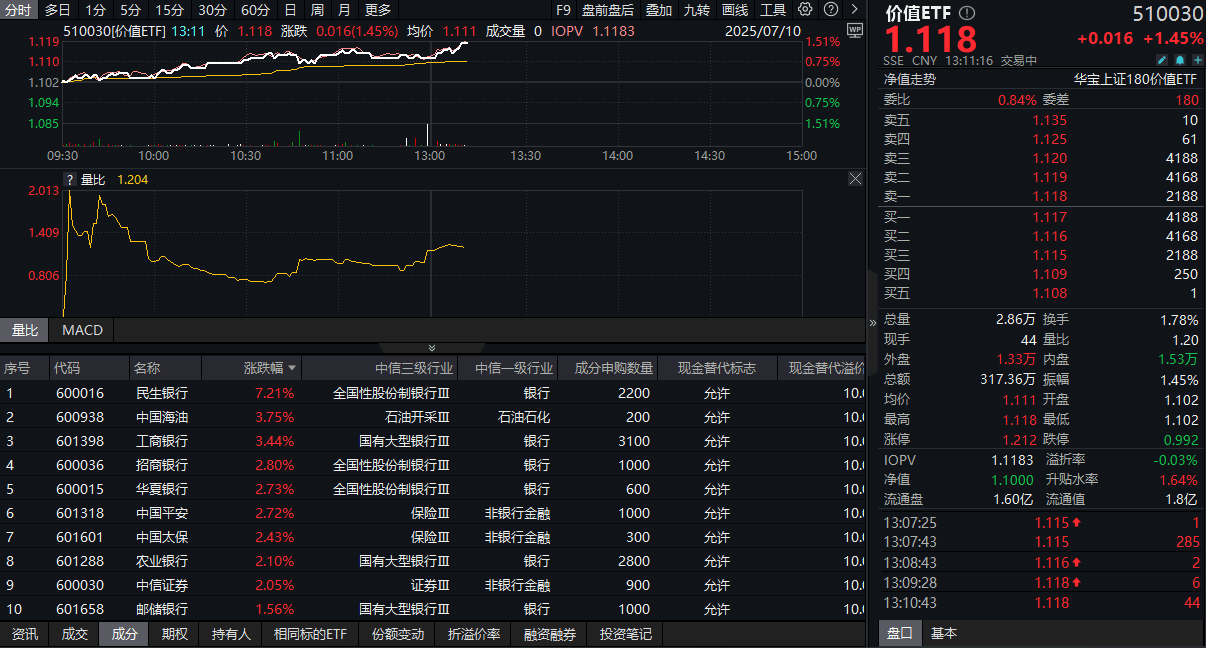
ETF盘中资讯|高股息猛攻,银行领涨,价值ETF(510030)大涨1.45%!机构:红利板块有望受到更多资金的青睐
Sou Hu Cai Jing· 2025-07-10 05:39
Core Viewpoint - High dividend stocks continue to perform strongly, with a focus on "high dividend + low valuation" large-cap blue-chip stocks in the value ETF (510030), which saw a price increase of 1.45% as of the report time [1]. Group 1: Market Performance - The value ETF (510030) opened with fluctuations and rose by 1.45%, with a trading price of 1.119 as of 13:11 [2]. - The 180 Value Index has outperformed major A-share indices, with a year-to-date increase of 7.44%, compared to the Shanghai Composite Index's 4.22% and the CSI 300 Index's 1.44% [3][4]. Group 2: Stock Performance - Key stocks in the banking and non-banking financial sectors showed significant gains, with Minsheng Bank soaring over 7%, and China National Offshore Oil Corporation and Industrial and Commercial Bank of China both rising over 3% [1]. - Other notable stocks included China Ping An, China Merchants Bank, and Huaxia Bank, each increasing by over 2% [1]. Group 3: Investment Insights - The current valuation of the 180 Value Index is at a price-to-book ratio of 0.85, indicating a favorable long-term investment opportunity [4]. - Analysts suggest that in the current uncertain global environment, investors may prefer dividend assets due to their stable cash flow and high dividend yields, which are expected to attract more capital in the medium to long term [4][5].