CMS(600999)

Search documents
招商证券:首予紫金黄金国际(02259) “强烈推荐”评级
智通财经网· 2025-10-06 06:19
截至今年6月底,紫金黄金国际合并口径金金属资源量约1,768.4吨,平均每吨品位1.5克,合并口径证明 加可信金金属储量达845.2吨,认为其具中长期增长前景奠定基础,预测2025至2027年纯利将分别达到 88亿、129亿及133亿元人民币,毛利率料达52.9%、59.5%及59.5%。 智通财经APP获悉,招商证券发布研报称,首次给予紫金黄金国际(02259) "强烈推荐"评级,紫金矿业 (02899)分拆其上市,整合海外黄金矿山资源,便于锚定海外同业估值体系,释放资产价值,通过国际 化资本平台有助提升估值与资本效率。 ...

招商证券:长假后计算机、通信、电子、银行等上涨概率较高
Sou Hu Cai Jing· 2025-10-05 09:52
招商证券张夏团队在9月26日发布的研报中表示,从近十年国庆节后行业表现来看,国庆后一周一级行 业上涨概率多数在50%以上,其中上涨概率靠前的行业集中在计算机、通信、电子、银行等行业,其中 银行、非银金融、汽车在国庆后两周和国庆后一个月上涨概率仍然较高。 另据Choice数据,近十年,节后第一个交易日,上证指数上涨概率达70%。 ...


OpenAI再造“爆款”!招商证券:So-ra 2正式开启AI应用变现的大幕
2 1 Shi Ji Jing Ji Bao Dao· 2025-10-04 08:01
Core Insights - OpenAI has launched its advanced video generation model Sora 2, marking a significant upgrade from the initial Sora model released in February 2024, and has introduced an iPhone application named "Sora by OpenAI" [1][3][4] - Sora 2 has quickly gained popularity, reaching the top of the App Store's free applications chart in the U.S. within four days of its launch, surpassing both ChatGPT and Google's Gemini [1][2] - The model offers enhanced realism and control in video generation, capable of executing complex instructions and maintaining consistent world states, which were challenging for previous models [3][4] Product Features - Sora 2 can generate highly realistic scenes and sound effects, overcoming limitations of earlier models, such as accurately simulating physical actions and maintaining object integrity [3][4] - The application includes features like "Cameos," allowing users to integrate their own or celebrity IPs into videos, promoting user-generated content and viral marketing [7] - Sora 2 is currently in an invite-only testing phase, available on iOS in the U.S. and Canada, with plans for broader expansion [5][6] Financial Performance - OpenAI reported revenues of $4.3 billion for the first half of the year, exceeding the total revenue of the previous year, but also recorded a net loss of $13.5 billion [6] - The company has consumed $2.5 billion in funds primarily for AI research and operational costs, with an estimated total expenditure of $8.5 billion for the year [6] - OpenAI's valuation has reached $500 billion, and the company is considering a future IPO while expanding its strategic partnership with NVIDIA [6] Market Impact - The launch of Sora 2 is seen as a pivotal moment for AI applications, potentially leading to a significant transformation in the creative industry, akin to a "Cambrian explosion" in art and entertainment quality [4][7] - The rapid adoption and positive reception of Sora 2 suggest a strong market potential for AI-generated content, positioning OpenAI as a leader in this emerging sector [2][7]
OpenAI再造“爆款”!招商证券:Sora 2正式开启AI应用变现的大幕
2 1 Shi Ji Jing Ji Bao Dao· 2025-10-04 07:41
Core Insights - OpenAI has launched its most advanced video generation model, Sora 2, along with an iPhone app named "Sora by OpenAI" which allows users to create AI-generated videos from text, images, or videos [1][3] - Sora 2 has quickly gained popularity, reaching the top of the free app charts in the US App Store within four days of its launch, surpassing both ChatGPT and Google's Gemini [1][2] - The model represents a significant technological upgrade from the initial Sora model released in February 2024, with enhanced realism and control in video generation [3][4] Product Features - Sora 2 can generate highly realistic scenes and sound effects, overcoming challenges faced by previous models, such as accurately simulating physical actions [3][4] - The app includes features like "Cameos" for integrating user or celebrity appearances in videos, and it has built-in safeguards for youth users [4][6] - Sora 2 is currently in an invite-only testing phase, available only on iOS devices in the US and Canada, with plans for broader expansion [5][6] Market Performance - In its first two days, Sora's iOS app achieved 164,000 downloads, indicating strong market potential despite being in a limited release [2] - OpenAI's financial performance shows a revenue of $4.3 billion in the first half of the year, with a net loss of $13.5 billion, highlighting the high costs associated with AI development [6] Strategic Partnerships - OpenAI has signed a letter of intent with NVIDIA for strategic collaboration, allowing access to extensive GPU resources for building AI data centers [6] - The company is also considering an IPO in the future, with a current valuation of $500 billion [6] Industry Impact - The launch of Sora 2 is seen as a pivotal moment in the AI video generation space, potentially leading to a significant increase in the quality of creative content [4][7] - The introduction of Sora 2 is expected to drive monetization opportunities in AI applications, marking a new era for AI in media and entertainment [7]
2025年前三季度ABS承销排行榜
Wind万得· 2025-10-01 03:18
Core Insights - The ABS market in China saw a total of 1,777 new issuance projects in the first three quarters of 2025, with an issuance scale of 16,336 billion yuan, representing a 17% increase from 14,007 billion yuan in the previous year [6][2]. Market Overview - As of the end of the first three quarters of 2025, the cumulative market size reached approximately 33,810 billion yuan, with credit ABS at 4,017 billion yuan, enterprise ABS at 21,405 billion yuan, ABN at 6,348 billion yuan, and public REITs at 2,040 billion yuan [4]. Credit ABS - In the credit ABS segment, 172 new projects were issued, totaling 1,866 billion yuan, a 2% decrease year-on-year. The largest issuance came from non-performing loans, with 134 projects totaling 634 billion yuan, followed by personal auto loans with 17 projects totaling 536 billion yuan [8][6]. Enterprise ABS - The enterprise ABS market saw 1,127 new projects issued, totaling 9,951 billion yuan, which is a 22% increase compared to the previous year. The largest issuance was in financing lease receivables, with 214 projects totaling 2,163 billion yuan, followed by corporate receivables with 160 projects totaling 1,497 billion yuan [10][6]. ABN - The ABN market had 460 new projects issued, totaling 4,157 billion yuan, marking an 18% increase year-on-year. The largest issuances were in bank/internet consumer loans, with 159 projects totaling 1,415 billion yuan, followed by general small loan receivables with 114 projects totaling 1,038 billion yuan [11][6]. Underwriting Rankings - In the underwriting rankings for the first three quarters of 2025, CITIC Securities led with 390 projects and a total underwriting amount of 1,851 billion yuan, followed by Guotai Junan with 328 projects totaling 1,449.9 billion yuan, and Ping An Securities with 208 projects totaling 1,231.2 billion yuan [15][14]. Detailed Underwriting Performance - In the credit ABS market, China Merchants Securities ranked first with 86 projects totaling 314.4 billion yuan, followed by CITIC Securities with 81 projects totaling 295.2 billion yuan [21][23]. - In the enterprise ABS market, CITIC Securities topped the rankings with 222 projects totaling 1,239.8 billion yuan, followed by Ping An Securities with 182 projects totaling 1,177.4 billion yuan [25][26]. ABN Market Rankings - In the ABN market, China Merchants Securities led with 80 projects totaling 413 billion yuan, followed by Bank of China with 90 projects totaling 356.1 billion yuan [29][30]. Asset Class Rankings - The top three asset classes by issuance scale are bank/internet consumer loans, financing leases, and general small loans, with detailed underwriting statistics available for these categories [33].




调研速递|航天智造接受招商证券等1家机构调研,透露多项关键数据与发展要点
Xin Lang Cai Jing· 2025-09-30 09:16
Core Viewpoint - The company has demonstrated strong operational performance in the first half of 2025, with a focus on various business segments and strategic development plans to enhance its market position and competitiveness [3][4][5]. Group 1: Operational Performance - The company's revenue for the first half of 2025 reached 4.163 billion, representing a year-on-year growth of 8.65% [3]. - The net profit attributable to shareholders was 390 million, showing a year-on-year increase of 1.2% [3]. - The automotive parts business saw significant growth, with total passenger vehicle sales in China reaching 18.384 million, up 13.8% year-on-year, and new energy vehicle sales hitting 9.62 million, up 36.7% [3]. Group 2: Business Segment Highlights - The oil and gas equipment segment maintained a leading position, with sales revenue of 221 million in the first half of the year, supported by over 30 years of collaboration with major oil companies [4]. - The high-performance functional materials segment experienced a decline due to the full electronicization of train tickets, but the company is accelerating market transformation to promote pressure testing membranes as a leading product [3]. Group 3: Strategic Development - The company has outlined a "1334" development strategy aimed at becoming a world-class aerospace intelligent equipment manufacturer, leveraging capital operations and industrial development [5]. - The military products segment, primarily focused on military explosives, reported revenue of 6.7338 million in the first half of 2025, a growth of 6.96% compared to the previous year [5]. Group 4: Market and Shareholder Engagement - The company is committed to enhancing its core competitiveness and long-term investment value through effective market management and increased cash dividends [6]. - A long-term incentive plan is being developed to align employee interests with company performance, promoting rapid and high-quality growth [6].
招商证券国际:AI属性强的机器人、智驾关注度高 维持优必选行业首选
智通财经网· 2025-09-30 08:50
Group 1 - The core viewpoint of the report is that there is a high interest in AI-driven robots and smart driving technologies, with a ranking of focus areas being robots > smart driving > complete vehicles and components [1] - The recommended companies in the humanoid robot sector include UBTECH Robotics (09880) and the supply chain is optimistic about Minth Group (00425) [1] - In the smart driving chain, key recommendations include Horizon Robotics-W (09660), Hesai Technology (HSAI.US), and SUTENG JUCHUANG (02498) [1] Group 2 - For complete vehicles and components, recommended companies are Geely Automobile (00175), XPeng Motors-W (09868), and Fuyao Glass (03606) [1] - The target price for UBTECH has been raised from HKD 155 to HKD 172, reflecting a forecasted price-to-sales ratio of 26.7 times for the fiscal year 2026, driven by sustained order growth [1] - UBTECH's Walker series humanoid robots have accumulated contract amounts nearing CNY 430 million, with a significant order of CNY 250 million received in September, marking the largest humanoid robot order globally [1] - The report anticipates that UBTECH's recent orders and deliveries will accelerate its technological iterations, with BOM costs expected to decrease by 20-30% by year-end and potentially by 30-50% next year, indicating a strong outlook for cost reduction and scalability [1]
招商证券国际:AI属性强的机器人、智驾关注度高 维持优必选(09880)行业首选
智通财经网· 2025-09-30 08:47
Group 1 - The core viewpoint of the report is that there is a strong interest in AI-driven robots and smart driving technologies, with a ranking of focus areas being robots > smart driving > complete vehicles and components [1] - The report highlights the recommended companies in the humanoid robot chain, with a top pick being UBTECH Robotics (09880) and a favorable outlook on the supply chain company Minth Group (00425) [1] - In the smart driving chain, key recommendations include Horizon Robotics-W (09660), Hesai Technology (HSAI.US), and SUTENG JUCHUANG (02498) [1] Group 2 - For complete vehicles and components, the report recommends Geely Automobile (00175), XPeng Motors-W (09868), and Fuyao Glass (03606) [1] - The target price for UBTECH has been raised from HKD 155 to HKD 172, reflecting a projected price-to-sales ratio of 26.7 times for the fiscal year 2026, driven by sustained order growth [1] - UBTECH's Walker series humanoid robots have accumulated contract amounts nearing CNY 430 million, with a significant order of CNY 250 million received in September, marking the largest humanoid robot order globally [1] - The report anticipates that UBTECH's recent orders and deliveries will accelerate its technological iterations, with expectations of a 20-30% reduction in BOM costs by year-end and a further 30-50% reduction next year, indicating a significant potential for cost decline and large-scale application [1]
招商证券成交额创2024年10月11日以来新高
Zheng Quan Shi Bao Wang· 2025-09-30 07:12
据天眼查APP显示,招商证券股份有限公司成立于1993年08月01日,注册资本869652.6806万人民币。 (数据宝) (文章来源:证券时报网) 数据宝统计,截至14:47,招商证券成交额38.83亿元,创2024年10月11日以来新高。最新股价下跌 1.16%,换手率3.04%。上一交易日该股全天成交额为37.99亿元。 ...
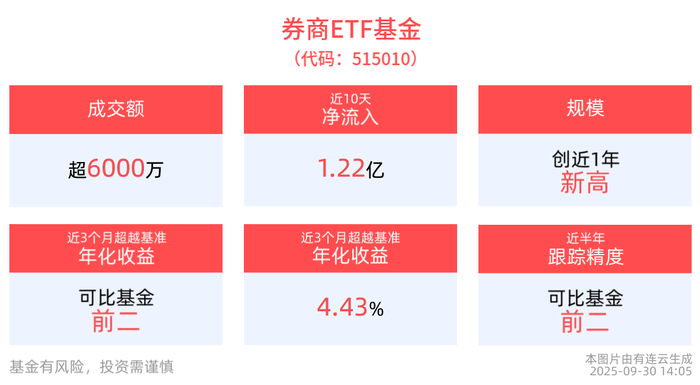
九月以来,券商ETF基金(515010)合计“吸金”3.6亿
Xin Lang Cai Jing· 2025-09-30 06:41
Group 1 - The three major indices experienced a decline, with the brokerage sector falling, as evidenced by the brokerage ETF fund (515010) dropping by 0.96% as of 14:05 on September 30 [3] - In September, the brokerage ETF fund (515010) saw net inflows of funds on 17 out of 21 trading days, totaling 360 million yuan, reaching a new high of 1.786 billion yuan as of September 29 [3] - The brokerage ETF fund (515010) tracks the securities company index (code 399975), with the top ten constituent stocks accounting for 60.56% of the weight, including major brokerages like CITIC Securities and Huatai Securities, benefiting directly from the recovery of the A-share market [3] Group 2 - The financial technology ETF Huaxia (516100) closely tracks the CSI Financial Technology Theme Index, covering software development, internet finance, and the digital currency industry chain, potentially benefiting from both market recovery and AI-related catalysts [3] - The management and custody fee rate for the brokerage ETF fund (515010) is the lowest in the sector at a combined rate of 0.2%, facilitating lower-cost investments in the brokerage sector [3]