NJBK(601009)

Search documents
100家银行年报里的中国
虎嗅APP· 2025-05-29 23:59
Core Viewpoint - The article emphasizes the performance of regional banks in China, particularly focusing on city commercial banks and rural commercial banks, highlighting the economic vitality of regions like Jiangsu and Zhejiang compared to others like Guangdong and Shanghai [3][4][10]. Group 1: Regional Bank Performance - Jiangsu and Zhejiang regions are identified as having strong city commercial banks, with institutions like Jiangsu Bank and Ningbo Bank showing robust performance, indicating high economic vitality [8][9]. - In contrast, banks headquartered in Shanghai, such as Shanghai Bank and Hu'nong Bank, have underperformed, attributed to the city's "deposit surplus" characteristic and intense competition [17][21]. - Guangdong, despite being the largest economy, lacks representation in the top city commercial banks, with local banks like Guangzhou Bank showing poor performance and significant declines in revenue and profit [23][25][28]. Group 2: Economic Indicators - Jiangsu and Zhejiang's GDP growth rates are 5.8% and 5.5% respectively, outperforming Guangdong's 3.5%, showcasing their economic competitiveness [9][28]. - The article suggests that examining local bank performance can provide a clearer picture of regional economic health than GDP figures alone [6][10]. Group 3: Specific Bank Analysis - Jiangsu Bank reported a 16.12% growth in asset scale, with a net profit of 31.84 billion yuan, while Ningbo Bank achieved a 15.25% growth with a net profit of 27.12 billion yuan [11]. - Chengdu Bank has shown significant growth, with a 14.56% increase in asset scale and a 10.17% rise in net profit, attributed to its focus on local infrastructure projects [38][40]. - In contrast, Guangzhou Bank's asset scale grew only 2.77%, with a net profit decline of 66%, reflecting its struggles in retail and corporate sectors [25][26]. Group 4: Risk and Asset Quality - The article notes that banks in Jiangsu and Zhejiang maintain non-performing loan ratios below 1%, indicating strong asset quality, while banks in regions like Northeast China face higher non-performing rates [5][14][58]. - The article highlights that many banks in Jiangsu and Zhejiang have high provision coverage ratios, often exceeding 300%, which helps mitigate risks associated with potential loan defaults [14][15]. Group 5: Governance and Management Issues - Governance issues are prevalent in some central region banks, with several high-level executives facing investigations, impacting their performance [70][71]. - In contrast, banks in Jiangsu and Zhejiang have fewer governance issues, contributing to their stronger performance [31][72].






100家银行年报里的中国
Hu Xiu· 2025-05-29 22:12
Core Viewpoint - The banking sector in China serves as a crucial economic barometer, reflecting regional economic conditions more accurately than the stock market, especially in the context of the new normal of slower economic growth [1][2][3]. Group 1: Regional Banking Performance - Over 100 city commercial banks and rural commercial banks released annual reports, revealing that banks in economically vibrant regions like Jiangsu and Zhejiang maintain low non-performing loan (NPL) ratios, often below 1% [2][4]. - Jiangsu and Zhejiang provinces rank second and fourth in GDP size, with growth rates of 5.8% and 5.5% respectively, outperforming Guangdong's 3.5% growth rate [5]. - Jiangsu Bank, Ningbo Bank, Nanjing Bank, and Hangzhou Bank are among the top city commercial banks, demonstrating strong performance despite macroeconomic pressures [4][6]. Group 2: Financial Metrics of Key Banks - Jiangsu Bank reported an asset scale of 3.95 trillion with a growth rate of 16.12%, revenue of 808.15 billion, and a net profit of 318.43 billion, reflecting a net profit growth of 10.76% [6]. - Ningbo Bank's asset scale reached 3.13 trillion, with a revenue of 666.31 billion and a net profit of 271.27 billion, showing a net profit growth of 6.23% [6]. - Hangzhou Bank's net profit growth was notably high at 18.07%, despite a lower net interest margin due to its focus on low-risk local government financing [8]. Group 3: Challenges in Other Regions - In contrast, banks in Guangdong, despite being in the top economic province, show poor performance, with Guangzhou Bank's asset scale growing only 2.77% and a significant drop in revenue and net profit [17][19]. - The performance of banks in the Northeast is hindered by high NPL ratios, often exceeding 2%, and low net interest margins, with some banks like Shengjing Bank reporting as low as 0.8% [56][58]. - The banking sector in the Northwest faces similar challenges, with low growth rates and high NPL ratios, reflecting a lack of quality projects and competition with larger state-owned banks [51][53]. Group 4: Governance Issues - Governance issues are prevalent in the central region, with several banks experiencing high-profile executive investigations, impacting their performance [68][70]. - Despite governance challenges, Huishang Bank has shown significant growth, with revenue increasing over 180% in the past decade, driven by the local economy [69][71]. Group 5: Emerging Opportunities - The banking sector in Fujian is thriving, with banks like Xiamen International Bank showing a 150% growth in asset scale over the past decade, supported by a robust private economy [26][28]. - Chengdu Bank has also seen substantial growth, with a 14.56% increase in asset scale, driven by a focus on local infrastructure projects [38][39].
股价持续走高银行转债退出加速,新一轮提前赎回潮或来袭
Di Yi Cai Jing· 2025-05-29 03:24
Core Viewpoint - The rapid redemption of bank convertible bonds is driven by the strong performance of underlying bank stocks, leading to a decrease in the number of outstanding convertible bonds in the market [1][2][4]. Group 1: Bank Convertible Bonds Redemption - Hangzhou Bank announced the early redemption of "Hangyin Convertible Bonds" due to triggering conditional redemption clauses, marking it as the third bank convertible bond to undergo forced redemption this year [2][3]. - As of May 26, 2025, Hangzhou Bank's stock price had closed above 130% of the bond's conversion price for 15 trading days, triggering the redemption [2][3]. - The number of outstanding bank convertible bonds is expected to decrease from 10 to 7 by the end of the year, with several bonds nearing redemption conditions [4]. Group 2: Market Dynamics and Trends - The strong performance of the banking sector, supported by high dividends and market risk aversion, has led to a rise in the China Securities Bank Index by over 7% this year [2][4]. - The scarcity of large convertible bonds is expected to increase due to the accelerated redemption process and the lack of new issuances in 2023 [4][5]. - Institutional reports indicate that the supply-demand imbalance for large convertible bonds will become more pronounced, with the total outstanding amount potentially decreasing from 170 billion to around 100 billion [4][5]. Group 3: Conversion Rates and Capital Supplementation - Historically, the conversion rates of bank convertible bonds have been low due to factors such as depressed stock prices and high conversion premiums [5][6]. - However, with rising stock prices, conversion rates are expected to improve, as evidenced by previous forced redemptions where conversion rates exceeded 99% [6]. - As of May 28, the unconverted balance of Hangyin Convertible Bonds has decreased significantly, indicating a trend towards higher conversion rates [6].
股息率高达8%!存款买理财不如买银行股?
21世纪经济报道· 2025-05-28 13:33
作 者丨林秋彤 编 辑丨曾芳 低利率环境下,银行股股息率"逆势而上"。 据wind数据,截至5月28日最新收盘, 42家A股上市银行中有15家银行的股息率已自2023年至今连续上升。 例如,南京银行2023年、2024年 和最新收盘的股息率分别为4.92%、5.11%、7.67%;江苏银行2023年、2024年和最新收盘的股息率分别为4.32%、4.78%、7.13%;渝农商 行2023年、2024年和最新收盘的股息率分别为3.95%、4.17%和6.60%。 此外,平安银行、民生银行、厦门银行和北京银行等,其股息率已经突破7%,且较今年年初有大幅上涨。截至最新收盘,上述几家银行股息 率分别为8.40%、8.10%、7.26%和7.02%,较2024年末分别上涨了3.11、3.60、2.36和1.91个百分点。 整体来看,42家A股上市银行中共有21家银行的最新收盘股息率较去年末有所上涨,有9家银行与去年末有所持平。 银行股走势稳健 与股息率"逆势而上"相对应的,是银行股走势稳健延续。 记者梳理发现,15家股息率连续上涨的银行中,除兰州银行和苏州银行外,其余13 家银行2024年全年股价涨幅均超过了40%。 ...




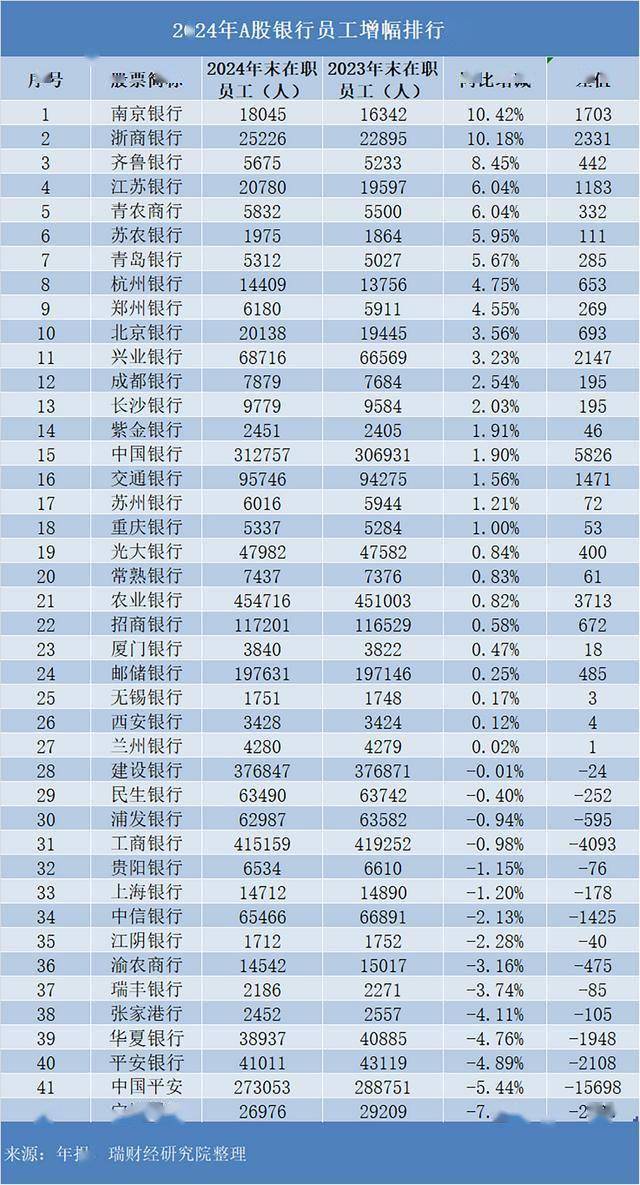
2024年A股上市银行员工增幅榜:2家增幅超10%,宁波银行降幅最高
Sou Hu Cai Jing· 2025-05-28 11:05
Core Insights - The total number of employees in A-share listed banks decreased by approximately 5,971 from 2023 to 2024, representing a year-on-year decline of about 0.21% [3][4] - Among the 42 listed banks, 27 experienced an increase in employee numbers, while 15 saw a decrease, indicating a trend of growth in certain institutions despite overall reductions [4] Employee Growth Rankings - Nanjing Bank and Zheshang Bank led the employee growth with increases of 10.42% and 10.18% respectively [1][4] - A total of 7 banks had employee growth rates exceeding 5%, highlighting a significant trend in workforce expansion among select banks [4] Employee Numbers - The total employee count for A-share listed banks reached approximately 2.8766 million by the end of 2024, down from 2.8826 million in 2023 [3] - Agricultural Bank and Industrial and Commercial Bank had the highest employee counts, with approximately 454,700 and 415,200 employees respectively [3] Employee Reduction Insights - Among the banks that reduced their workforce, China Ping An and Ningbo Bank had the most significant declines, with reductions of 5.44% and 7.64% respectively [4] - China Ping An's workforce decreased by about 15,698 employees, reflecting broader trends in the financial services sector [2][4]


南京银行杭州分行开展爱心助学及清廉教育活动
Ren Min Wang· 2025-05-28 10:28
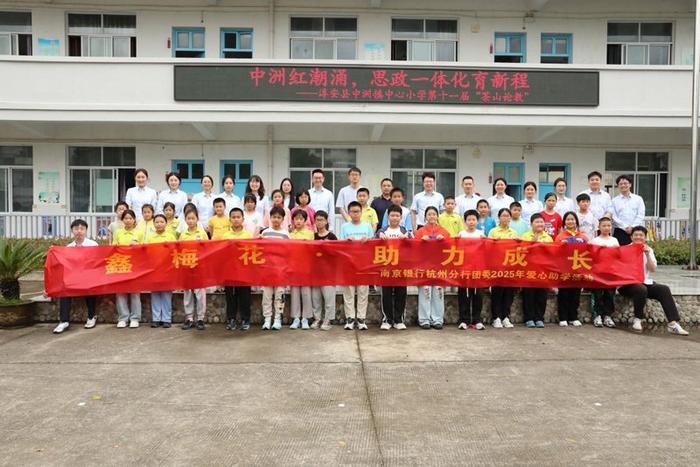
Group 1 - The core activity organized by Nanjing Bank Hangzhou Branch Youth League Committee is the "Xing Meihua · Supporting Growth" charity education event for 2025, along with the theme day activity "Inheriting Integrity and Strengthening Original Intent" [1][5] - The event involved collecting children's wishes from the Central Primary School in Zhongzhou Town, Chun'an, and employees actively donated various materials to fulfill these wishes [2] - On May 23, representatives from the bank delivered gifts with blessing tags to the children, who expressed joy, and a financial knowledge class titled "Little Banker" was conducted by a wealth manager from the bank [2][4] Group 2 - On May 24, the youth employees participated in a theme day activity at the Hai Rui Temple, where they learned about the integrity and diligence of the Ming Dynasty official Hai Rui, enhancing their awareness of self-discipline and improving work style [4] - This year marks the sixth consecutive year that the Youth League Committee of Nanjing Bank Hangzhou Branch has accompanied the children of Zhongzhou Town Central Primary School for the "June 1" Children's Day [5] - The bank emphasizes its cultural philosophy of "Responsible Finance, Harmonious Win-Win" and aims to continue fulfilling its social responsibilities while fostering integrity among its youth members [5]
机构:银行股具有良好的短中长期配置价值。南京银行涨超2%,红利低波100ETF(159307)连续7天净流入
Xin Lang Cai Jing· 2025-05-28 05:29
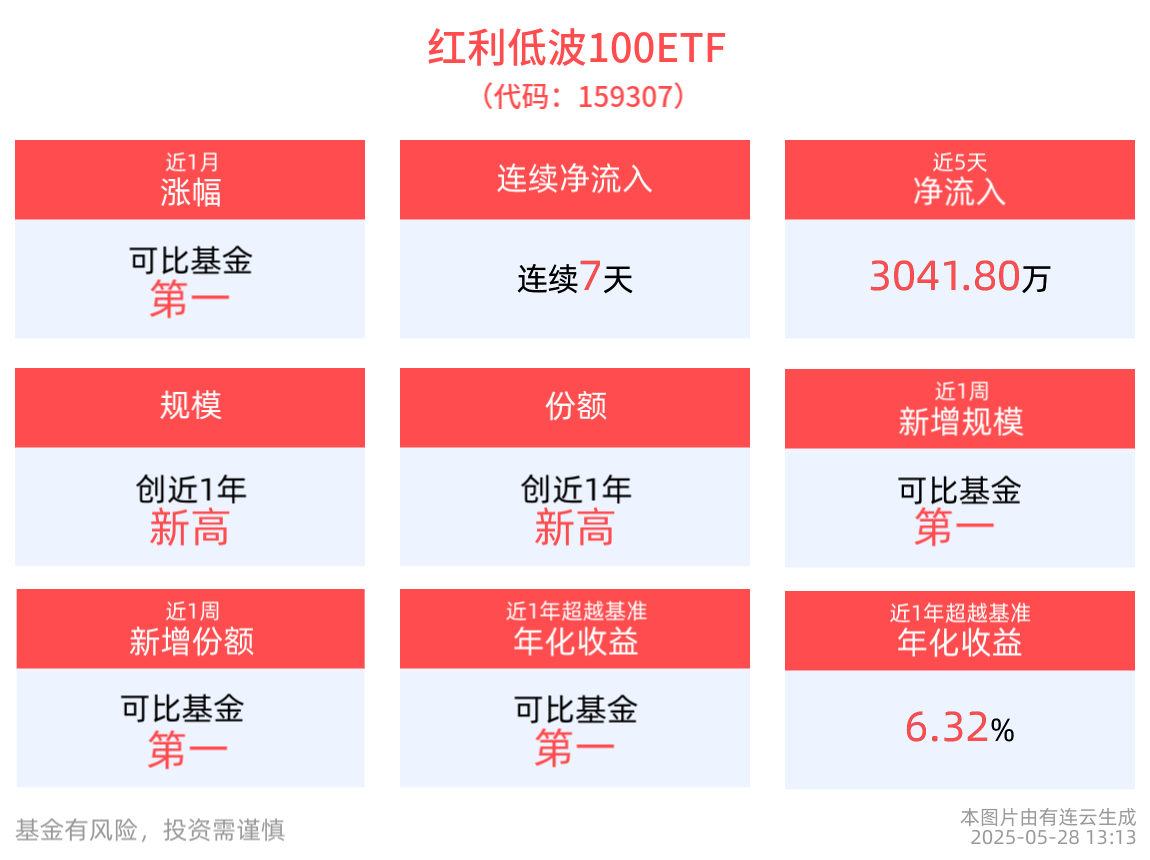
Core Viewpoint - The performance of the China Securities Dividend Low Volatility 100 Index and its corresponding ETF indicates a positive trend in bank stocks, which are expected to attract long-term investment due to their stability and high dividend yield [2][3]. Group 1: Index and ETF Performance - As of May 28, 2025, the China Securities Dividend Low Volatility 100 Index rose by 0.35%, with notable increases in constituent stocks such as Nanjing Bank (up 2.93%) and China Petroleum (up 2.20%) [2]. - The Dividend Low Volatility 100 ETF (159307) increased by 0.19%, with a latest price of 1.05 yuan and a trading volume of 347.20 million yuan [2]. - The ETF's recent scale reached 9.67 billion yuan, marking a one-year high, and its shares totaled 9.28 billion, also a one-year high [3]. Group 2: Fund Inflows and Leverage - The Dividend Low Volatility 100 ETF has seen continuous net inflows over the past week, with a maximum single-day net inflow of 12.54 million yuan, totaling 47.21 million yuan in net inflows [3]. - The ETF's financing net purchase on the previous trading day was 1.03 million yuan, with a latest financing balance of 165.40 million yuan, indicating ongoing interest from leveraged funds [3]. Group 3: Historical Performance and Risk Metrics - Over the past year, the Dividend Low Volatility 100 ETF's net value increased by 6.19%, ranking first among comparable funds [4]. - The ETF's maximum drawdown this year was 6.18%, which is the smallest among comparable funds, with a recovery time of 36 days [4]. - The management fee for the ETF is 0.15%, and the custody fee is 0.05%, both of which are the lowest in its category [4]. Group 4: Top Holdings - As of April 30, 2025, the top ten weighted stocks in the Dividend Low Volatility 100 Index accounted for 19.66% of the index, with companies like Jizhong Energy and Daqin Railway among the top [5][8].




银行发行科创债规模快速增长 为科技金融发展打开新空间
Jin Rong Shi Bao· 2025-05-28 01:46
Group 1 - The core viewpoint of the news is that the launch of the "Technology Board" in the bond market has led to a significant increase in the issuance of technology innovation bonds (科创债), with banks becoming the main issuers, reflecting a trend of financial resources being directed towards technological innovation [1][4]. - As of May 25, 14 banks have collectively issued 170 billion yuan in technology innovation bonds, accounting for approximately 60% of the total issuance, indicating strong participation from the banking sector [1][2]. - The issuance of technology innovation bonds is supported by policies from the People's Bank of China and the China Securities Regulatory Commission, which aim to enhance the product system and support mechanisms for these bonds [4][5]. Group 2 - Major banks such as China Bank and Shanghai Bank have successfully issued technology innovation bonds with significant demand, showcasing the market's enthusiasm for these financial instruments [2][6]. - The collaboration between banks and securities firms is highlighted, as they work together to support technological innovation, forming a core force in the financial ecosystem [2][4]. - The expected growth in the technology innovation bond market is driven by ongoing policy support and market momentum, with projections indicating a potential explosive increase in issuance this year [6].




南京银行镇江分行:金融活水润泽江河 奋楫扬帆再谱新篇
Jiang Nan Shi Bao· 2025-05-27 02:53
Core Viewpoint - The 11th anniversary of Nanjing Bank's Zhenjiang branch highlights its growth and contributions to the local economy, showcasing over 700 billion yuan in asset scale and numerous honors, reflecting its alignment with national strategies and commitment to community development [1][4]. Group 1: Achievements and Recognition - Nanjing Bank's Zhenjiang branch has achieved over 10 city-level industry innovations and nearly 180 internal and external honors, serving over 200,000 customers [1]. - The branch has received multiple awards, including "National Women's Civilization Post" and "Jiangsu Province Worker Pioneer," and has been recognized for its financial service contributions for four consecutive years [5]. Group 2: Party and Employee Engagement - The branch emphasizes party leadership and integration, launching initiatives to encourage employees to take on high-quality development responsibilities [3]. - Employee care initiatives have been implemented, including blood donation drives and community support activities, enhancing the branch's corporate image [4]. Group 3: Technological and Green Finance Innovations - The branch has developed a "dual express service" system for technology finance, focusing on early-stage project incubation and providing tailored financing solutions for tech companies [6][7]. - Nanjing Bank has introduced innovative green finance products, such as carbon footprint-linked loans, promoting low-carbon transformation in industries [9][10]. Group 4: Inclusive Finance for Small Enterprises - The branch's inclusive finance initiatives have led to a 24% increase in loans, with the "Xin Transfer Loan" product serving nearly 200 small enterprises, totaling over 1.4 billion yuan [11][12]. - Customized financial solutions are provided for various sectors, including manufacturing and agriculture, to support small and micro enterprises [12]. Group 5: Elderly and Digital Financial Services - The branch has established "Elderly Care Zones" to enhance financial services for senior citizens, implementing a "five ones" service standard [13][14]. - Digital financial services have been expanded through the "Xin e-Ban" platform, improving efficiency and customer experience across various sectors [15][16]. Group 6: Future Directions - The branch aims to align with the "Industry Strong City" strategy, focusing on innovation and comprehensive financial services to support Zhenjiang's economic development [19].

银行股配置重构系列四:为何本轮重点推荐优质城商行?
Changjiang Securities· 2025-05-26 15:36
Investment Rating - The report maintains a "Positive" investment rating for the banking sector, particularly favoring high-quality city commercial banks [11]. Core Insights - In the current macroeconomic environment, government leverage expansion is the clearest direction for bank operations, with state-owned banks and city commercial banks focusing on government-related business as a core strategy for balance sheet expansion [2][7]. - Leading city commercial banks are accelerating their market share acquisition, with their performance growth consistently outpacing the banking industry, driven primarily by relatively high-speed balance sheet expansion [6][10]. - The asset quality of city commercial banks, primarily engaged in government-related business, is currently the most stable, with expectations for a decline in the net generation rate of non-performing loans this year [2][9]. Summary by Sections Macroeconomic Environment - The current macroeconomic environment favors government-related business, with city commercial banks focusing on local government, urban construction, and local state-owned enterprises [7]. - The demand for government-led financing continues to expand in key economic regions, such as the Chengdu-Chongqing area and Shandong province, despite concerns about export pressures in the Yangtze River Delta [7][8]. Competitive Landscape - The competitive dynamics between state-owned banks and leading city commercial banks are evolving, with state-owned banks experiencing a significant increase in credit market share due to macro policy guidance [8]. - Regulatory measures are being implemented to protect the net interest margins of state-owned banks, indirectly slowing their loan issuance and creating a more favorable competitive environment for city commercial banks [8][9]. Asset Quality and Loan Performance - City commercial banks have maintained low non-performing loan rates due to their focus on government-related loans, which have seen reduced risk following recent debt restructuring efforts [9]. - The tightening of risk control and loan issuance in retail banking is expected to lead to a slight decrease in the net generation rate of non-performing loans this year [9]. Investment Outlook - The report is optimistic about city commercial banks becoming the core focus for institutional investors in the banking sector, with expectations for their valuations to rise above 1x PB [10]. - Specific banks, such as Hangzhou Bank, are anticipated to lead in valuation increases due to their regional economic strength, asset quality, and performance growth [10].