
SERES(601127)

Search documents
问界百万下线:高端新能源从“拼产品”走向“拼体系”
汽车商业评论· 2026-01-15 23:08
Core Viewpoint - The article emphasizes that in the high-end electric vehicle market, the focus should be on delivery and service quality rather than just sales volume, highlighting the importance of a stable operational system, supply chain resilience, and consistent manufacturing quality [4][6]. Group 1: Sales Milestones - The delivery of the 270,000th Wanjie M9 marks a significant milestone as it is also the 1,000,000th vehicle for the Wanjie brand, indicating a transition from growth to maturity for the company [6]. - Wanjie M9 has achieved remarkable sales, leading the market in the 500,000 yuan segment and capturing 70% of the sales in the over 500,000 yuan electric vehicle market [6][9]. - The growth trajectory of Wanjie is notable, with deliveries increasing from 76,200 units in 2022 to 944,000 units in 2023, and projected to exceed 420,000 units in 2025 [9]. Group 2: Product and Service Strategy - Wanjie has successfully launched multiple models, including the Wanjie M9, M8, and M7, creating a comprehensive product matrix that caters to various market segments [10]. - The company has established a smart service system with 375 user centers across 214 cities, enhancing customer experience through proactive service measures [10][11]. - Wanjie's approach combines product precision with comprehensive service coverage, resulting in a complete value loop that supports its rapid growth [11]. Group 3: Brand Positioning and Market Strategy - The Wanjie M9 has redefined the value logic in the high-end market by focusing on technological advancements rather than merely luxury branding [14]. - The vehicle features advanced technology, including Huawei's ADS 4 driving assistance system and a customizable interior layout, catering to diverse user needs [14][15]. - Wanjie has achieved high brand recognition and trust through strategic marketing initiatives, including collaborations with national platforms and cultural events [19][22]. Group 4: Manufacturing and Innovation - The production capabilities of Wanjie are supported by the Sairis Super Factory, which adheres to Industry 4.0 standards, ensuring high-quality and efficient manufacturing processes [17]. - The factory's automation and AI technologies enable consistent quality control and rapid response to market demands, addressing common challenges faced by new entrants in the automotive industry [17]. - Wanjie's integrated approach to technology, manufacturing, and branding has established a robust competitive advantage, positioning the company for sustained growth in the evolving automotive landscape [22].


重夺“汽车第一城” 西部大佬杀回来了
Mei Ri Jing Ji Xin Wen· 2026-01-15 15:14
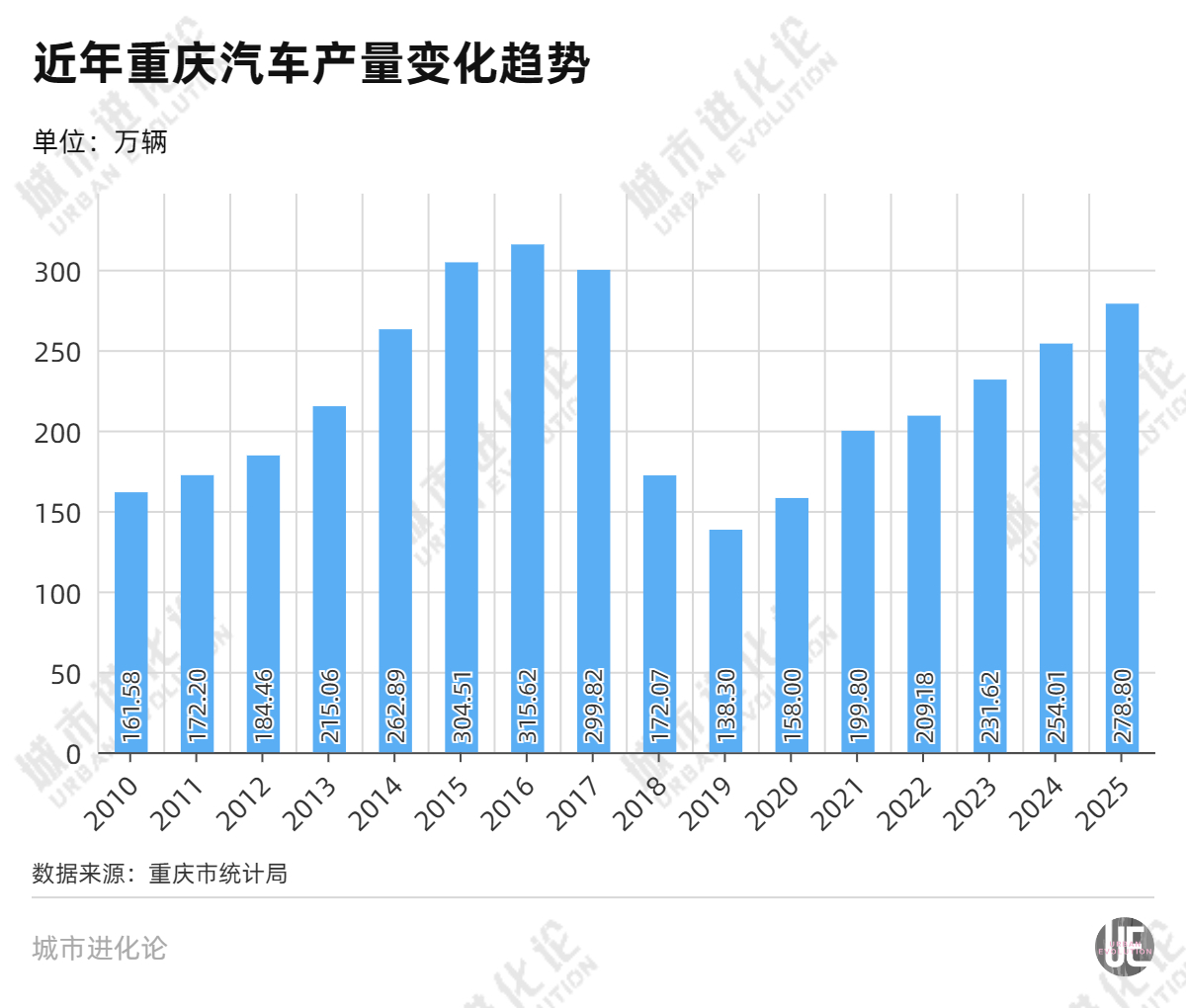
Core Insights - The competition for the title of "Automobile Capital" in China is intensifying, with Chongqing projected to produce 2.788 million vehicles in 2025, marking a 9.7% increase and solidifying its position as the top city in vehicle production [1] - Chongqing's automotive industry is experiencing a resurgence after a decade, particularly in the production of new energy vehicles (NEVs), which are expected to reach 1.296 million units, a 36% increase [1] - The issuance of China's first L3-level autonomous driving license to Changan Automobile signifies a historic milestone for smart driving in China, positioning Chongqing as a leader in this domain [1] Industry Overview - Chongqing aimed to become "China's Detroit" in 2013, achieving the highest vehicle production in the country by 2014, with production peaking at 3.156 million units in 2016 [4] - However, from 2017, Chongqing's vehicle production began to decline, dropping to 1.383 million units by 2019, attributed to a shift in consumer preferences towards mid-to-high-end vehicles and insufficient production capacity [5] - The rise of NEVs has disrupted the traditional automotive landscape, with national NEV sales surpassing 1 million units within three years after first exceeding 100,000 units in 2015 [6] Company Developments - Changan Automobile launched the "Shangri-La" plan in 2017, aiming for full electrification by 2025, but initially faced challenges as NEV production in Chongqing grew slowly from 40,400 units to 51,100 units by 2020 [7] - A turning point occurred in 2021 when Changan partnered with Huawei and CATL to introduce new high-end NEV brands, leading to a significant increase in sales, with total vehicle sales reaching 2.913 million units and NEV sales at 1.11 million units, a 51.1% increase year-on-year [7] - Seres, another key player, transitioned from traditional automotive manufacturing to NEVs, achieving profitability in 2024 and selling 472,300 NEVs in the previous year, a 10.63% increase [7] Competitive Landscape - The collaboration with Huawei has been pivotal for Chongqing's NEV transformation, with Seres being the first to adopt Huawei's smart selection model [8] - The automotive industry is entering a new competitive phase characterized by smart electric vehicles, with Chongqing positioned to lead due to its early adoption of L3-level autonomous driving technologies [12] - The competition is heating up, with cities like Guangzhou and Shenzhen also vying for leadership in the NEV sector, each setting ambitious goals for future growth [17] Challenges and Future Outlook - Despite its recent successes, Chongqing faces challenges in AI and core technology competitiveness, ranking 14th nationally in AI industry competitiveness, indicating a need for improvement in talent attraction and retention [20] - The city aims to address these shortcomings by enhancing its automotive industry through innovation and integration with advanced technologies, targeting high-quality development by 2024 [14][21]

重夺“汽车第一城”,西部大佬杀回来了
Mei Ri Jing Ji Xin Wen· 2026-01-15 15:12
Group 1 - The core viewpoint of the article highlights the intense competition among cities for the title of "Automobile Capital," with Chongqing regaining its position as the leader in automobile production after a decade of decline [1][2][3] - Chongqing's automobile production is projected to reach 2.788 million units in 2025, marking a 9.7% increase, with new energy vehicles (NEVs) expected to account for 1.296 million units, a growth of 36% [1][2] - The issuance of the first L3-level autonomous driving license in China to Changan Automobile signifies a historic milestone for smart driving in the country, positioning Chongqing as a frontrunner in this field [2][11] Group 2 - The article discusses the historical context of Chongqing's automotive industry, noting its peak production of 3.156 million units in 2016, followed by a significant decline starting in 2017, where production fell to 1.383 million units by 2019 [5][6] - The resurgence of Chongqing's automotive sector is attributed to its focus on new energy vehicles, with Changan and Seres leading the charge through strategic partnerships, including collaborations with Huawei [7][10] - The competitive landscape is evolving, with predictions that the penetration rate of L3 and above autonomous vehicles will exceed 10% by 2030, indicating a shift towards smart electric vehicles as a new competitive arena [13][21] Group 3 - Chongqing aims to become a "smart connected new energy vehicle capital" by 2024, leveraging its unique geographical features as a testing ground for intelligent vehicles [14][17] - The article notes that while Chongqing is making strides, it faces challenges in AI competitiveness, ranking 14th nationally in AI industry strength, which could hinder its automotive ambitions [19][20] - The need for Chongqing to address its weaknesses in core technologies and talent retention is emphasized, as it seeks to maintain its leading position in the next round of industry competition [21]
乘用车板块1月15日跌0.58%,北汽蓝谷领跌,主力资金净流出8.72亿元
Zheng Xing Xing Ye Ri Bao· 2026-01-15 08:53
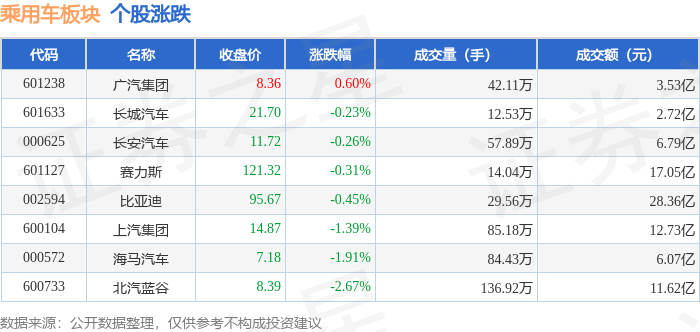
Core Viewpoint - The passenger car sector experienced a decline of 0.58% on January 15, with Beiqi Blue Valley leading the drop, while the Shanghai Composite Index fell by 0.33% and the Shenzhen Component Index rose by 0.41% [1]. Group 1: Market Performance - The closing price for GAC Group was 8.36, with an increase of 0.60% and a trading volume of 421,100 shares, amounting to 353 million yuan [1]. - Great Wall Motors closed at 21.70, down by 0.23%, with a trading volume of 125,300 shares and a transaction value of 272 million yuan [1]. - Changan Automobile's closing price was 11.72, decreasing by 0.26%, with a trading volume of 578,900 shares and a transaction value of 679 million yuan [1]. - The closing price for Seres was 121.32, down by 0.31%, with a trading volume of 140,400 shares and a transaction value of 1.705 billion yuan [1]. - BYD closed at 95.67, down by 0.45%, with a trading volume of 295,600 shares and a transaction value of 2.836 billion yuan [1]. - SAIC Motor's closing price was 14.87, down by 1.39%, with a trading volume of 851,800 shares and a transaction value of 1.273 billion yuan [1]. - Haima Automobile closed at 7.18, down by 1.91%, with a trading volume of 844,300 shares and a transaction value of 607 million yuan [1]. - Beiqi Blue Valley closed at 8.39, down by 2.67%, with a trading volume of 1,369,200 shares and a transaction value of 1.162 billion yuan [1]. Group 2: Fund Flow Analysis - The passenger car sector saw a net outflow of 872 million yuan from main funds, while retail funds had a net inflow of 540 million yuan [1]. - GAC Group experienced a net inflow of 23.84 million yuan from main funds, while retail funds had a net outflow of 46.64 million yuan [2]. - Great Wall Motors had a net outflow of 0.7565 million yuan from main funds, with a net inflow of 15.78 million yuan from retail funds [2]. - Changan Automobile faced a net outflow of 44.50 million yuan from main funds, while retail funds had a net inflow of 28.43 million yuan [2]. - Beiqi Blue Valley had a significant net outflow of 164 million yuan from main funds, with a net inflow of 91.78 million yuan from retail funds [2]. - BYD saw a net outflow of 32.57 million yuan from main funds, while retail funds had a net inflow of 301 million yuan [2].




2025中国企业ESG“金责奖”最佳责任进取奖揭晓
Xin Lang Cai Jing· 2026-01-15 07:31
Core Viewpoint - The 2025 China Enterprise ESG "Golden Responsibility Award" aims to recognize companies that have made significant contributions to ESG (Environmental, Social, and Governance) practices, with over 5,000 enterprises participating in the evaluation process [1][4]. Group 1: ESG Award Overview - The award was launched in November 2025 by Sina Finance ESG Rating Center, focusing on promoting sustainable development and responsible investment [1][4]. - The award emphasizes the importance of responsibility in ESG practices, symbolizing that responsibility is as valuable as gold [1][4]. - The evaluation process included comprehensive performance assessments, professional scoring, and online voting, culminating in the announcement of the award winners after three months of competition [1][4]. Group 2: Award Winners - The "Best Responsibility Initiative Award" was awarded to ten companies, including: - Fenghuo Communication - Wens Foodstuff Group - Haitian Flavoring and Food - Aier Eye Hospital - Yunnan Baiyao - Anker Innovation - Jinfa Technology - Huatai Securities - Seres - Hainengda [2][5]. - The award committee congratulated the winners and expressed hope that these companies will lead by example in enhancing their ESG capabilities and contribute to China's high-quality development [2][5]. Group 3: ESG Rating Center Introduction - The Sina Finance ESG Rating Center is the first Chinese platform dedicated to ESG information and ratings, promoting sustainable development and responsible investment [3][6]. - The center aims to establish ESG evaluation standards suitable for China's characteristics and enhance corporate ratings [3][6]. - It also publishes multiple ESG innovation indices to provide investors with more options regarding corporate ESG performance [3][6].




赛力斯向华为支付200亿采购费,占其2025年上半年收入的三分之一
Jin Rong Jie· 2026-01-15 06:53
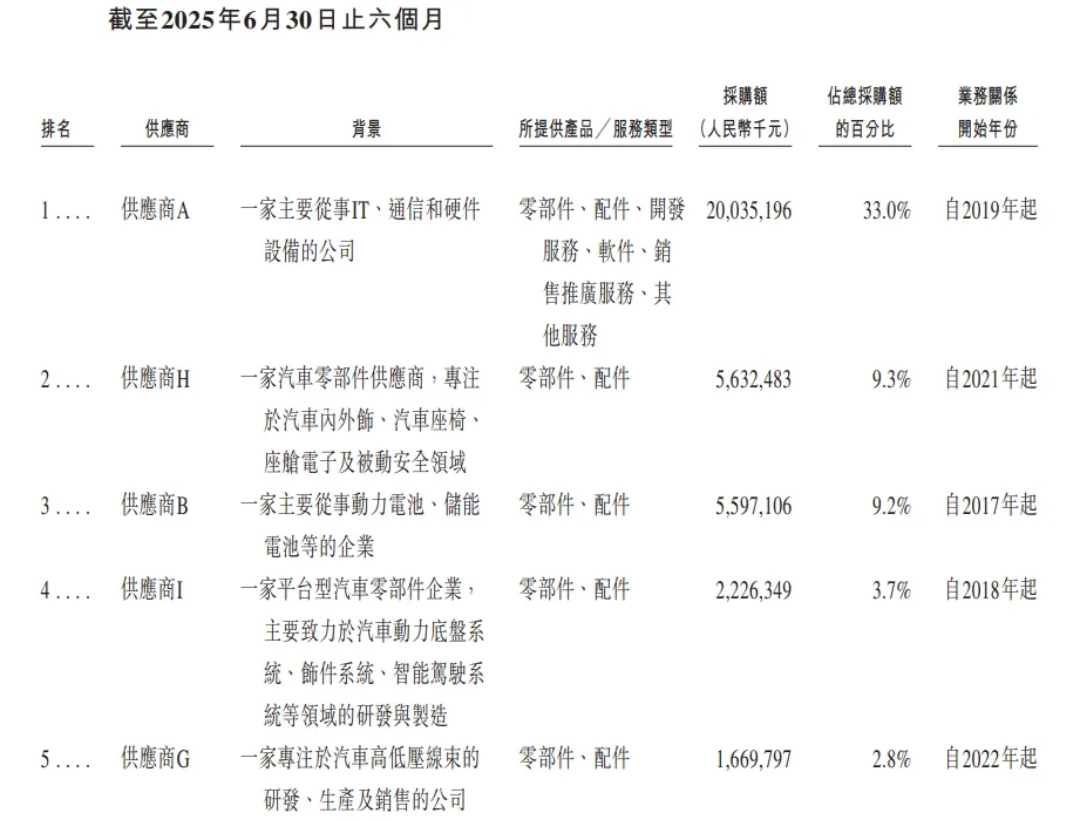
Core Insights - The core point of the news is that Seres Group has significantly increased its procurement expenses to Huawei, which has become a major part of its revenue and has contributed to its rapid growth in the electric vehicle market [1][5]. Group 1: Procurement and Financials - In the first half of 2025, Seres paid Huawei 20 billion RMB for procurement, accounting for approximately one-third of its total revenue during that period [1]. - From 2022 to the first half of 2025, Seres' total procurement expenses to Huawei exceeded 75 billion RMB [1]. - The average payment to Huawei per vehicle sold is estimated at 136,000 RMB [1]. - Seres reported a gross margin increase from 8% in 2022 to 23.8% in 2024, reaching 26.5% in the first half of 2025, and 29.4% by the third quarter of 2025 [2]. Group 2: Partnership and Market Performance - Since the deep collaboration with Huawei began in 2021, Seres has entered a phase of rapid development, launching the "Wenjie" brand, which achieved the milestone of 1 million vehicles in just 46 months, the fastest among new forces in the industry [5]. - In 2025, Seres is projected to have cumulative sales of approximately 472,300 vehicles, representing a year-on-year growth of 10.63%, with over 420,000 units delivered under the Wenjie brand, leading the high-end electric vehicle market [5].
赛力斯申请艺芯智能体商标
Zhong Guo Neng Yuan Wang· 2026-01-15 06:13
Group 1 - The core point of the article is that Sairisi Group Co., Ltd. has applied to register three trademarks for "Yixin Intelligent Body," which are currently in the status of awaiting substantive examination [1] - Sairisi Group was established in May 2007 and has a registered capital of approximately 1.63 billion RMB [1] - The company's business scope includes manufacturing and selling automotive parts, motor vehicle parts, general machinery, electrical machinery, and electronic products [1] Group 2 - The shareholders of Sairisi Group include Chongqing Xiaokang Holdings Co., Ltd., Dongfeng Motor Group Co., Ltd., and Chongqing Yuhan Automotive Industry Co., Ltd. [1]
2025中国企业ESG“金责奖”评选结果揭晓 共筑可持续发展新生态
Xin Lang Cai Jing· 2026-01-15 02:38
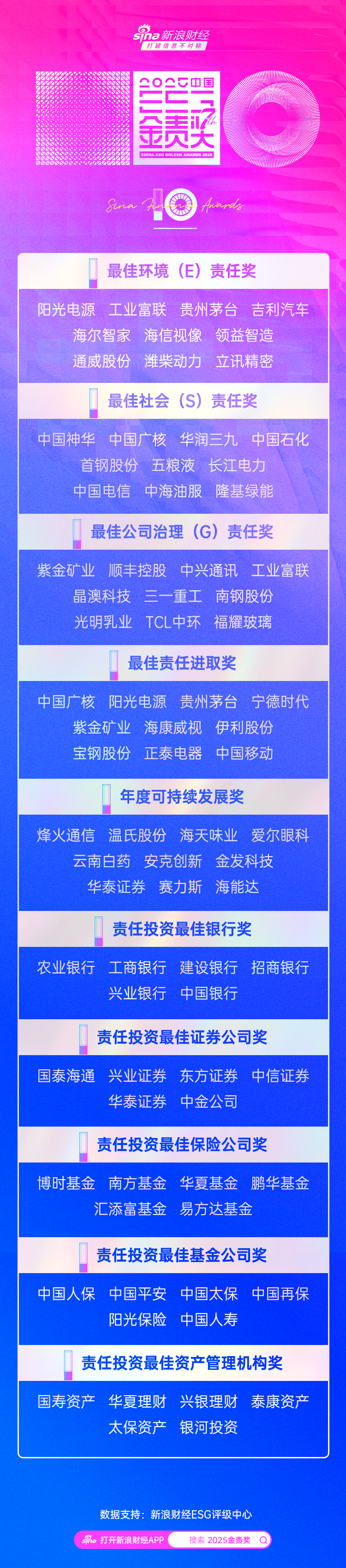
Core Viewpoint - The 2025 China Enterprise ESG "Golden Responsibility Award" aims to recognize companies and institutions that have made significant contributions to ESG initiatives in China, reflecting a shift from voluntary practices to compliance requirements in ESG performance [1][18]. Group 1: Award Categories and Winners - The award includes ten categories: Best Environmental Responsibility Award, Best Social Responsibility Award, Best Corporate Governance Responsibility Award, Best Responsibility Initiative Award, Annual Sustainable Development Award, Best Responsible Investment Bank Award, Best Responsible Investment Securities Company Award, Best Responsible Investment Insurance Company Award, Best Responsible Investment Fund Company Award, and Best Responsible Investment Asset Management Institution Award [1][18]. - The Best Environmental Responsibility Award winners include: Sungrow Power Supply, Industrial Fulian, Kweichow Moutai, Geely Automobile, Haier Smart Home, Hisense Visual Technology, Linyang Electronics, Tongwei Co., Weichai Power, and Luxshare Precision [10][28]. - The Best Social Responsibility Award winners include: China Shenhua, China General Nuclear Power, China Resources Sanjiu, Sinopec, Shougang, Wuliangye, Yangtze Power, China Telecom, China Oilfield Services, and LONGi Green Energy [10][28]. - The Best Corporate Governance Responsibility Award winners include: Zijin Mining, SF Holding, ZTE Corporation, Industrial Fulian, JA Solar, Sany Heavy Industry, Nanjing Steel, Bright Dairy, TCL Zhonghuan, and Fuyao Glass [10][28]. - The Best Responsibility Initiative Award winners include: FiberHome Technologies, Wens Foodstuff Group, Haitian Flavoring and Food, Aier Eye Hospital, Yunnan Baiyao, Anker Innovations, Kingfa Sci. & Tech., Huatai Securities, Silex, and Hainengda [11][28]. - The Annual Sustainable Development Award winners include: China General Nuclear Power, Sungrow Power Supply, Kweichow Moutai, Contemporary Amperex Technology, Zijin Mining, Hikvision, Yili, Baosteel, Chint Electric, and China Mobile [11][28]. Group 2: Responsible Investment Awards - The Best Responsible Investment Bank Award winners include: Agricultural Bank of China, Industrial and Commercial Bank of China, China Construction Bank, China Merchants Bank, Industrial Bank, and Bank of China [11][28]. - The Best Responsible Investment Securities Company Award winners include: Guotai Junan, Everbright Securities, CITIC Securities, Huatai Securities, and CICC [12][28]. - The Best Responsible Investment Insurance Company Award winners include: China Life Insurance, China Ping An, China Pacific Insurance, China Re, Sunshine Insurance, and China Life [13][28]. - The Best Responsible Investment Fund Company Award winners include: Bosera Funds, Southern Fund, China Asset Management, Penghua Fund, Huitianfu Fund, and E Fund [14][28]. - The Best Responsible Investment Asset Management Institution Award winners include: China Life Asset Management, Huaxia Wealth Management, Xingyin Wealth Management, Taikang Asset, Taikang Asset, and Galaxy Investment [15][28]. Group 3: ESG Development Context - By 2025, China's ESG development has transitioned from "setting standards" to "strengthening regulations," with a comprehensive disclosure standard system being established [1][18]. - The ESG performance of enterprises is now a compliance requirement, linking commercial value with social value [1][18]. - The ESG rating center aims to promote sustainable development and responsible investment, enhancing the ESG performance of listed companies [17][34].


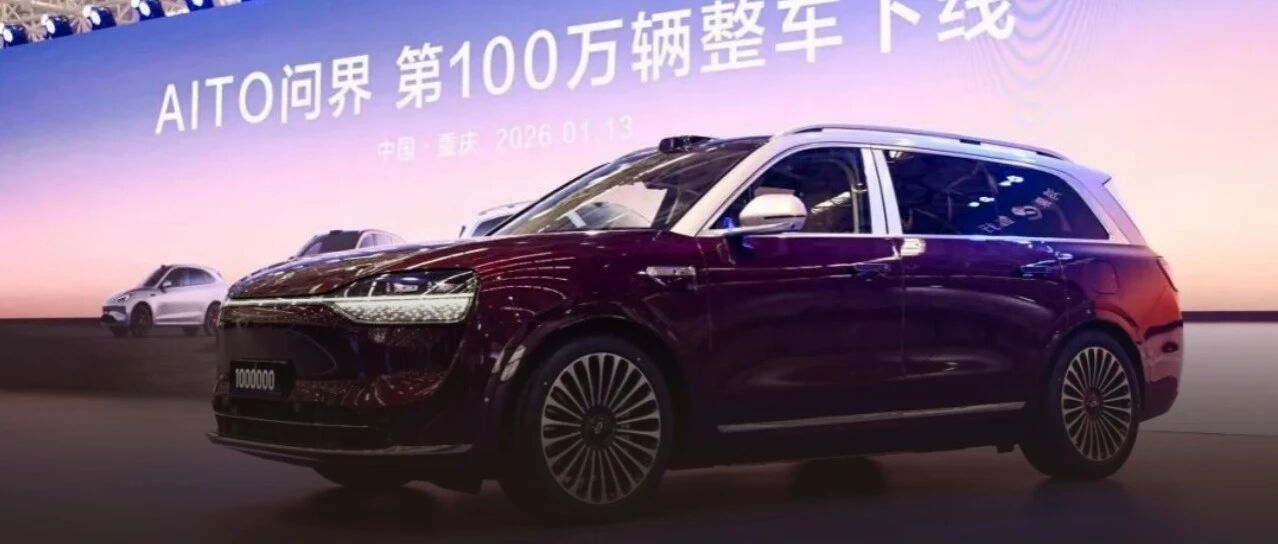
问界品牌第100万辆整车下线,跨界融合模式引关注
Zhong Guo Qing Nian Bao· 2026-01-14 14:02
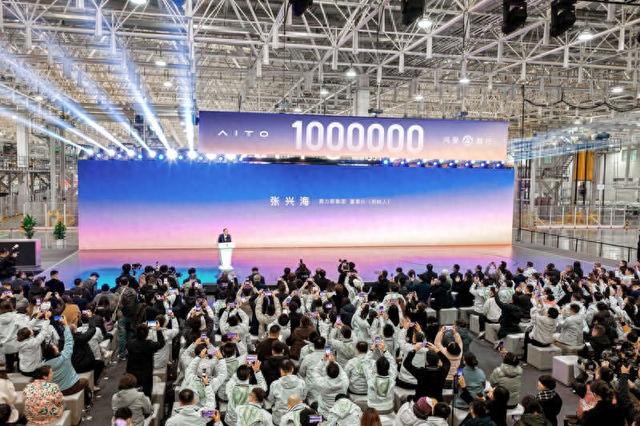
Core Insights - The AITO brand, co-created by Seres and Huawei, celebrated the production of its one millionth vehicle, the AITO M9, in Chongqing, achieving a significant milestone in just 46 months since its first model launch [2] - The brand aims to reach a second million vehicles within two years, indicating strong growth ambitions and a commitment to the high-end smart vehicle market [2] - AITO's sales performance has positioned it among the top three new force brands in China, with a monthly sales target of over 50,000 units by December 2025 [2] Industry Analysis - The success of AITO reflects the evolving competitive landscape of the automotive industry, driven by the integration of traditional manufacturing capabilities with cutting-edge technology and software ecosystems [3] - The collaboration between traditional automakers and tech companies is fostering new product forms and cooperative paradigms, particularly in the context of electrification and intelligent transformation [3]
赛力斯张兴海有了更大的野心
Hua Er Jie Jian Wen· 2026-01-14 13:33
Core Viewpoint - The article highlights the ambitious goal set by Zhang Xinghai, the founder and chairman of Seres, to achieve the next one million vehicle deliveries within two years, following the milestone of one million deliveries reached by the AITO brand [1][4]. Group 1: Company Performance and Strategy - Seres has established a deep partnership with Huawei, which has significantly influenced its business model and growth trajectory [3][6]. - The financial data reveals that Seres has paid Huawei a total of 75 billion yuan in procurement fees over three and a half years, with 20 billion yuan paid in the first half of 2025 alone, representing 33% of Seres' revenue during that period [6]. - Despite high procurement costs, Seres maintained a gross margin of 26.5% in the first half of 2025, which increased to 29.4% by the third quarter, positioning it as a leader among new energy vehicle manufacturers [6]. Group 2: Market Position and Competition - The AITO M9 has dominated the luxury car market, with 70% of sales in its segment, indicating the effectiveness of the investment made in the partnership with Huawei [6]. - There is a growing concern in the market regarding Seres' dependency on Huawei, as competition increases with other brands entering the "Hongmeng Intelligent Driving" ecosystem [9][10]. Group 3: Future Plans and Investments - Zhang Xinghai's urgency to achieve the two-million delivery goal reflects a strategic move to secure Seres' future position and independence within the automotive industry [12]. - The company has ramped up its R&D spending to 5.06 billion yuan in the first three quarters of 2025, nearly matching the total for 2024, to strengthen its technological capabilities beyond Huawei's influence [11]. - Seres is also exploring diversification by investing in areas outside of automotive, such as intelligent robotics, to reduce reliance on Huawei and enhance its market presence [11][12].