
INDUSTRIAL BANK(601166)

Search documents
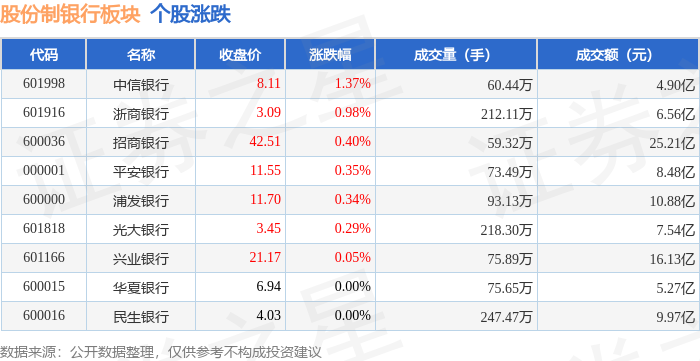
股份制银行板块11月7日涨0.42%,中信银行领涨,主力资金净流出1513.37万元
Zheng Xing Xing Ye Ri Bao· 2025-11-07 08:37
Core Insights - The banking sector saw a slight increase of 0.42% on November 7, with CITIC Bank leading the gains [1] - The Shanghai Composite Index closed at 3997.56, down 0.25%, while the Shenzhen Component Index closed at 13404.06, down 0.36% [1] Banking Sector Performance - CITIC Bank's closing price was 8.11, with a rise of 1.37% and a trading volume of 604,400 shares, amounting to a transaction value of 490 million [1] - Other notable banks included Zhejiang Commercial Bank at 3.09 (up 0.98%), China Merchants Bank at 42.51 (up 0.40%), and Ping An Bank at 11.55 (up 0.35%) [1] - The overall trading volume for the banking sector showed mixed results, with some banks experiencing slight increases while others remained flat or decreased [1] Fund Flow Analysis - The banking sector experienced a net outflow of 15.13 million from institutional investors, while retail investors saw a net inflow of 18.1 million [1] - Specific banks like China Merchants Bank had a net inflow of 17.9 million from institutional investors, while CITIC Bank faced a net outflow of 24.62 million from retail investors [2] - The overall trend indicates a divergence in fund flows, with institutional investors pulling back while retail investors are more active in the sector [2]






上市银行大类资产配置跟踪:信贷投放稳健,债券配置灵活性提升
Ping An Securities· 2025-11-07 08:10
Industry Investment Rating - The investment rating for the banking sector is "Outperform" [1] Core Insights - The proportion of corporate loans has increased, while retail demand recovery is being monitored. As of mid-2025, the proportion of corporate loans among listed banks rose by 1.65 percentage points from the end of 2024 to 60.2%. The manufacturing sector's loans accounted for 18.5% of corporate loans, reflecting a recovery in the operations of manufacturing enterprises [3][12] - The flexibility in bond allocation has increased, with bond trading helping to stabilize market fluctuations. In the first half of 2025, listed banks saw a significant decline in other comprehensive income and fair value changes due to interest rate fluctuations. Some banks, primarily state-owned, increased bond trading to enhance investment returns and stabilize net profit growth [3][6] - Asset quality pressure is manageable, with a focus on risks in the retail sector. The overall asset quality remains stable, with the non-performing loan (NPL) ratio for A-share listed banks holding steady at 1.15% as of Q3 2025. However, the average NPL ratio for retail loans increased by 15 basis points to 1.58% compared to the end of 2024 [3][6] Summary by Sections Corporate Loan Structure - The overall asset structure of listed banks shows an increase in loan allocation, with the loan proportion rising by 0.1 percentage points from the end of 2024. State-owned banks increased interbank asset allocation, while small and medium-sized banks focused more on loan issuance [12][19] - Corporate loans remain the primary focus of credit allocation, with corporate loans accounting for 91.1% of all new loans in the first nine months of 2025. Short-term corporate loans made up 33.7% of new corporate loans [17][18] Bond Investment Preferences - The preference for flexible bond allocation has increased, with banks primarily investing in government bonds and central bank bills. The proportion of OCI accounts has risen, indicating a shift towards more flexible investment strategies [6][3] Asset Quality and Risk Monitoring - The asset quality of the banking sector is stable, with a non-performing loan ratio of 1.15% as of Q3 2025. The retail loan sector has shown slight increases in NPL ratios, necessitating ongoing monitoring of risks in this area [3][6]



沪深300ESGETF南方(560180)开盘跌0.34%
Xin Lang Cai Jing· 2025-11-07 01:47
Core Viewpoint - The article discusses the performance of the Hu-Shen 300 ESG ETF managed by Southern Fund Management, highlighting its recent market activity and returns since inception [1]. Group 1: Fund Performance - The Hu-Shen 300 ESG ETF (560180) opened at 1.182 yuan, experiencing a decline of 0.34% [1]. - Since its inception on April 13, 2023, the fund has achieved a return of 18.78%, with a monthly return of 1.07% [1]. Group 2: Major Holdings - Key stocks in the fund include: - Ningde Times: down 0.30% - Kweichow Moutai: unchanged at 0.00% - China Merchants Bank: up 0.14% - Zhongji Xuchuang: down 1.18% - Changjiang Power: up 0.04% - Midea Group: up 0.31% - BYD: down 0.53% - Industrial Bank: up 0.57% - Industrial and Commercial Bank of China: unchanged at 0.00% - Heng Rui Pharmaceutical: down 0.67% [1].




私行业务成银行“香饽饽”?七家客户数破10万大关
Xin Lang Cai Jing· 2025-11-07 00:20
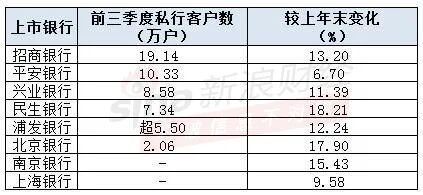
Core Insights - The private banking sector in China is experiencing significant growth, with several listed banks reporting an increase in private banking clients exceeding 10% [1][2][3] - Notably, Minsheng Bank, Beijing Bank, and Nanjing Bank have all reported client growth rates above 15% [1][2][3] - As of the end of September, the total number of private banking clients at Minsheng Bank reached 73,409, marking an 18.21% increase from the previous year [3][5] Private Banking Client Growth - Multiple banks have shown robust growth in private banking clients, with Minsheng Bank, Beijing Bank, and Nanjing Bank leading with growth rates over 15% [1][2][3] - As of September 30, 2023, the number of private banking clients at major banks is as follows: - China Merchants Bank: 191,418 clients, up 13.2% - Ping An Bank: 103,300 clients, up 6.7% - Minsheng Bank: 73,409 clients, up 18.21% - Beijing Bank: 20,586 clients, up 17.9% - Nanjing Bank: growth of 15.43% [3][5][6] Wealth Management Market Expansion - The wealth management market in China continues to expand, with listed banks reporting steady growth in wealth clients [8][9] - As of September 30, 2023, Ping An Bank reported 1.4911 million wealth clients, a 2.4% increase from the previous year [9] - Nanjing Bank's wealth clients grew by 16.31%, while Guiyang Bank's wealth clients increased by 7.77% [9] Asset Under Management (AUM) Growth - The total assets under management (AUM) for private banking clients at Minsheng Bank reached 1,014.72 billion yuan, an increase of 148.75 billion yuan, or 17.18% [3][5] - Beijing Bank's private banking AUM was 224 billion yuan, up 14.39% from the beginning of the year [4] Revenue from Wealth Management Services - Several banks reported positive growth in wealth management fee income, with many exceeding 15% growth [10][12] - For instance, China Merchants Bank's wealth management fee income reached 20.67 billion yuan, an 18.76% year-on-year increase [10] - Ping An Bank's wealth management fee income was 3.979 billion yuan, up 16.1% [10] Distribution and Sales Growth - The distribution of financial products has become a significant revenue source for banks, with many reporting substantial increases in sales [11][12] - For example, Ping An Bank's income from personal insurance sales grew by 48.7%, while its income from personal fund sales increased by 6.7% [12] - China Merchants Bank's income from fund sales rose by 38.76%, driven by increased sales and improved product structure [12]


5家银行不良率下降,零售AUM增长成亮点
Nan Fang Du Shi Bao· 2025-11-06 23:10
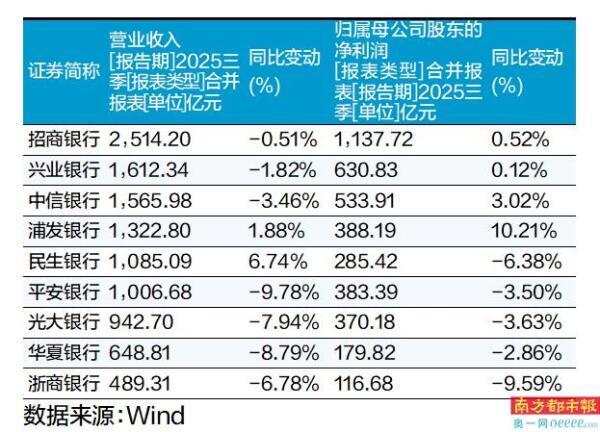
Core Viewpoint - The performance of A-share listed joint-stock banks in the third quarter of 2025 shows a mixed picture, with seven banks experiencing a year-on-year decline in operating income and five banks reporting a drop in net profit. Only Shanghai Pudong Development Bank achieved growth in both metrics [1][2][3]. Group 1: Revenue Performance - Among the nine listed joint-stock banks, only Shanghai Pudong Development Bank and Minsheng Bank reported year-on-year revenue growth, with Minsheng Bank achieving the highest growth rate of 6.74% [2]. - China Merchants Bank led in revenue scale with 2,514.20 billion yuan, followed by Industrial Bank and CITIC Bank with 1,612.34 billion yuan and 1,565.98 billion yuan, respectively [2][3]. - Ping An Bank experienced the most significant revenue decline at -9.78%, while several other banks, including Everbright Bank and Huaxia Bank, also saw declines exceeding 6% [2][3]. Group 2: Net Profit Analysis - China Merchants Bank maintained the highest net profit at 1,137.72 billion yuan, with a slight increase of 0.52% year-on-year. Shanghai Pudong Development Bank saw a notable increase of 10.21% in net profit [3]. - The banks that reported a decline in net profit include Zhejiang Commercial Bank, which had the largest drop at -9.59%, along with Minsheng Bank, Ping An Bank, and others experiencing varying degrees of decline [3]. Group 3: Interest Income and Net Interest Margin - Interest income growth varied significantly, with China Merchants Bank leading at 1,600.42 billion yuan and a 1.74% increase. Shanghai Pudong Development Bank had the highest growth rate in interest income at 3.93% [5]. - The net interest margin faced pressure across the industry, with CITIC Bank experiencing the largest decline of 16 basis points. Only Minsheng Bank reported a slight increase of 2 basis points [5][6]. Group 4: Asset Quality and Provision Coverage - The asset quality of joint-stock banks showed resilience, with a mixed performance in non-performing loan (NPL) ratios. China Merchants Bank had the best NPL ratio at 0.94%, while several banks saw slight increases in their NPL ratios [8]. - Provision coverage ratios decreased for most banks, with China Merchants Bank still leading at 405.93%, despite a decline of 6.05 percentage points [9][10]. Group 5: Loan Structure - The loan structure indicates a shift towards corporate loans, with all five banks reporting growth in corporate loans, while personal loan growth was weak for several banks [11][12]. - China Merchants Bank led in personal loan balance with nearly 3.7 trillion yuan, while corporate loan growth was particularly strong for CITIC Bank, which saw a 10.45% increase [11][12].
绿水青山就是金山银山理念提出二十周年 以金融服务推动绿色转型——兴业银行服务地方经济剪影
Zheng Quan Ri Bao· 2025-11-06 15:50
Core Insights - The article highlights the integration of green finance into urban development and industrial transformation, emphasizing the role of financial institutions in supporting sustainable projects and the transition from traditional industries to eco-friendly alternatives [1][2][3] Group 1: Green Finance Initiatives - The Longjiang North Bank project in Fuzhou, which aims to improve the ecological environment, has received a total investment of 1.1 billion yuan, with 80% financed through bank loans [2] - The project includes multiple sub-projects focused on flood control, water quality improvement, and ecological restoration, requiring long-term financial support from banks [2] - The bank has customized financial service solutions for the project, approving loans of 3.2 billion yuan with a repayment period extended to 17 years and offering preferential interest rates for green loans [2][3] Group 2: Transformation of Local Economies - The Yucun Group in Zhejiang has transitioned from a resource-dependent model to a green tourism model, supported by a 1 billion yuan syndicated loan, with 500 million yuan from the bank, to enhance local tourism [3] - The village's per capita income has reached 80,000 yuan, with total economic income exceeding 10 million yuan, demonstrating the economic benefits of ecological transformation [3] Group 3: Innovative Loan Mechanisms - Banks are innovating loan pricing mechanisms linked to sustainability performance, allowing for interest rate adjustments based on the achievement of environmental goals [5][6] - The bank has implemented a mechanism where loan rates are adjusted based on carbon emission reduction targets, incentivizing companies to pursue green transformations [6][7] - As of now, projects linked to climate ecological evaluation indicators have a total credit limit of 688 million yuan, with an average interest rate discount of 23 basis points [7] Group 4: Future Directions for Financial Institutions - Financial institutions are encouraged to integrate green finance into their development strategies and link it to business growth metrics and performance evaluations [8] - Recommendations include enhancing the green finance product system, developing risk management frameworks for green projects, and fostering collaboration with third-party organizations for data sharing [8]
银行业“反内卷”热潮涌动,基层“最后一公里”待破局
Bei Jing Shang Bao· 2025-11-06 13:35
Core Viewpoint - The banking industry is undergoing a profound transformation from competitive logic to development models, driven by policies aimed at preventing "involution" and promoting efficiency [1][3]. Group 1: Industry Response - Multiple banking associations and institutions are actively responding to the call to end "involution" by promoting self-regulation and discouraging blind expansion and price wars [3][4]. - The Baise Banking Association has initiated self-regulatory agreements among 27 member banks to prohibit malicious low-price competition and encourage innovation and service enhancement [3][4]. - Other regions, such as Qingyang, are also exploring local strategies to resist "involution" and promote sustainable development [4]. Group 2: Institutional Actions - Some banks are implementing specific measures to combat "involution," including commitments to compliance, stable growth, and reasonable pricing [5]. - Major banks like ICBC and Guangfa Bank have emphasized the importance of resisting "involution" and focusing on long-term value rather than short-term metrics [5][6]. Group 3: Challenges in Execution - Despite the industry's efforts, there are still significant challenges at the grassroots level, including the persistence of practices like indicator swapping among employees [6][7]. - The pressure of year-end performance assessments leads to aggressive marketing tactics, which can undermine the goals of reducing "involution" [6][8]. Group 4: Recommendations for Change - Experts suggest that the banking sector should shift from focusing on short-term metrics to long-term indicators such as customer retention and satisfaction [9][10]. - A three-dimensional governance framework is proposed, emphasizing regulatory guidance, industry collaboration, and institutional transformation to shift the competitive logic from "scale competition" to "value creation" [9][10]. Group 5: Strategic Transformation - Banks are encouraged to transition from being "funding intermediaries" to "service intermediaries," focusing on wealth management, supply chain finance, and digital finance [11]. - The transformation requires banks to leverage their core advantages and integrate into broader economic ecosystems while nurturing specialized talent [11].
生态“高颜值”变经济“高价值”,兴业银行落地湿地VEP质押贷款
Xin Hua Cai Jing· 2025-11-06 11:32
Core Insights - The article discusses the transformation of ecological products into financial assets, addressing challenges such as difficulty in measurement, collateralization, trading, and monetization [1][2]. Group 1: VEP Pledge Loan - Recently, Industrial Bank launched its first VEP (Value of Ecological Products) pledge loan, providing a loan of 100 million yuan to the project operator of the Sichuan Xichang Qionghai Wetland Scenic Area, which is a national AAAA-level scenic area [1]. - VEP represents the total value of various ecological product revenues that can be generated from specific geographic areas over a defined development period, encompassing material supply, regulatory services, and cultural services [1]. - The VEP pledge loan is a green loan product that quantifies ecological values such as vegetation biomass, water conservation, climate regulation, oxygen release, carbon sequestration, and biodiversity maintenance [1]. Group 2: Green Financial Innovations - As a pioneer in green finance in China, Industrial Bank actively develops products that realize ecological value, having introduced innovative products like carbon emission rights pledge loans, water rights pledge loans, and forest rights pledge loans [2]. - The bank has made significant strides in ecological value realization, including the first GEP (Gross Ecosystem Product) pledge loan in Sichuan and the first market-based forestry biological asset bill pledge loan in Fujian [2]. - As of the end of September, Industrial Bank's green finance financing balance reached 2.47 trillion yuan, with a green loan balance of 1.103781 trillion yuan, supporting projects that can achieve annual carbon dioxide emissions reductions exceeding 27 million tons [2].
银行永续债补位 优先股“性价比”低遭集中赎回
2 1 Shi Ji Jing Ji Bao Dao· 2025-11-06 11:12
Core Viewpoint - Recent announcements from multiple banks indicate a trend of redeeming preferred shares, driven by cost optimization and capital structure adjustments in response to regulatory requirements [4][6]. Group 1: Redemption of Preferred Shares - Ningbo Bank plans to fully redeem 100 million preferred shares issued on November 7, 2018, with a total scale of 10 billion RMB, at a redemption price of 104.5 RMB per share, scheduled for November 7, 2025 [1]. - Hangzhou Bank, Shanghai Bank, and Changsha Bank also announced plans to redeem their preferred shares in December 2025, with similar redemption structures [2]. - The total amount of preferred shares redeemed by banks this year is significant, with a focus on optimizing costs and reducing liabilities [1][2]. Group 2: Issuance of Perpetual Bonds - In conjunction with the redemption of high-cost preferred shares, banks are increasingly issuing perpetual bonds as a replacement, with 51 perpetual bonds issued this year totaling 675.4 billion RMB, surpassing last year's figures [1][6]. - Perpetual bonds are seen as a more flexible and lower-cost capital tool compared to preferred shares, which typically have higher dividend rates [4][6]. Group 3: Market Trends and Regulatory Environment - The trend of redeeming preferred shares and issuing perpetual bonds reflects a broader market shift, where banks are adapting to lower interest rates and tighter regulatory requirements [4][7]. - The issuance of perpetual bonds is particularly crucial for smaller banks facing capital adequacy pressures, as they seek to enhance their capital structure and meet regulatory demands [7].




兴业银行济南分行:持续发力园区金融 点亮特色服务名片
Zhong Guo Jin Rong Xin Xi Wang· 2025-11-06 10:51
Core Insights - The core viewpoint of the articles highlights the efforts of Industrial Bank's Jinan Branch in enhancing financial services for industrial parks, addressing funding challenges, and supporting the development of modern industrial clusters in Shandong province [1][2] Group 1: Financial Services and Support - Industrial Bank's Jinan Branch has upgraded its financial service system for industrial parks, providing a diversified product matrix to meet the specific needs of these parks [1] - The bank has successfully provided a 350 million yuan loan and over 6 million yuan in "quick pledge loans" to a holding group involved in industrial park development, demonstrating its commitment to solving funding issues [1] - The bank offers a comprehensive financial service solution covering the entire lifecycle of industrial park development, including relocation, construction, and operation [1] Group 2: Strategic Initiatives - In alignment with the national innovation-driven development strategy, Industrial Bank's Jinan Branch has established a dedicated "Park Finance" task force to streamline business research, solution design, credit approval, and fund allocation [2] - The task force employs a "map-based operation" approach to efficiently address challenges and bottlenecks in park development, ensuring continuous financial support for modern industrial clusters [2]