
SHCI(601225)

Search documents
煤炭行业2025年中报总结及9月月报:煤价、业绩同步探底,改善可期-20250905
Guoxin Securities· 2025-09-05 13:06
Investment Rating - The coal industry is rated as "Outperform" [1] Core Viewpoints - The coal industry is experiencing a performance bottoming out, with improvements expected in the future. In Q2 2025, national raw coal production remained high, but commodity coal consumption decreased by 11.8% month-on-month during the off-season, leading to a significant supply-demand imbalance and high social inventory, which pressured coal prices downwards. Except for the coking coal sector, which benefited from the price dual-track system, the performance of coal companies generally faced pressure [2][11] - The supply side is tightening due to rainfall and production checks, with July's production decreasing by 40 million tons month-on-month and 9 million tons year-on-year. The four major producing regions all saw a reduction in output, with Xinjiang experiencing the largest month-on-month decrease [3][30] - Demand improved significantly in July, entering the peak season, with national commodity coal consumption reaching 450 million tons, a year-on-year increase of 1.9% and a month-on-month increase of 12.5%. The upcoming non-electric consumption peak season in September and October is expected to support coal demand [4][67] - Inventory levels across various segments have decreased, with port inventories lower than the same period last year, which may provide support for coal prices [5] - Coal prices are expected to rebound due to supply contraction expectations and the upcoming non-electric demand peak season. The price of thermal coal has rebounded close to 100 yuan/ton, and the downside potential is limited [5] Summary by Sections Q2 2025 Performance Summary - The coal industry is at a performance bottom, with improvements anticipated. Q2 2025 saw a high national raw coal output but a significant drop in commodity coal consumption during the off-season, leading to a supply-demand imbalance and falling prices [2][11] Supply - July's coal production decreased significantly due to rainfall and production checks, with a month-on-month reduction of 40 million tons and a year-on-year decrease of 9 million tons. The supply tightening expectations remain [3][30] Demand - July marked the peak demand season, with a notable improvement in coal consumption. National commodity coal consumption reached 450 million tons, a year-on-year increase of 1.9% and a month-on-month increase of 12.5%. The upcoming non-electric consumption peak season is expected to sustain coal demand [4][67] Inventory - Inventory levels across various segments have decreased, with port inventories lower than the same period last year, potentially supporting coal prices [5] Price - Coal prices are expected to rebound due to supply contraction expectations and the upcoming non-electric demand peak season. The price of thermal coal has rebounded close to 100 yuan/ton, with limited downside potential [5]



煤炭开采板块9月5日涨0.66%,山西焦煤领涨,主力资金净流入3.47亿元
Zheng Xing Xing Ye Ri Bao· 2025-09-05 09:06
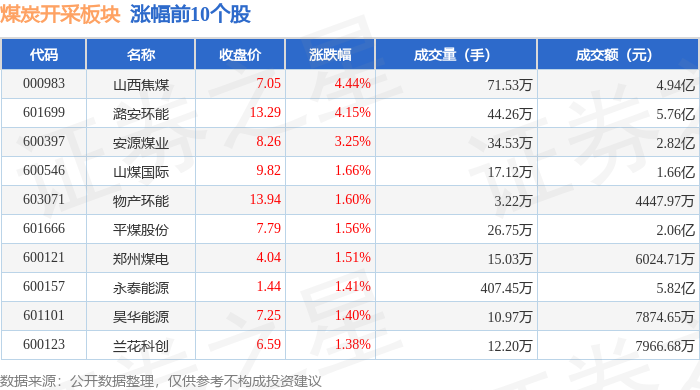
Group 1 - The coal mining sector increased by 0.66% on September 5, with Shanxi Coking Coal leading the gains [1] - The Shanghai Composite Index closed at 3812.51, up 1.24%, while the Shenzhen Component Index closed at 12590.56, up 3.89% [1] - Key stocks in the coal mining sector showed significant price increases, with Shanxi Coking Coal rising by 4.44% to a closing price of 7.05 [1] Group 2 - The coal mining sector saw a net inflow of 347 million yuan from main funds, while retail investors experienced a net outflow of 456 million yuan [2] - Major stocks like Shanxi Coking Coal and China Shenhua experienced varying levels of fund inflow and outflow, indicating mixed investor sentiment [3] - The trading volume and turnover for key stocks in the coal sector reflected active market participation, with Shanxi Coking Coal achieving a turnover of 494 million yuan [1][2]


煤炭2025中报总结(一):业绩压力测试结束,反转,不是反弹
GOLDEN SUN SECURITIES· 2025-09-05 08:41
Investment Rating - The report maintains a "Buy" rating for the coal mining sector, indicating a positive outlook for the industry moving forward [5]. Core Insights - The report emphasizes that the coal industry is experiencing a reversal rather than a rebound, with expectations for profitability to improve as coal prices have likely reached their lowest point [12][10]. - The report highlights that coal prices have begun to stabilize and recover, particularly in the context of both thermal and coking coal [15][19]. Summary by Sections Market Overview - As of September 1, 2025, the spot price for Q5500 thermal coal is reported at 695 CNY/ton, down 73 CNY/ton from the beginning of the year but up 77 CNY/ton from the lowest price in June [19]. - The average spot price for Q5500 thermal coal in Q2 2025 was 642 CNY/ton, reflecting a year-on-year decline of 211 CNY/ton (24.7%) and a quarter-on-quarter decline of 91 CNY/ton (12.5%) [19]. - Coking coal prices have also shown resilience, with the price for low-sulfur coking coal reported at 1480 CNY/ton, up 100 CNY/ton from the start of the year [23]. Performance Overview - The report notes that the coal sector has underperformed compared to the broader market, with the CSI 300 index rising by 16.37% from April 1 to September 1, 2025, while the coal index only increased by 8.99% [2][29]. - Among 26 sampled coal companies, 19 saw their stock prices rise, while 7 experienced declines during the same period [2]. Fund Holdings - As of Q2 2025, active funds held 0.43% of their portfolios in the coal sector, a slight decrease from Q1, while passive funds held 0.71%, also down from the previous quarter [3][34]. - The combined holding of both active and passive funds in the coal sector is 0.55%, reflecting a decline of 0.06 percentage points from Q1 2025 [3]. Financial Performance - The report indicates that coal companies' profits have been under pressure due to declining coal prices, with a total profit decline of 5.4% to 113.7% among the sampled companies [3][12]. - Notably, companies like Electric Power Energy and Kailuan achieved profit growth despite the overall downward trend in the sector [3]. Operational Insights - Coal companies are focusing on increasing production, improving quality, and reducing costs to mitigate the impact of falling prices [4][12]. - The total coal production for the sampled companies in H1 2025 was 586 million tons, a year-on-year increase of 4.5% [12]. Investment Recommendations - The report recommends stocks with strong earnings elasticity such as Lu'an Energy, Yanzhou Coal, and Jinkong Coal, while also highlighting key state-owned enterprises like China Shenhua and China Coal Energy for potential investment [10][11].



煤炭行业2025年半年报总结:上半年业绩承压,下半年回暖可期
Minsheng Securities· 2025-09-05 07:22
Investment Rating - The report maintains a "Buy" rating for the coal industry, recommending specific companies based on their performance and market conditions [7][8]. Core Insights - The coal market experienced a decline in prices during the first half of 2025, with an average price of 675.7 CNY/ton for thermal coal, a year-on-year decrease of 22.8% [3][14]. - A rebound in coal prices is anticipated in the second half of 2025 due to increased demand and supply constraints, potentially returning to levels seen in Q3 2024 [4][29]. - The report highlights a significant reduction in production from both domestic and international sources, with a year-on-year decrease in coal production from major exporting countries [18][24]. Market Review - In H1 2025, thermal coal prices continued to decline, with Q2 prices hitting a low of 631.6 CNY/ton, down 25.6% year-on-year [3][14]. - The average price of coking coal also saw a significant drop, with the main coking coal price at 1377.67 CNY/ton, down 38.79% year-on-year [3][14]. Industry Outlook - The report forecasts a price recovery driven by supply reductions and seasonal demand increases, with expectations for prices to return to Q3 2024 levels [4][29]. - Supply-side constraints are expected to persist, with an estimated annual reduction of 230 million tons due to stricter production regulations [24][25]. - Non-electric demand, particularly from the coal chemical sector, is projected to grow, providing additional support for coal prices [29][30]. Fund Holdings - In Q2 2025, most listed companies in the coal sector saw an increase in fund holdings compared to Q1, with notable increases for companies like Huabei Mining and Xinjie Energy [5][34]. Half-Year Report Summary - The coal sector's total revenue in H1 2025 decreased by 18.8% year-on-year, with the thermal coal sub-sector experiencing a 16.6% decline [36][37]. - The net profit attributable to shareholders fell by 32% year-on-year, with the coking coal sub-sector facing the steepest decline of 60.1% [38].


陕煤集团70亿元小公募债项目获上交所受理
Xin Lang Cai Jing· 2025-09-05 06:45
Group 1 - The project status of Shaanxi Coal and Chemical Industry Group Co., Ltd.'s 7 billion yuan small public bond has been updated to "accepted" as of September 5, 2025 [1] - The funds raised from this bond issuance, after deducting issuance costs, are intended to be used for repaying maturing debts and interest [1]
中国煤炭:在结构性低迷中选择-Selective amid a structural downturn
2025-09-04 15:08
Summary of Key Points from the Conference Call Industry Overview - **Industry**: China's Coal Segment - **Current Status**: The coal segment is in structural decline due to the energy transition, with thermal coal facing slight oversupply while coking coal is broadly balanced for the year [1][4] Core Insights - **Thermal Coal**: - Demand is expected to decline by approximately 1% YoY to around 4.17 billion tons (bnt) in 2025, driven by a 2.5% drop in power-sector coal consumption and a 6% decrease in construction-related consumption [3][19] - Total thermal coal supply is projected to increase by about 1% YoY to 4.3 billion tons in 2025, despite a 12% YoY drop in imports [3][18] - The average price of thermal coal has corrected by 22% YoY, with domestic prices hitting lows of RMB 677 per ton [18] - **Coking Coal**: - Supply is expected to remain flat at approximately 592 million tons (mnt) in 2025, with demand also flat at 591 mnt, supported by stable pig iron production [4][22] - The market is expected to face rising supply pressure in the coming years, despite current balance [4] Policy Context - **Regulatory Environment**: The current industry backdrop is different from the 2015 supply-side reform, with fewer loss-makers and greater consolidation. The share of output from large, advanced mines has increased, making broad cuts unlikely [2][16] - **Safety and Environmental Checks**: Supply discipline is more likely to come from tighter safety and environmental checks rather than blanket quotas [2][16] Stock Implications - **Investment Ratings**: - Shenhuo Coal & Power initiated at Overweight (OW) due to strong aluminum contributions [6][26] - Shenhua (H) remains OW, while Yankuang H is moved to Equal Weight (EW) and Yancoal Australia to Underweight (UW) [6][10] - China Coal (A) is rated UW, reflecting a weaker outlook [6][10] Risks and Opportunities - **Key Risks**: Implementation of anti-involution measures could lead to deeper production cuts, driving prices up for both thermal and coking coal [5][28] - **Other Risks**: Stricter inspections could lead to material supply reductions, while stronger-than-expected thermal power demand could increase coal demand [31] Additional Insights - **Market Preferences**: Coal is ranked lower among commodities, with preferences for copper, aluminum, and steel over coal [24] - **Dividend Yields**: Coal producers typically offer high dividend payouts, around 5%, which may attract yield-focused investors despite the structural downturn [27] Conclusion - The coal industry in China is navigating a complex landscape marked by declining demand, regulatory scrutiny, and shifting market dynamics. While coking coal remains relatively balanced, thermal coal faces significant challenges. Investment strategies should consider the potential for regulatory impacts and the overall commodity landscape.

煤炭中报“寒意浓”!25家煤企利润集体滑坡,头部四企同比少赚100多亿
Hua Xia Shi Bao· 2025-09-04 04:17
Core Viewpoint - The coal industry is experiencing significant profit declines, with 23 out of 25 listed coal companies reporting revenue drops and all showing negative net profit growth in their mid-year reports for 2025, indicating a severe contraction in industry profitability [1][2][4]. Financial Performance - In the first half of 2025, the total net profit of 25 coal companies was 554.72 billion yuan, down nearly 250 billion yuan from 808.11 billion yuan in the same period last year, and a decrease of almost 500 billion yuan compared to 2023 [1][2]. - Major coal companies, including China Shenhua, China Coal Energy, Shaanxi Coal and Electricity, and Yanzhou Coal, collectively earned over 100 billion yuan less than in the previous year, highlighting a significant profit shrinkage [1][2]. Revenue Decline - The top four coal companies reported a combined net profit of 446.36 billion yuan in the first half of 2025, down from 574.16 billion yuan last year and 669.03 billion yuan two years ago [2]. - Specific revenue figures for major companies include: - China Shenhua: Revenue of 1,381.09 billion yuan, down 18.34% [2]. - China Coal Energy: Revenue of 744.36 billion yuan, down 19.95% [2]. - Shaanxi Coal: Revenue of 779.83 billion yuan, down 14.19% [2]. - Yanzhou Coal: Revenue of 593.49 billion yuan, down 17.93% [2]. Price and Demand Factors - The decline in coal prices is attributed to oversupply and weak demand, with average sales prices for coal dropping significantly [3][4]. - For instance, Shaanxi Coal reported a coal price of 439.67 yuan/ton, down 23.81% year-on-year, while China Coal Energy's sales price fell by 114 yuan/ton [3]. - The overall coal production in China increased by 5.4% in the first half of 2025, while coal imports decreased by 11.1% [4]. Market Outlook - Despite the current downturn, there are expectations for a potential recovery in coal prices due to seasonal demand increases and supply constraints [8][10]. - Analysts suggest that the coal market may stabilize as seasonal factors and macroeconomic policies could improve demand in the latter half of 2025 [10][11].
煤炭中报“寒意浓”!25家上市煤企利润集体滑坡
Hua Xia Shi Bao· 2025-09-04 01:54
Core Viewpoint - The coal industry is experiencing significant profit declines, with 23 out of 25 listed coal companies reporting revenue drops and all 25 showing negative net profit growth in the first half of 2025, indicating a severe contraction in industry profitability [1][2]. Financial Performance - In the first half of 2025, the total net profit of 25 coal companies was 554.72 billion yuan, down nearly 250 billion yuan from 808.11 billion yuan in the same period last year, and a decrease of almost 500 billion yuan compared to 1,057.54 billion yuan in 2023 [1][2]. - The top four coal companies, including China Shenhua, China Coal Energy, Shaanxi Coal and Electricity, and Yanzhou Coal Mining, collectively earned over 100 billion yuan less than in the first half of 2024 [1]. - China Shenhua maintained the highest revenue at 1,381.09 billion yuan, down 18.34% year-on-year, with a net profit of 246.41 billion yuan, a decrease of 12.03% [2]. Price Decline Factors - The decline in coal prices is attributed to a combination of factors, including a 10.9% drop in sales volume and a 12.9% decrease in average selling prices for coal, leading to a significant reduction in sales revenue [3]. - The average selling price of coal for Shaanxi Coal was 439.67 yuan/ton, down 23.81% year-on-year, while China Coal Energy reported a drop of 114 yuan/ton in its comprehensive sales price [3]. Supply and Demand Dynamics - The coal supply remains high, with a production increase of 5.4% year-on-year, while demand is weak, leading to a surplus in the market [4]. - The price of thermal coal has seen significant declines, with the NCEI index showing a 24 yuan/ton decrease in long-term contract prices compared to the end of the previous year [4]. Profitability Trends - The number of coal companies with profits exceeding 10 billion yuan has halved, dropping from 15 to 8, with several companies experiencing profit declines exceeding 80% [5]. - The number of loss-making companies increased from 1 to 5, with the most significant loss reported by Anyuan Coal at 290 million yuan [5]. Market Outlook - Despite short-term pressures, there are optimistic forecasts for coal prices in the latter half of the year, with expectations of improved demand during seasonal peaks [7][8]. - Analysts suggest that while the supply side may see marginal contractions, the demand side remains resilient, potentially alleviating downward pressure on coal prices [8].
发挥长钱长投优势险资系私募偏好大蓝筹
Zhong Guo Zheng Quan Bao· 2025-09-03 22:42
Group 1 - A new insurance-funded private equity firm, Hengyi Chiying (Shenzhen) Private Fund Management Co., Ltd., has completed registration with an initial fund size of 30 billion yuan [1] - The total number of insurance-funded private equity firms has reached seven, with a combined trial amount of 222 billion yuan [1][2] - The investment strategy of these firms is focused on long-term and value investments, favoring leading companies in energy and infrastructure sectors such as China Petroleum, China Shenhua, and Daqin Railway [1][4] Group 2 - The first batch of insurance capital long-term investment reforms was approved in October 2023, with China Life and Xinhua Insurance each contributing 25 billion yuan to establish a 50 billion yuan company fund [2] - As of now, six insurance-funded private equity securities investment funds are operational, with significant holdings in major companies [2][3] - The Honghu Zhiyuan Fund has become a major shareholder in China Petroleum and China Shenhua, with holdings valued at approximately 1.857 billion yuan and 2.116 billion yuan respectively [2][3] Group 3 - The Honghu Zhiyuan series of funds emphasizes a long-term investment approach, focusing on stable dividend yields through low-frequency trading and long-term holding [4] - The total assets of the Honghu Zhiyuan Fund I reached 57.112 billion yuan, with a net profit of 9.68 billion yuan in the first half of the year [3][4] - Insurance companies are establishing private equity funds to leverage their long-term investment advantages, supporting the capital market and promoting stable, sustainable investment returns [4]




煤炭中报“寒意浓”!25家上市煤企利润集体滑坡,中国神华等头部四企同比少赚100多亿
Hua Xia Shi Bao· 2025-09-03 14:08
Core Viewpoint - The coal industry is experiencing significant profit declines, with 23 out of 25 listed coal companies reporting revenue drops and all 25 showing negative net profit growth in the first half of 2025, indicating a severe contraction in industry profitability [1][2][4]. Group 1: Financial Performance - In the first half of 2025, the total net profit of 25 coal companies was 554.72 billion yuan, a decrease of nearly 250 billion yuan from 808.11 billion yuan in the same period last year, and down nearly 500 billion yuan from 1,057.54 billion yuan two years ago [1][2]. - The top four coal companies, including China Shenhua, China Coal Energy, Shaanxi Coal and Yanzhou Coal, collectively earned over 100 billion yuan less compared to the first half of 2024 [1][2]. - China Shenhua maintained the highest revenue at 1,381.09 billion yuan, down 18.34% year-on-year, with a net profit of 246.41 billion yuan, down 12.03% [2][3]. Group 2: Price and Demand Factors - The decline in coal prices is attributed to a weak supply-demand relationship, with average sales prices for thermal coal dropping by over 20% across major markets [1][4]. - China Shenhua reported a 10.9% decrease in coal sales volume and a 12.9% drop in average sales price, leading to a significant reduction in sales revenue [3][4]. - The average selling price of coal for Shaanxi Coal was 439.67 yuan/ton, down 23.81% year-on-year, while China Coal Energy's price fell by 114 yuan/ton [3][4]. Group 3: Industry Outlook - Despite the current downturn, there are expectations for a potential recovery in coal prices during the second half of 2025, driven by seasonal demand increases and policy support [7][9]. - Analysts suggest that while short-term pressures remain, the coal market may stabilize as supply constraints and seasonal demand factors come into play [8][9]. - The overall sentiment among several coal companies indicates a cautious optimism for the second half of 2025, with expectations of improved demand due to seasonal factors and economic recovery policies [9].