GAC GROUP(601238)

Search documents
时报观察丨人形机器人站上车展C位的冷思考
Zheng Quan Shi Bao· 2025-11-24 23:18
Group 1 - Major automotive companies are increasingly venturing into the humanoid robot sector, showcasing a shift in focus from traditional automotive innovations to robotics at the 2025 Guangzhou International Auto Show [1] - Companies like GAC Group and XPeng Motors presented their humanoid robots, indicating a trend where humanoid robots are becoming a key selling point amidst a temporary lull in smart automotive technology advancements [1] - The underlying technology for smart cars and humanoid robots shares commonalities, allowing automotive companies to leverage their expertise in intelligent manufacturing and user engagement to explore new revenue streams in robotics [1] Group 2 - The commercial logic and developmental stage of humanoid robots differ significantly from that of automobiles, requiring substantial investment and a long return cycle, which could strain cash flow if pursued blindly by automotive companies [2] - The Chinese automotive industry is currently facing challenges, with an overall profit margin of only 4.5% in the first nine months, which is below the average for downstream industrial enterprises [2] - A strategic approach to humanoid robot development should be based on technological applicability and genuine market demand rather than merely chasing trends, emphasizing the need for a balance between innovation investment and financial health [2]



广汽“番禺行动”一周年
2 1 Shi Ji Jing Ji Bao Dao· 2025-11-24 23:09
Core Insights - GAC Group has launched the "Panyu Action" to strengthen its independent brand segment, aiming for 60% of total sales from independent brands by 2027, with a target of 2 million units sold [1] - The introduction of the "Qijing" model, a collaboration with Huawei, marks a shift in GAC's strategy towards user-centric product development, moving away from an engineering-focused approach [1][5] - The "Qijing" model aims to position itself as a high-end intelligent electric vehicle targeting young consumers, with a price point around 300,000 yuan [6][7] GAC's Strategic Changes - GAC has reduced its new car development cycle to 18-21 months and improved market response efficiency by over six times [1] - The company has optimized its product planning by reducing the number of models by approximately 20% and increased procurement efficiency by about 50% [1] - The leadership change, with He Xianqing as the new general manager, signifies a shift towards a more matrix-oriented organizational structure [5] Collaboration with Huawei - The "Qijing" model represents a new collaboration approach where GAC retains brand control while leveraging Huawei's technology and expertise [4][5] - Huawei's involvement includes a significant number of personnel dedicated to the project, with over 200 team members and peak involvement of 800 [5] - The collaboration aims to integrate Huawei's IPD and IPMS systems into GAC's processes, enhancing product development and marketing [5][8] Market Positioning and Challenges - The "Qijing" model is designed to compete in the high-end market, with a focus on aesthetics and performance, drawing comparisons to Xiaomi's automotive strategy [6][7] - GAC's previous models under the Aion brand faced challenges due to a focus on B2B sales, prompting a necessary shift to a B2C approach [9][10] - The success of the "Qijing" model will depend on GAC's ability to effectively market and sell the vehicle, as the high-end market is limited in capacity [8] Brand Development and Future Outlook - Aion and other GAC brands are undergoing rebranding efforts to better align with market demands, with Aion's new models focusing on younger, trendier consumers [10][11] - The positioning of the Aion brand is shifting from a performance focus to a more balanced approach that includes technology and business appeal [10][11] - GAC aims to ensure quality and maintain competitive advantages by learning from Huawei's successful operational practices [11]
直击第二十三届广州国际汽车展览会:自主品牌站C位 产业链加速融合
Zheng Quan Ri Bao Zhi Sheng· 2025-11-24 16:40
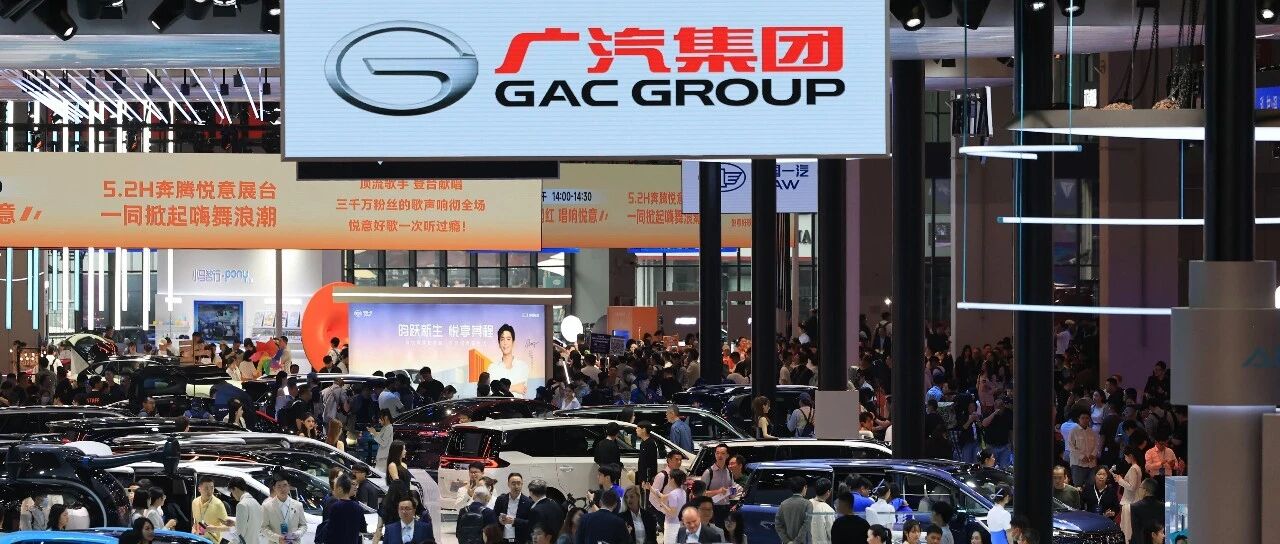
Core Insights - The 23rd Guangzhou International Auto Show showcased a significant increase in visitor turnout and featured 1,085 vehicles, including 93 global debuts and 629 new energy vehicles, highlighting the strong presence of domestic brands and the acceleration of localization strategies by foreign brands [1][2] Industry Trends - The Chinese automotive market has crossed the critical point of electric vehicle (EV) adoption, with cumulative sales of new energy vehicles reaching 12.943 million units from January to October 2025, marking a 32.7% year-on-year increase and a market penetration rate exceeding 52.9% [2] - The shift towards electric and intelligent vehicles is no longer optional but essential, driving profound changes in product development, supply chain management, and overall industry ecology [2][4] Company Developments - Great Wall Motors unveiled its VLA advanced driver-assistance model, emphasizing the evolution of driving technology and user experience [3] - Ford and Buick are adapting their strategies to local market demands, with Ford's Mustang featuring a localized architecture and advanced technology, while Buick integrates local innovations for enhanced user experience [3] Innovation in the Supply Chain - The auto show highlighted the importance of collaboration across the automotive supply chain, with companies like Jiangsong Technology showcasing innovative solutions such as vertical parking systems with fire safety features and automated charging robots [5] - Xpeng Motors is venturing into humanoid robotics, demonstrating a bionic robot that integrates automotive technology and AI capabilities, indicating a trend towards multi-functional applications of automotive technology [6] - CATL presented its latest battery technology solutions, emphasizing the shift of core supply chain companies from mere suppliers to co-creators in the automotive ecosystem [6]


广汽集团今日涨停,向华为学习能否带来转机?
第一财经· 2025-11-24 13:43
Core Viewpoint - GAC Group has made significant progress in the development of solid-state batteries, aiming for small-scale vehicle testing by 2026 and mass production between 2027 and 2030, despite facing financial losses in recent quarters [3][4]. Group 1: Battery Development - GAC Group's solid-state battery pilot production line has been established, achieving conditions for mass manufacturing of automotive-grade solid-state batteries with energy density nearly double that of current batteries [3]. - The company plans to conduct small-scale vehicle testing of the new solid-state batteries in 2026, with a gradual ramp-up to mass production from 2027 to 2030 [3]. Group 2: Organizational Changes - GAC Group is undergoing a transformation by adopting a matrix organizational structure to enhance end-to-end collaboration, moving away from its previous functional model [4]. - The company has focused on learning from Huawei, adjusting its internal structure and product development processes to improve efficiency and innovation [5]. Group 3: New Brand and Market Strategy - GAC has prioritized the launch of its new brand "Qijing," targeting a younger demographic with a planned vehicle priced around 300,000 yuan, set to debut next year [5]. - The company plans to introduce nine new or updated models in 2026, including a mid-size MPV and a model aimed at young consumers [6]. Group 4: Market Expansion - GAC is expanding its market presence by planning to open 600 new brand experience stores, aiming to cover over 90% of county-level markets in China [6]. - The recent launch of the Aion UT Super, priced at 49,900 yuan, reflects GAC's strategy to penetrate lower-tier markets, leveraging online channels for distribution [7].

“四大引擎”发布,再造新广汽,广汽集团携全品牌登陆2025广州车展
财富FORTUNE· 2025-11-24 13:07
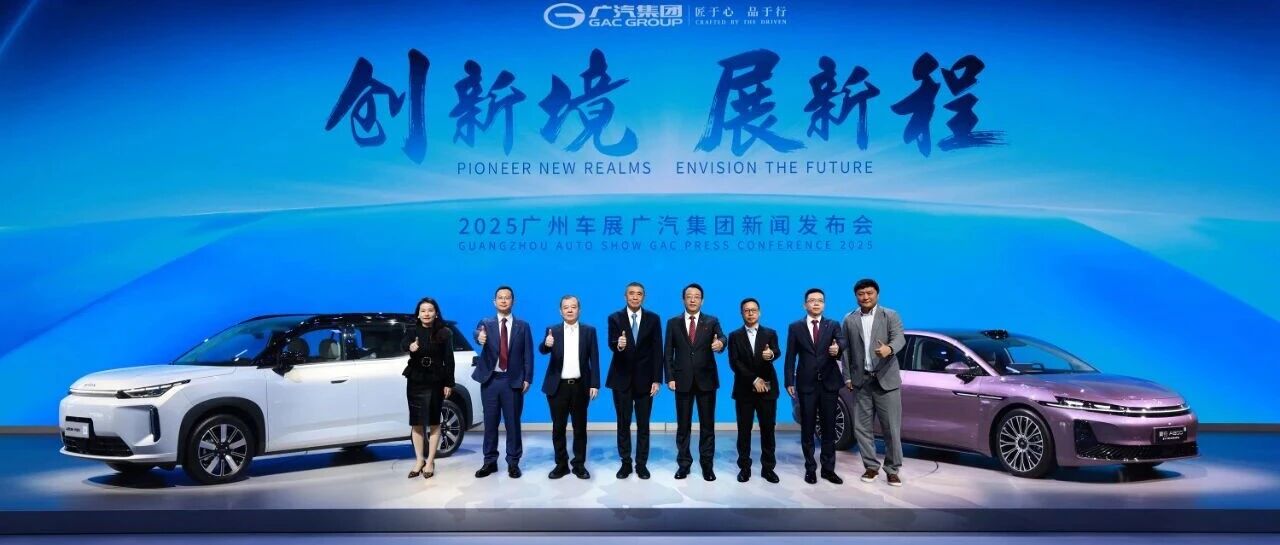
Core Viewpoint - GAC Group showcases its "Panyu Action" reform achievements at the 23rd Guangzhou International Auto Show, emphasizing the creation of user value through "four engines" based on new technologies, products, services, and ecosystems, aiming to establish a new GAC that is technology-leading, quality-leading, and ecology-leading [1][4][6]. Group 1: Panyu Action and User-Centric Approach - GAC Group is committed to a user-centric approach, advancing the "Panyu Action" integrated reform, focusing on three major battles: user demand, product value, and service experience [4][6]. - The introduction of the Integrated Product Development (IPD) process has improved business efficiency by approximately 50%, reduced new car development cycles from 26 months to 18-21 months, and lowered R&D costs by over 10% [4][6]. Group 2: Four Engines for Value Creation - The "four engines" of GAC Group include new technologies, products, services, and ecosystems, aimed at enhancing user value [7][9]. - In new technology, GAC has achieved breakthroughs in user experience, including the "Star Source Range Extender" and the highest efficiency electric motor in the industry, exceeding 99% [9][11]. - GAC plans to launch nine new or updated models by 2026, driven by user demand and a comprehensive R&D system [11][20]. Group 3: Service and Ecosystem Innovations - GAC is expanding its service network with plans to add 600 brand experience stores, covering over 90% of county-level markets in China [11][13]. - The company has completed 45 over-the-air (OTA) updates this year, enhancing over 300 features across nearly 150,000 vehicles [11][15]. - GAC is building a comprehensive energy ecosystem, partnering with industry leaders like CATL to develop a battery swap network and a charging network covering 31 provinces [15][16]. Group 4: Product Highlights at the Auto Show - GAC Aion's i60 and UT super models were highlighted, showcasing advanced technologies and competitive pricing, with the UT super starting at 49,900 yuan [26][30]. - The GAC Trumpchi brand introduced several models, including the Trumpchi M8 and S9, aimed at providing high-quality, long-range, and high-value experiences [20][31]. - GAC's collaboration with Huawei on the A800 model features innovative interior designs and advanced driving assistance systems, enhancing user experience [18][20]. Group 5: Future Directions - GAC Group is entering a deep transformation phase, focusing on user-centric strategies and the "four engines" to achieve its goal of reinventing itself during the 14th Five-Year Plan period [40].
广汽集团今日涨停,向华为学习能否带来转机?
Di Yi Cai Jing· 2025-11-24 12:33
相对于广汽旗下其他自主品牌,启境品牌已被视为广汽的重中之重。冯兴亚多次在公开场合提及,"公 司把启境置于最高优先级""广汽all in 启境"等。根据规划,启境首款新车将在明年上市,瞄准年轻人, 定位30万元级别。 除了启境,2026年,广汽集团还将推出9款改款及全新车型,其中传祺向往计划明年推出一款中型MPV 及一款中大型MPV;埃安将于明年一季度,推出一款针对年轻人开发的车型,以及MPV车型。但多位 车企高层和专家均认为,明年,汽车市场将迎来更为激烈的竞争,如何突出重围,仍是广汽的课题。 广汽集团平台技术研究院新能源动力研发负责人祁宏钟称,现在开发的全固态电池的能量密度比现有的 电池能量密度高了接近一倍,计划是2026年可以进行小批量装车试验,2027年到2030年期间,逐步进行 批量生产。 在固态电池之外,广汽集团仍在持续改革。今年前三季度,广汽集团营收约662.72亿元,归母净利润亏 损约43.12亿元。冯兴亚在2025广州车展上称:"一年前的今天,我们吹响了'番禺行动'号角。说实话, 这一年来汽车行业真的很卷。"他认为,在变革方面广汽已经找准了路子,见到了果子。 纵观广汽这一年,向华为学习是其变革的 ...
广汽打造启境:制度学习华为,产品对标小米
2 1 Shi Ji Jing Ji Bao Dao· 2025-11-24 11:44
Core Viewpoint - GAC Group is undergoing significant reforms to strengthen its independent brand segment, aiming for independent brands to account for over 60% of total sales by 2027, with a target of 2 million units sold [1][14]. Group 1: GAC's Reform and Strategy - GAC has shortened its new car development cycle to 18-21 months and improved market response efficiency by over six times [1]. - The company has optimized its product planning by reducing the number of models by approximately 20% and increased procurement efficiency by about 50% [1]. - The shift from "engineer thinking" to "user thinking" is highlighted as a major transformation within GAC's system [1]. Group 2: Partnership with Huawei - GAC and Huawei have launched the "Qijing" model, marking a new collaboration approach where GAC retains brand control while leveraging Huawei's technology [2][8]. - The "Qijing" model is a result of deep collaboration across product, technology, demand, marketing, and delivery, with significant input from Huawei's R&D teams [8]. - GAC aims to create high-performance, aesthetically pleasing, and technologically advanced products targeting the young and fashionable demographic [10]. Group 3: Aion's Market Positioning - Aion is shifting its focus from B2B to B2C, with the launch of the Aion UT Super, which has already received over 16,000 orders since its release [14][15]. - The Aion i60 is also being marketed with a focus on a youthful and trendy image, with a sales target of at least 10,000 units per month [15]. - Aion's previous performance issues are being addressed through a rebranding strategy that emphasizes value and appeal to younger consumers [15]. Group 4: Other Brands and Future Outlook - The Haobo brand is transitioning from a sporty image to a more stable, technology-oriented positioning, with new models expected to improve sales performance [15][16]. - The Trumpchi brand will continue to enhance its "MPV master" label while advancing its transition to new energy vehicles [16]. - The success of GAC's reforms and the "Panyu Action" will depend on maintaining quality across its brands and effectively implementing lessons learned from Huawei [16].
广汽打造启境:制度学习华为,产品对标小米
21世纪经济报道· 2025-11-24 11:29
Core Viewpoint - GAC Group is undergoing significant reforms to enhance its autonomous vehicle segment, aiming for 60% of total sales from self-owned brands by 2027, with Aion as a key player in this strategy [1][12]. Group 1: GAC's Reform and Strategy - GAC has shortened its new car development cycle to 18-21 months and improved market response efficiency by over 600% [1]. - The company aims to increase the number of self-owned brand models by 20% and enhance procurement efficiency by approximately 50% [1]. - The shift from "engineer thinking" to "user thinking" is highlighted as a major transformation within GAC [1]. Group 2: Partnership with Huawei - GAC and Huawei have launched the "Qijing" model, marking a new collaboration approach where GAC retains brand control while leveraging Huawei's technology [2][5]. - The "Qijing" model is a result of deep collaboration across product, technology, and marketing, with significant input from Huawei's R&D teams [7]. - GAC's organizational structure has shifted from a functional model to a matrix structure, focusing on project-based product development [9]. Group 3: Aion's Market Positioning - Aion is transitioning from a B2B focus to a B2C strategy, with the launch of the Aion UT Super, which has already received over 16,000 orders since its launch [12][13]. - The Aion i60 is being marketed with a focus on youth and modernity, aiming to redefine its brand image [13]. - Aion's past performance issues are acknowledged, with a commitment to improve sales and market presence through strategic marketing and product positioning [12][14]. Group 4: Overall Market Challenges - The high-end sedan market, where the "Qijing" is positioned, is competitive, with limited capacity, making it crucial for GAC and Huawei to effectively execute their product and marketing strategies [10]. - GAC's other brands, including Haobo and Trumpchi, are also undergoing rebranding and repositioning to enhance their market competitiveness [14].
广汽“番禺行动”一周年:落地华为“第一境” 埃安战略由B转C
2 1 Shi Ji Jing Ji Bao Dao· 2025-11-24 11:02
Core Insights - GAC Group has launched the "Panyu Action" to strengthen its independent brand segment, aiming for independent brands to account for over 60% of total sales by 2027 and to achieve sales of 2 million units [1] - The introduction of the "Qijing" model, a collaboration with Huawei, marks a shift in GAC's strategy, focusing on high-performance, high-tech vehicles aimed at young consumers [4][5] - GAC's transformation involves a shift from an "engineer mindset" to a "user mindset," emphasizing the importance of product quality in measuring the success of institutional reforms [1][4] GAC's Strategic Goals - GAC aims to reduce the new car development cycle to 18-21 months and improve market response efficiency by over six times [1] - The company plans to optimize the number of planned models by approximately 20% and enhance procurement efficiency by about 50% [1] - The core goal of the "Panyu Action" is to strengthen GAC's independent brand segment amidst declining sales of joint venture brands [1] Collaboration with Huawei - The "Qijing" model represents a new collaboration approach where GAC retains brand control while leveraging Huawei's technology and market presence [3][4] - Huawei's involvement includes a significant number of personnel dedicated to the project, with over 200 team members and peak involvement of 800 [4] - The collaboration aims to integrate Huawei's IPD and IPMS systems into GAC's processes, enhancing product development and marketing [4] Market Positioning and Challenges - The "Qijing" model is positioned as a high-end intelligent electric vehicle targeting the young and fashionable demographic, with a price point around 300,000 yuan [4][5] - GAC's previous models under the Haobo brand struggled in the market, prompting a shift in strategy to focus on performance and technology [5][7] - The success of the "Qijing" model will depend on GAC's ability to effectively market and deliver quality products while competing in a crowded market [5][6] Performance of GAC's Brands - Aion, one of GAC's key brands, is undergoing a transformation from a B2B focus to a B2C approach, with the launch of the Aion UT Super model [6][7] - The Aion i60 is being marketed with a focus on youth and modernity, aiming for monthly sales of at least 10,000 units [7] - Haobo is repositioning itself towards a more stable, technology-driven image, while GAC's Trumpchi brand will continue to emphasize its MPV expertise and push for a transition to new energy vehicles [7][8]
揭秘涨停 | 商业航天板块掀起涨停潮
Zheng Quan Shi Bao· 2025-11-24 10:57
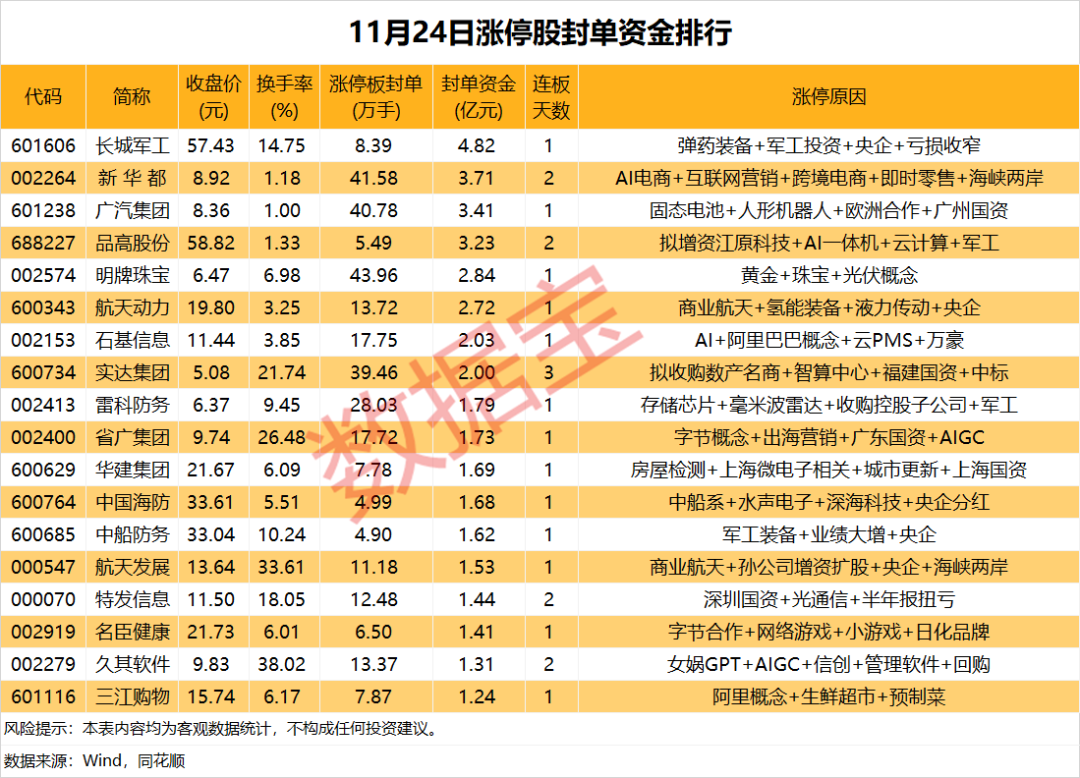
Group 1: Market Overview - Today, 28 stocks had a closing limit order amount exceeding 100 million yuan, indicating strong market interest [1] - The top five stocks with limit order volume exceeding 200,000 hands include Mingpai Jewelry, Xinhua Du, GAC Group, Shida Group, and Leike Defense, with volumes of 439,600, 415,800, 407,800, 394,600, and 280,300 hands respectively [1][3] - Continuous limit-up stocks include Zhongshui Fishery with 7 consecutive limit-ups, while *ST Suwu, Guofeng New Materials, and Meng Tian Home achieved 4 consecutive limit-ups [1] Group 2: Individual Stock Performance - Changcheng Military Industry closed at 57.43 yuan per share with a total market value of 41.592 billion yuan, reporting a single-quarter revenue decline but overall revenue growth year-on-year [2] - Xinhua Du closed at 8.92 yuan with a limit order volume of 415,800 hands and a limit order amount of 371 million yuan, driven by AI e-commerce and cross-border retail [3] - GAC Group closed at 8.36 yuan with a limit order volume of 407,800 hands and a limit order amount of 341 million yuan, benefiting from solid-state batteries and humanoid robots [3] Group 3: Sector Highlights - The commercial aerospace sector has seen a surge in limit-up stocks, including Aerospace Changfeng, Leike Defense, and China Marine Defense, indicating strong investor interest in this area [5][6] - Companies like Tianjian Technology and Zhongtian Rocket are positioned well within the commercial aerospace market, with significant contracts and technological advancements [5] - China Marine Defense is recognized for its comprehensive research and production capabilities in underwater electronic defense equipment, highlighting its strategic importance in the defense sector [6]