PING AN OF CHINA(601318)

Search documents
保险板块1月28日跌0.38%,中国平安领跌,主力资金净流出6.02亿元
Zheng Xing Xing Ye Ri Bao· 2026-01-28 09:04
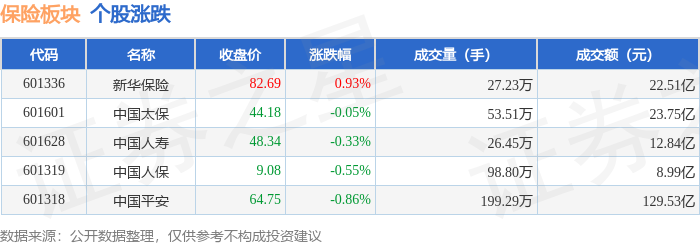
证券之星消息,1月28日保险板块较上一交易日下跌0.38%,中国平安领跌。当日上证指数报收于4151.24,上涨0.27%。深证成指报收于14342.9, 上涨0.09%。保险板块个股涨跌见下表: | 代码 | 名称 | 收盘价 | 涨跌幅 | 成交重(手) | 成交额(元) | | --- | --- | --- | --- | --- | --- | | 601336 | 新华保险 | 82.69 | 0.93% | 27.23万 | 22.51 Z | | 601601 | 中国太保 | 44.18 | -0.05% | 53.51万 | 23.75 7 | | 601628 | 中国人寿 | 48.34 | -0.33% | 26.45万 | 12.84 Z | | 601319 | 中国人保 | 9.08 | -0.55% | 98.80万 | 8.99 Z | | 601318 | 中国平安 | 64.75 | -0.86% | 199.29万 | 129.53亿 | 从资金流向上来看,当日保险板块主力资金净流出6.02亿元,游资资金净流出1.12亿元,散户资金净流入7.14亿元。保险板块个股资金 ...


融资融券周报:主要指数多数上涨,两融余额继续上升-20260128
BOHAI SECURITIES· 2026-01-28 08:09
- The financing balance of the Shanghai and Shenzhen stock markets increased by 139.05 billion yuan to 26,969.49 billion yuan last week[13][16] - The top five stocks with the highest net financing purchases last week were Ping An Insurance (601318), New Easys (300502), Zijin Mining (601899), Tianfu Communication (300394), and Industrial Bank (601166)[48][50] - The top five stocks with the highest net securities lending sales last week were BYD (002594), Chifeng Gold (600988), BlueFocus (300058), Kweichow Moutai (600519), and Foxconn Industrial Internet (601138)[48][52] - The financing balance of the ETF market was 1142.77 billion yuan, a decrease of 9.40 billion yuan from January 20[43] - The top five ETFs with the highest net financing purchases were Huaxia SSE 50ETF, Huatai-PineBridge CSI 300ETF, GF CSI Hong Kong Stock Connect Non-Bank ETF, Huaan Gold ETF, and Harvest CSI 300ETF[45][46]





金再破历史高位,黄金股ETF迎来“戴维斯双击”窗口
Sou Hu Cai Jing· 2026-01-28 06:08
Group 1 - The international gold market has experienced a significant surge, with London spot gold prices breaking through the $5,200 per ounce mark, reaching a historical high [1] - The rise in gold prices is attributed to multiple structural factors rather than short-term sentiment, including the ongoing pressure on the US dollar credit system and an accelerated phase of "de-dollarization" [1] - The World Gold Council reports that global gold ETF holdings have reached a historical peak of 4,025 tons, indicating a strong long-term allocation interest from institutional investors [1] Group 2 - Despite fluctuations in Federal Reserve interest rate expectations, the macroeconomic environment remains favorable for non-yielding assets like gold, as the cost of holding gold decreases [2] - The dual attributes of gold as a safe-haven and a hedge are being fully activated amid regional political risks and financial system vulnerabilities [2] - The Ping An CSI Hong Kong-Shenzhen Gold Industry ETF (159322) closely tracks the CSI Hong Kong-Shenzhen Gold Industry Stock Index, which covers leading mining companies listed in the Hong Kong and Shenzhen markets, benefiting from high gold prices that are expected to significantly boost sales revenue and profits [2]
中国平安3.8亿港元增持国寿H股,持股比例升至9.14%
Jin Rong Jie· 2026-01-28 04:57
Group 1 - Ping An Life increased its stake in China Life H-shares by acquiring 11.891 million shares at an average price of HKD 32.0553 per share, totaling approximately HKD 381 million [1] - After the acquisition, Ping An Life's total holdings in China Life H-shares rose to 681 million shares, increasing its ownership percentage from 8.98% to 9.14% [1] - This is not the first time Ping An has invested in China Life H-shares, as it previously reached the 5% threshold in August 2025 and has continued to increase its holdings without exceeding the 10% threshold [1] Group 2 - Ping An Life has also made significant investments in other financial institutions, including Agricultural Bank of China H-shares, where its stake surpassed 20%, and has actively increased holdings in several state-owned banks [1] - The investment strategy of insurance capital, as analyzed by Huachuang Securities, focuses on two main objectives: prioritizing high-yield assets with stable future dividend cash flows and targeting state-owned enterprises with monopolistic positions and mature profit models for long-term equity investments [2]

保险业迎战二〇二六年首场寒潮
Jin Rong Shi Bao· 2026-01-28 04:34
Core Viewpoint - The insurance industry has demonstrated a strong commitment to disaster response during the recent severe snowstorm, showcasing a coordinated effort in prevention, rescue, and compensation through technology and human resources [1][18][20]. Group 1: Prevention - Prior to the snowstorm, multiple insurance companies proactively implemented risk prevention measures, including sending over 1 million safety alerts and disaster reduction tips to clients [4][7]. - Companies utilized various platforms to disseminate weather warnings and safety tips, with Ping An Property & Casualty sending over 38.63 million alerts [4]. - On-site assistance was provided to high-risk areas, with companies like Ping An conducting risk assessments and offering reinforcement advice to vulnerable structures [4][6]. Group 2: Rescue - During the snowstorm, insurance companies quickly established specialized rescue teams to coordinate resources for timely and efficient assistance [10][12]. - For instance, China Life Property & Casualty collaborated with rescue companies to enhance support in critical areas, providing emergency services such as towing and battery jump-starts [10]. - The insurance sector also engaged in joint operations with local police and emergency services to ensure effective road safety and rapid response to incidents [14][19]. Group 3: Compensation - Following the disaster, many insurance companies opened green channels for claims, simplifying processes and leveraging technology to enhance efficiency [18][20]. - For example, Ping An Property & Casualty reported that the fastest claim payment took only 9 minutes from the time of reporting [19]. - Companies utilized advanced technologies such as remote damage assessment and AI to expedite claims processing, ensuring timely compensation for clients [20].

四川金融监管局同意平安产险成都市锦城支公司变更营业场所
Jin Tou Wang· 2026-01-28 03:45
Group 1 - The Sichuan Financial Regulatory Bureau approved the request for China Ping An Property & Casualty Insurance Company to change its business location [1] - The new business address is set to be in the China (Sichuan) Pilot Free Trade Zone, specifically at 1199 Tianfu Avenue North, Building 3, 12th Floor, Rooms 1201-1210, Chengdu High-tech Zone [1] - China Ping An Property & Casualty Insurance Company is required to handle the change and obtain new permits in accordance with relevant regulations [1]
梅州监管分局同意平安产险梅州市丰顺支公司变更营业场所
Jin Tou Wang· 2026-01-28 03:45
Core Viewpoint - The National Financial Supervision Administration of Meizhou has approved the request from China Ping An Property & Casualty Insurance Company to change the business location of its Meizhou branch [1] Group 1 - The business location of China Ping An Property & Casualty Insurance Company in Meizhou will be changed to: 5th Floor, Block L, New Century Engineering, Municipal Avenue, Fengshun County, Meizhou City [1] - The company is required to handle the change and obtain the necessary permits in accordance with relevant regulations [1]
银保渠道领跑保险“开门红” 业内专家:警惕销售误导抬头
Jin Rong Shi Bao· 2026-01-28 01:02
Core Insights - The insurance industry is experiencing significant growth in the bancassurance channel, with new premium scale reaching approximately 530 billion yuan in the first half of 2025, surpassing individual insurance channels [1] - The bancassurance channel is expected to continue its strong growth due to the upcoming maturity of a large volume of fixed deposits, estimated at 50 trillion yuan, which will likely shift towards insurance products [1][4] - Despite the growth, there are concerns regarding sales misguidance, product structure uniformity, and imbalanced assessment mechanisms within the bancassurance channel [1][6] Industry Performance - During the 2026 "opening red" period, the bancassurance channel has become the core engine for industry premium growth, with a total premium growth rate of approximately 10% for the period [2] - Major insurance companies like China Life, Ping An Life, and PICC Life reported significant increases in bancassurance premium growth, with increases of 205%, 168%, and 108% respectively [2] - The high growth in premium payments indicates a shift from traditional lump-sum payments to a higher proportion of regular premium payments, enhancing the channel's value contribution [2] Product Trends - The market is seeing a concentration in products, particularly dividend-type savings products, which align with consumer demand for stable returns and potential appreciation [3] - Analysts predict that new premium growth for listed insurance companies will continue to be driven by the bancassurance channel, with an expected growth rate exceeding 25% in 2026 [3] Market Dynamics - The resurgence of the bancassurance channel is attributed to changes in market conditions and operational optimizations by insurance companies [4] - Policy changes, such as the "reporting and banking integration" policy and the removal of restrictions on bank partnerships, have significantly reduced costs and expanded collaboration opportunities [4] Operational Strategies - Insurance companies are optimizing product designs to meet the needs of bank customers, including shortening payback periods and relaxing age limits for policyholders [4][5] - Banks are enhancing collaboration by integrating insurance sales with financial advisory services and improving the training of financial advisors to boost sales efficiency [5] Sales Concerns - There is a rising concern about sales misguidance, with some bank advisors misrepresenting the returns of dividend insurance products, leading to regulatory scrutiny and penalties [6][7] - The over-reliance on dividend-type savings products and the focus on premium scale in assessments are contributing to short-term profit motives at the expense of long-term customer satisfaction [7]

粤港澳大湾区打造养老服务“湾区方案”
Xin Lang Cai Jing· 2026-01-27 23:30
Group 1: Industry Overview - The Guangdong-Hong Kong-Macao Greater Bay Area is experiencing a profound demographic transformation, with the elderly population in Guangdong exceeding 18 million and over 23% of Hong Kong's population aged 65 and above, leading to a growing demand for high-quality elder care services [1][2] - The region is leveraging its international medical resources, policy advantages, and economic strength to turn the challenges of aging into strategic opportunities for developing the "silver economy" [1][2] Group 2: Policy and Integration - The release of the policy document "Opinions on Deepening the Reform and Development of Elderly Care Services" emphasizes the establishment of a supply mechanism for elderly care services and promotes integration across major regions, including the Greater Bay Area [2] - The integration of services in the Greater Bay Area is characterized by differentiated development among cities, with Guangzhou focusing on high-end medical care, Shenzhen on technology-driven elder care, and other cities developing unique cultural and tourism-based elder care models [2][3] Group 3: Innovative Practices - The "9073" model proposed by the National Health Commission indicates that about 90% of elderly individuals prefer home care, prompting diverse social entities, including insurance companies and real estate firms, to explore new elder care models [5][6] - Companies like Qianhai Life Insurance are investing in elder care facilities, such as the Qianhai Life Shenzhen Happiness Home, which integrates insurance with elder care services [6][7] Group 4: Market Dynamics - The market for elder care in the Greater Bay Area is evolving, with various stakeholders, including real estate and insurance companies, recognizing the long-term potential and actively developing products and business models [7][8] - The integration of medical services within elder care facilities is becoming more common, with local institutions embedding medical functions or establishing partnerships with hospitals to streamline care [3][4] Group 5: Challenges and Solutions - Despite clear demand, the elder care industry in the Greater Bay Area faces challenges such as land supply constraints, long operational cycles, and an uneven payment system, which hinder high-quality development [8][9] - Innovative approaches are being explored, such as market-oriented operations in facilities like the Shenzhen Elderly Care Institute, which aims to meet diverse community needs while alleviating operational pressures [10]


平安继续扫货同业,增持国寿H股能否直逼10%
Hua Er Jie Jian Wen· 2026-01-27 13:37
Core Viewpoint - Ping An is significantly increasing its stake in China Life Insurance, reflecting a strategic move to strengthen its position in the financial sector amidst a low-interest-rate environment [1][4][6]. Group 1: Investment Actions - On January 22, Ping An Life increased its holdings in China Life by purchasing 11.891 million H-shares at an average price of HKD 32.0553 per share, totaling approximately HKD 381 million [1]. - Following this transaction, Ping An's total holdings in China Life H-shares rose to 681 million shares, increasing its ownership percentage from 8.98% to 9.14% [1]. - This is not the first time Ping An has taken action against China Life, having previously crossed the 5% threshold for H-shares in August 2025 [2][3]. Group 2: Broader Market Strategy - Since 2025, Ping An has been actively acquiring shares in the Hong Kong stock market, focusing not only on insurance companies but also on state-owned banks, with significant increases in holdings in Agricultural Bank and Industrial and Commercial Bank [4]. - Ping An's strategy includes building a large portfolio of high-dividend financial assets through its asset management channels [4]. Group 3: Rationale Behind Investments - The rationale for increasing stakes in China Life and other financial institutions is to find stable and substantial assets to match the liabilities faced by insurance companies in a declining interest rate environment [4][5]. - H-shares in the financial sector are seen as undervalued compared to A-shares, providing a high margin of safety for investors [5]. - The adoption of IFRS 9 allows these high-dividend stocks to be classified in a way that enhances profits while mitigating the impact of stock price volatility on net income [5]. Group 4: Industry Perspective - Ping An's significant investments can be viewed as a vote of confidence in the insurance sector's fundamentals, suggesting that current valuations of insurance stocks may be overly compressed and present long-term investment opportunities [6]. - The investment principles articulated by Ping An's co-CEO emphasize reliability, growth potential, and sustainable dividends, which align with the characteristics of companies like China Life and China Merchants Bank [7]. - As "asset scarcity" becomes a norm, insurance giants with strong cash flows are reshaping the pricing power within the Hong Kong financial sector [8].