
PING AN OF CHINA(601318)

Search documents
瑞银集团对中国平安的多头持仓比例增至9.39%
Xin Lang Cai Jing· 2026-01-29 09:12
据香港交易所披露,瑞银集团对中国平安保险(集团)股份有限公司 - H股的多头持仓比例于2026年1月23 日从8.83%增至9.39%。 ...

刚刚!大面积涨停!三大原因!
天天基金网· 2026-01-29 09:12
Core Viewpoint - The A-share market is experiencing a sideways trend with differentiated performance among the three major indices, while consumer stocks, particularly in the liquor sector, are showing strong activity [2][3]. Group 1: Liquor Sector Performance - The liquor sector has seen a significant surge due to three main reasons: the trading logic of recent hot sectors has been fully played out, the liquor sector is at a cyclical bottom, and there is an inherent market demand for "high-low switching" [2]. - The wholesale price of Feitian Moutai has been gradually recovering, with the price for 2025 and 2026 Moutai increasing by 20 yuan per bottle to 1620 yuan and 1610 yuan respectively [2]. - The recent trend of price increases in commodities and upstream semiconductor industries is expected to benefit the liquor sector, which is becoming a new trading expectation in the market [2]. Group 2: Market Indices and Sector Performance - As of the market close, the Shanghai Composite Index rose by 0.16%, while the Shenzhen Component Index and the ChiNext Index fell by 0.3% and 0.57% respectively [3]. - The white liquor, oil and gas extraction and services, precious metals, cultural media, and AI application sectors led the gains, while sectors like photolithography machines, semiconductors, components, and storage chips experienced adjustments [5]. Group 3: Consumer Stocks and Investment Opportunities - Consumer stocks remain active, with significant gains in the liquor sector and related concepts such as Xiaohongshu, beverage manufacturing, and retail [8]. - Institutions believe that the liquor sector is at a bottoming phase, with a clear recovery trend expected, particularly as the Spring Festival approaches in 2026, which is anticipated to boost liquor sales [11]. - Open-source Securities suggests focusing on high-quality companies in the emotional consumption theme, particularly in gold and jewelry, offline retail, and cosmetics sectors [12]. Group 4: Insurance Sector Performance - The insurance sector saw a strong rally, with China Ping An rising over 5% and New China Life Insurance reaching a historical high [14]. - Institutions view the insurance sector as being in a historically undervalued range, recommending attention to large listed insurance companies with significant competitive advantages [15]. - Donghai Securities notes that the transformation of life insurance liabilities is progressing, and there is a significant improvement in production capacity, which should be monitored [16].






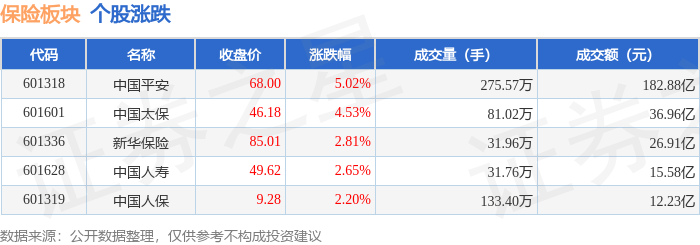
保险板块1月29日涨3.49%,中国平安领涨,主力资金净流入14.77亿元
Zheng Xing Xing Ye Ri Bao· 2026-01-29 09:03
| 代码 | 名称 | 收盘价 | 涨跌幅 | 成交量(手) | 成交额(元) | | --- | --- | --- | --- | --- | --- | | 601318 | 中国平安 | 68.00 | 5.02% | 275.57万 | 182.88 Z | | 601601 | 中国太保 | 46.18 | 4.53% | 81.02万 | 36.9617 | | 601336 | 新华保险 | 85.01 | 2.81% | 31.96万 | 26.91 Z | | 601628 | 中国人寿 | 49.62 | 2.65% | 31.76万 | 15.58 7 | | 61319 | 中国人保 | 9.28 | 2.20% | 133.40万 | 12.23 Z | 证券之星消息,1月29日保险板块较上一交易日上涨3.49%,中国平安领涨。当日上证指数报收于4157.98,上涨0.16%。深证成指报收于 14300.08,下跌0.3%。保险板块个股涨跌见下表: 从资金流向上来看,当日保险板块主力资金净流入14.77亿元,游资资金净流出7.92亿元,散户资金净流出6.85亿元。保险板块个股资金流 ...
午后爆发,“涨停潮”!三大原因
Zhong Guo Zheng Quan Bao· 2026-01-29 08:27
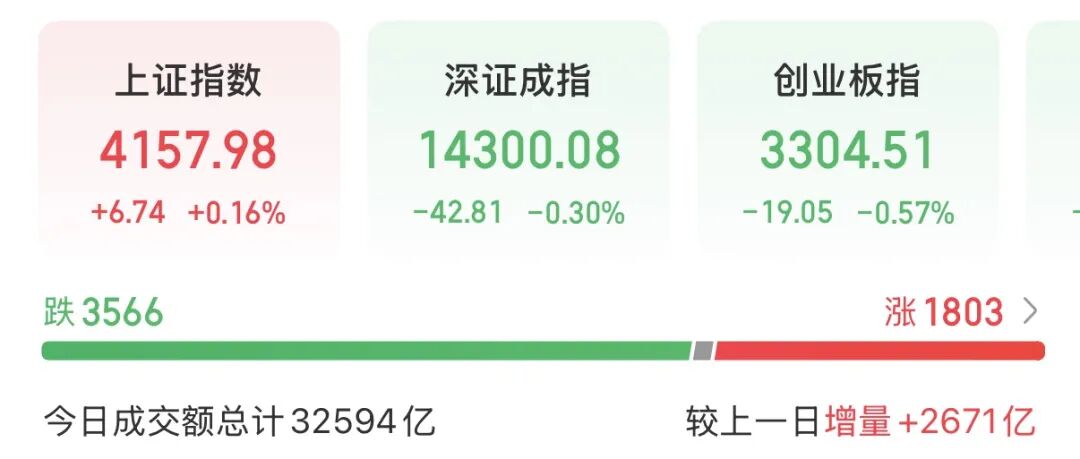
二是最近飞天茅台市场批发价格逐步回暖。1月29日,第三方平台数据显示,53度、500ml飞天茅台酒批发价格继续上涨。其中,2025年飞天茅台原箱较 上一日上涨20元/瓶,至1620元/瓶。此外,2026年飞天茅台原箱亦较上一日上涨20元/瓶,至1610元/瓶。 三是"涨价"是最近市场的潜在主线,主要集中在大宗商品、半导体产业链上游等领域,涨价趋势向下游传导,以白酒板块为代表的大消费有望受益,成为 市场新的交易预期。 今天,A股市场横盘震荡,三大指数走势分化,消费股表现活跃,资源股延续强势。 午后,白酒股爆发,分析人士表示,白酒板块大涨,主要有三个原因:一是近期热点板块各自的交易逻辑已经充分演绎,与此同时,商业航天、存储芯片 等板块处于相对高位,市场有"高低切"的内在需求。白酒股处于周期底部,成为最贴合当前市场要求的板块。 截至收盘,上证指数涨0.16%,深证成指跌0.3%,创业板指跌0.57%。 板块方面,白酒、油气开采及服务、贵金属、文化传媒、AI应用等板块涨幅居前,光刻机、半导体、元件、储存芯片等板块调整。 个股方面,白银有色(601212)走出"8连板",四川黄金(001337)、豫光金铅(600531 ...


内险股震荡走高 保险开门红销售火热 居民挪储或带动NBV强劲增长
Zhi Tong Cai Jing· 2026-01-29 06:22
Group 1 - Domestic insurance stocks experienced a rally, with notable increases in share prices for major companies such as Xinhua Insurance (up 3.48% to HKD 65.4), China Pacific Insurance (up 3.48% to HKD 39.9), China Ping An (up 3.03% to HKD 73.1), and China Life (up 1.02% to HKD 35.54) [1] - The expiration of over CNY 50 trillion in high-interest fixed deposits since 2026 has sparked discussions about capital flows, with East China Securities indicating that the competition for dividend insurance is improving due to the migration of deposits and the boost from the equity market [1] - The "New Year" sales for insurance in 2026 are expected to be robust, with leading insurance companies showing impressive growth in new premium income, supported by sustained demand for stable financial management from residents and the realization of capacity in the bank-insurance channel [1] Group 2 - Huachuang Securities anticipates that listed insurance companies will see a significant increase in performance in 2025, primarily driven by investment performance [2] - In the medium term, the first half of 2026 is expected to have relatively low baseline pressure, with an active equity market and a flourishing liability side likely to drive performance beyond expectations [2] - Long-term trends indicate a stabilization in long-term interest rates, significantly reducing pressure from interest margin losses, with potential for PEV valuations to recover towards 1x, and the migration of residents' savings may lead to strong growth in NBV, potentially elevating the PEV valuations of some leading insurance companies above 1x [2]
港A异动|中国平安H股涨近4% 股价创2021年5月以来新高 市值站上1.33万亿!
Ge Long Hui· 2026-01-29 06:01
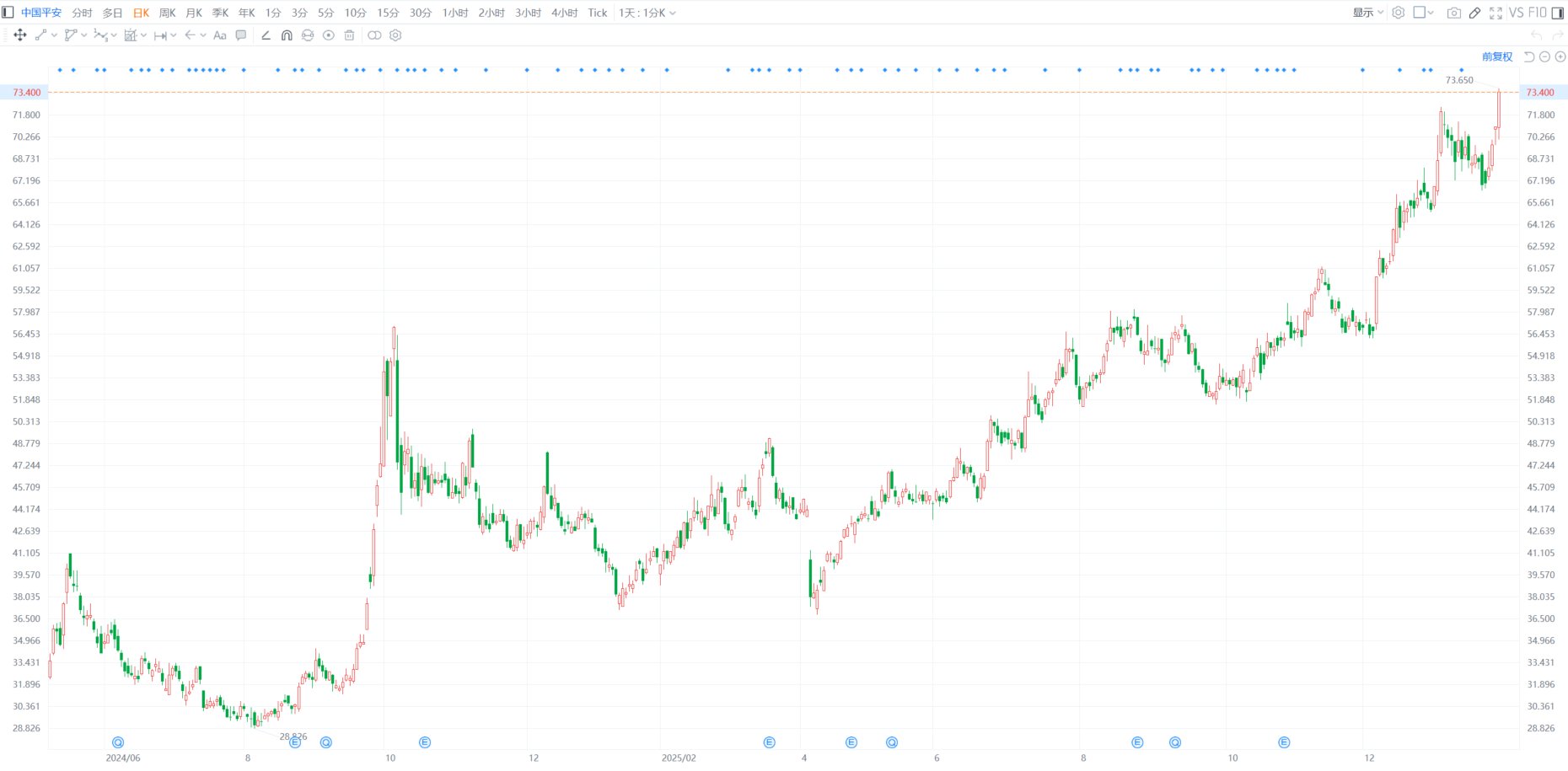
Core Viewpoint - China Ping An has been included in the "Top 10 Core Assets to Bet on China" list for 2026, leading to a significant rise in both its A-shares and H-shares, with A-shares increasing by 4.32% and H-shares by 3.81%, reaching new highs since May 2021 [1] Group 1: Stock Performance - China Ping An's A-shares rose by 4.32%, peaking at 67.55 yuan, while H-shares increased by 3.81%, reaching a maximum of 73.65 HKD [1] - The company's market capitalization has surpassed 1.33 trillion HKD [1] Group 2: Analyst Ratings and Projections - CMB International has maintained a "Buy" rating for China Ping An, raising its target price for H-shares from 75 HKD to 90 HKD [1] - The firm projects that China Ping An's group after-tax operating profit will grow by 12% year-on-year to 136 billion yuan by 2025, indicating a 46% year-on-year increase in operating profit for the fourth quarter [1] Group 3: Business Growth Drivers - The accelerated growth is attributed to strong performance in life and health insurance, a decrease in asset management impairment losses, and stable underwriting profits in property insurance [1] - China Ping An is expanding its bancassurance channels, now covering approximately 19,000 non-Ping An bank outlets, which presents further penetration potential amid a trend of household savers seeking stable returns [1] - The new business value (NBV) for China Ping An is expected to grow by 41.7% year-on-year by 2025 [1]
资金风向标 | 28日两融余额增加192.52亿元 有色金属行业获融资净买入居首
Sou Hu Cai Jing· 2026-01-29 01:50
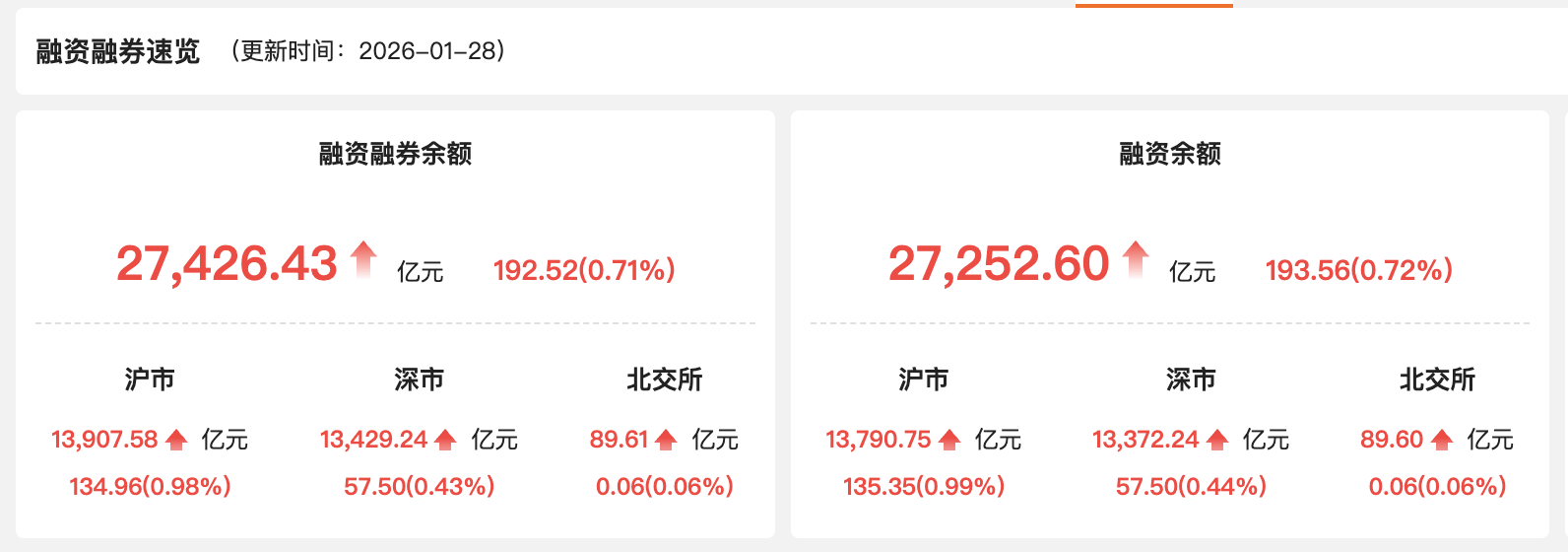
Group 1 - The total margin balance of A-shares reached 27,426.43 billion yuan on January 28, an increase of 192.52 billion yuan from the previous trading day, accounting for 2.63% of the A-share circulating market value [1] - The trading volume of margin financing on the same day was 2,963.24 billion yuan, which is an increase of 168.28 billion yuan from the previous trading day, representing 9.90% of the total A-share trading volume [1] Group 2 - Among the 31 primary industries in Shenwan, 27 industries experienced net financing inflows, with the non-ferrous metals industry leading with a net inflow of 5.968 billion yuan [3] - Other industries with significant net financing inflows include telecommunications, computers, construction decoration, non-bank financials, and pharmaceuticals [3] Group 3 - A total of 64 stocks had net financing inflows exceeding 100 million yuan, with Zijin Mining leading at 1.471 billion yuan [3] - Other notable stocks with high net financing inflows include Tianfu Communication, China Ping An, Wangsu Science and Technology, Hengyun Chang, Changjiang Electric Power, Kweichow Moutai, Jiangxi Copper, Cambricon, and Northern Rare Earth [3] Group 4 - The top stocks by net financing inflow on January 28 are as follows: 1. Zijin Mining: 1,470.57 million yuan 2. Tianfu Communication: 825.18 million yuan 3. China Ping An: 792.95 million yuan 4. Wangsu Science and Technology: 747.54 million yuan 5. Hengyun Chang: 656.63 million yuan 6. Changjiang Electric Power: 429.54 million yuan 7. Kweichow Moutai: 397.22 million yuan 8. Jiangxi Copper: 375.39 million yuan 9. Cambricon: 363.92 million yuan 10. Northern Rare Earth: 340.54 million yuan [4]



50万亿元存款到期!银行推广保险产品抢客
Zhong Guo Jing Ying Bao· 2026-01-28 11:27
Group 1 - In 2026, a significant amount of residential fixed deposits, estimated to exceed 50 trillion yuan, will mature, leading banks to promote insurance products, particularly dividend and annuity insurance, as key investment options during the "opening red" period [1] - Insurance products are gaining popularity among customers due to their competitive annualized interest rates, which can reach over 3%, depending on market conditions [1][2] - The sales of insurance products, especially during the "opening red" period, are experiencing high demand, with some products facing tight quotas, particularly those with higher returns [2] Group 2 - Dividend and annuity insurance products are characterized by a certain lock-in period, typically requiring at least two years before withdrawals can be made, making them long-term investment options [3] - Dividend insurance generally offers higher returns compared to annuity insurance, while annuity insurance is more suitable for clients with cash flow needs [3] - The safety of principal is generally assured as long as clients do not withdraw funds during the lock-in period, with fixed-term returns expected [3]


掘金内参(1.28)|金价日内屡刷新高,主力340亿狂买有色金属,机构看好长期上涨逻辑
和讯· 2026-01-28 11:13
Market Overview - A-shares showed mixed performance with the Shanghai Composite Index up by 0.27% and the Shenzhen Component Index up by 0.09%, while the ChiNext Index fell by 0.57% [1] - Over 3600 stocks in the three markets closed lower, with significant gains in sectors like non-ferrous metals, oil and gas, and coal, while solar equipment and biopharmaceuticals faced declines [1] Sector Performance - The weakening US dollar and geopolitical risks led to significant gains in precious metals and oil and gas sectors, while semiconductor and real estate sectors also performed well [2] - Resource sectors attracted substantial capital inflows, with non-ferrous metals leading the way, while previously popular sectors like electric equipment and defense faced capital outflows [3][4] Capital Flow Analysis - The top five sectors for capital inflow included non-ferrous metals (net inflow of 343.73 billion), basic chemicals, building materials, coal, and oil and petrochemicals, indicating a strong preference for resource and cyclical industries [4] - Conversely, the sectors experiencing the most capital outflow were electric equipment, defense, pharmaceuticals, food and beverage, and automotive [4] Stock Performance - The top five stocks for capital inflow were dominated by non-ferrous metals and technology, with China Aluminum and Tongling Nonferrous Metals seeing significant gains [5] - Major outflows were observed in consumer and financial stocks, with Kweichow Moutai experiencing a net outflow exceeding 31 billion [5] Market Dynamics - On January 28, 85 stocks hit the daily limit up, with non-ferrous metals accounting for 41% of these, indicating a strong sector concentration driven by resource and policy factors [6][7] - The market showed a high level of event-driven trading, with significant interest in non-ferrous metals due to global supply chain restructuring and domestic policy support [6][7] Precious Metals Insights - International gold prices surged, reaching a historical high of 5300 USD/oz, with the precious metals index rising by 6.76% [9] - The increase in gold prices was attributed to a significant decline in the US dollar index, which fell to 95.77, the lowest since February 2022, making gold more attractive as a non-dollar asset [10][11] Geopolitical and Economic Factors - Geopolitical tensions and concerns over the US dollar's credibility have driven investors towards gold as a safe-haven asset, reflecting heightened global risk aversion [11] - Central banks' continued purchases of gold and expectations of interest rate cuts by the Federal Reserve have further boosted demand for gold ETFs and institutional allocations [12] Domestic Market Trends - Domestic gold prices also rose, with mainstream gold jewelry brands exceeding 1600 CNY/g, driven by strong market demand [13] - The oil sector's rise was primarily due to geopolitical supply disruptions, reflecting a systemic response to both geopolitical risks and a weakening dollar [13]





平安高才计划从量变到质变:人均价值保费超同期新人数倍
Xin Lang Cai Jing· 2026-01-28 10:13
在寿险个险渠道深度调整的当下,平安人寿高才队伍取得这一亮眼成绩,背后是公司对行业转型发展的 深度战略思考。陈兵辉认为,寿险行业进入黄金发展期,代理人发展必须要走职业化、专业化道路,队 伍建设必须要回归以客户为中心、以人才为核心的原点。 上证报中国证券网讯(记者 何奎)2025年4月,为贯彻落实保险业新"国十条",金融监管总局印发《关 于推动深化人身保险行业个人营销体制改革的通知》,推动个人代理渠道转型升级。同年6月,寿险巨 头平安人寿启动"保险康养顾问·高才计划"试点,成为业内关注的标杆项目。 近日,平安人寿总部个险事业部队发及培训部总经理兼人力发展团队总经理陈兵辉接受上海证券报记者 专访时直言,试点至今已招募到600余名高才精英,人才数量符合预期,人才质量更为可喜。"截至今年 1月中旬,'高才'人均价值保费超同期新人数倍。" 来源:上海证券报·中国证券网 只要最优、只做最优 往年收入达到40万元以上、招募采用配额制……,平安人寿高才计划设计了多个招募"硬要求",一举打 破行业惯有的"人海战术"发展思路,极高的招募门槛也展示出公司高才队伍只要最优、只做最优的战略 规划。 设计较高的招募门槛,正是基于高才计划的 ...