
PSBC(601658)

Search documents
邮储银行11月6日获融资买入9845.89万元,融资余额8.43亿元
Xin Lang Cai Jing· 2025-11-07 03:51
Core Viewpoint - Postal Savings Bank of China (PSBC) experienced a decline in stock price and trading volume, indicating potential investor caution and market volatility [1] Financing Summary - On November 6, PSBC had a financing buy-in amount of 98.45 million yuan and a financing repayment of 109 million yuan, resulting in a net financing outflow of 10.52 million yuan [1] - The total financing and securities balance for PSBC reached 848 million yuan, with the current financing balance at 843 million yuan, accounting for 0.21% of the circulating market value, which is below the 20th percentile level over the past year [1] Securities Lending Summary - On November 6, PSBC repaid 170,600 shares in securities lending and sold 26,100 shares, with a selling amount of 152,700 yuan based on the closing price [1] - The remaining securities lending volume was 774,200 shares, with a balance of 4.53 million yuan, exceeding the 70th percentile level over the past year, indicating a relatively high position [1] Company Overview - PSBC, established on March 6, 2007, and listed on December 10, 2019, provides banking and related financial services in China, focusing on personal banking, corporate banking, and fund operations [2] - The revenue composition of PSBC includes 65.15% from personal banking, 22.71% from corporate banking, and 12.10% from fund operations, with other businesses contributing 0.04% [2] Financial Performance - As of September 30, PSBC reported a net profit attributable to shareholders of 76.562 billion yuan, reflecting a year-on-year growth of 0.98% [2] - The total cash dividends distributed by PSBC since its A-share listing amount to 137.796 billion yuan, with 77.395 billion yuan distributed over the past three years [3] Shareholder Information - As of September 30, 2025, the number of PSBC shareholders decreased by 13.09% to 142,600, while the average circulating shares per person increased by 15.29% to 478,570 shares [2] - Major shareholders include Hong Kong Central Clearing Limited and various ETFs, with notable reductions in their holdings compared to previous periods [3]

中国银行业(HA 股)_ 2025 年第三季度表现分化,上行空间有限但下行支撑稳固-Banks - China (H_A)_ 3Q25 mixed, upside limited but good for downside support
2025-11-07 01:28
Summary of Key Points from the Conference Call Industry Overview - **Industry**: Chinese Banking Sector (H-share banks) - **Period**: 3Q25 results and 9M25 performance Earnings Review - **Net Profit Growth**: Increased from +0.4% YoY in 1H25 to +0.5% in 9M25, with all big six state banks reporting positive YoY growth [1][11] - **Core Earnings Growth**: Slowed from +1.6% YoY in 1H to +0.8% by 9M25 [1] - **Performance Comparison**: H-share bank sector rose 19.9% YTD, underperforming MSCI China and HSI by 16ppt and 9ppt, respectively [1][11] - **Dividend Yield**: Sector's dividend yield at 5.3% is considered unattractive [1][11] - **Stock Recommendations**: Downgraded CCB-H/ABC-H from Buy to Neutral; upgraded BoComm-H from Underperform to Neutral; ICBC is the top pick among large banks [1][11] Loan Growth and Deposit Trends - **Loan Growth**: Average loan growth decelerated from 6.8%/6.9% YoY in FY24/1H25 to 6.3% in 9M25; big six state banks led with 7.5-10.0% YoY growth [2] - **Small Banks**: Experienced loan size contraction of 0.3-1.4% QoQ, raising concerns [2] - **Deposit Growth**: Seasonally low at 0.2% QoQ in 3Q, but YoY growth at 6.8% exceeded loan growth [2] Net Interest Margin (NIM) - **NIM Trends**: Average NIM edged down 1bp QoQ to 1.42% in 3Q; some banks reported NIM increases due to reduced funding costs [3] - **Future Outlook**: Potential stabilization of margins expected if no further policy rate cuts occur [3] Non-Interest Income - **Fee Income Growth**: Improved from +3.3% YoY in 1H to +4.8% in 9M25, attributed to a lower base and strong capital markets [4] - **Trading Gains**: Weakened from 29% YoY in 1H25 to 16% in 9M25, with some banks experiencing significant QoQ drops [4] Credit Quality and Provisions - **NPL Ratio**: Stable at 1.22% QoQ/YTD; average credit cost fell 5bp YoY to 67bp in 9M25 [5] - **Provisions**: Total provisions rose by +0.5% YoY in 9M, down from +3.5% in 1H [5] - **Coverage Ratios**: NPL and loan reserve coverage edged down QoQ to 232% and 2.75%, respectively [5] Valuation and Market Performance - **Valuation Metrics**: H-share banks currently trade at 0.55x P/B, 3.5x P/PPOP, and 6.0x P/E; dividend yield has declined from nearly 10% in Jan-2024 to 5.3% [11][21][23] - **Market Performance**: H-share banks underperformed the MSCI China index YTD; A-H share premium narrowed from 34% to 21% [31][11] Conclusion - The Chinese banking sector is showing mixed signals with modest profit growth and declining loan growth. While larger banks provide some stability, the overall market performance and valuation metrics suggest caution for investors. The focus remains on key players like ICBC, with recommendations adjusted based on recent performance.



8100亿元!年内A股定增大涨
Shen Zhen Shang Bao· 2025-11-06 13:53
Core Viewpoint - The fundraising amount through private placements in the A-share market has significantly increased this year, with financial stocks leading the way in terms of capital raised [2]. Group 1: Fundraising Statistics - As of November 3, 2023, 140 companies have raised a total of 812.37 billion yuan through private placements, marking a 23% increase in the number of companies and a 5.4 times increase in the amount raised compared to the previous year [2]. - Among the top 10 companies by fundraising amount, 6 are financial institutions, highlighting the dominance of this sector in the private placement market [2]. - Four major state-owned banks, including China Bank, Postal Savings Bank, and others, have raised over 100 billion yuan each through private placements, contributing significantly to the overall market size [2]. Group 2: Specific Company Fundraising - China Bank raised 165 billion yuan, Postal Savings Bank 130 billion yuan, Traffic Bank 120 billion yuan, and Construction Bank 105 billion yuan through private placements [2]. - The successful completion of fundraising by these banks indicates a substantial breakthrough in their plans to supplement core Tier 1 capital through the capital market [2]. Group 3: Use of Funds - Companies are utilizing the funds raised through private placements for various purposes, including asset acquisitions and operational funding [3]. - For instance, AVIC Chengfei raised 17.439 billion yuan for acquiring 100% equity of AVIC Chengfei, while Sairisi raised 8.164 billion yuan for a new factory and operational funds [3]. - Guolian Securities raised 29.492 billion yuan to acquire 99.26% of Minsheng Securities [3]. Group 4: Policy Support and Market Dynamics - The revival of the private placement market is supported by policy initiatives, including the China Securities Regulatory Commission's new merger and acquisition guidelines [3]. - Local governments have also introduced measures to support corporate mergers and acquisitions, further stimulating the market [3]. Group 5: Notable Cases and Challenges - Some companies have seen significant participation from major shareholders in their private placements, such as Nanfang Electric, which plans to raise up to 2 billion yuan with substantial backing from its controlling shareholder [3]. - However, not all private placements have been successful; for example, GCL-Poly announced the termination of its nearly three-year fundraising plan, originally aimed at raising 4.842 billion yuan, due to market adjustments in the photovoltaic industry [4].



零售风险专题:风险缓释,资产质量局部趋稳
Western Securities· 2025-11-06 11:45
Investment Rating - The industry rating is "Overweight" and has been maintained from the previous rating [5]. Core Viewpoints - The retail loan quality is under pressure, with growth slowing down, and the overall retail loan bad debt ratio has been on the rise since 2022, reaching 1.29% in Q2 2025, an increase of 13 basis points from Q4 2024 [2][12]. - Retail loan growth is weak, with a year-on-year increase of only 3.5% in Q2 2025, which is a further slowdown compared to 2024 [20]. - Banks are increasing efforts to dispose of retail bad debts, which is expected to mitigate the impact of retail loan risk exposure on overall asset quality [3][33]. Summary by Sections 1. Retail Loan Asset Quality Under Pressure, Growth Slowing - As of Q2 2025, the total retail loan amount of listed banks reached 63.3 trillion yuan, accounting for 34.3% of total loans [2][11]. - The retail loan bad debt ratio has continued to rise, with the overall bad debt ratio for listed banks at 1.23% [12][19]. - The increase in retail bad debts is attributed to weak consumer demand and a decline in repayment capacity, with the retail bad loan balance growing by 28.7% year-on-year [20][21]. 2. Retail Loan Risk Exposure Easing, Credit Cost Pressure Marginally Reduced - The bad debt generation rate for retail loans in H1 2025 was 1.18%, slightly up from 2024, but the increase is less pronounced compared to previous years [34][35]. - The marginal easing of credit cost pressure is reflected in the credit cost for retail loans, which increased by only 1 basis point to 1.02% in H1 2025 [35][41]. - The overall retail loan risk exposure is expected to remain manageable due to banks' proactive measures in bad debt disposal [33]. 3. Retail Asset Quality Outlook: Policy Support, Risks Expected to Continue Easing - The overall credit risk of retail loans is expected to continue easing under supportive policies, particularly in consumer credit [4]. - The asset quality of consumer credit, including housing loans, is anticipated to stabilize marginally, while the asset quality in the small and micro-enterprise sector may continue to face pressure [4].

银行差异化应对“黄金征税”新政,黄金理财风向有变
Sou Hu Cai Jing· 2025-11-06 10:02
Core Viewpoint - The new gold tax policy, effective from November 1, 2025, distinguishes between "investment" and "non-investment" uses of gold, leading to significant adjustments in banking operations and investor behavior [1][2]. Group 1: Impact on Banking Operations - Major banks have temporarily suspended certain gold-related services, such as招商银行's "金生利" and工商银行's gold accumulation services, in response to the new tax policy [1][3]. - The new tax policy allows for VAT exemption on standard gold transactions through designated exchanges, while non-investment uses will incur a reduced VAT of 6% [2]. Group 2: Changes in Investor Behavior - Investors are shifting towards more rational investment strategies, with banks advising clients to limit gold investments to about 10% of their portfolios and to adopt a long-term holding approach [4]. - The demand for gold has surged, leading to increased prices and longer delivery times for gold products, with some banks adjusting their pricing strategies accordingly [3][4]. Group 3: Alternative Investment Products - With restrictions on physical gold, banks are promoting "paper gold" products, which allow for virtual trading of gold without the need for physical delivery, providing a more flexible investment option [6][9]. - "Paper gold" includes various forms such as gold accounts, gold ETFs, and gold futures, which offer advantages like low transaction costs and high liquidity [9].


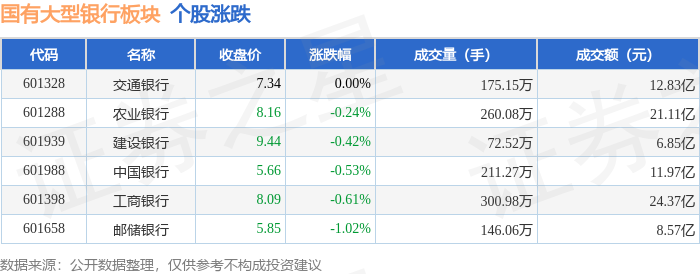
国有大型银行板块11月6日跌0.46%,邮储银行领跌,主力资金净流出6185.65万元
Zheng Xing Xing Ye Ri Bao· 2025-11-06 08:51
Core Insights - The state-owned large bank sector experienced a decline of 0.46% on November 6, with Postal Savings Bank leading the drop [1] - The Shanghai Composite Index closed at 4007.76, up 0.97%, while the Shenzhen Component Index closed at 13452.42, up 1.73% [1] Bank Performance Summary - **Bank of Communications (601328)**: Closed at 7.34, unchanged; trading volume of 1.75 million shares, total transaction value of 1.283 billion [1] - **Agricultural Bank of China (601288)**: Closed at 8.16, down 0.24%; trading volume of 2.6008 million shares, total transaction value of 2.111 billion [1] - **China Construction Bank (601939)**: Closed at 9.44, down 0.42%; trading volume of 725,200 shares, total transaction value of 685 million [1] - **Bank of China (601988)**: Closed at 5.66, down 0.53%; trading volume of 2.1127 million shares, total transaction value of 1.197 billion [1] - **Industrial and Commercial Bank of China (601398)**: Closed at 8.09, down 0.61%; trading volume of 3.0098 million shares, total transaction value of 2.4371 billion [1] - **Postal Savings Bank (601658)**: Closed at 5.85, down 1.02%; trading volume of 1.4606 million shares, total transaction value of 857.1 million [1] Fund Flow Analysis - The state-owned large bank sector saw a net outflow of 61.8565 million from institutional investors and a net outflow of 115 million from speculative funds, while retail investors had a net inflow of 177 million [1] - **Bank of Communications**: Net inflow from institutional investors of 44.968 million, net outflow from speculative funds of 1.25 billion, and net inflow from retail investors of 79.8107 million [2] - **Bank of China**: Net inflow from institutional investors of 16.3932 million, net outflow from speculative funds of 10.0614 million, and net outflow from retail investors of 6.3318 million [2] - **Industrial and Commercial Bank of China**: Net inflow from institutional investors of 7.3789 million, net inflow from speculative funds of 348.77 million, and net outflow from retail investors of 1.08666 million [2] - **Postal Savings Bank**: Net outflow from institutional investors of 5.412 million, net outflow from speculative funds of 342.014 million, and net inflow from retail investors of 39.6134 million [2] - **Agricultural Bank of China**: Net outflow from institutional investors of 100 million, net inflow from speculative funds of 53.8183 million, and net inflow from retail investors of 46.2417 million [2]
前三季度上市银行稳健运行 多维度赋能经济发展大局
Jin Rong Shi Bao· 2025-11-06 03:47
Group 1: Banking Sector Performance - A-share listed banks reported stable performance in the first three quarters of the year, showcasing a steady operational trend with notable highlights [1] Group 2: Urban-Rural Integration and Regional Development - The banking sector is actively supporting urban-rural integration and regional coordinated development as part of a significant national strategy [2] - Industrial and Commercial Bank of China (ICBC) has allocated nearly 3.5 trillion yuan in loans for new urbanization projects and over 5 trillion yuan for agricultural loans, with significant investments in poverty alleviation counties [2] - Agricultural Bank of China has increased its loan balance in key rural revitalization counties to 481.2 billion yuan, marking a growth of 10.21%, and in poverty-stricken counties to 2.52 trillion yuan, with a growth of 10.66% [3] Group 3: High-Level Opening Up - The banking sector is contributing to high-level opening up, which is a strategic choice to enhance national security and respond to external uncertainties [4] - Bank of China has been actively involved in the Belt and Road Initiative, maintaining a leading position in the issuance of panda bonds and offshore RMB bonds, with a global custody scale of 4.8 trillion yuan [5] - Construction Bank has enhanced its international competitiveness and supported cross-border e-commerce, with settlement volumes exceeding 400 billion yuan [5] Group 4: Digital Transformation - Digital transformation is a critical focus for banking institutions, with ongoing efforts to enhance digital infrastructure and service efficiency [6] - Bank of Communications has improved its digital service capabilities, achieving significant user engagement with its mobile banking applications and open banking interfaces [7] - Postal Savings Bank is leveraging digital technology to enhance operational efficiency and customer experience through initiatives like remote services and digital personnel [8]
深耕绿色金融“沃土” 上饶市“政银企”协同绘就生态经济共富新图景
Jin Rong Shi Bao· 2025-11-06 03:42
Core Insights - The People's Bank of China, Shangrao Branch, is actively promoting green finance to achieve dual carbon goals, enhancing collaboration across departments to drive innovation in financial services and products, ultimately supporting ecological protection and economic development [1][5][6] Group 1: Green Loan Growth - As of the second quarter of 2025, the total balance of green loans in Shangrao reached 118.49 billion yuan, marking a year-on-year increase of 28.34%, positioning it as a key driver for the green transformation of the economy [1] Group 2: Innovative Financial Models - The Shangrao Branch has introduced innovative financial models, such as asset-backed lending against future earnings from ecological projects, transforming dormant assets into active revenue streams [2] - For instance, the Bank of China Shangrao Branch issued 450 million yuan in loans to support the construction of the Gexianshan Scenic Area by leveraging future revenue from integrated visitor services [2] - Additionally, the Construction Bank Shangrao Branch utilized a "water surface operating rights pledge" model to provide 180 million yuan in credit for water resource enhancement projects, which improved the livelihoods of 120,000 residents and increased aquaculture output value by 40% [2] Group 3: Focus on Green Transformation in Key Industries - The Shangrao Branch is focusing on green transformation in sectors such as ecological agriculture, industrial parks, and homestays, utilizing various financial tools to support these industries [3][4] - In ecological agriculture, projects have been initiated to establish agricultural service centers, providing long-term low-cost funding for modern farming equipment, resulting in significant carbon reduction [4] - In industrial parks, a steam centralized heating project received 250 million yuan in loans, leading to a reduction of 80,000 tons of carbon dioxide emissions annually [4] Group 4: Collaborative Green Finance Ecosystem - The Shangrao Branch is building a collaborative green finance ecosystem through institutional frameworks, inter-departmental cooperation, and platform development [5][7] - A comprehensive plan has been established to promote high-quality development of green finance, focusing on both low-carbon industry growth and the green transformation of high-carbon industries [5] - The establishment of a green project library and a joint review mechanism aims to enhance the efficiency of green financial resource allocation [6][7] Group 5: Support for Rural Development - The Shangrao Branch is supporting rural development initiatives in Wuyuan County by implementing policies that promote ecological product value realization and low-carbon financial development [6] - Five major projects have been launched to enhance the region's green development, including initiatives focused on cultural heritage and tourism [6]
邮储银行湖南长沙市分行: 赋能新业态 服务新发展
Jin Rong Shi Bao· 2025-11-06 03:33
Core Viewpoint - Postal Savings Bank of China (PSBC) Changsha Branch focuses on innovation and public welfare, enhancing financial services to support local economic development and meet diverse financial needs of enterprises [1][2][3][4][6] Group 1: Financial Innovation and Services - The bank emphasizes product innovation, achieving breakthroughs in wealth management and supply chain finance, utilizing 12 functional modules for centralized account management [2] - A customized wealth management model has been introduced, facilitating 1 billion yuan in company financial self-balancing business, while directing funds to support non-standard financing for local enterprises [2] - The supply chain financing model has successfully facilitated over 60 million yuan in commercial bills for 13 suppliers, promoting win-win development between core enterprises and their upstream suppliers [2] Group 2: Inclusive Financial Network - The bank is committed to social responsibility, focusing on protecting the rights of migrant workers and rural revitalization through targeted financial products and services [3] - A wage guarantee regulatory service for migrant workers has been implemented, covering 25 construction units, ensuring their wages while strengthening public deposits [3] - The "Huinong Loan" policy has been utilized to provide customized financing solutions for key agricultural enterprises, effectively addressing their funding challenges [3] Group 3: Support for Innovation and Industry Development - PSBC Changsha Branch has launched specialized products for technology innovation, providing 10 million yuan in credit support to a high-tech enterprise in the Ningxiang Economic Development Zone [4] - The bank has established a "de-core" list of core enterprises to provide up to 5 million yuan in pure credit loans to eligible small and micro enterprises in the supply chain [4] Group 4: Comprehensive Financial Service Ecosystem - The bank integrates financial services into consumption and livelihood scenarios, creating an "online + offline" service model [6] - Focused on local characteristics, the bank has implemented exclusive payment tools to streamline financing, order management, and fund settlement processes in industries like medical devices and agriculture [6] - A financial ecosystem has been developed in educational settings, achieving a 90% penetration rate in targeted schools, enhancing financial services for teachers through customized credit card offerings [6]
邮储银行河南省分行开展金融知识普及宣传教育活动
Huan Qiu Wang· 2025-11-06 03:18
Core Viewpoint - Postal Savings Bank of China Henan Branch is actively promoting financial consumer education to protect consumer rights and prevent financial risks through a comprehensive campaign that integrates agricultural finance with anti-fraud measures [1] Group 1: Financial Education Campaign - The campaign focuses on six key areas: loan knowledge, compliance knowledge, anti-money laundering, anti-fraud measures, avoiding excessive borrowing, and personal information protection [1] - The initiative aims to enhance public understanding of basic financial and loan knowledge, as well as to raise awareness about personal information protection and fraud prevention [1] Group 2: Outreach and Impact - The campaign employs a combination of online and offline methods, including LED screen displays, banners, distribution of promotional materials, and outreach to various community sectors [1] - The campaign has successfully reached over 300,000 individuals, demonstrating a high level of engagement and effectiveness [1] Group 3: Future Plans - Postal Savings Bank of China Henan Branch plans to continue guiding its branches in ongoing financial knowledge education efforts to further enhance consumer self-protection awareness and risk prevention [1]