
PSBC(601658)

Search documents
险资三季度加码银行股 国有大行成布局重点
Zhong Guo Zheng Quan Bao· 2025-11-05 20:08
Core Viewpoint - Insurance capital is increasingly investing in the banking sector, particularly in state-owned banks, due to the high dividend yields that align with their investment needs [1][2][3] Group 1: Insurance Capital Increases in State-Owned Banks - Insurance capital has significantly increased its holdings in major state-owned banks, with Postal Savings Bank and China Construction Bank being the primary targets for investment [1] - Ping An Life has increased its stake in Postal Savings Bank by 2.189 billion shares, making it the second-largest shareholder [1] - New China Life Insurance has also increased its holdings in China Construction Bank by 8.8 million shares, becoming its fifth-largest shareholder [1] Group 2: Entry of Insurance Capital in Other Major Banks - For the first time, insurance capital appears in the top ten shareholders of Industrial and Commercial Bank of China and Agricultural Bank of China, with China Life Insurance and Ping An Life becoming significant shareholders [2] - Insurance capital has also been active in the Hong Kong market, frequently increasing stakes in H-shares of state-owned banks [2] Group 3: Attractive Features of Banking Stocks - The six major banks have shown stable profit growth, with a total net profit of 1.07 trillion yuan in the first three quarters, alongside improved asset quality [2] - The low valuation and high dividend yield of banking stocks align well with the asset allocation needs of insurance capital, making them a core investment area [3] Group 4: Future Outlook for Insurance Capital Investment - Industry experts predict that insurance capital will increase its market presence and allocation in banking stocks due to favorable policy environments [3] - The implementation of new accounting standards in early 2026 will likely enhance the demand for stable, low-volatility stocks, further solidifying the preference for banking stocks among insurance capital [4]



邮储银行跌0.17%,成交额9.10亿元,近3日主力净流入5554.76万
Xin Lang Cai Jing· 2025-11-05 11:03
Core Viewpoint - Postal Savings Bank of China (PSBC) shows a slight decline in stock price, with a market capitalization of 709.76 billion yuan and a trading volume of 910 million yuan on November 5 [1] Financial Performance - PSBC's dividend yields over the past three years were 5.58%, 6.00%, and 4.61% respectively, indicating a stable return for investors [2] - For the period from January to September 2025, PSBC reported a net profit of 76.562 billion yuan, reflecting a year-on-year growth of 0.98% [7] Shareholder Information - As of September 30, 2025, the number of PSBC shareholders decreased by 13.09% to 142,600, while the average number of circulating shares per person increased by 15.29% to 478,570 shares [7] Dividend Distribution - Since its A-share listing, PSBC has distributed a total of 137.796 billion yuan in dividends, with 77.395 billion yuan distributed over the last three years [8] Market Position - PSBC is classified as a state-owned enterprise, ultimately controlled by China Post Group [2] - The bank's main business segments include personal banking (65.15% of revenue), corporate banking (22.71%), and funding operations (12.10%) [6] Technical Analysis - The average trading cost of PSBC shares is 5.14 yuan, with the stock price currently near a support level of 5.88 yuan [5]
云南邮储:金融活水助力科创企业加快发展
Xin Hua She· 2025-11-05 08:16
Group 1 - The company faces high R&D costs and significant funding requirements, especially after obtaining the "specialized, refined, characteristic, and innovative" enterprise qualification, necessitating working capital for technological upgrades [1] - Postal Savings Bank of China, Yunnan Branch, has tailored a pure credit financing solution for the company, providing a total of 13 million yuan in credit loans to address urgent funding needs [1] - Specialized and innovative enterprises are often technology-based SMEs that lack traditional collateral but exhibit good growth potential [1] Group 2 - Yunnan Lidar Biotechnology Co., Ltd. is a high-tech enterprise in Yunnan Province that urgently needs funding support for new business development as its industrial scale expands [2] - Postal Savings Bank of China, Yunnan Branch, has issued a technology credit loan of 30 million yuan to the company to alleviate immediate financial pressures [2] - In the first ten months of 2025, Postal Savings Bank of China, Yunnan Branch, has added 732 million yuan in loans to technology-based enterprises, supporting industrial upgrades [2]
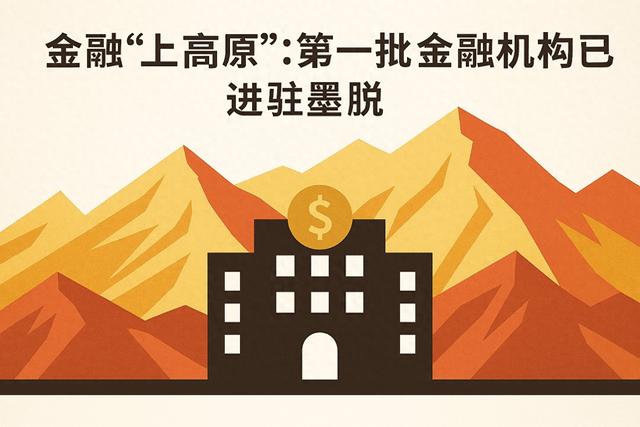
金融“上高原”:第一批金融机构已进驻墨脱
Zhong Guo Jing Ying Bao· 2025-11-05 07:33
Core Viewpoint - China Postal Savings Bank (Postal Bank) is the first national financial institution to provide financial services in Motuo Village, highlighting its commitment to rural revitalization and financial inclusion [2][3]. Group 1: Financial Services and Network - Postal Bank has established a strong presence in rural areas, with nearly 40,000 outlets covering 100% of cities and over 98% of county regions [3]. - The bank has developed a differentiated service model for agriculture and rural areas, including proactive credit granting and the establishment of credit villages, resulting in over 30 million new farmers and more than 10 million new users [3][4]. - During the 14th Five-Year Plan period, Postal Bank has issued over 5 trillion yuan in agricultural loans, with its first loan product specifically designed for farmers and individual businesses totaling over 10 trillion yuan in disbursements, serving over 70 million people [3]. Group 2: Agricultural Ecosystem Development - Postal Bank aims to create a "four flows integration" agricultural ecosystem, addressing common issues in rural revitalization such as sales difficulties, logistics challenges, and financing issues [4][5]. - The bank's strategy includes enhancing intellectual empowerment through tailored courses, expanding credit coverage through credit village construction, focusing on industrial revitalization with targeted financial support, and promoting smart rural development leveraging its comprehensive resources [5].

金融助力科技创新和产业创新深度融合|新刊亮相
清华金融评论· 2025-11-05 06:34
48 脚 स्त्रीय 波 TSINGHUA Financial Review 清华金融评论 144 数据资产化浪潮下的 P65 保险赋能与价值重构 张伟 等: 我国寿险业高质量 发展模式的构想 P73 聂庆平: 全球资本市场面临的 挑战与前景展望 TSINGHUA Financial Review 清华金融评论 封面专题 金融助力科技创新 和产业创新深度融合 闻出版管理 部门认定第一 中国人文社会科学核心期刊 P69 生力值 年第11期 总第144期 1日5日4 ANDELL 30 T. CN 10-1169/F SSN 209 PQ2 王泊: 充分发挥科创板"试验田"作用 助力深化资本市场改革 支持加快高水平科技自立自强 P16 田轩 等: 赋能新质生产力: 资本市场服务科技创新的逻辑与对策 P19 杜春野: 深化科技金融范式创新: 商业银行助力科技企业高质量发展的思考与实践 P23 刘健 等: 打造科技投行, 提升资本市场服务科技创新能力 P27 葛小波 等 关于证券公司服务新质生产力 和推动科技创新的思考 充分发挥科创板"试验田"作用 助力深化资本市场改革 支持加快高水平科技自立自强 文/上海证券交 ...




晨会纪要:2025年第188期-20251105
Guohai Securities· 2025-11-05 03:12
Key Insights - The report highlights a rebound in the electrolyte industry, with significant growth potential in fluorinated liquids, particularly for the company Xinzhou Bang, which reported a revenue of 6.616 billion yuan for the first three quarters of 2025, a year-on-year increase of 16.75% [6][10] - The company achieved a net profit of 748 million yuan, up 6.64% year-on-year, with a sales gross margin of 24.51%, reflecting a decline of 2.58 percentage points [6][10] - The report indicates that the company is well-positioned to benefit from the recovery in the electrolyte market, driven by rising prices of lithium hexafluorophosphate and improved operational efficiency [10][11] Group 1: Xinzhou Bang (Battery) - The company reported a revenue of 2.368 billion yuan in Q3 2025, a year-on-year increase of 13.60% and a quarter-on-quarter increase of 5.45% [7] - The net profit for Q3 2025 was 264 million yuan, down 7.51% year-on-year but up 4.03% quarter-on-quarter, indicating a mixed performance [7][8] - The company is focusing on optimizing its product structure and enhancing operational efficiency, with a stable growth trajectory in its organic fluorine chemicals and electronic information chemicals [9][10] Group 2: Weijian Medical (Personal Care Products) - The company achieved a revenue of 7.897 billion yuan in the first three quarters of 2025, a year-on-year increase of 30.10%, with a net profit of 732 million yuan, up 32.36% [13][14] - The medical segment saw a revenue increase of 44.4%, driven by strong growth in surgical consumables and high-end dressings [14] - The consumer segment also performed well, with a revenue of 4.01 billion yuan, up 19.1%, led by significant growth in the sales of sanitary products [15] Group 3: Longqi Technology (Consumer Electronics) - The company reported a revenue of 31.332 billion yuan for the first three quarters of 2025, a year-on-year decrease of 10.28%, but a net profit increase of 17.74% [21] - In Q3 2025, the revenue was 11.424 billion yuan, down 9.62% year-on-year, while the net profit increased by 64.46% [22] - The company is expanding its product portfolio under the "1+2+X" strategy, focusing on smart devices and automotive electronics [23][24] Group 4: Minxin Technology (Semiconductors) - The company reported a revenue of 464 million yuan in the first three quarters of 2025, a year-on-year increase of 37.73%, with a gross margin of 30.28% [25][26] - In Q3 2025, the revenue was 160 million yuan, up 21.9% year-on-year, indicating strong demand for pressure and inertial sensors [25][27] - The company is well-positioned to benefit from the growth of MEMS sensors in the AI era, with a diverse product matrix [26][28] Group 5: Yingly Technology (General Equipment) - The company reported a revenue of 2.121 billion yuan in the first three quarters of 2025, a year-on-year increase of 11.02%, with a net profit of 294 million yuan, up 29.59% [35][36] - The company is expanding its processing and coating capabilities in the blade and casing industry, which is expected to enhance its production capacity [37] - The gross margin for Q3 2025 was 38.03%, reflecting a significant improvement in profitability [38] Group 6: Weichai Power (Automotive Parts) - The company reported a revenue of 170.57 billion yuan for the first three quarters of 2025, a year-on-year increase of 5.3%, with a net profit of 8.88 billion yuan, up 5.7% [44] - In Q3 2025, the revenue was 57.42 billion yuan, up 16.1% year-on-year, driven by strong demand in the heavy truck sector [44] - The company is benefiting from the recovery in the heavy truck market, with significant growth in natural gas and electric vehicle sales [44]




小红日报 | 银行再度领涨!标普红利ETF(562060)标的指数收跌0.06%显韧性
Xin Lang Ji Jin· 2025-11-05 00:50
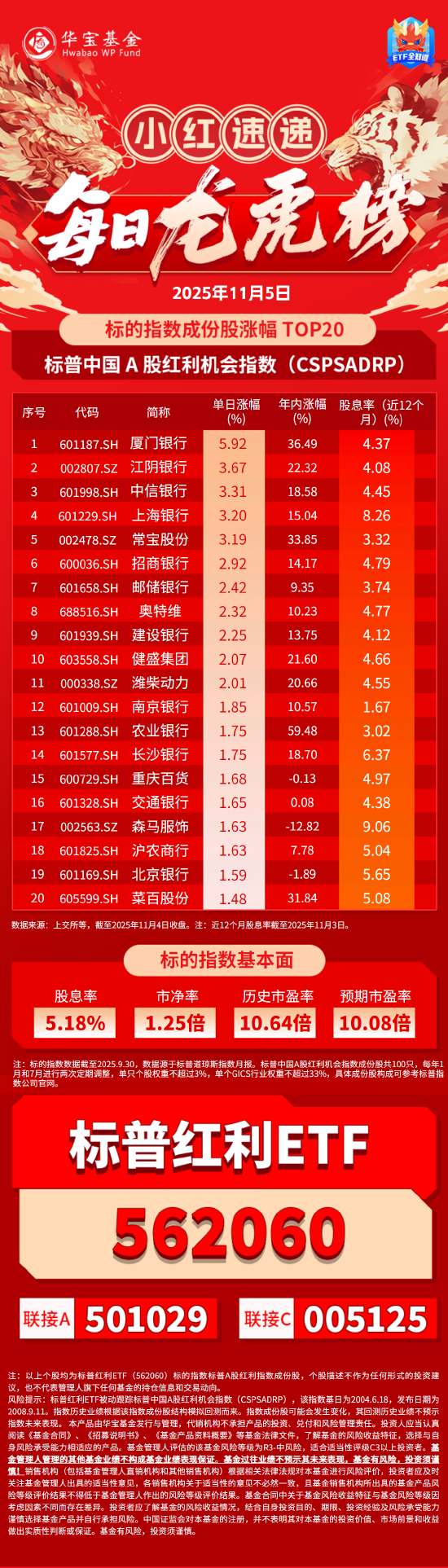
Core Insights - The article highlights the top-performing stocks in the S&P China A-Share Dividend Opportunity Index, showcasing significant year-to-date gains and dividend yields for various companies [1]. Group 1: Stock Performance - Xiamen Bank (601187.SH) leads with a 5.92% increase in the latest trading session and a 36.49% year-to-date gain, along with a dividend yield of 4.37% [1]. - Jiangyin Bank (002807.SZ) follows with a 3.67% daily increase and a 22.32% year-to-date gain, offering a dividend yield of 4.08% [1]. - CITIC Bank (601998.SH) shows a 3.31% rise today and an 18.58% increase year-to-date, with a dividend yield of 4.45% [1]. - Shanghai Bank (601229.SH) has a daily increase of 3.20% and a year-to-date gain of 15.04%, boasting a high dividend yield of 8.26% [1]. - Other notable performers include Changbao Co. (002478.SZ) with a 3.19% daily increase and a 33.85% year-to-date gain, and China Merchants Bank (600036.SH) with a 2.92% daily rise and a 14.17% year-to-date increase [1]. Group 2: Dividend Yields - Shanghai Bank (601229.SH) offers the highest dividend yield at 8.26%, indicating strong returns for investors [1]. - Other companies with notable dividend yields include Semei Clothing (002563.SZ) at 9.06% and Changsha Bank (601577.SH) at 6.37% [1]. - The average dividend yield among the top 20 stocks reflects a trend towards higher returns for dividend-seeking investors [1].



银行业2025年三季报综述:业绩稳健性凸显,引领银行价值回归
Shenwan Hongyuan Securities· 2025-11-04 14:41
Investment Rating - The report maintains a positive outlook on the banking sector, indicating a potential return to a valuation of 1 times net asset value [4][7]. Core Insights - The banking sector has demonstrated steady performance, with a year-to-date revenue growth of 0.8% and a net profit growth of 1.5% for the first nine months of 2025, reflecting a stable regulatory environment supporting bank profitability [10][14]. - The report highlights a shift in focus from scale to balance in credit growth, with banks increasingly pursuing a "quantity-price balance" strategy [4][7]. - The cost of liabilities has improved more significantly than the decline in asset pricing, leading to a stabilization of net interest margins, which is expected to continue into the next year [4][7]. - Asset quality remains stable but shows signs of divergence, particularly with rising risks in small and micro businesses [4][7]. - The report suggests that the current dividend yield of the banking sector has returned to an attractive range, indicating a significant disconnect between stable earnings and stock holdings, which could lead to a value recovery [4][7]. Summary by Sections Performance Overview - The banking sector's performance has been characterized by a steady increase in revenue and profit, with state-owned banks showing better-than-expected stability and regional banks leading in performance [11][12][15]. - The report notes that the revenue growth of state-owned banks has turned positive, with non-interest income contributing significantly to this growth [12][15]. Credit Growth and Strategy - The report indicates a gradual abandonment of scale-driven growth, with banks focusing on achieving a balance between volume and pricing in their lending practices [4][7]. - The credit growth rate for listed banks decreased by 0.3 percentage points to 7.7% in Q3 2025, with state-owned banks maintaining a growth rate of approximately 8.5% [4][7]. Profitability and Asset Quality - The net interest margin for listed banks remained stable at 1.5%, with a slight quarter-on-quarter increase of 3 basis points in Q3 2025 [4][7]. - The overall non-performing loan ratio remained stable at 1.22%, indicating manageable risk levels across the sector [4][7]. Investment Recommendations - The report recommends focusing on leading banks and undervalued regional banks as key investment opportunities, suggesting that the recovery in valuations is supported by stable earnings and attractive dividend yields [4][7].

高股息资产逆市爆发,价值ETF(510030)收涨超1%!高股息策略正当时?
Xin Lang Ji Jin· 2025-11-04 12:00
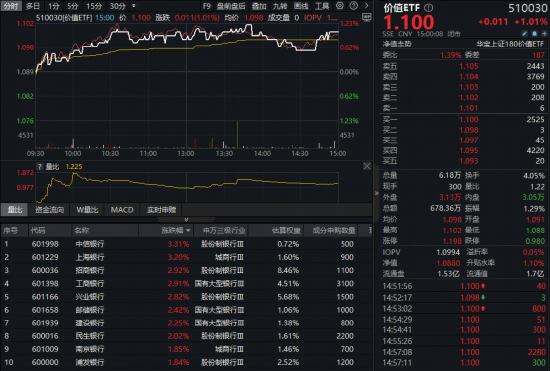
Group 1 - High dividend stocks, particularly in the banking sector, experienced a significant increase on November 4, with the value ETF (510030) rising by 1.01% [1][4] - Major banks such as CITIC Bank and Shanghai Bank saw their shares rise over 3%, while others like China Merchants Bank and Industrial and Commercial Bank of China increased by over 2% [1][4] - The 180 Value Index, which the value ETF tracks, has outperformed major indices like the Shanghai Composite Index and CSI 300 since October, with a cumulative increase of 5.99% compared to 1.99% and -0.47% respectively [1][3] Group 2 - Insurance capital has been increasingly investing in bank stocks, with notable increases in holdings by companies like China Life Insurance and Dajia Life Insurance in various banks [4] - The banking sector is the largest weight in the 180 Value Index, accounting for 47.5% as of the end of October 2025 [5] - Analysts suggest that the fourth quarter of 2025 may be a critical time for investing in dividend stocks, as low valuations and increased demand for quality stocks with high dividend yields are expected [7] Group 3 - The 180 Value Index includes high dividend and low valuation blue-chip stocks, with significant representation from the banking sector, including leading financial institutions [7] - The index is designed to select the top 60 stocks based on value factor scores from the Shanghai 180 Index, emphasizing the defensive attributes of its constituents during volatile market conditions [7]




银行股延续涨势,上海银行涨超2%
Mei Ri Jing Ji Xin Wen· 2025-11-04 11:38
Core Viewpoint - Bank stocks continue to rise, with Shanghai Bank increasing by over 2% and several other banks, including Chongqing Bank, CITIC Bank, Agricultural Bank, China Merchants Bank, Qilu Bank, and Postal Savings Bank, rising by over 1% [1] Group 1 - Shanghai Bank's stock price increased by more than 2% [1] - Chongqing Bank, CITIC Bank, Agricultural Bank, China Merchants Bank, Qilu Bank, and Postal Savings Bank each saw stock price increases of over 1% [1]
