HTSC(601688)

Search documents
华泰证券开启“忙碌季”!集团及子公司齐换帅、境外业务同步加码
Xin Lang Cai Jing· 2026-01-26 03:31
Core Viewpoint - Huatai Securities has completed its seventh board of directors reshuffle, appointing Wang Huiqing as the new chairman and Zhou Yi as the CEO, while the former chairman Zhang Wei has retired due to age [1][10]. Leadership Changes - Wang Huiqing, born in February 1970, has a background in finance and law, along with qualifications as a certified public accountant and lawyer, creating a comprehensive skill set in "law + finance + management" [2][11]. - Wang has experience in various governmental roles and has been involved in the financial sector since 2009, leading significant financial platforms [2][11]. - Zhou Yi, who has been with Huatai since 2006, has successfully led the company's digital transformation and global expansion since becoming CEO in 2019 [5][14]. Strategic Focus - The new leadership emphasizes a dual-driven strategy of wealth management and institutional services powered by technology, aiming to enhance the global collaborative organizational and business framework [4][13]. - Huatai Securities has maintained a leading position in financial technology investments, with expenditures of 2.724 billion yuan in 2022, and projected investments of 2.578 billion yuan and 2.448 billion yuan for 2023 and 2024, respectively [5][14]. Subsidiary Management Changes - Huatai Securities Asset Management has also undergone management restructuring, with Jiang Xiaoyang becoming the sole chairman and Zhu Qian appointed as the new general manager [7][16]. - The new management team consists of experienced individuals who have been with Huatai for many years, ensuring continuity and expertise in the company's operations [7][16]. Business Performance - Huatai Securities Asset Management has focused on various investment areas, including fixed income, equity, multi-asset, and FOF investments, as well as ABS and REITs [7][16]. - By the end of 2025, the company had issued 994 ABS products totaling 1,011.123 billion yuan, ranking third in the industry [8][17]. - The public fund management scale reached 180.824 billion yuan by the end of 2025, marking a year-on-year growth of 31.59% [8][17].


证券ETF鹏华(159993)涨超1.8%,A股市场持续活跃
Xin Lang Cai Jing· 2026-01-26 03:02
Group 1 - The capital market has been active recently, with brokers conducting research on 440 A-share companies this year, predominantly in the electronics and machinery sectors, while the power equipment and chemical sectors have seen a surge in interest [1] - According to Founder Securities, brokers are still in a "lagging" phase, but ROE is on an upward trend, indicating that sector performance, although delayed, is expected to improve [1] - The capital market is projected to remain robust in 2025, with an average daily stock trading volume of 20.8 trillion yuan, a year-on-year increase of 70.2%, and an average margin balance of 2.08 trillion yuan, up 32.7% year-on-year [1] Group 2 - The 国证证券龙头指数 (399437) has shown a strong increase of 1.98%, with notable gains in constituent stocks such as 财通证券 (6.50%), 兴业证券 (4.95%), and 华泰证券 (3.52%) [1] - The 证券ETF鹏华 (159993) closely tracks the 国证证券龙头指数 and aims to reflect the market performance of quality listed companies in the securities theme [2] - As of December 31, 2025, the top ten weighted stocks in the 国证证券龙头指数 account for 79.13% of the index, including companies like 东方财富, 中信证券, and 华泰证券 [2]




A股证券板块短线拉升,财通证券涨超7%
Mei Ri Jing Ji Xin Wen· 2026-01-26 02:35
Group 1 - The A-share securities sector experienced a short-term surge on January 26, with notable increases in stock prices [2] - Citic Securities saw a rise of over 7%, while Huatai Securities and Industrial Securities increased by more than 3% [2] - Other companies such as GF Securities and Huaxin Securities also showed significant upward movement [2]

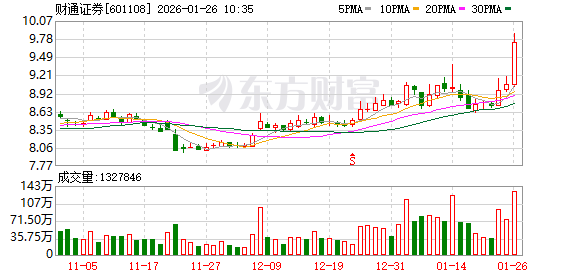
A股证券板块拉升:财通证券涨超7% 广发证券等跟涨
Ge Long Hui· 2026-01-26 02:29
Core Viewpoint - The A-share securities sector experienced a short-term surge, with notable increases in stock prices for several securities firms [1] Group 1: Company Performance - Caitong Securities saw a rise of over 7% in its stock price [1] - Huatai Securities and Industrial Securities both increased by more than 3% [1] - Other firms such as GF Securities and Huaxin Securities also experienced significant stock price increases [1]
华泰证券(06886.HK)向港交所申请100亿美元有担保中期票据计划上市
Xin Lang Cai Jing· 2026-01-26 01:55
Core Viewpoint - Huatai Securities Co., Ltd. announced a plan to list a guaranteed medium-term note program with a total face value increased from $3 billion to $10 billion [1][2] Group 1 - The issuer of the plan is Pioneer Reward Limited, with Huatai Securities providing an unconditional and irrevocable guarantee [1][2] - An application has been submitted to the Hong Kong Stock Exchange for approval to list the program with the increased total face value for a period of 12 months starting from September 10, 2025 [2] - The notes under this program will be issued only to professional investors as defined in the Hong Kong Stock Exchange Listing Rules [2]
华泰证券“换帅”:55岁王会清当选董事长,周易续任CEO;今年以来新成立基金达76只,合计募集资金规模超700亿元 | 券商基金早参
Mei Ri Jing Ji Xin Wen· 2026-01-26 01:39
Group 1 - Huatai Securities has elected Wang Huaiqing as the new chairman and Zhou Yi continues as CEO, marking a smooth transition in the core management team [1] - Wang Huaiqing, aged 55, has extensive experience in finance and state-owned asset management, which is expected to enhance the company's strategic layout and governance structure [1] - The leadership changes are anticipated to boost investor confidence and solidify Huatai's leading position among top brokerages, contributing positively to market sentiment [1] Group 2 - Huatai Securities Asset Management has completed its executive adjustments, appointing Jiang Xiaoyang as chairman and Zhu Qian as general manager, both of whom are seasoned professionals within the company [2] - The new leadership is expected to ensure strategic continuity and team stability, positively impacting the development of Huatai's asset management business [2] - The smooth transition in management is likely to enhance operational efficiency in the securities sector, driving high-quality industry development [2] Group 3 - Since the beginning of 2026, 76 new funds have been established, raising a total of 71.939 billion yuan, with an average fund size of 9.47 billion yuan [3] - The market has seen a significant increase in fund issuance, with 12 blockbuster funds raising a total of 39.033 billion yuan, accounting for 54.3% of the total fundraising [3] - The strong performance of newly established funds indicates increased investor confidence in the equity market, which may lead to enhanced activity and positive support for overall market sentiment [3]
华泰证券:A股市场逐步切换向绩优方向
Mei Ri Jing Ji Xin Wen· 2026-01-25 23:57
Core Viewpoint - The A-share market experienced a divergence in capital sentiment last week, with small-cap stocks leading in gains, and industry rotation continuing. The focus is on the elasticity of capital and the direction of future rotations [1] Group 1: Market Dynamics - Since mid-January, the outflow of capital from broad-based ETFs has been relatively high, but there are still inflows from insurance funds and arbitrage demands from investors, indicating ongoing market momentum [1] - The rotation direction may gradually shift from thematic investments to sectors with performance validation, as historically, industries with sustained recovery capabilities during earnings forecast disclosures tend to yield excess returns [1] Group 2: Sector Focus - Current recovery signals are primarily concentrated in price increase chains, high-end manufacturing, and AI-related sectors. Specific attention is recommended for power equipment, basic chemicals, and semiconductor equipment, with a moderate increase in allocation towards cyclical dividends [1]
华泰证券:科技与周期“耗材”引领港股回升
Di Yi Cai Jing· 2026-01-25 23:50
Group 1 - The macro environment shows easing external pressures from US-Europe relations, with a rebound in the Fed's interest rate cut trades and stable domestic macro data, alongside improvements in real estate high-frequency indicators [1] - Foreign and southbound capital continue to flow in, with public fund positions in Hong Kong stocks dropping to 23% in Q4, significantly reducing potential selling pressure [1] - The sentiment index has returned to a neutral range, with bullish expectations increasing, indicating a continued potential for a rebound in the first quarter [1] Group 2 - Focus on the AI chain (semiconductors, software) and innovative pharmaceuticals, while gradually accumulating quality consumer leaders and overweighting the upstream of the cyclical and power chains [1]
“大手笔”增资再现 券商竞相加码国际业务
Zheng Quan Ri Bao· 2026-01-25 16:55
Group 1 - The core viewpoint of the articles highlights the increasing internationalization of Chinese securities firms, with firms like Huatai Securities and GF Securities actively investing in their international subsidiaries to enhance competitiveness in the global market [1][2]. - Huatai Securities plans to increase its investment in its wholly-owned subsidiary, Huatai International Financial Holdings, by up to 9 billion HKD to support overseas business development [1]. - Huatai International has become a key platform for Huatai Securities' international operations, with significant revenue contributions, reporting 3.762 billion HKD in revenue and 1.145 billion HKD in net profit for the first half of 2025 [1]. Group 2 - The internationalization strategy is seen as a crucial approach for Chinese securities firms to expand their profit margins, with several firms, including GF Securities, also announcing substantial capital increases for their overseas subsidiaries [2]. - Analysts suggest that increasing capital for international subsidiaries will enhance the capital strength of Chinese securities firms, improving their competitiveness and market share in the international arena [2]. - The focus of international business development is shifting from mere scale expansion to value cultivation, with firms aiming to provide comprehensive financial services and support for domestic enterprises going global [3].
非银金融行业周报:偏股基金新发同比明显增长,公募强化基准约束-20260125
KAIYUAN SECURITIES· 2026-01-25 12:45
Investment Rating - The industry investment rating is "Overweight" (maintained) [1] Core Insights - The report indicates a significant improvement in market trading volume and new fund issuance at the beginning of 2026, which is favorable for the fundamentals of financial IT and brokerage sectors. Brokerage firms are expected to continue rapid growth in their brokerage business, while investment banking, asset management, and overseas expansion are likely to enhance the return on equity (ROE) of leading brokerage firms. The insurance sector has also seen a strong start in both individual and bank-insurance channels, with a continued trend of deposit migration, suggesting a positive outlook for the insurance sector in the spring market [4][6]. Summary by Sections Brokerage Sector - Daily average trading volume for stock funds reached 3.44 trillion, down 16% week-on-week; however, the average trading volume since the beginning of 2026 is 3.64 trillion, a 105% increase compared to Q1 2025 [4] - New stock and mixed fund issuance in January 2026 totaled 44.3 billion, a 56% year-on-year increase [4] - The "Public Fund Performance Benchmark Guidelines" was officially released on January 23, 2026, establishing stricter standards for benchmark selection and changes, enhancing performance evaluation and compensation management systems [4] Insurance Sector - The fourth quarter of 2025 saw a stable research value for ordinary life insurance products at 1.89%, slightly down from 1.90% in the previous quarter, indicating a trend towards stability [6] - The individual insurance channel is under pressure due to various factors, but the strong start in 2026 is expected to improve new policy growth, aided by favorable market conditions [6] - The stabilization of long-term interest rates and a favorable equity market are expected to enhance net assets and profitability for insurance companies, with a potential valuation recovery towards 1x PEV for leading firms [6] Recommended Stocks - Recommended stocks include Guangfa Securities, Guotai Junan, Huatai Securities, and China International Capital Corporation H, as well as China Life, China Pacific Insurance, and Ping An Insurance [7]