
PETROCHINA(601857)

Search documents
石油股活跃 中国石油化工涨超2%刷新历史新高
Ge Long Hui· 2026-02-12 04:29
Group 1 - The core viewpoint of the news highlights the active performance of Hong Kong oil stocks, with notable increases in shares of China National Offshore Oil Corporation (CNOOC) and Sinopec, both rising over 2% [1] - CNOOC's stock reached a new high, while CNOOC Oilfield Services rose by 1.8%, and China Petroleum & Chemical Corporation (Sinopec) increased by over 1% [2] - The rise in oil stocks is attributed to traders' focus on the escalating tensions between the U.S. and Iran, overshadowing signals of increased supply, with WTI crude oil stabilizing around $65 per barrel [1] Group 2 - WTI crude oil prices had previously increased by over 1% on Wednesday, despite President Trump's comments aimed at reaching an agreement with Tehran following discussions with Netanyahu [1] - Traders remain concerned about potential military strikes and supply risks, indicating a cautious market sentiment [1] - The International Energy Agency (IEA) is set to release its monthly market outlook report, which may reiterate concerns about global supply surplus [1]





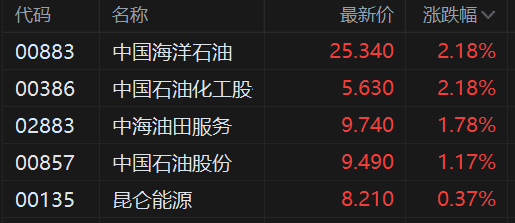
港股石油股活跃 中国石油化工涨超2%刷新历史新高
Jin Rong Jie· 2026-02-12 03:58
港股石油股持续活跃,其中,中国海洋石油、 中国石油 化工均涨超2%,且中石化刷新上市新高价,中 海 油田服务涨1.8%,中国石油股份涨超1%,昆仑能源跟涨。 ...
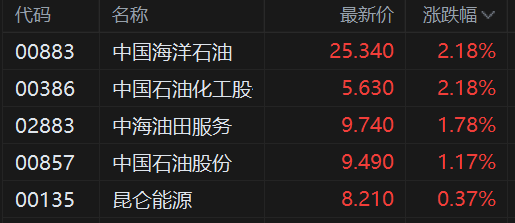
港股异动丨石油股活跃 中国石油化工涨超2%刷新历史新高
Ge Long Hui· 2026-02-12 03:41
Group 1 - The core viewpoint of the news highlights the active performance of Hong Kong oil stocks, with notable increases in shares of China National Offshore Oil Corporation (CNOOC) and Sinopec, both rising over 2% [1] - CNOOC's stock price reached a new high since its listing, while CNOOC Oilfield Services rose by 1.8%, and China Petroleum & Chemical Corporation (Sinopec) increased by over 1% [1] - The rise in oil stocks is attributed to traders' focus on the escalating tensions between the US and Iran, overshadowing signals of increased supply, with WTI crude oil stabilizing around $65 per barrel [1] Group 2 - The report indicates that WTI crude oil prices had previously risen by over 1% on Wednesday, despite comments from Trump regarding potential agreements with Tehran [1] - Concerns about potential military strikes and supply risks continue to weigh on traders, indicating a cautious market sentiment [1] - The International Energy Agency (IEA) is set to release its monthly market outlook report, which may reiterate concerns about global supply surplus [1]
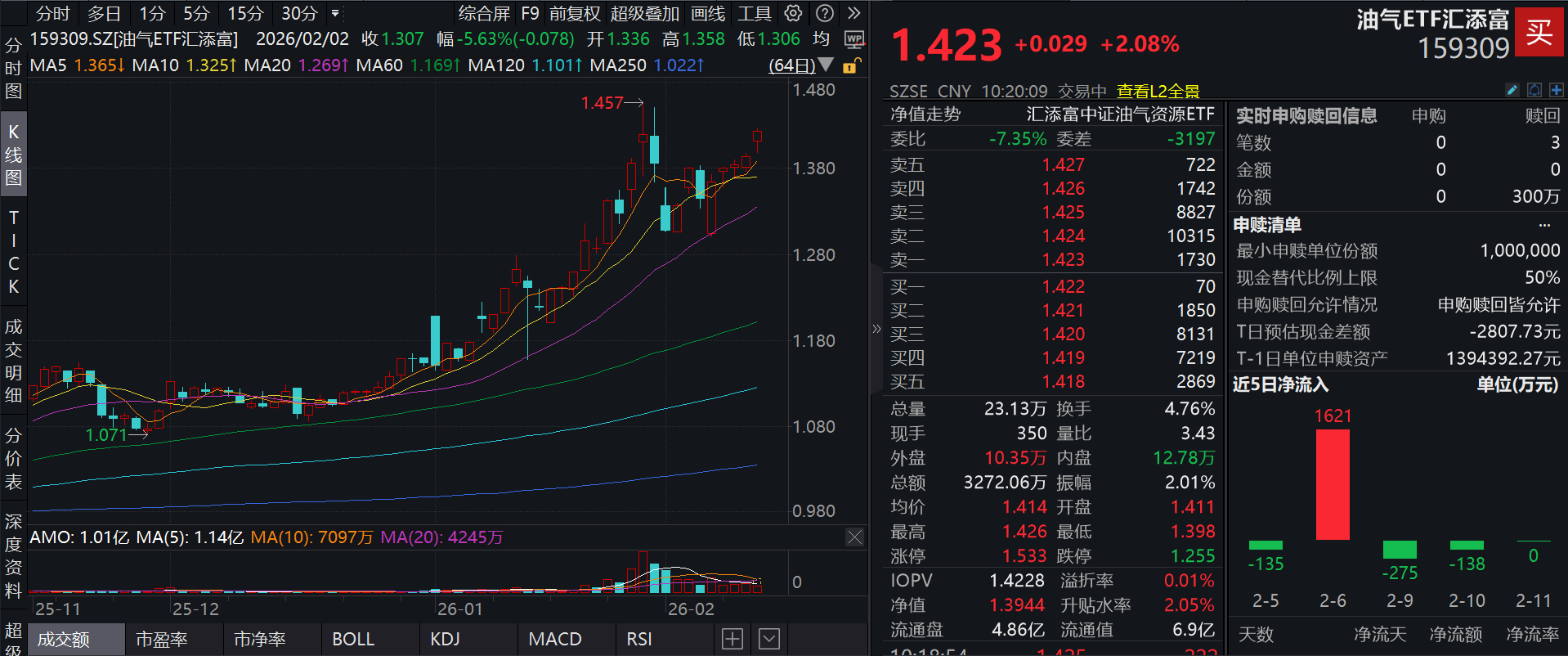
原油强劲冲高!油气高歌猛进,油气ETF汇添富(159309)涨超2%,冲击五连阳!美国“披萨指数”再度升高,地缘风险提振原油价格
Sou Hu Cai Jing· 2026-02-12 02:40
Group 1 - The core viewpoint of the news highlights the performance of oil and gas ETFs, with significant gains in several component stocks, including a 9.98% increase in China Merchants Energy and over 8% in COSCO Shipping Energy [2][4] - The OPEC report maintains its global oil supply and demand forecast for the next two years, with a notable decrease in January's average daily production by 439,000 barrels to 42.448 million barrels, exceeding market expectations [4][5] - The recent geopolitical tensions between the US and Iran have contributed to rising oil prices, with US crude oil futures closing at $64.89 per barrel, up 1.45%, and Brent crude at $69.60, up 1.15% [4][5] Group 2 - The marginal improvement in the supply-demand fundamentals is providing solid support for oil prices, with OPEC+ confirming a continued production halt until March 2026, alleviating concerns about oversupply [5][6] - Domestic oil companies are reducing their sensitivity to oil price fluctuations through integrated upstream and downstream operations and diversifying their oil and gas sources [6][7] - The oil and gas ETF focuses on the upstream and downstream sectors of the oil and gas industry, including exploration, equipment, refining, and transportation, emphasizing companies with quality reserves and stable dividend capabilities [6][7]





石油ETF鹏华(159697)涨近1%,区域局势持续扰动原油供应
Sou Hu Cai Jing· 2026-02-12 01:54
Group 1 - The ongoing regional tensions are disrupting the global oil supply chain, leading to a continuous rise in oil prices, with WTI crude oil up by 1.45% to $64.89 per barrel and Brent crude oil up by 1.15% to $69.60 per barrel [1] - OPEC maintains its global oil demand growth forecast for 2026 and 2027, expecting an average global demand of 42.6 million barrels per day in Q1 2026 and 42.2 million barrels per day in Q2 2026, unchanged from previous predictions [1] - OPEC+ crude oil production averaged 42.45 million barrels per day in January, a decrease of 439,000 barrels per day from December 2025, primarily due to a decline in Kazakhstan's production [1] Group 2 - The uncertainty surrounding the situation in Iran, combined with the recent trade agreement between the US and India, and India's commitment to halt imports of Russian oil while increasing purchases of US and Venezuelan oil, is accelerating the restructuring of global oil trade flows, providing strong short-term support for oil prices [1] - As of February 12, 2026, the National Petroleum and Natural Gas Index (399439) rose by 0.87%, with significant gains in component stocks such as China Merchants Energy (up 6.91%), COSCO Shipping Energy (up 5.34%), and China Merchants Oil (up 4.35%) [1] - The oil ETF Penghua (159697) increased by 0.88%, marking its fifth consecutive rise, with the latest price reported at 1.38 yuan [1] Group 3 - As of January 30, 2026, the top ten weighted stocks in the National Petroleum and Natural Gas Index (399439) include China National Petroleum, China National Offshore Oil, and Sinopec, collectively accounting for 66.76% of the index [2]
石油ETF鹏华(159697)深度受益,美伊紧张局势升级推动油价,OPEC1月产量减少超预期
Sou Hu Cai Jing· 2026-02-12 01:43
Group 1 - The core viewpoint of the articles indicates that international oil prices are rising due to escalating tensions between the US and Iran, which outweighs the impact of a significant increase in US crude oil inventories [1] - OPEC's latest monthly report maintains its forecast for global oil supply and demand for the next two years, with a notable decrease in OPEC+ daily production in January, down by 439,000 barrels to 42.448 million barrels, exceeding market expectations [1] - Current international oil prices are characterized by a tendency to rise rather than fall, with various bullish catalysts emerging, leading to a greater potential for price increases compared to declines [1] Group 2 - The Guozheng Oil and Gas Index (399439) has seen an increase of 0.94%, with significant gains in constituent stocks such as CNOOC Engineering (up 9.97%) and Zhongman Petroleum (up 5.90%) [1] - The Penghua Oil ETF (159697) closely tracks the Guozheng Oil and Gas Index, which reflects the price changes of publicly listed companies in the oil and gas sector on the Shanghai and Shenzhen stock exchanges [2] - As of January 30, 2026, the top ten weighted stocks in the Guozheng Oil and Gas Index account for 66.76% of the index, including major companies like China National Petroleum, CNOOC, and Sinopec [2]


油气ETF博时(561760)开盘涨0.52%,重仓股中国海油涨0.55%,中国石油涨0.37%
Xin Lang Cai Jing· 2026-02-12 01:37
Group 1 - The oil and gas ETF Bosera (561760) opened with a gain of 0.52%, priced at 1.350 yuan [1] - Major holdings in the ETF include China National Offshore Oil Corporation (CNOOC) up 0.55%, China Petroleum up 0.37%, and China Petrochemical down 0.15% [1] - The ETF's performance benchmark is the CSI Oil and Gas Resource Index return rate, managed by Bosera Fund Management Co., with a return of 34.44% since its establishment on April 19, 2024, and a return of 16.23% over the past month [1] Group 2 - Notable stock performances include Jerry Holdings up 1.27%, China Merchants Energy up 3.49%, and CNOOC Engineering up 1.81% [1] - The ETF's performance reflects the overall trends in the oil and gas sector, indicating a mixed performance among its key holdings [1]
中国石油股份(00857.HK):2月11日南向资金增持784.6万股
Sou Hu Cai Jing· 2026-02-11 19:15
中国石油天然气股份有限公司是一家主要从事石油和天然气生产和分销业务的中国公司。该公司主要通 过五个分部开展业务。油气和新能源分部从事原油及天然气的勘探、开发、生产、输送和销售以及新能 源业务。炼油化工和新材料分部从事原油及石油产品的炼制,基本及衍生化工产品、其他化工产品的生 产和销售以及新材料业务。销售分部从事炼油产品和非油品的销售以及贸易业务。天然气销售分部从事 天然气的输送及销售业务。总部及其他分部从事资金管理、融资、总部管理、研究开发及为集团其他经 营分部提供商务服务。 证券之星消息,2月11日南向资金增持784.6万股中国石油股份(00857.HK)。近5个交易日中,获南向 资金增持的有5天,累计净增持9316.79万股。近20个交易日中,获南向资金增持的有15天,累计净增持 1.49亿股。截至目前,南向资金持有中国石油股份(00857.HK)73.47亿股,占公司已发行普通股的 34.81%。 以上内容为证券之星据公开信息整理,由AI算法生成(网信算备310104345710301240019号),不构成 投资建议。 ...

中国石油新注册《地质应用专业软件网盘数据系统V1.0》项目的软件著作权
Sou Hu Cai Jing· 2026-02-11 18:13
Group 1 - The core point of the article highlights that China National Petroleum Corporation (CNPC) has registered a new software copyright for the "Geological Application Professional Software Cloud Data System V1.0" project, indicating a focus on technological development [1] - In 2023, CNPC registered a total of 163 software copyrights, which represents a significant increase of 73.4% compared to the same period last year [1] - For the first half of 2025, CNPC invested 9.899 billion yuan in research and development, reflecting a year-on-year increase of 2.51% [1] Group 2 - According to data analysis from Tianyancha, CNPC has made investments in 1,298 enterprises and participated in 443 bidding projects [1] - The company holds 105 trademark registrations and 48,442 patents, showcasing its strong intellectual property portfolio [1] - Additionally, CNPC possesses 168 administrative licenses, indicating its compliance and operational capabilities [1]
2025年我国油气勘探开发硕果累累
Yang Shi Xin Wen· 2026-02-11 12:18
Core Insights - The National Energy Administration announced ten landmark achievements in oil and gas exploration and development for 2025, highlighting significant advancements in domestic production capabilities and resource management. Group 1: Oil and Gas Production Achievements - By 2025, domestic crude oil production is expected to reach 216 million tons, a historical high, while natural gas production will exceed 260 billion cubic meters, marking the first time production exceeds 200 million tons of equivalent [1] - The "Seven-Year Action Plan" has successfully concluded, with cumulative newly proven geological reserves of oil and gas exceeding 10 billion tons and 10 trillion cubic meters from 2019 to 2025, reinforcing the foundation for sustained production [1] Group 2: Regional Production Highlights - The Ordos Basin has established the country's first 100 million-ton oil and gas production base, with oil production stabilizing at 38 million tons and natural gas production nearing 80 billion cubic meters [2] - The Sichuan Basin's natural gas production is projected to surpass 80 billion cubic meters, contributing over 40% to national production, with shale gas accounting for approximately 27 billion cubic meters [3] Group 3: Marine Oil and Gas Developments - Marine oil production is expected to exceed 66 million tons, with natural gas production around 30 billion cubic meters, leading to a total marine oil and gas equivalent of 90 million tons [4] - Significant discoveries in the Bohai Sea include three large to medium-sized oil fields, with the Qinhuangdao 29-6 oil field achieving proven reserves of over 100 million tons [4] Group 4: Shale Oil and Technology Advancements - The establishment of national-level shale oil demonstration zones in Xinjiang, Daqing, and Shengli is expected to enhance production capacity, with core technologies leading to rapid output increases [5] - The deep earth exploration initiative has achieved breakthroughs, including the successful drilling of wells exceeding 10,000 meters, with significant gas discoveries in the Tarim Basin [6] Group 5: Technological Innovations in Oil and Gas - The industry is advancing towards high-end technology with the development of new equipment for exploration and extraction, including the first domestically produced 80,000-pound controlled seismic source [7] - China National Offshore Oil Corporation (CNOOC) is leading the digital transformation of offshore oil fields, with the "Deep Sea One" gas field being recognized as a model for intelligent factory practices [8] Group 6: Sustainable Practices and Energy Transition - Sinopec's Victory Oilfield has pioneered a clean thermal energy utilization model, achieving significant energy savings and reducing natural gas consumption [9] - The Jilin Oilfield has implemented the "Honggang Model" for green transformation, significantly increasing oil production while reducing carbon emissions and energy consumption [10]