
CCB(601939)

Search documents
银行今十条:数字人民币1月1日起计付利息;农商行头部阵营形成“五强”格局;新疆银行注册资本增至122亿元...
Jin Rong Jie· 2026-01-04 14:13
Group 1 - The People's Bank of China conducted a 365 billion yuan 7-day reverse repurchase operation, resulting in a net withdrawal of 433.6 billion yuan [1] - The People's Bank of China issued the "Non-Bank Payment Institutions Classification Rating Management Measures" to enhance supervision of non-bank payment institutions, effective from February 1, 2026 [2] - In 2025, the banking sector saw a net increase of 623 physical bank branches, marking the first positive growth in three years despite the closure of 7,871 branches [3] Group 2 - Ten digital RMB operating banks announced that starting January 1, 2026, they will pay interest on digital RMB wallets at the same rate as their demand deposit rates [4] - Chengdu Rural Commercial Bank announced that its total assets have surpassed 1 trillion yuan, becoming the fifth rural commercial bank in China to reach this milestone [5] - Xinjiang Bank received approval to increase its registered capital from 7.906 billion yuan to 12.222 billion yuan [6] Group 3 - Baoding Bank's plan to change its registered capital was approved, allowing it to raise 250 million shares [7] - Ningbo Tongshang Bank was approved to issue capital instruments not exceeding 2 billion yuan, including perpetual bonds and subordinated bonds [8][9] - The Dongguan Financial Regulatory Bureau and other departments will pilot real estate trust property registration in Dongguan to support the transformation of the trust business [10] Group 4 - New Era Trust's 100% equity is being offered for transfer for the third time, with a base price of approximately 1.851 billion yuan, consistent with previous offers [11]






建行莲旺支行:暖农润沂水,担当助振兴
Qi Lu Wan Bao· 2026-01-04 13:51
Group 1 - The core idea of the articles emphasizes the commitment of China Construction Bank's Lianwang Branch to provide tailored financial services to rural areas, enhancing local economic development and supporting agricultural industries [1][2] - The branch has established a "Zhang Fuqing Financial Service Team" to directly engage with local farmers and cooperatives, facilitating access to financial products like "Yunong Quick Loan" which allows for quick approval and disbursement of funds without collateral [1] - As of now, the branch has issued over 30 million yuan in agricultural loans to more than 120 agricultural entities, addressing the financing challenges faced by farmers through customized loan products [1] Group 2 - The bank's initiatives include hands-on assistance at community service stations, where staff educate elderly residents on using financial services and conducting transactions, thereby promoting financial inclusion [1] - The branch also conducts anti-fraud education sessions in local dialects to help residents recognize and avoid scams, reinforcing community trust and financial security [1] - The overall approach of the Lianwang Branch reflects the responsibility and commitment of state-owned banks to support rural revitalization and enhance the livelihoods of local residents [2]
2025,银行大罚单明显变多了
Xin Lang Cai Jing· 2026-01-04 12:48
Core Insights - A significant trend observed in 2025 is the increase in large fines imposed on banks, reflecting compliance shortcomings and risk points during the transition to high-quality development in the banking industry [2][16] - In 2025, regulatory authorities issued a total of 454 fines exceeding one million yuan to banking institutions and personnel, an increase of 58 from the previous year, with the total amount of fines nearly doubling [2][16] - The main areas of violations in 2025 were concentrated in credit business, anti-money laundering, and internal control systems, with anti-money laundering violations seeing the most notable increase, reaching 894 fines, a rise of 185.09% compared to the previous year [2][16] Summary of Fines Over 20 Million Yuan - In 2025, there were 12 fines disclosed with amounts exceeding 20 million yuan, primarily related to compliance management issues in traditional business areas such as loans and bills, indicating deficiencies in basic business risk control and regulatory cooperation [4][17] - Common violations included issues with account management and anti-money laundering, highlighting flaws in customer identity verification and transaction monitoring processes [3][17] Summary of Fines Between 10 Million and 20 Million Yuan - This category of fines predominantly involved joint-stock banks, reflecting a conflict between business innovation and compliance management [6] - Violations were mainly related to compliance operations (account and anti-money laundering) and business management (internet loans and agency sales), with cross-border foreign exchange violations being a secondary concern [7] Summary of Fines Between 5 Million and 10 Million Yuan - Fines in this range were primarily concentrated among city commercial banks, joint-stock banks, and rural commercial banks [10] - The most common violations included anti-money laundering and customer identity verification issues, alongside traditional problems related to credit "three checks" failures [10]




今年1月1日起 六大银行数字人民币计利息收益
Sou Hu Cai Jing· 2026-01-04 11:48
Group 1 - From January 1, 2026, digital RMB real-name wallet balances will earn interest based on the current demand deposit rate set by the respective banks, which is currently 0.05% [1] - The digital RMB is categorized into four types of wallets, with only the first three types (real-name wallets) eligible for interest, while the fourth type (anonymous wallet) will not earn interest [1] - The interest will be calculated according to the People's Bank of China’s demand deposit interest rules, with interest credited on the 20th of each quarter's last month [1] Group 2 - There are currently 10 designated operating institutions for digital RMB, including six state-owned commercial banks, two joint-stock commercial banks, and two internet banks [2] - The central bank is working on expanding the number of operating institutions and has introduced a new action plan to enhance the management and service system for digital RMB, set to be implemented on January 1, 2026 [2] - Banks will manage the digital RMB wallet balances autonomously and provide the same level of security as traditional deposits through deposit insurance [2]
工农中建交邮储六大行集体公告!数字人民币实名钱包余额计付利息,计结息规则与活期存款一致
Sou Hu Cai Jing· 2026-01-04 06:55
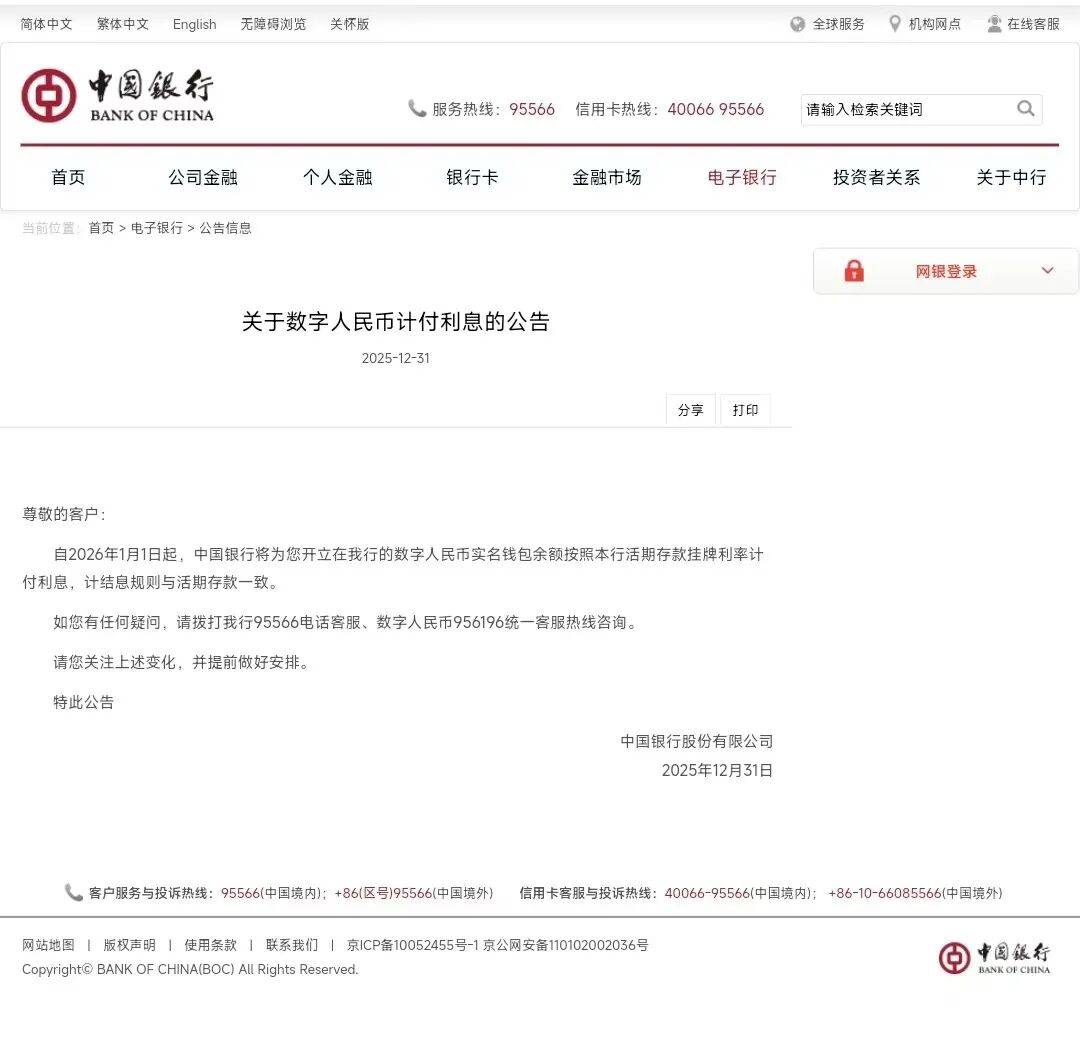
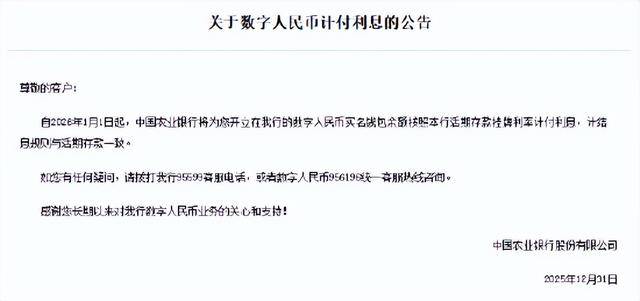
Core Viewpoint - Major Chinese banks, including ICBC, ABC, BOC, CCB, BOCOM, and PSBC, will start paying interest on the balances of digital RMB wallets at the rate of their respective demand deposit rates from January 1, 2026 [1][2][4][5][8][9]. Group 1: Bank Announcements - ICBC will pay interest on digital RMB wallet balances according to its demand deposit rate, with interest calculation rules consistent with those for demand deposits [1]. - ABC will also apply the same interest payment policy for digital RMB wallet balances starting January 1, 2026 [2]. - BOC will follow the same approach, paying interest on digital RMB wallet balances at its demand deposit rate from January 1, 2026 [4]. - CCB will implement interest payments on digital RMB wallet balances based on its demand deposit rate, with relevant service agreement updates [5]. - BOCOM will pay interest on digital RMB wallet balances according to its demand deposit rate, effective January 1, 2026 [8]. - PSBC will also apply the same interest payment policy for digital RMB wallet balances starting January 1, 2026 [9].
实测8家银行收益展示:多数未展示年化持仓收益率
2 1 Shi Ji Jing Ji Bao Dao· 2026-01-04 04:02
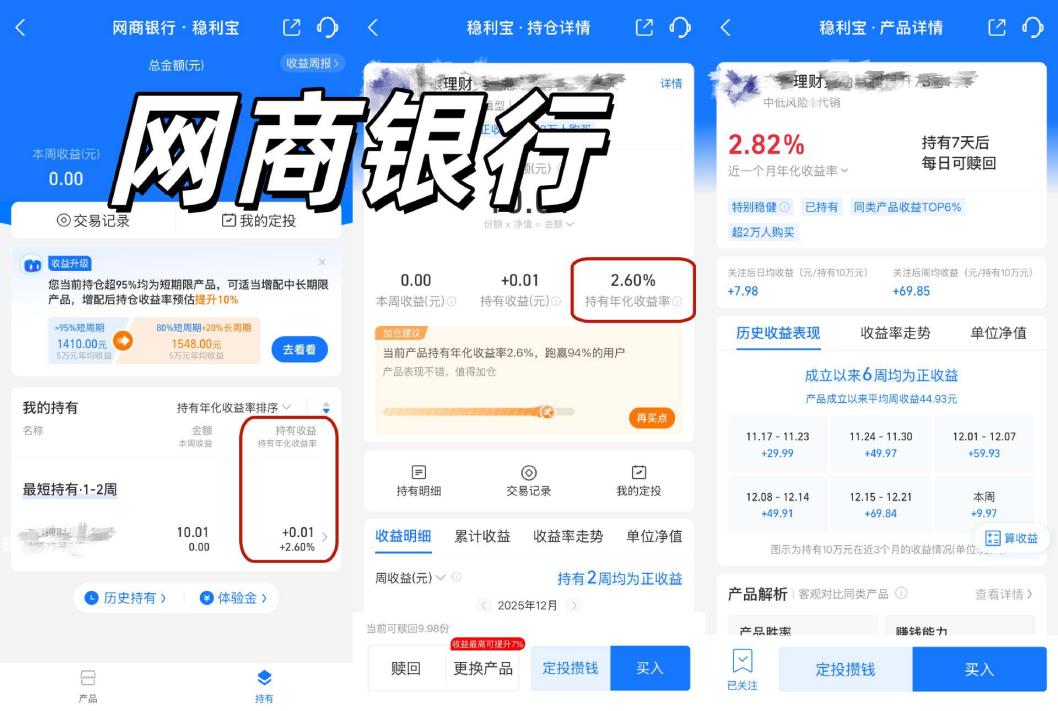
21世资管研究院研究员 杨梦雪 你知道自己购买的理财产品实际收益率,以及实际收益率与理财产品页面所展示的收益率有多少差距吗? 不少银行理财投资者向《21世纪经济报道》反映称,冲着页面展示的高达5%甚至7%的收益率数据买进去,结果发现实际获得的收益并不高,但也不知道是 怎么回事、具体差异有多少。 "当时看到页面展示的收益率还可以就买了,后面也没在意过。我大概能知道我的收益率到不了页面展示的那么高,但实际到底差多少,我不会算也就没关 注过了。"某投资者对记者表示。 《21世纪经济报道》曾多次报道银行理财行业中部分理财公司存在的"打榜"现象,即,通过估值魔法以及其他方式包装出收益数据很高的新产品用于吸引客 户和资金,待"使命"完成便沦为庸常的老产品,前期被高收益数据吸引而来的投资者实际享受不到产品所展示的诱人业绩。 该现象背后,主要成因固然是银行理财产品管理层面的把戏,但是,一些渠道在客户持仓产品业绩展示上是一本糊涂账,导致投资者很难了解到真实情况, 这某种程度上也是推手之一。 银行理财是最具普惠性的财富管理工具,其绝大部分的客户都是个人投资者,产品展示功能和客户服务尤其重要。据银行业理财登记托管中心数据,理财市 ...



2026年起数字人民币余额计息 年利率0.05%仅限实名钱包
Sou Hu Cai Jing· 2026-01-04 03:38
Core Points - Starting from January 1, 2026, interest will be paid on the balances in real-name digital RMB wallets [1] - Ten official designated operating institutions, including major banks like ICBC, ABC, BOC, and CCB, have announced this adjustment [1] - The interest rate will be based on the bank's current deposit benchmark rate, which is currently 0.05% annually [1] Summary by Categories Interest Payment Implementation - The interest payment feature is a result of the People's Bank of China's recent action plan to enhance the management and service system for digital RMB [1] - Banks are required to comply with self-discipline agreements on deposit rate pricing [1] Wallet Classification and Eligibility - The interest payment feature is only available to users of real-name wallets [1] - Digital RMB wallets are categorized into four types based on customer identity verification strength, with only authenticated wallets eligible for interest [1] - Balances in anonymous wallets, which can be opened with just a phone number, will not earn interest [1] Digital RMB App Upgrade - The digital RMB App has been upgraded to version 2.0 to support the new interest payment functionality [1] - Users can check interest details on the wallet asset page after the quarterly interest settlement date [1]
三部门联合印发通知,加大消费重点领域金融支持
Jing Ji Ri Bao· 2026-01-04 01:50
Core Viewpoint - The joint issuance of the "Notice on Strengthening Business and Financial Coordination to Boost Consumption" by the Ministry of Commerce, the People's Bank of China, and the Financial Regulatory Bureau aims to enhance financial support for key consumption areas through various measures [1] Group 1: Boosting Consumption - Multiple departments have implemented targeted measures to boost consumption, integrating livelihood benefits with consumption promotion [2] - Banks are leveraging a "Boost Consumption and Expand Domestic Demand" initiative, integrating credit, scenarios, payment, and derivative services to enhance consumer finance [2] - The Notice encourages financial institutions to collaborate with platforms and key merchants to improve payment services, catering to consumer demand for upgrades [2] Group 2: Innovative Application Scenarios - The Notice proposes developing specialized loan products to enhance rural e-commerce and improve county-level commercial efficiency [4] - Financial products are being embedded in diverse consumption scenarios, facilitating consumer convenience and helping merchants expand their market [4] - A digital RMB initiative is being launched at the Shanghai Lego Resort, promoting a convenient payment environment for visitors [4] Group 3: Cultivating New Consumption Formats - The Notice emphasizes promoting new consumption formats based on local conditions, exploring financial support for emerging economic models such as green consumption and digital consumption [5] Group 4: Strengthening Supply and Demand Alignment - Financial institutions are encouraged to optimize product services to enhance alignment between supply and demand in key consumption areas [6] - There is a need for financial products to transition from standardized to personalized offerings, tailored to specific consumer scenarios and needs [6] - Collaboration among various policy sectors is essential to create a healthy consumer finance market, reducing financing costs and encouraging consumer spending [7]
三部门联合印发通知:加大消费重点领域金融支持
Jing Ji Ri Bao· 2026-01-04 01:45
Core Viewpoint - The joint issuance of the notification by the Ministry of Commerce, the People's Bank of China, and the Financial Regulatory Administration aims to enhance financial support for key consumption areas to stimulate domestic demand and consumption [1] Group 1: Support for Consumption - Various departments have implemented targeted measures to boost consumption, integrating livelihood benefits with consumption promotion [2] - Banks are leveraging a "Consumption Finance in Action" initiative to enhance the integration of credit, scenarios, payment, and derivative services, thereby expanding domestic demand [2] - The notification emphasizes collaboration between financial institutions and key merchants to improve payment services and meet consumer upgrade needs [2] Group 2: Innovation in Consumption Scenarios - The notification encourages the development of specialized loan products tailored to rural e-commerce and county-level commercial improvements [4] - Financial institutions are collaborating with businesses to promote digital RMB usage in consumer scenarios, such as at the Shanghai Lego Park [4] - The integration of consumption finance into various sectors, including shopping, tourism, and home appliances, facilitates consumer convenience and market expansion [4] Group 3: New Consumption Models - The notification advocates for the development of new consumption formats, including green consumption and digital consumption, with a focus on risk control and commercial sustainability [5] - Financial services are encouraged to be diverse and differentiated to support emerging consumption models [5] Group 4: Strengthening Supply-Demand Connection - Financial institutions are urged to optimize product services to enhance the alignment of supply and demand in upgraded consumer goods and innovative consumption scenarios [6] - The notification highlights the need for financial support measures to be tailored to specific consumer needs and scenarios, moving from standardized to personalized financial products [7] - A collaborative approach among business, finance, and industrial policies is essential to create a healthy consumption finance market, reducing financing costs for consumers [7]
三部门联合印发通知 加大消费重点领域金融支持
Xin Hua Wang· 2026-01-03 23:36
Core Viewpoint - The joint issuance of the notification by the Ministry of Commerce, the People's Bank of China, and the Financial Regulatory Administration aims to enhance financial support for key consumption areas to stimulate domestic demand and consumption growth [1] Group 1: Support for Consumption - Various departments have implemented targeted measures to boost consumption, integrating livelihood benefits with consumption promotion [2] - Banks are leveraging a "Consumption Finance in Action" initiative to enhance the integration of credit, scenarios, payment, and derivative services, thereby expanding domestic demand [2] - The notification emphasizes collaboration between financial institutions and key merchants to improve payment services and meet consumer demand for upgrading products [2] Group 2: Innovation in Consumption Scenarios - The notification encourages the development of specialized loan products tailored to rural e-commerce and county-level commercial improvements [4] - Financial institutions are collaborating with businesses to promote digital RMB usage in consumer scenarios, such as at the Shanghai Lego Land, enhancing payment convenience [4] - The integration of consumption finance into various sectors, including shopping, tourism, and home improvement, facilitates consumer access and supports market expansion [4] Group 3: New Consumption Models - The notification advocates for the development of new consumption formats, focusing on sustainable and controllable risks while exploring financial support for emerging economic models [5] - Financial services are encouraged to be diverse and differentiated to support new consumption patterns, including green and digital consumption [5] Group 4: Strengthening Supply-Demand Connection - Financial institutions are urged to optimize product services to enhance the alignment between supply and demand in upgraded consumer goods and innovative consumption scenarios [6] - The need for financial products to transition from standardized to personalized offerings is highlighted, ensuring they meet diverse consumer needs [6] - Collaboration among various policies is essential to create a healthy consumption finance market, reducing financing costs for consumers [7]