BANK OF CHINA(601988)

Search documents
固定收益专题报告:绿色债券浅析
BOHAI SECURITIES· 2026-01-19 09:26
Report Industry Investment Rating The provided content does not mention the report industry investment rating. Core Viewpoints - Green bonds are securities raised for green industries, projects, or economic activities, and have become an important financing tool. As of the end of 2025, the cumulative issuance scale in China reached 5.32 trillion yuan [2]. - The development of China's green bond market can be divided into three stages: the exploration and launch stage (2015), the standardization development stage (2016 - 2020), and the system improvement stage (2021 - present) [2][16]. - By the end of 2025, the annual issuance scale increased from 207.231 billion yuan in 2016 to 1.079283 trillion yuan, and the number of issuances rose from 89 to 834. The stock of green bonds was 2,014, with a market size of 2.464521 trillion yuan. Green bonds are suitable for long - term investment [3][109]. - Green bonds generally have a "green spread" over non - green bonds, which has weakened in the past three years but still supports pricing. They are more suitable as a stable portfolio base rather than a source of significant excess returns [4]. Summary by Directory 1. Green Bond Development 1.1 Green Bond Concept - Green bonds are securities that raise funds for green industries, projects, or economic activities. They are divided into four types according to the "China Green Bond Principles (2022)" and play an important role in global green finance [13]. 1.2 Policy Context - China's green bond market has established a relatively complete system. The development is divided into three stages: - Exploration and launch stage (2015): The People's Bank of China and the National Development and Reform Commission issued relevant documents, marking the official start of the green bond market [16][17]. - Standardization development stage (2016 - 2020): Multiple departments issued a series of policies to improve the regulatory mechanism, project catalog, and evaluation and certification mechanism [16][18]. - System improvement stage (2021 - present): Policies continued to be refined, the standard system was integrated with international standards, and cross - border green financing advanced steadily [16][25]. 2. Green Bond Value 2.1 Value to Issuers - Green bonds generally have a lower issuance interest rate than non - green bonds, showing a "green spread," which has weakened in the past three years. They can also access overseas ESG funds [34]. 2.2 Value to Investors - Green bonds are fixed - income tools. Their credit risk is mainly determined by the issuer's quality and credit enhancement. They are suitable as a stable portfolio base and can meet institutional ESG and sustainable investment goals. Their tradability has also improved [46]. 3. Green Bond Issuance Statistics 3.1 Green Asset - Backed Securities - Their issuance rhythm has different stages. From 2016 - 2018, it was in the start - up phase; 2019 - 2020 saw market expansion; 2021 entered the accelerated development stage; 2022 - 2023 maintained a high - level operation; 2024 - 2025 had a decline in scale. They are mainly short - term and ultra - long - term products, with concentrated underlying assets [48][49]. 3.2 Non - Asset - Backed Green Bonds - The issuance showed phased characteristics. It expanded steadily from 2016 - 2020, jumped significantly in 2021, reached a high in 2022, declined in 2023, and significantly increased in 2025. State - owned enterprises are the main issuers, and bank - to - bank market is the main trading platform. Their issuance interest rate has been declining, and the term is mainly medium - short term [59][61][71]. 4. Green Bond Stock and Transaction Analysis 4.1 Green Bond Stock Analysis - As of the end of 2025, the stock of green bonds was 2,014, with a market size of 2.464521 trillion yuan. Financial bonds accounted for nearly half of the stock, followed by medium - term notes and asset - backed securities. The stock was concentrated in short - and medium - term bonds, a few industries, and regions such as Beijing, Shanghai, and Guangdong [83][90][95]. 4.2 Green Bond Transaction Analysis - The secondary - market trading volume of green bonds has been rising with fluctuations, and the turnover rate has shown a trend of "falling from a high level, fluctuating in the central range, and weakening again in recent years." Compared with credit bonds and financial bonds, the turnover rate of green bonds is relatively low, but it has stable trading and periodic surges. The valuation of green bonds shows a clear stratification [100][101][105]. 5. Investment Viewpoint - Similar to the core viewpoints, green bonds have good development prospects, supply - side expansion, and are suitable for long - term investment and portfolio optimization [108][109][110].





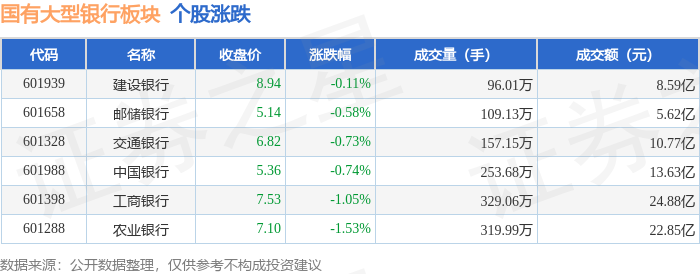
国有大型银行板块1月19日跌1.12%,农业银行领跌,主力资金净流出4.07亿元
Zheng Xing Xing Ye Ri Bao· 2026-01-19 08:58
Group 1 - The core viewpoint of the news is that the state-owned large bank sector experienced a decline of 1.12% on January 19, with Agricultural Bank leading the drop [1] - The Shanghai Composite Index closed at 4114.0, up 0.29%, while the Shenzhen Component Index closed at 14294.05, up 0.09% [1] - The trading performance of individual stocks in the state-owned large bank sector showed varied results, with Agricultural Bank down 1.53% and Industrial and Commercial Bank down 1.05% [1] Group 2 - The net outflow of main funds from the state-owned large bank sector was 407 million yuan, while retail investors saw a net inflow of 539 million yuan [1] - The detailed fund flow data indicates that the Agricultural Bank had a significant net outflow of 35.37 million yuan from main funds, but a net inflow of 73.72 million yuan from retail investors [2] - The overall trend shows that while main and speculative funds are withdrawing, retail investors are increasing their positions in certain banks [2]




绩优基金经理王登元掌舵 富国智汇稳健FOF于1月19日起售
Zhong Zheng Wang· 2026-01-19 06:33
Core Insights - The A-share market has entered a high volatility phase, making diversified asset allocation crucial for managing market changes [1] - The newly launched FOF product, 富国智汇稳健3个月持有期混合FOF, aims to balance opportunity and risk through a multi-asset allocation strategy [1][4] Group 1: FOF Product Overview - The FOF product is designed to leverage the advantages of diversified allocation by combining various asset classes such as bonds, equities, and gold to mitigate risks and reduce volatility [1][2] - It is managed by experienced FOF manager Wang Dengyuan, who has 14 years of experience in the securities industry and 6 years in FOF management [3] Group 2: Investment Strategy - The product adheres to a "fixed income foundation" logic, selecting high-performing and risk-controlled bond funds as a safety net for the portfolio [2] - It employs a "multi-asset + multi-strategy" approach, focusing on sectors influenced by policies against "involution," PPI recovery in the manufacturing midstream, and technological changes driven by overseas AI [2] Group 3: Risk Management - The FOF product utilizes a robust risk management framework, including risk budget management and dynamic position adjustments to control portfolio volatility [2] - The investment research system of 富国基金 supports the product, ensuring comprehensive backing across fixed income, active equity, and quantitative investments [3] Group 4: Performance Metrics - Recent performance data shows that 富国鑫汇养老目标日期2035三年持有A and 富国鑫汇养老目标日期2045五年持有A achieved returns of 13.02% and 24.26% respectively over the past year, outperforming their benchmarks [3]
银行资负跟踪20260119:降准降息还有空间
GF SECURITIES· 2026-01-19 04:26
Investment Rating - The industry investment rating is "Buy" [3] Core Viewpoints - The report indicates that there is still room for further cuts in reserve requirement ratios and interest rates, with a focus on structural monetary policy support for high-quality economic development [15][19] - The central bank has implemented a reduction of 0.25 percentage points in various structural monetary policy tool rates, signaling a supportive monetary policy stance [15][19] - The report emphasizes the importance of timing for future policy implementations, particularly in relation to government bond issuance peaks and the maturity schedule of high-interest bank deposits [15] Summary by Sections 1. Monetary Policy Adjustments - The report notes a reduction of 0.25 percentage points in structural monetary policy tool rates, with a focus on supporting key areas through increased re-lending [15] - Future attention is directed towards December economic data and January LPR [22] 2. Central Bank Dynamics and Market Rates - The central bank conducted a total of 9,515 billion yuan in 7-day reverse repos at an interest rate of 1.40%, with a net injection of 9,741 billion yuan [16] - The report highlights that the funding rates remained stable, with expectations of slight increases due to tax payments and government bond net repayments [16] 3. Bank Financing Tracking - The report indicates that the total outstanding amount of interbank certificates of deposit (CDs) is 19.09 trillion yuan, with an average issuance rate of 1.65% [20] - The report also notes that there were no commercial bank bond issuances during the period, with a total outstanding commercial bank bond size of 3.38 trillion yuan [20]



跨境流动性跟踪20260118:12月跨境净回流、净结汇规模均创历史新高
GF SECURITIES· 2026-01-19 02:46
Investment Rating - The industry investment rating is "Buy" [2] Core Views - December saw a record high in both cross-border net inflow and net settlement scale, with the bank's foreign-related payment surplus reaching 801.1 billion CNY, a year-on-year increase of 400.2 billion CNY [14][17] - The arbitrage trading return rate declined significantly, influenced by the depreciation of the US dollar against the offshore RMB, which fell by 1.32% to 6.98 [14][17] - The cross-border funds' net inflow in December was the highest on record, driven by a substantial increase in merchandise trade surplus [17][31] Summary by Sections Section 1: December Cross-Border Net Inflow and Settlement - The bank's foreign-related payment surplus in December was 801.1 billion CNY, with a year-on-year increase of 400.2 billion CNY, primarily due to a significant expansion in merchandise trade surplus [17] - The net settlement in December reached a historical high of 705.5 billion CNY, with a month-on-month increase of 589.1 billion CNY and a year-on-year increase of 780.6 billion CNY [31] Section 2: Arbitrage Trading Returns - The arbitrage trading return rate for 10Y US Treasury bonds in RMB terms fell by 1.43 percentage points to -1.77% due to the marginal appreciation of the RMB [14][17] - The 10Y China-US interest rate spread widened by 15 basis points, with the 10Y US Treasury yield rising by 16 basis points [14] Section 3: Cross-Border Funds and M2 Liquidity - Cross-border funds contributed significantly to M2 liquidity, with a total of 774.4 billion CNY added, reflecting an increase of 863.2 billion CNY month-on-month [55] - The cross-border funds' inflow had a pull rate of 0.10% on M2, indicating a continued upward trend [55]
中国银行 -我们对近期货币刺激的看法:财政刺激在路上,是时候重估了-China Banks Our take on recent monetary stimulus Fiscal stimulus on the way Time to revisit
2026-01-19 02:29
Summary of Conference Call on China Banks Industry Overview - The conference call focused on the Chinese banking sector, particularly the implications of recent monetary and fiscal stimulus measures announced by the People's Bank of China (PBoC) [1][2]. Key Points and Arguments Monetary Policy Changes - PBoC announced new supportive monetary policies on January 15, including: - Expansion of relending facilities with an additional quota of approximately RMB 1.1 trillion, targeting private enterprises and key industries such as agriculture, small businesses, technological innovation, carbon reduction, service consumption, and elderly care [1]. - A 25 basis points (bps) interest rate cut for relending facilities, reducing the rate from 1.5% to 1.25% [7]. - Potential for further cuts in the Reserve Requirement Ratio (RRR) and Loan Prime Rate (LPR) [1][2]. Impact on Banks' Net Interest Margin (NIM) - The relending facilities rate cut is expected to benefit banks' NIM by approximately 0.3 bps, as banks can borrow cheaper funds from PBoC [1]. - The balance of relending facilities reached around RMB 5 trillion by Q3 2025, representing about 1% of banks' total assets [1]. - The anticipated fiscal stimulus, including interest subsidies on consumer and micro loans, is expected to have a limited negative impact on banks' NIM [1]. Credit Growth and Loan Demand - The stimulus measures are designed to incentivize banks to direct credit towards policy-favored sectors, supporting loan growth at the beginning of 2026, coinciding with the start of the 15th five-year plan [1]. - There is an expectation of stronger-than-expected loan growth in early 2026 due to these targeted lending initiatives [1]. Treasury Bond Market Dynamics - Lower treasury bond yields are projected to widen the spread between banks' dividend yields and the 10-year China treasury bond yield, attracting yield-seeking investors [2][5]. - The PBoC may actively participate in treasury bond trading to rebalance supply and demand dynamics, potentially lowering treasury bond yields further [2]. Investment Outlook for China Banks - China banks' H-shares have underperformed the Hang Seng Index by 7 percentage points year-to-date in 2026, but there is optimism for recovery due to: - Expected growth in insurers' premiums, leading to increased inflows into high-yield bank stocks [6]. - The attractiveness of banks' dividend yields due to lower treasury bond yields [6]. - The positive impact of monetary and fiscal stimulus on loan growth with limited negative effects on NIM [6]. - Specific banks highlighted for potential investment include ICBC-H and BOC-H, which offer above-peer dividend yields and favorable valuations [6]. Insurer Investments in Banks - Notable changes in equity stakes by insurers in various banks were discussed, indicating a trend towards increased financial investments in the banking sector [12]. Additional Important Information - The conference call emphasized the importance of monitoring the evolving regulatory environment and market conditions that could impact the banking sector's performance [1][2][6]. - Analysts expressed caution regarding the potential for NIM compression in FY26, estimating a 6 bps decrease, but noted that RRR cuts and potential deposit rate cuts could provide some offset [2]. This summary encapsulates the key insights and projections regarding the Chinese banking sector as discussed in the conference call, highlighting the implications of recent monetary policies and the outlook for investment opportunities.
银行投资观察20260118:贝塔弹性主导近期板块表现
GF SECURITIES· 2026-01-19 01:47
Core Insights - The banking sector has shown weak relative and absolute returns recently, primarily due to market funds shifting towards high-beta and small-cap stocks, leading to a diversion of funds from low-beta banking stocks [18] - The report suggests that the banking sector is likely to experience further internal differentiation in 2026, with larger banks and wealth management banks expected to outperform [18] - Core stock recommendations include Ningbo Bank, China Merchants Bank, Qingdao Bank, and large state-owned banks [18] Section Summaries 1. Current Observation: A-shares in Banking Decline, H-shares Outperform - During the observation period from January 12 to January 16, 2026, the banking sector (CITIC first-level industry) declined by 2.6%, ranking 25th among all industries and underperforming the Wind All A index [16] - The performance of state-owned banks, joint-stock banks, city commercial banks, and rural commercial banks varied, with declines of -2.16%, -3.33%, -1.92%, and -2.24% respectively [16] - H-shares of banks increased by 2.4%, underperforming the Hang Seng Composite Index, while A-share banks showed mixed results [16] 2. Investment Recommendations: Beta Elasticity Dominates Recent Sector Performance - The report indicates that the recent downturn in the banking sector has solidified valuations, with limited further downside expected [18] - The anticipated trends include a shift towards non-bank financial services, wealth management, and disintermediation, with large banks expected to gain an advantage [18] 3. Sector Performance: Banking Sector Decline, Weekly Turnover Rate Increases - The banking sector's weekly turnover rate increased to 1.61%, ranking last among 30 CITIC first-level industries [42] - As of January 16, 2026, the banking sector's latest price-to-earnings (P/E) ratio was 6.89x, and the price-to-book (P/B) ratio was 0.67x, indicating valuations at historical average levels [42] 4. Individual Stock Performance: A-share Banks Overall Decline, City Commercial Banks Relatively Stable - Among A-share banks, Ningbo Bank saw a rise of 4.09%, while Beijing Bank, Huaxia Bank, and Shanghai Pudong Development Bank experienced declines of 4.90%, 4.73%, and 4.33% respectively [16] - In H-shares, Industrial and Commercial Bank of China and China Construction Bank increased by 3.59% and 3.16%, while China Everbright Bank and Chongqing Bank saw declines of 6.14% and 3.10% [16] 5. Convertible Bond Performance: Average Price Increase - The average price of banking convertible bonds rose by 0.06%, underperforming the Zhongzheng convertible bond index by 1.02 percentage points [17] - The top-performing convertible bonds included Chongqing Bank's convertible bond (+0.58%) and Industrial Bank's convertible bond (+0.18%) [17] 6. Profit Forecast Tracking: 2025 Profit Growth Expectations Remain Stable - For the current period, three banks (China Merchants Bank, Minsheng Bank, and Hangzhou Bank) showed changes in the consensus profit growth expectations for 2025 [17] - The net profit growth and revenue growth expectations for A-share banks in 2025 adjusted slightly downwards by -0.08 percentage points and -0.03 percentage points respectively [17]
大额存单利率跌入“0字头”
第一财经· 2026-01-18 08:53
Core Viewpoint - The article discusses the significant decline in large-denomination certificate of deposit (CD) interest rates, with many banks offering rates below 1% for one-year and shorter products, while a substantial amount of deposits, approximately 75 trillion yuan, is set to mature in 2026, leading to a "deposit migration" trend among savers [3][10]. Group 1: Interest Rate Trends - Large-denomination CD rates are rapidly entering the "0% era," with most banks' new one-year and shorter products falling below 1%, and three-year rates generally below 2% [3][4]. - The trend towards shorter-term products is evident, with five-year options nearly disappearing, and some banks raising minimum deposit requirements to 1 million yuan [4][6]. - The average interest rates for various terms have dropped significantly, with the average rate for three-month deposits at 0.944% and one-year deposits at 1.277% as of September 2025 [8]. Group 2: Deposit Maturity and Migration - An estimated 75 trillion yuan of residential fixed-term deposits will mature in 2026, with a notable increase in the amount maturing compared to 2025 [10][11]. - Many savers are opting to transfer their funds from large banks to smaller banks, which typically offer slightly higher rates, rather than moving to equity markets [11][12]. - Younger savers are creatively splitting their deposits among different banks to take advantage of promotional offers, likening it to a game [12]. Group 3: Bank Strategies to Retain Deposits - In response to the pressure of deposit outflows, banks are launching various initiatives to retain funds, including temporarily raising interest rates to around 2% and enhancing customer service through personalized strategies [13][14]. - Some banks are offering promotional products with rates above 2% to attract new customers, while others are implementing pre-reminder mechanisms and tailored renewal plans for existing customers [16][17]. - The focus has shifted from merely selling products to deepening customer relationships and providing precise recommendations based on competitive analysis of deposit rates [17].


严监管趋势不断增强 2026年以来银行业收到超200张监管罚单
Zhong Zheng Wang· 2026-01-17 08:27
Group 1 - The core viewpoint of the news is that the Financial Regulatory Administration emphasizes the importance of risk prevention, strong regulation, and promoting high-quality development in the financial sector for 2026, aiming to avoid systemic financial risks [1] - In 2025, the banking sector received over 6,500 penalties totaling more than 2.6 billion yuan, with around 1,100 banks penalized [1] - The largest penalties in 2025 were imposed on China Bank (9.79 million yuan), Huaxia Bank (8.725 million yuan), and Bank of Communications (6.783 million yuan) for various management violations [1][2] Group 2 - In 2026, the trend of strict regulation is expected to continue, with over 200 penalties issued to banks and their branches since the beginning of the year [1] - Common violations leading to penalties include non-compliance in credit business, anti-money laundering issues, and inadequate internal controls, with approximately 2,900 penalties related to credit business violations, 1,380 related to anti-money laundering, and 1,360 related to internal control deficiencies in 2025 [2]

一箱难求!银行“古早”业务突然火了,保管箱为何“爆单”?
券商中国· 2026-01-16 23:38
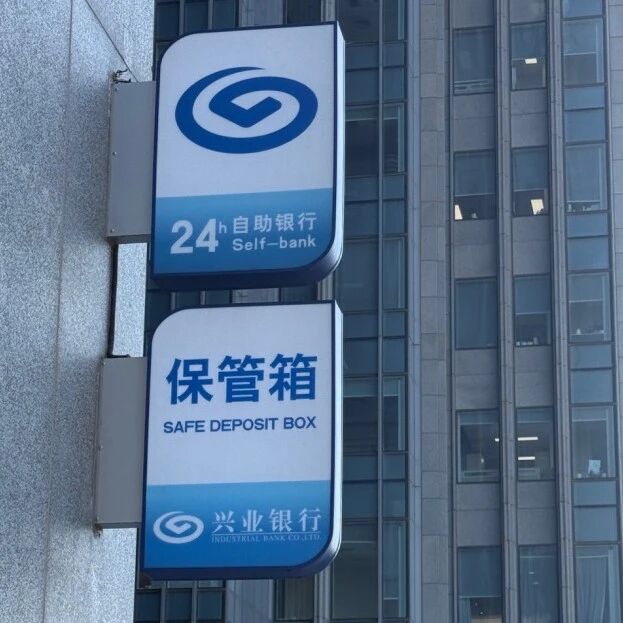
所谓保管箱服务,其全称为保管箱租赁服务,是银行以出租保管箱形式,代租用人保管贵重物品、有价证券及文件等财物的一项服务业务。券商中国记者从已使用 多年银行保管箱服务的人士处了解到,通常会将重要合同等文件放在保管箱中,"以前也放过金条,在银行买的金条不开封直接就放进去了。" 记者走访多家银行网点发现,目前北京地区保管箱"一箱难求"的情况较为普遍。 "我们这儿现在已经有40多位客户在排队了,但去年只有1位退箱,所以目前也就不再接受新的排队。"工商银行某支行营业部工作人员对记者表示。 近期,银行保管箱"一箱难求"引发关注。券商中国记者近日走访或致电工商银行、农业银行、中国银行、招商银行、民生银行、兴业银行在北京地区的多家分支机 构,仅中国银行一家支行仍有空箱,其余网点均需排队等待或因排队人数过多而不再新增预约。 从排队等待人数来看, 少则三四人,多则三四十人 ;至于等待时长,多数网点工作人员表示无法给出准确时点,因为这一业务已存续很长时间,客户大多为存量 客户,只能等待每年自然退租、腾出空箱;而腾退本身又具有比较强的主观性,因此无法给出明确判断。 "一箱难求"情况普遍 "一般其他网点没有(空箱)了,才会再到我们这儿来 ...