
BANK OF CHINA(601988)

Search documents
金融适老服务迈入“精耕”新阶段
Zhong Guo Jing Ying Bao· 2026-01-16 18:34
中经记者 张漫游 北京报道 近年来,金融机构主动响应人口老龄化国家战略,从线下硬件设施升级到线上数字服务优化,从单一产 品供给到多元生态构建,全方位推进适老化改造实践。 高鹏飞指出,当前,金融机构的适老化改造不仅体现为软硬件升级,更延伸至服务内容。针对老年人金 融风险防范意识相对薄弱的特点,不少金融机构通过走进社区、举办讲座等方式,普及防范电信诈骗、 识别非法集资等知识。在销售环节加强风险提示和过程管理,帮助老年群体树立理性投资观念。 如建设银行(601939.SH)在全国设置的超200家"健养安"养老金融特色网点,定期举办养老金融课堂, 汇聚养老规划师团队、养老领域专家、保险理财等专业人士,展开养老规划、财富管理、消保防诈等系 列讲座。同时,建设银行也深入周边企业,提供年金之类的养老专属服务,并整合网点周边资源,构建 融合生活消费、健康医疗的全方位养老综合生态。 从"有"到"优" 当前,随着众多新政的落地实施,金融机构适老化改造正迎来从"有没有"向"好不好"的转型期,如何破 解服务痛点、深化科技赋能、构建协同生态,成为行业高质量发展的重要课题。 2026年1月13日,民政部召开新闻发布会,介绍《关于培育养老 ...




银行“古早”业务焕新机,保管箱“一箱难求”为哪般?
Zheng Quan Shi Bao· 2026-01-16 14:28
Core Insights - The demand for bank safe deposit boxes has surged, leading to a situation where they are difficult to obtain, with many banks in Beijing reporting long waiting lists and limited availability [1][2][6] Group 1: Current Situation - Many banks, including Industrial and Commercial Bank of China (ICBC), Agricultural Bank of China, and China Bank, have reported that they are no longer accepting new reservations for safe deposit boxes due to high demand [1][2] - The waiting lists for safe deposit boxes can range from a few people to over 40, with some banks unable to provide an estimated waiting time due to the unpredictable nature of box availability [1][2][3] - China Bank is the only institution currently offering a limited number of available boxes, but customers must meet a minimum asset requirement of 1 million yuan [3] Group 2: Historical Context - The safe deposit box service in China has its origins in the early 20th century, introduced by modern commercial banks as a means to store valuable items securely [5] - The service has been a longstanding part of banking operations, with many branches reporting that they have not seen significant turnover in box rentals, contributing to the current scarcity [4][6] Group 3: Market Dynamics - The current shortage of safe deposit boxes is attributed to a mismatch between high demand and limited supply, driven by increased interest in physical assets like gold and important documents amid low interest rates and market volatility [6][8] - Banks face challenges in expanding this service due to the need for specialized physical space and high security costs, which limits their incentive to increase supply [6][8] Group 4: Customer Segmentation - Some banks are offering expedited access to safe deposit boxes for high-net-worth clients, indicating a trend towards prioritizing services for wealthier customers [8] - Banks are using the scarcity of safe deposit boxes as a means to attract and retain high-end clients, suggesting that the service may evolve into a more exclusive offering rather than a widely available one [8]





银行业“10万亿俱乐部”扩容至10家,陈国汪详解大中小银行划分标准
Jin Rong Jie· 2026-01-16 09:09
Group 1 - The core viewpoint of the articles highlights that both Pudong Development Bank and CITIC Bank have successfully surpassed the 10 trillion yuan asset threshold, expanding the "10 trillion asset club" in China's banking industry to 10 members, which includes six major state-owned banks and four national joint-stock banks [1] - The total asset scale of the 10 banks now accounts for 60% of the entire banking industry, indicating a growing concentration of resources among leading institutions [1] - Chen Guowang, director of the Financial Industry Research Institute, noted that the significant changes in asset scale among banks have created a clear disparity with the classification standards established in 2015, which need to be updated to better reflect the current industry landscape [2] Group 2 - The classification standards for banks, established in 2015, categorize institutions based on asset size, but the threshold for large banks is no longer applicable as multiple institutions have surpassed the 10 trillion yuan mark [2] - The current classification includes various types of banks, such as policy banks, state-owned commercial banks, joint-stock banks, urban commercial banks, rural small banks, and private banks, indicating a diverse banking landscape [2] - Chen Guowang suggests that the asset scale classification standards should be revised to adapt to the new developments in the banking industry [2]


国有大型银行板块1月16日跌1.08%,农业银行领跌,主力资金净流入1.46亿元
Zheng Xing Xing Ye Ri Bao· 2026-01-16 08:55
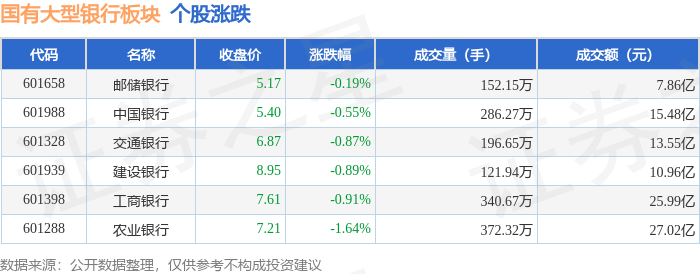
Market Performance - The state-owned large bank sector declined by 1.08% compared to the previous trading day, with Agricultural Bank leading the decline [1] - The Shanghai Composite Index closed at 4101.91, down 0.26%, while the Shenzhen Component Index closed at 14281.08, down 0.18% [1] Individual Bank Performance - Postal Savings Bank closed at 5.17, down 0.19% with a trading volume of 1.52 million shares and a transaction value of 7.86 billion [1] - Bank of China closed at 5.40, down 0.55% with a trading volume of 2.86 million shares and a transaction value of 15.48 billion [1] - Bank of Communications closed at 6.87, down 0.87% with a trading volume of 1.97 million shares and a transaction value of 13.55 billion [1] - China Construction Bank closed at 8.95, down 0.89% with a trading volume of 1.22 million shares and a transaction value of 10.96 billion [1] - Industrial and Commercial Bank closed at 7.61, down 0.91% with a trading volume of 3.41 million shares and a transaction value of 25.99 billion [1] - Agricultural Bank closed at 7.21, down 1.64% with a trading volume of 3.72 million shares and a transaction value of 27.02 billion [1] Fund Flow Analysis - The state-owned large bank sector saw a net inflow of 146 million from institutional investors, while retail investors contributed a net inflow of 123 million [1] - The sector experienced a net outflow of 269 million from speculative funds [1] Detailed Fund Flow for Individual Banks - Bank of Communications had a net inflow of 172 million from institutional investors, while speculative funds saw a net outflow of 67.34 million [2] - Industrial and Commercial Bank had a net inflow of 73.01 million from institutional investors, with a significant net outflow of 363 million from speculative funds [2] - Postal Savings Bank had a net inflow of 65.23 million from institutional investors, while speculative funds had a net inflow of 37.30 million [2] - Bank of China had a net inflow of 6.76 million from institutional investors, with speculative funds contributing a net inflow of 43.81 million [2] - China Construction Bank experienced a net outflow of 18.52 million from institutional investors, while speculative funds had a net inflow of 66.99 million [2] - Agricultural Bank had a net outflow of 153 million from institutional investors, with a small net inflow of 13.28 million from speculative funds [2]

美国中国总商会举行2026年农历马年颁奖晚宴
Zhong Guo Xin Wen Wang· 2026-01-16 07:38
Group 1 - The event held by the China General Chamber of Commerce (CGCC) in New York on January 15, 2026, gathered around 300 attendees from the political and business sectors of both China and the United States [1][3] - The theme of the evening was "Riding Together, Moving Forward," emphasizing the importance of cooperation and trust in a complex and uncertain world [1][3] - CGCC awarded the "Outstanding Partner Award" to Vornado Realty Trust and "Brand Awards" to SANY Group, Saint-O Group Limited, and Pop Mart for their contributions to strengthening Sino-U.S. economic relations and promoting local community and global economic development [3] Group 2 - Michael Franco, President and CFO of Vornado Realty Trust, highlighted the importance of CGCC as a model for U.S.-China cooperation, emphasizing the foundation of mutual respect and long-term commitment in their partnerships [3] - The event featured a performance by Zhiyuan Robotics from China, showcasing a blend of technology and art, which added a dynamic atmosphere to the evening [3]




中国银行业:企业贷款强劲支撑贷款平稳增长,零售需求持续疲软-China Banks_ Strong corporate lending supports stable loan growth amid persistently weak retail demand
2026-01-16 02:56
Summary of Key Points from the Conference Call Industry Overview - **Industry**: Chinese Banking Sector - **Key Metrics**: Total Social Financing (TSF), Loans, Deposits Core Insights 1. **Total Social Financing (TSF) and Loan Growth**: - New TSF in December 2025 reached Rmb 2.2 trillion, a year-over-year decrease of Rmb 0.6 trillion, primarily due to a decrease in government bond issuance by Rmb 1.1 trillion [1] - Government bond issuance for the full year 2025 increased by Rmb 14 trillion (+23% year-over-year), contributing 39% of new TSF, up from 35% in 2024 [1] - Rmb loans to the real economy decreased by Rmb 16 trillion (-7% year-over-year), contributing 45% of new TSF, down from 53% in 2024, indicating weak demand from the real economy [1] 2. **Loan Composition**: - New loans totaled Rmb 0.9 trillion in December 2025, a year-over-year decrease of Rmb 0.1 trillion [1] - Retail credit saw a net decrease of Rmb 0.1 trillion, with short-term retail loans continuing a downward trend since October [1] - Corporate loans increased by Rmb 1.1 trillion (up Rmb 0.6 trillion year-over-year), attributed to a low base from December 2024 due to local government debt swaps [1] 3. **Credit Growth Dynamics**: - For the full year 2025, corporate loans contributed 95% of new credits, compared to 79% in 2024, with corporate loan growth at 9.1% versus 0.5% for retail loans [1] - Discussions with banks suggest that retail credit demand may improve in 2026 as retail risks are digested and consumption stimulus policies take effect [1] 4. **Deposit Trends**: - Deposits increased by Rmb 1.7 trillion, up Rmb 3.1 trillion year-over-year, primarily due to a smaller decline in non-bank financial institution deposits [5] - Household deposit growth remained robust, with a net increase of Rmb 2.6 trillion (up Rmb 0.4 trillion year-over-year) [5] - M2 growth rate was 8.5% year-over-year, rebounding from 8.0% in November, supported by fiscal spending [5] 5. **Market Conditions**: - M1 growth rate declined to 3.8% year-over-year from 4.9% in November, possibly due to a high base from large-scale corporate debt repayments in December 2024 [5] Additional Important Insights - The banking sector is experiencing a shift with corporate lending becoming the primary driver of credit growth, while retail lending remains subdued due to weak consumption and regulatory impacts [1][5] - The overall economic environment is characterized by a cautious outlook on retail credit demand, with expectations for gradual improvement in the coming year [1]
银行大额存单利率新低 部分跌破1%
Jin Rong Shi Bao· 2026-01-16 01:13
Core Insights - The deposit market is undergoing significant changes in 2026, with large-denomination certificates of deposit (CDs) seeing a decline in interest rates, with some small and medium-sized banks offering 3-month products below 1%, marking a historic low [1][2] - This shift is altering depositors' perceptions of "high-interest deposits" and is prompting a restructuring of asset allocation in the financial market [1] Summary by Categories Interest Rate Trends - The interest rates for short-term large-denomination CDs have dropped below 1% for the first time, with most banks focusing on products with a maturity of one year or less [1] - The issuance of three-year products has significantly decreased, and five-year products are nearly non-existent, with rates for three-year products generally not exceeding 2% and one-year rates often below 1.5% [1][2] Market Dynamics - The interest rate gap between newly issued large-denomination CDs and regular fixed-term deposits is narrowing, indicating a deepening downward trend in deposit rates as of 2026 [2] - The decline in large-denomination CD rates is attributed to multiple factors, including sustained pressure on banks' net interest margins and regulatory efforts to curb irrational deposit competition [2][4] Investment Strategies - Experts suggest that the era of "easy money" from large-denomination CDs is coming to an end, urging investors to diversify their asset allocations [4][5] - Recommended investment options for conservative investors include fixed-term deposits and savings bonds, while those with a higher risk tolerance may consider "fixed income plus" products and equity-based financial products to enhance returns [4][5]
并购票据机制优化月余 多家银行助力业务落地
Zhong Guo Zheng Quan Bao· 2026-01-15 21:11
Core Viewpoint - The optimization of the merger note mechanism enhances market attractiveness and serves as a catalyst for structural adjustments in the real economy, with banks actively facilitating merger note projects following the new regulations [1][2]. Group 1: Mechanism Optimization - The highlights of the merger note mechanism optimization include expanded scope and improved efficiency, allowing funds to be used more flexibly for transaction payments and replacing bridge financing, significantly reducing liquidity pressure on enterprises [2]. - The notification prioritizes support for traditional advantageous industries' transformation, strategic emerging industries, and future industrial layout mergers, aligning with the macro guidance for resource allocation optimization [2]. - The optimization of the registration mechanism significantly shortens the cycle from project initiation to fund availability, addressing the previous issue of slow fund availability compared to transaction pace [2]. Group 2: Bank Involvement - Since the notification was released, multiple banks have facilitated the successful issuance of merger notes, including a record financing scale of 5 billion yuan for China Minmetals Corporation's mid-term notes [3]. - Banks play a crucial role in the issuance process, acting as underwriters and book managers, leveraging interbank market mechanisms to provide information disclosure, organize transactions, and support liquidity [3][4]. - The involvement in merger note projects allows banks to enhance their income structure through underwriting fees, deepen client relationships, and promote their investment banking transformation [4]. Group 3: Comprehensive Service for Mergers - In addition to merger notes, merger loans are also vital tools for banks in providing merger financing services, with larger state-owned enterprises preferring merger notes to reduce financial costs [5]. - Merger loans are favored by small and medium-sized enterprises for their flexibility, while merger notes require higher information transparency due to public disclosure [5]. - A combination of merger loans and merger notes can improve the accessibility and matching of financing for enterprises, addressing both short-term bridge funding needs and long-term cost reduction [5].

银行大额存单利率新低,部分跌破1%
新华网财经· 2026-01-15 14:03
Core Viewpoint - The deposit market is undergoing significant changes in 2026, with large-denomination certificates of deposit (CDs) experiencing a downward trend in interest rates, leading to some small and medium-sized banks offering 3-month products with rates falling below 1%, officially entering the "0" range [2][3]. Group 1: Changes in Deposit Products - The decline in interest rates for short-term large-denomination CDs is a notable market phenomenon, marking the first occurrence in recent years [3]. - This shift is altering depositors' perceptions of "high-interest deposits" and is driving a restructuring wave in the asset allocation of the entire wealth management market [4]. - Over 40 banks have announced the issuance of large-denomination CDs in early 2026, with significant changes in both "term" and "interest rate" compared to previous years. Most banks are focusing on products with a term of one year or less, while the issuance of three-year products has sharply decreased, and five-year products are nearly extinct [5]. Group 2: Interest Rate Trends - The interest rates for three-year products are generally below 2%, with one-year rates often falling below 1.5%, and rates for products with a term of one year or less have dropped below 1% [5]. - Major banks have collectively removed five-year large-denomination CDs from sale, with available products typically having a term of three years or less. For instance, the Industrial and Commercial Bank of China and China Construction Bank offer three-year CDs at a rate of 1.55%, while one-month and three-month CDs from several major banks have rates of 0.9% [5]. Group 3: Market Dynamics and Future Outlook - The interest rate gap between newly issued large-denomination CDs and regular fixed-term deposits is narrowing, indicating a deepening trend of declining deposit rates as 2026 begins [7]. - The decline in large-denomination CD rates is attributed to multiple factors, including the pressure on banks' net interest margins, leading them to lower long-term high-cost liabilities and adjust rates downward [8]. - Regulatory efforts to curb irrational deposit competition among banks have also played a role in suppressing high-interest deposit strategies [8]. - There is a growing trend of private negotiations for high-interest CDs on social platforms, indicating a shift in market behavior [8][9]. - Experts predict that large-denomination CD rates will continue to decline, especially for short-term products, suggesting that the likelihood of earning passive income through these instruments is significantly decreasing [10]. - Investors are advised to diversify their asset allocations, with stable investors focusing on fixed-term deposits and savings bonds, while those with higher risk tolerance may consider "fixed income plus" products and equity investments [10].

中国银行董事长葛海蛟会见加中贸易理事会董事会主席德马雷
Zheng Quan Shi Bao Wang· 2026-01-15 12:32
转自:证券时报 人民财讯1月15日电,1月15日,中国银行董事长葛海蛟在中国银行总行大厦会见加中贸易理事会董事会 主席奥利维耶·克雷蒂安·德马雷一行,围绕支持两国企业双向投资、深化中加经贸金融交流、推动绿色 金融合作、拓展人民币国际使用等话题深入交流。双方一致认为,中加经济互补性强、合作潜力巨大。 双方将以此次会见为契机,进一步加强多领域务实合作,持续服务两国企业交流,共享市场发展机遇, 为深化中加经贸关系注入新动力。 ...