Nanhua Futures(603093)

Search documents
南华期货:以提升新质生产力为抓手 推进期货行业服务创新
Qi Huo Ri Bao· 2025-11-27 02:28
Core Viewpoint - The transformation of the futures industry is driven by new productive forces, leveraging advanced technologies such as big data, artificial intelligence, and blockchain to reconstruct industry infrastructure and service processes, shifting from a trading channel to a comprehensive risk management service provider [1] Group 1: Challenges in the Futures Industry - The development of new productive forces in the industry faces significant bottlenecks, including insufficient technological integration, a lack of AI-based real-time risk warning systems, and a high proportion of basic brokerage services that fail to meet the personalized hedging needs of enterprises [1] - There is a notable shortage of innovative derivative tools to address the complex risk exposures of emerging industries such as new energy and semiconductors [1] - The scarcity of high-end, cross-disciplinary talent proficient in financial engineering, industry logic, and technology applications poses a challenge to the industry's growth [1] Group 2: Technological Empowerment and Service Innovation - The company emphasizes the need to invest heavily in intelligent trading and risk control systems, deploying machine learning algorithms for real-time market monitoring and risk assessment [2] - Blockchain technology is being explored to enhance trust and efficiency in commodity financing and credit security through immutable records of warehouse receipts and delivery tracing [2] - A data hub is being developed to integrate diverse data sources, creating industry-specific risk maps to guide dynamic hedging strategies [2] Group 3: Product Innovation - The company is accelerating the development of innovative futures and options products linked to emerging fields such as new energy metals, electricity, and weather derivatives to provide tailored financial tools for various industries [4] - There is a focus on promoting "futures+" combination products, such as integrating minimum guaranteed return options into insurance and futures collaborations [4] Group 4: Service Model Restructuring - The company advocates for "embedded advisory" services, integrating professional teams into the decision-making processes of enterprises to offer comprehensive solutions for inventory management and cost locking [5] - A vertical industry service platform is being developed to consolidate price information and logistics resources, creating an ecosystem for industry risk management [5] Group 5: Risk Control System Enhancement - A multi-level stress testing matrix is being established to simulate the impact of unforeseen events on investment portfolios and market liquidity [7] - The company has developed a risk management system that effectively measures credit and price risks in real-time, enhancing risk control efficiency [7] Group 6: Talent Development and Innovation - The company is implementing a dual-track training mechanism to cultivate both traditional trading skills and industry-specific knowledge through hands-on experience [8] - The "Spark Program" aims to create a talent ecosystem in the financial derivatives field, fostering modern financial talent with cross-market analysis capabilities [9]

铂、钯期货上市首日,南华资本首单铂场外期权交易落地
Qi Huo Ri Bao· 2025-11-27 02:13
Core Insights - The launch of platinum and palladium futures on November 27 at the Guangzhou Futures Exchange marks a significant breakthrough in China's precious metals derivatives system, providing domestic enterprises with independent risk management tools and reducing reliance on foreign futures instruments [1][2] - The introduction of these futures is expected to help establish a more comprehensive and authoritative domestic pricing system for platinum and palladium [1] Group 1: Industry Impact - Platinum and palladium are critical raw materials for the automotive, refining, and new energy industries, with their price fluctuations significantly affecting production costs for companies in these sectors [2] - Prior to the domestic futures launch, companies relied on NYMEX platinum and palladium futures for cross-border revenue swap transactions, indicating a need for more localized risk management solutions [2] Group 2: Company Initiatives - Nanhua Futures and its risk management subsidiary, Nanhua Capital, have actively responded to client needs, achieving the first off-exchange options transaction on the listing day of platinum futures [1] - The collaboration with a domestic high-tech enterprise specializing in advanced coating and functional materials demonstrates the effective use of financial derivatives to enhance product price competitiveness and operational efficiency [2] - Nanhua Futures and Nanhua Capital are committed to serving the real economy by providing comprehensive risk management services across the entire platinum and palladium industry chain, aiming to foster new productive forces in China's modernization efforts [2]
衍生品助黄金零售企业破解经营困局
Qi Huo Ri Bao· 2025-11-26 16:07
Core Insights - The gold jewelry market in China is experiencing a significant decline in demand, with a reported consumption of 278 tons in the first three quarters of 2025, representing a 25% year-on-year decrease [1] - Despite high international gold prices, retail companies in the gold jewelry sector are facing structural challenges, including a "store closure wave" and pressure on inventory management and profitability [1][4] - The pricing mechanism in the gold jewelry supply chain exposes retailers to risks due to price fluctuations, leading to a dual challenge of high prices reducing operational efficiency and suppressing consumer demand [2] Industry Performance - Major gold jewelry retailers, such as Chow Tai Fook and Luk Fook, have reported significant store closures, with Chow Tai Fook closing 296 stores and Chow Sang Sang reducing 333 stores in the first nine months of the year [1] - The retail sector is under pressure from high costs and low consumer demand, impacting profitability and operational strategies [1][4] Risk Management Strategies - A "laddered" risk management solution has been designed for gold jewelry retailers, incorporating put option protection strategies and zero-cost collar strategies to mitigate price fluctuation risks [2][3] - The put option strategy offers a safety net for retailers against price declines while allowing them to benefit from price increases, although it comes with high premium costs [2][3] - The zero-cost collar strategy provides downside protection while capping upside potential, allowing retailers to manage their financial exposure effectively without initial costs [3] Market Outlook - The gold market is expected to remain in a long-term bullish trend due to factors such as central bank purchases, geopolitical risks, and production cost support [2] - The industry is encouraged to explore market-based compensation mechanisms and innovative pricing models to adapt to the current economic environment [4]
中美大豆贸易正“按计划进行” 豆一期货高位震荡
Jin Tou Wang· 2025-11-26 07:09
Core Viewpoint - The soybean futures market is experiencing a downward trend, with the main contract reported at 4093.00 yuan/ton, reflecting a decrease of 0.58% [1] Group 1: Market Data - Brazil's soybean export volume for November is projected to be 4.4 million tons, down from the previous forecast of 4.71 million tons [2] - As of November 21, the deliverable soybean inventory at CBOT was 18.441 million bushels, an increase of 2.54% from the previous week and a significant rise of 68.12% compared to the same period last year [2] Group 2: Institutional Insights - Nanhua Futures reports that the domestic soybean spot market remains stable, with prices holding steady and limited changes. The selling pressure from the Northeast region is noticeably dispersed, and high-quality soybeans are being withheld from sale, maintaining strong prices. Market participants are cautious about high-price purchases, leading to slow circulation of goods [3] - Guotou Anxin Futures notes that domestic soybean prices are fluctuating, with a rebound followed by a pullback. The current spot market prices are stable, and there is a strong willingness among market participants to maintain prices. The tightening supply of high-protein soybeans is creating optimistic expectations, which is positively influencing the overall soybean market [3]
南华期货早评-20251126
Nan Hua Qi Huo· 2025-11-26 02:17
1. Report Industry Investment Ratings No industry investment ratings are provided in the given reports. 2. Core Views of the Reports Macro and Financial Futures - The US economic data indicates an increasing possibility of interest - rate cuts. The market is focusing on November employment data and the appointment process of the Fed Chair. In China, the economic fundamentals are cooling marginally, while the policy remains firm, and the market anticipates more policy support [1][2]. - The USD/CNY exchange rate is expected to "oscillate at the bottom with a slowly declining central level". The RMB's internal appreciation power is accumulating, and the potential rebound of the US dollar is weaker than the previous cycle [4]. - The expectation of Fed rate cuts in December exceeds 80%, which supports the repair of stock index valuations. However, market sentiment is cautious, and the short - term stock index is expected to run strongly and gradually fill the previous gap [5]. - The short - term trading sentiment of treasury bonds is weak, but the medium - term outlook is optimistic [6]. Commodities Metals - Precious metals are expected to see their price centers rise in the medium - to - long term. Short - term attention should be paid to the December Fed rate - cut expectation and the 60 - day moving average [9][12]. - Copper prices are likely to fluctuate around 86,000 yuan/ton, and downstream enterprises in need of inventory are recommended to buy futures for hedging [13][16]. - Aluminum is expected to oscillate at a high level; alumina is expected to run weakly; cast aluminum alloy is expected to oscillate at a high level; zinc is expected to oscillate; nickel and stainless steel may continue to correct; tin is expected to oscillate at a high level; lithium carbonate futures prices will fluctuate greatly; industrial silicon and polysilicon are expected to oscillate weakly; lead is expected to oscillate [16][17][20]. Black Commodities - Rebar and hot - rolled coils are expected to oscillate within a range with bottom support [27][29]. - Iron ore prices are expected to oscillate widely in the short term, and it is recommended to wait for the basis to repair before considering short - selling [29][30]. - Coking coal and coke: The short - term downward space of coking coal is limited, and the far - month 05 contract has medium - to - long - term long - allocation potential; for coke, it is not recommended to blindly participate in the downward trend [31][32]. - Ferrosilicon and ferromanganese are expected to oscillate weakly [33]. Energy and Chemicals - LPG is expected to oscillate, with overall fundamentals changing little and slightly weakening [34][35]. - PTA - PX: The aromatics blending - oil logic is weakening. PTA's supply - demand margin has improved, and it is recommended to consider buying on dips [37][39]. - MEG - bottle chips: The overall supply - demand situation is still surplus, and it is recommended to short on rallies [40][42]. - Methanol: The rebound height of the 01 contract is limited, and it is recommended to hold short - call options and conduct reverse spreads [43][44]. - PP is expected to oscillate at a low level, with supply pressure marginally relieved but weak demand [46][47]. - PE is expected to maintain a low - level oscillation pattern, with a supply - strong and demand - weak situation [49][50]. - Pure benzene and styrene are expected to oscillate weakly. In the long term, the price may fall if the US - South Korea pure benzene trading lacks continuity [51]. - Fuel oil: The cracking spread of high - sulfur fuel oil has stabilized and rebounded, but it is still bearish in the future; the cracking spread of low - sulfur fuel oil has weakened, but the overall driving force is still upward [51][53]. - Asphalt: The short - term price is expected to oscillate. It is recommended to pay attention to the long - allocation opportunity of BU2603 [54][55]. - Glass, soda ash, and caustic soda are expected to oscillate at a low level. Soda ash is mainly cost - priced; glass is affected by cold - repair expectations; caustic soda has supply pressure and weak demand [55][57][58]. Pulp and Paper - Pulp prices are still likely to decline, while the price of offset paper has received some support from paper mills' price increases [58][59]. Others - Logs: The 01 contract is expected to be weak in the short term, and it is recommended to consider short - selling on rallies and 01 - 03 reverse spreads [61][62]. - Propylene is expected to maintain a weak pattern [63][64]. 3. Summaries by Relevant Catalogs Macro and Financial Futures Market Information - US economic data: September PPI increased by 0.3% month - on - month, core PPI increased by 0.1% month - on - month; ADP data showed a weekly average decrease of 13,500 private - sector jobs in the past four weeks; September retail sales increased by 0.2% month - on - month [1][4][5]. - Fed officials' statements and related news: Some Fed officials' statements strengthened the expectation of a December rate cut; there are speculations about the Fed Chair nominee [1][4]. - Geopolitical events: Ukraine agreed to the core terms of the US - proposed plan, and the situation in the Red Sea is related to the shipping market [1]. - Exchange rate: On - shore and off - shore RMB exchange rates against the US dollar rose above 7.09 [3]. Core Logic - Overseas: The US employment data is divided, and the market focuses on November employment data and the Fed Chair appointment. Domestic: The economic fundamentals are cooling, but the policy is firm, and the market expects more policy support [2]. Commodities Metals Precious Metals - Market performance: COMEX gold and silver futures prices fluctuated slightly; SHFE gold and silver futures prices rose [9]. - Rate - cut expectations and fund holdings: The market expects an over 80% probability of a Fed rate cut in December; long - term funds increased their holdings of gold and silver ETFs [10][11]. - Key points of attention: US government data release, Fed economic beige book, and Thanksgiving holiday trading arrangements [11]. Base Metals - Copper: Overnight copper prices in different markets showed different trends; copper inventories in different exchanges changed; the US PPI was in line with expectations, and copper prices were affected by rate - cut expectations [13][14][16]. - Aluminum and related products: The price of electrolytic aluminum is expected to oscillate at a high level; alumina is expected to run weakly; cast aluminum alloy is recommended to pay attention to the price difference with aluminum [16][17]. - Zinc: Zinc prices oscillated, with high smelting - end ore - grabbing and reduced TC, and the market is in a state of long - short divergence [17][18]. - Nickel and stainless steel: Nickel and stainless - steel prices corrected, affected by Indonesian policies and cost support; nickel - iron prices continued to decline, and stainless - steel exports had some positive factors [18][20]. - Tin: Tin prices oscillated at a high level, with supply problems and Congo - Kinshasa unrest affecting the market [20][21]. - Lithium carbonate: Futures prices rose, and the market is concerned about supply and demand changes and battery - cell production schedules [22]. - Industrial silicon and polysilicon: Futures prices showed different trends, and the market is expected to oscillate weakly, with the trading logic potentially shifting to supply - demand fundamentals [23][24]. - Lead: Lead prices continued to decline, with raw - material shortages in the smelting end and potential import increases to balance the market [25][26]. Black Commodities Rebar and Hot - Rolled Coils - Market performance: Prices rose slightly, and the increase was accompanied by position reduction, affected by iron ore [27]. - Core logic: The supply and demand of steel improved marginally, with inventory slowly decreasing; iron ore prices oscillated, and the profit of steel enterprises decreased, increasing the risk of negative feedback [27][28]. Iron Ore - Market information: Iron ore prices were strong, with port and overseas inventories changing; the Fed's dovish statements increased the rate - cut probability [29]. - Core logic: Prices oscillated widely, affected by coking coal; the iron - ore market was balanced in the short term, with structural shortages of medium - grade ore [30]. Coking Coal and Coke - Market information: Coking coal prices in Shanxi decreased; the Fed official advocated rate cuts; relevant coal - mine policies were introduced [30]. - Core logic: Coking coal prices continued to decline, with supply increasing and demand weakening in the short term, but there is support in the medium term; for coke, it is not recommended to blindly short [31][32]. Ferrosilicon and Ferromanganese - Market performance: Prices oscillated. - Core logic: The profitability of steel mills declined, iron - alloy demand is expected to decrease, and they face high - inventory and weak - demand problems [33]. Energy and Chemicals LPG - Market performance: LPG futures prices oscillated, and spot prices changed slightly. - Core logic: Supply increased slightly, demand was weak, and the market was affected by crude - oil price fluctuations [34][35]. PTA - PX - Market information: PX supply increased, and PTA had many shutdowns; polyester demand was expected to remain high [37][38]. - Core logic: The aromatics blending - oil logic weakened, and PTA's supply - demand margin improved, with attention paid to restart plans and blending - oil dynamics [37][39]. MEG - Bottle Chips - Market information: MEG inventory was stable, and some devices restarted or shut down; polyester demand was expected to remain high [40][42]. - Core logic: The supply - demand situation was still surplus, and it is recommended to short on rallies [40][42]. Methanol - Market performance: Methanol futures prices oscillated around 2000 yuan/ton. - Core logic: The port pressure in December is expected to increase, and the rebound height of the 01 contract is limited [43][44]. PP - Market performance: PP futures prices declined, and spot prices were weak. - Core logic: Supply pressure was marginally relieved, but demand was weak after the "Double Eleven" [46][47]. PE - Market performance: PE futures prices declined, and spot prices changed slightly. - Core logic: The supply - strong and demand - weak situation continued, with the end of the agricultural - film peak season [49][50]. Pure Benzene and Styrene - Market performance: Futures prices showed different trends, and spot prices changed slightly. - Core logic: The market was affected by the aromatics blending - oil speculation, and the long - term price may fall if the US - South Korea pure benzene trading lacks continuity [51]. Fuel Oil - Market performance: High - sulfur and low - sulfur fuel - oil futures prices showed different trends. - Core logic: The cracking spread of high - sulfur fuel oil is bearish; the cracking spread of low - sulfur fuel oil has upward driving force [51][53]. Asphalt - Market performance: Asphalt futures and spot prices changed slightly. - Core logic: The short - term price is expected to oscillate, and it is recommended to pay attention to the long - allocation opportunity of BU2603 [54][55]. Glass, Soda Ash, and Caustic Soda - Market performance: Futures prices of glass, soda ash, and caustic soda showed different trends. - Core logic: Soda ash is cost - priced; glass is affected by cold - repair expectations; caustic soda has supply pressure and weak demand [55][57][58]. Pulp and Paper - Market performance: Pulp and offset - paper futures prices showed different trends. - Core logic: Pulp prices are likely to decline, while offset - paper prices are supported by paper mills' price increases [58][59]. Others Logs - Market performance: Log futures prices declined, and spot prices generally decreased. - Core logic: The 01 contract is weak, and it is recommended to short on rallies and consider 01 - 03 reverse spreads [61][62]. Propylene - Market performance: Propylene futures prices declined, and spot prices increased slightly. - Core logic: Propylene supply is loose, and demand is affected by PP and other downstream industries, with an expected weak - oscillation pattern [63][64].
油料产业周报:中美领导人会面,关注中方采购-20251125
Nan Hua Qi Huo· 2025-11-25 11:35
Report Industry Investment Rating No information provided in the report. Core Views - The trading focus of the domestic soybean meal futures lies in whether the 53 bushels per acre yield of US soybeans will continue to decline and whether China's purchase of 12 million tons of US soybeans will be fulfilled. If the US soybean inventory remains around 300 million bushels, the annual price of US soybeans will oscillate around the cost line, and the domestic soybean meal futures will lack a clear trend in the short term and follow the US market. In the medium term, the shipment schedule of China's US soybean purchases will determine the domestic supply situation [1]. - Rapeseed meal will maintain a weak supply - demand situation in the fourth quarter. With the depletion of rapeseed and rapeseed meal inventories, the market is weak due to the expected supply recovery after Australian rapeseed arrives in November. As it is the off - season for aquaculture, demand growth is limited, and inventories are expected to rise. The timing of going long after November depends on subsequent changes in warehouse receipts [1]. - In the short term, the near - month soybean meal market is affected by high inventory levels at ports and oil mills, a slight increase in oil mill crushing volume, and limited downstream purchasing sentiment. The approaching expiration of warehouse receipts is also influencing the market. In the long term, the cost of distant - month soybeans is firm, import profits have slightly recovered, but the supply of distant - month purchases is limited. The easing of Sino - US trade relations is expected to fill the supply gap, and the demand for rapeseed meal is expected to weaken. The downstream demand for rapeseed meal is expected to decline slightly in the fourth quarter, and the potential for a bumper harvest in South America will put pressure on the domestic rapeseed meal market [5][8]. Summary by Directory Chapter 1: Core Contradictions and Strategy Recommendations 1.1 Core Contradictions - **Soybean Meal**: The trading focus of the outer - market US soybeans is on the supply - side yield and the demand - side China's purchase. The domestic soybean meal lacks a clear trend in the short term and is affected by China's purchase schedule in the medium term [1]. - **Rapeseed Meal**: It is in a weak supply - demand situation in the fourth quarter. The market is weak due to expected supply recovery and limited demand growth. The timing of going long depends on warehouse receipts [1]. 1.2 Trading Strategy Recommendations - **Trend Judgment**: The market is expected to oscillate within a range. The M2601 contract is expected to oscillate between 2800 - 3200, and it is difficult to break through this range [16]. - **Strategy Suggestions**: Consider covered call strategies using options, hold previously sold call options on rapeseed meal 2601, and go short at the upper end of the range for those without positions [16]. - **Basis, Spread, and Arbitrage Strategies**: Use accumulated option purchases to reduce basis risk, expect the M1 - 5 spread to stop falling around 170, and contract the spread between soybean meal and rapeseed meal 2601 at high levels (650, 700) [17]. 1.3 Industry Customer Operation Suggestions - **Price Range Forecast**: The price of soybean meal is expected to be between 2800 - 3300, and rapeseed meal between 2250 - 2750 [19]. - **Hedging Strategies**: Traders with high protein inventories can short soybean meal futures to lock in profits; feed mills with low inventories can buy soybean meal futures to lock in purchase costs; oil mills worried about excessive imports can short soybean meal futures to lock in profits [19]. 1.4 Basic Data Overview - **Futures Prices**: Provide closing prices, daily changes, and percentage changes of soybean meal, rapeseed meal, CBOT soybeans, and the offshore RMB [20]. - **Spreads and Basis**: Include spreads between different contracts of soybean meal and rapeseed meal, as well as basis data for spot prices [21]. - **Import Costs and Crushing Profits**: Present import costs and crushing profits of soybeans and rapeseed from different origins [22]. Chapter 2: This Week's Important Information and Next Week's Focus Events 2.1 This Week's Important Information - **Positive News**: The US Secretary of Agriculture expects to announce a farmer assistance program and a China - US soybean purchase agreement in two weeks. The USDA export inspection report shows the export inspection volume of US soybeans, and private US exporters have reported multiple sales of soybeans to China [24][25]. - **Negative News**: The soybean sowing progress in Argentina is delayed, and Brazil's soybean exports in November have increased [26]. - **Spot Transaction Information**: Downstream buyers continue to purchase on a need - to - use basis [26]. 2.2 Next Week's Focus Events - Monitor domestic weekly inventory data, Brazilian Secex weekly reports, USDA crop growth reports, export inspection reports, export sales reports, and CFTC agricultural product position reports [32]. Chapter 3: Market Interpretation 3.1 Price - Volume and Capital Interpretation - **Domestic Market** - **Unilateral Trends**: The domestic soybean meal futures followed the outer - market trend, falling first and then rising. Rapeseed meal rose first and then fell due to news of Australian rapeseed imports [31]. - **Capital Movements**: The main profitable positions in soybean meal and rapeseed meal are hedging or institutional short positions. Foreign capital has closed long positions, and institutional positions have reduced short positions and increased long positions. The put - call ratio of soybean meal options indicates a bearish sentiment in the market [31]. - **Spread Structure**: The spread between different contracts of soybean meal and rapeseed meal shows a seasonal pattern. This week, the 1 - 5 spread of soybean meal weakened, and the same is true for rapeseed meal [36]. - **Basis Structure**: The basis of soybean meal remained stable, while the basis of rapeseed meal declined. The spot spread between soybean meal and rapeseed meal narrowed. The far - month basis is inversely related to the crushing profit, and the basis is expected to decline [41]. - **Foreign Market** - **Foreign Trends**: This week, the outer - market US soybeans rebounded due to Sino - US negotiations and potential soybean purchases, but the increase was limited by EUDR and the US soybean oil government restructuring [52]. - **Capital Positions**: The net managed positions in CBOT soybeans have returned above the zero line, indicating a short - term return of long - only funds [58]. Chapter 4: Valuation and Profit Analysis 4.1 Production Area Profit Tracking - The crushing profit in the US soybean production area has increased due to the decline in soybean prices and the rise in soybean oil and soybean meal prices. The profit in the Brazilian production area has also increased, while the profit in the Argentine production area has weakened. The domestic crushing profit of Canadian rapeseed has remained stable due to the rise in rapeseed prices [64]. 4.2 Import - Export Crushing Profit Tracking - Despite the recent rebound in US soybeans, crushing profits have not improved effectively. The rebound in US soybean prices has offset the decline in the premium of Brazilian and Argentine soybeans, and it is difficult to obtain profitable commercial purchases. The acceleration of non - commercial purchases of distant - month US soybeans may lead to supply pressure, and the pricing method based on cost or profit may be temporarily invalid [68]. - Although rapeseed imports show a crushing profit, the purchase of rapeseed is expected to remain cautious due to import margin requirements [69]. Chapter 5: Supply - Demand and Inventory Projection 5.1 International Supply - Demand Balance Sheet Projection - **US**: The estimated US soybean production in November is 4.3 billion bushels, a decrease of 48 million bushels from the September forecast, mainly due to a decline in yield. Exports are expected to decrease by 50 million bushels, while crushing volume remains unchanged. The ending inventory is expected to decline slightly, and the average farm price is expected to increase by $0.50 per bushel to $10.50 [72][73]. - **Global**: In 2025/26, the global soybean supply - demand forecast shows a decline in beginning stocks and production, a decrease in crushing volume, a slight increase in exports, and a decline in ending stocks. The decrease in ending stocks in Argentina, Brazil, the US, the EU, Ukraine, and India is partially offset by the increase in China's inventory [75][76]. 5.2 Domestic Supply and Projection - The import volume of soybeans is expected to decline seasonally in the second half of the fourth quarter, mainly due to the loss of crushing profits and the difficulty of fully purchasing US soybeans through commercial channels. Rapeseed imports will remain at a low level [77]. 5.3 Domestic Demand and Projection - Domestic soybean crushing volume is expected to remain high due to the carry - over inventory from the third quarter and the fourth - quarter imports. However, the consumption of soybean meal is expected to have limited growth after the previous high - level stocking [79]. 5.4 Domestic Inventory and Projection - Domestic soybean inventories are at a seasonal high but are expected to decline in the fourth quarter and stabilize and rebound in the first quarter of next year. The inventory of soybean meal is also expected to decline with the reduction of raw material inventory and crushing volume and remain at around 600,000 tons in the first quarter of next year [81].
南华期货:清算资质再扩容,打通“加密+能源”双市场
Zheng Quan Shi Bao Wang· 2025-11-25 05:40
Core Insights - Nanhua Futures has successfully obtained clearing membership with Nodal Clear, enhancing its global clearing capabilities and marking a significant step in its internationalization strategy [1][2][5] Group 1: Clearing Membership and Global Expansion - Nanhua Futures' subsidiary, Nanhua USA LLC, has been approved as a clearing member of Nodal Clear, allowing access to both Nodal Exchange and Coinbase Derivatives [1][2] - This approval follows Nanhua Futures' earlier membership with ICEU, making it the third major clearing license acquired, thus strengthening its global service network across Asia, Europe, and North America [1][2][5] - The new clearing qualification enables Nanhua Futures to participate in specialized markets for North American electricity, natural gas, and environmental products, as well as innovative crypto products [2][3] Group 2: Business Performance and Financial Growth - Nanhua Futures has seen significant growth in its overseas business, with revenue from international operations increasing from 231 million to 654 million yuan from 2022 to 2024, reflecting a compound annual growth rate of 68.26% [4] - The net profit of its subsidiary, Honghua International, reached 417 million yuan in 2024, highlighting the importance of overseas operations as a key profit source [4] - As of June 2025, the total client equity in Nanhua Futures' overseas brokerage business was 17.768 billion HKD, with a year-on-year growth of 32.25% [4] Group 3: Strategic Positioning and Market Trends - Nanhua Futures is one of the few domestic firms with clearing qualifications in major exchanges in China, the U.S., and Europe, positioning itself favorably in the competitive landscape [5] - The firm is responding to the challenges in the domestic brokerage business by expanding its international presence, which is seen as a pathway to mitigate intense competition and transition towards comprehensive solutions [5][6] - The global political and economic environment has heightened the role of futures and derivatives in risk management, with the Chinese futures market experiencing significant growth in trading volume and value [6]
短期无更多利好驱动 预计尿素期货震荡筑底为主
Jin Tou Wang· 2025-11-24 07:08
Core Viewpoint - The domestic futures market for the chemical sector shows mixed performance, with urea futures experiencing a downward trend due to high supply pressures and limited short-term demand drivers [1] Supply - As of November, urea daily production is expected to remain high due to policy support and profit recovery, which exerts significant pressure on prices [1] - Total inventory of Chinese urea enterprises is reported at 1.4372 million tons, lower than last week's expectations, while port sample inventory stands at 100,000 tons, aligning with previous forecasts [1] Demand - Recent concentrated procurement for reserve demand in Northeast China may slow down as previous purchases have adequately supplemented stocks [1] - There is a slight increase in compound fertilizer production, with companies beginning to schedule winter storage fertilizers, leading to a narrow rise in capacity utilization [1] - Export demand is gradually increasing with the implementation of a new batch of quotas [1] Market Outlook - Urea prices are expected to stabilize with limited downward space due to export policies and cost support, while there are no significant upward drivers in the short term [1] - Future demand will focus on export and winter storage needs, while supply considerations will include winter production halts and cost support [1] - The strategy suggests focusing on buying on dips due to low prices [1]

四季度新粮的压力还在 玉米盘面单边上行难度较大
Jin Tou Wang· 2025-11-23 23:27
Core Viewpoint - The corn futures market is experiencing a slight upward trend, with a weekly increase of 0.60% in prices, while supply pressures are gradually easing due to consumption of existing stocks [1][2][3] Market Performance - As of November 21, 2025, the main corn futures contract closed at 2195 CNY/ton, with a weekly trading range between 2162 CNY/ton and 2205 CNY/ton, and an increase in open interest by 2138 contracts compared to the previous week [1] - The weekly opening price was 2188 CNY/ton, indicating a stable trading environment [1] Supply and Demand Analysis - The USDA reported net corn export sales for the 2025/2026 marketing year at 2.2597 million tons, a significant increase from the previous week's 1.3948 million tons [2] - National corn inventory among 96 major processing enterprises was recorded at 2.727 million tons, reflecting a slight decrease of 0.29% [2] - The corn prices in the Bayuquan Port region for new corn with 15% moisture content ranged from 2170 to 2175 CNY/ton, showing a decrease of 10 CNY/ton from the previous day [2] Institutional Insights - Nanhua Futures noted that while supply pressures are easing, the fourth quarter's supply capacity remains sufficient, and the market is observing the selling sentiment among farmers [3] - Dongwu Futures highlighted that feed enterprises are experiencing low inventory levels, which, combined with strong demand from downstream sectors, is leading to a tightening supply situation and a rebound in spot prices [3] - The overall grain selling progress is at 22%, which is faster than the same period last year, indicating a robust selling pace [3]
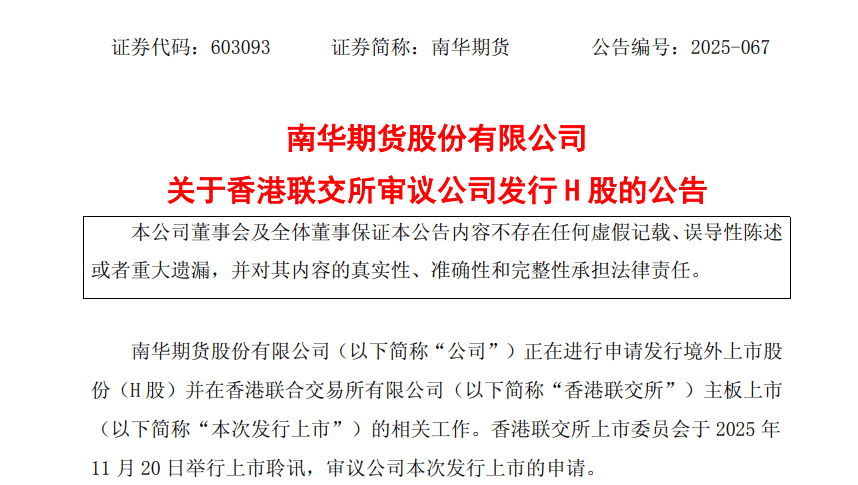
南华期货(603093)已举行香港上市聆讯,保荐人收到相关信函、但不构成正式的上市批准
Sou Hu Cai Jing· 2025-11-22 06:29
Core Viewpoint - Nanhua Futures Co., Ltd. is progressing with its application for a Hong Kong listing, with the listing hearing scheduled for November 20, 2025, by the Hong Kong Stock Exchange's listing committee [1]. Group 1: Listing Progress - Nanhua Futures announced its application for a Hong Kong listing, with the listing hearing held on November 20, 2025 [1]. - The exclusive sponsor received a letter from the Hong Kong Stock Exchange on November 21, 2025, indicating that the listing application has been reviewed, but this does not constitute formal approval [1]. - The company still requires final approval from the Hong Kong Securities and Futures Commission and the Hong Kong Stock Exchange, indicating uncertainty in the listing process [1]. Group 2: Company Ranking and Services - Nanhua Futures is recognized as a leading futures company in China, providing global financial services, including domestic futures brokerage, risk management, and wealth management [2]. - According to a Frost & Sullivan report, in 2024, Nanhua Futures ranked 8th among all futures companies in China by total revenue and 1st among non-financial institution-related futures companies [2]. - The company ranked 1st in overseas income among all futures companies in China in 2024 and 3rd in return on equity (ROE) among all 53 listed securities and futures companies [2].