HAI TIAN(603288)

Search documents
【早报】吴清发声,事关资本市场;商务部:已批准部分稀土出口通用许可申请
财联社· 2025-12-18 23:10
Industry News - The State Council issued opinions on cracking down on illegal tobacco activities, emphasizing strict regulation of e-cigarettes and severe penalties for illegal production, wholesale, transportation, and sales [2][7] - Wu Qing attended a meeting to discuss the capital market's 14th Five-Year Plan, focusing on risk prevention, strong regulation, and promoting high-quality development [6][7] - The Ministry of Commerce responded to the European Commission's investigations into Chinese companies, highlighting the discriminatory nature of these actions and affirming China's commitment to protecting its enterprises [2][7] Company News - GuoDun Quantum's chairman, Lv Pin, unexpectedly passed away [10] - China International Capital Corporation announced a cash dividend of 434 million yuan for the first half of 2025, with the record date set for December 26 [10] - Li Chunhua, a shareholder of Lida Xin, reduced his stake by 1.56% between December 10 and December 17 [10] - Visionox plans to sign an investment cooperation agreement to advance the Hefei 8.6-generation AMOLED production line project, with a capital requirement of 9.443 billion yuan [10] Investment Opportunities - Micron Technology reported a booming demand for High Bandwidth Memory (HBM), with a projected compound annual growth rate (CAGR) of approximately 40%, increasing from about $35 billion in 2025 to around $100 billion by 2028 [20] - The persistent demand for memory in AI computing highlights the critical role of HBM, as the need for memory capacity and bandwidth continues to grow significantly [20]




陆家嘴财经早餐2025年12月19日星期五
Wind万得· 2025-12-18 22:45
Group 1 - China's Hainan Free Trade Port officially launched its zero-tariff operation on December 18, expanding the range of zero-tariff goods to over 6,600 items, enhancing consumer experience for travel and shopping [2] - The Ministry of Commerce has reintroduced export license management for steel for the first time in 16 years to strengthen monitoring and analysis of steel product exports [2] - A giant underwater gold mine has been discovered in Shandong Province, with proven gold reserves of over 3,900 tons, accounting for approximately 26% of the national total [2] Group 2 - The State Administration for Market Regulation emphasizes the need to strengthen the construction of a unified national market and promote fair competition [3] - The U.S. has initiated a military sale to Taiwan valued at approximately $11 billion, marking one of the largest military sales [3] - The State-owned Assets Supervision and Administration Commission has issued guidelines for holding central enterprises accountable for investment violations, effective from January 1, 2026 [3] Group 3 - The China Securities Regulatory Commission is advancing the "14th Five-Year" plan for the capital market, focusing on comprehensive reforms and high-level opening-up [4] - A-share indices showed divergence, with the Shanghai Composite Index closing up 0.16% while the Shenzhen Component Index and ChiNext Index fell by 1.29% and 2.17%, respectively [4] - The Hong Kong stock market is undergoing a narrow consolidation, with the Hang Seng Index closing up 0.12% [4] Group 4 - Morgan Stanley predicts that chip stocks will remain one of the best-performing sectors in the U.S. stock market next year, highlighting Nvidia, Broadcom, and Astera Labs as top picks [5] - Insurance asset management institutions have registered 83 asset-backed plans this year, totaling approximately 344.56 billion yuan [5] - Domestic GPU companies, Moore Threads and Muxi Co., have recently listed on the STAR Market, attracting significant investment from insurance funds [5] Group 5 - A wave of IPOs is expected in the Hong Kong capital market, with several companies starting public offerings on December 18 [6] - The Ministry of Industry and Information Technology announced that the photovoltaic industry will enter a critical phase in 2026, focusing on capacity regulation [8] Group 6 - The State Council has issued guidelines to strengthen electronic cigarette regulation and combat illegal tobacco-related activities [9] - The upcoming New Year's holiday is projected to significantly boost the domestic tourism market, with flight bookings increasing by approximately 46% year-on-year [9] - The total scale of bank wealth management products reached a historical high of about 34 trillion yuan by the end of November [9] Group 7 - The People's Bank of China will issue 40 billion yuan in central bank bills in Hong Kong on December 22, with a maturity of six months [18] - The U.S. Treasury Department reported an increase in Japan's holdings of U.S. Treasury securities to $1.2 trillion in October [18]


佛山市海天调味食品股份有限公司2025年回报股东特别分红预案公告
Shang Hai Zheng Quan Bao· 2025-12-18 21:13
Core Viewpoint - The company, Foshan Haitian Flavoring and Food Co., Ltd., has announced a special dividend plan for 2025, proposing a cash dividend of 3.0 RMB per 10 shares (including tax) to reward shareholders [2][3]. Dividend Distribution Plan - The special dividend will be distributed based on the total share capital registered on the equity distribution date, excluding shares held in the company's repurchase account. The total share capital as of the board meeting date is 5,851,824,944 shares, with 5,289,491 shares in the repurchase account, resulting in a base for distribution of 5,846,535,453 shares. The total cash dividend to be distributed amounts to 1,753,960,635.90 RMB (including tax) [3][11]. - If there are changes in the total share capital before the equity distribution date, the total distribution amount will remain unchanged, and the per-share distribution ratio will be adjusted accordingly [3][11]. Decision-Making Process - The special dividend plan was approved during the 11th meeting of the 6th Board of Directors held on December 18, 2025. The board authorized the chairman and designated personnel to determine the payment date and other necessary matters for the smooth implementation of the special dividend [5][26]. - The plan is subject to approval by the company's shareholders' meeting [6][26]. Future Shareholder Return Plan - The company has established a three-year shareholder return plan for 2025-2027, committing to a cash dividend totaling no less than 80% of the net profit attributable to the parent company's shareholders each year, excluding special dividends [21][24]. - The plan emphasizes long-term development and aims to create a sustainable and predictable shareholder return mechanism while ensuring the company's healthy and sustainable growth [22][24].
晚间公告|12月18日这些公告有看头
Di Yi Cai Jing· 2025-12-18 14:55
Group 1 - Haitai Flavor Industry plans to distribute cash dividends of no less than 80% of the net profit attributable to shareholders for the next three years (2025-2027) [2] - Haitai will implement a special dividend plan for 2025, distributing 3.0 yuan (including tax) for every 10 shares [2] Group 2 - Xusheng Group's controlling shareholder is planning a change in control, leading to a suspension of trading for the company's stock starting December 19, 2025 [3] Group 3 - Guandong Quantum's chairman, Lü Pin, has passed away, and the company expresses deep condolences [4] Group 4 - Former controlling shareholder of Guao Technology, Chen Chongjun, has been sentenced to six years in prison for manipulating the securities market, with a fine of 4 million yuan [5] - The company states that this judgment will not significantly impact its operations [5] Group 5 - Tianfeng Securities plans to extend a 4 billion yuan subordinated debt for one year and reduce the interest rate from 5% to 4% [6] Group 6 - Zhongwei Company is planning to acquire controlling stakes in Hangzhou Zhonggui Electronic Technology Co., Ltd., leading to a stock suspension starting December 19, 2025 [7] Group 7 - Shandong Highway intends to provision for a long-term equity investment impairment of approximately 690 million yuan related to Dongxing Securities, which will reduce the company's consolidated profit for 2025 by the same amount [8] Group 8 - HeFu China has experienced a significant stock price increase of 349.25% from October 28 to December 18, 2025, despite being in a loss position [9] - The company warns of risks related to high valuation and operational performance [9] Group 9 - Xizang Pharmaceutical plans to repurchase shares worth between 170 million and 200 million yuan, with a maximum repurchase price of 55 yuan per share [11] Group 10 - Junshi Biological's major shareholder, Shanghai Tanying, plans to reduce its stake by up to 2% through block trading [12] Group 11 - Dazhong Mining's major shareholders and executives plan to reduce their holdings by up to 1.44% due to personal financial needs [13] Group 12 - Ruicheng Environmental Protection's shareholder plans to reduce its stake by up to 3% [14] Group 13 - Allianz Vision's actual controller Xu Jin plans to reduce his stake by up to 0.9609% [15] Group 14 - Yidong Electronics' controlling shareholder's concerted action reduced their holdings by 1% from December 10 to December 17 [16] Group 15 - Ningbo Construction won a project bid worth 747 million yuan for infrastructure enhancement [18] Group 16 - Qinglong Pipe Industry signed a sales contract worth 55.27 million yuan for a water diversion project [19] Group 17 - Zhongfutong received a selection notice for a procurement project with estimated amounts of 411 million yuan and 162 million yuan [20] Group 18 - Shikong Technology won a bid for a smart cultural tourism integration project worth 141 million yuan [21]


突发!这家公司前实际控制人因操纵证券市场罪获刑六年
Xin Lang Cai Jing· 2025-12-18 14:21
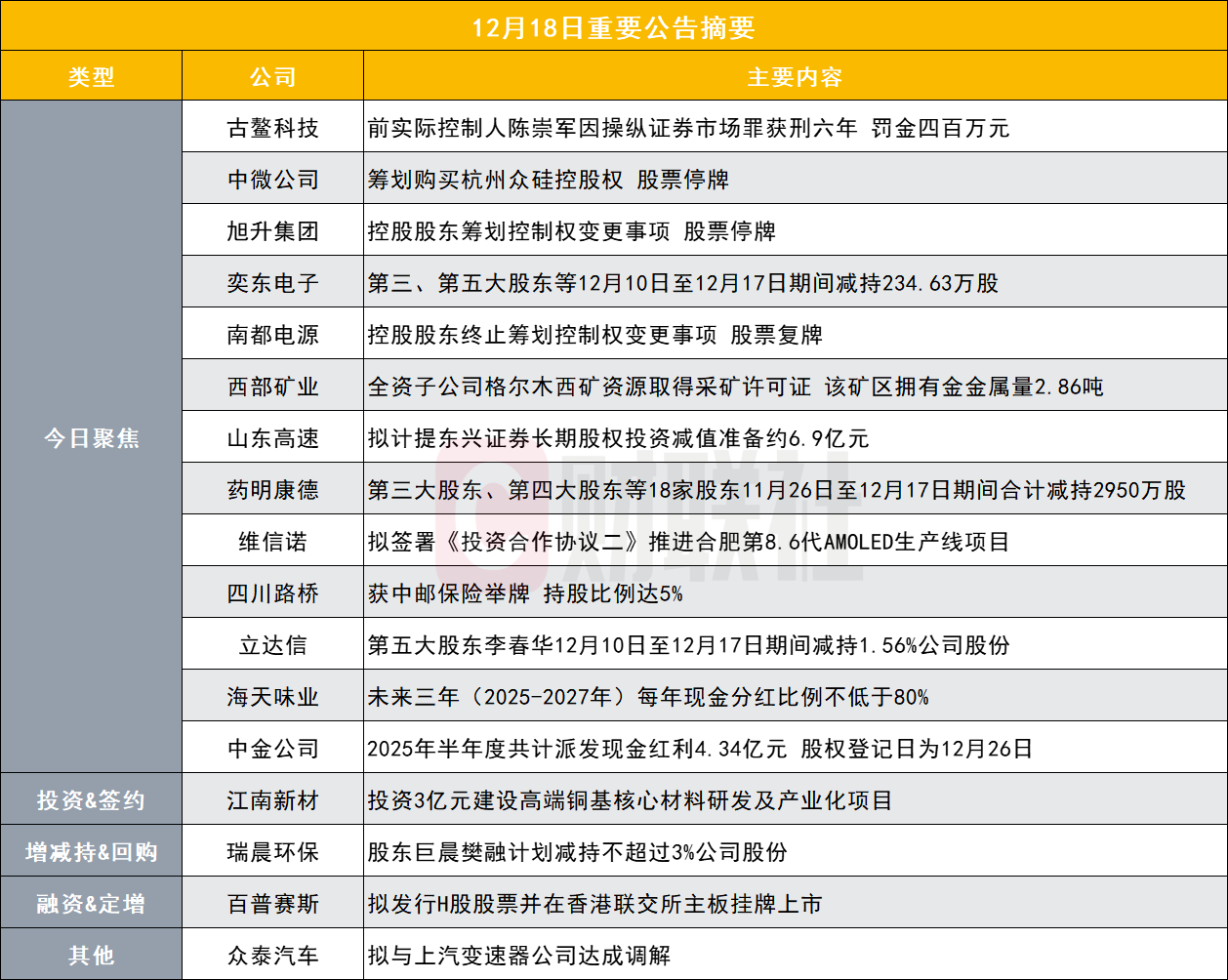
Company Announcements - Guo Xin Technology's former actual controller Chen Chongjun was sentenced to six years in prison and fined 4 million yuan for manipulating the securities market [2] - Zhongwei Company is planning to acquire the controlling stake in Hangzhou Zhonggui, leading to a stock suspension [3] - Xusheng Group's controlling shareholder is planning a change of control, resulting in a stock suspension [4] - Yidong Electronics' major shareholders reduced their holdings by 2.3463 million shares between December 10 and December 17 [5] - Nandu Power's controlling shareholder has terminated plans for a change of control, leading to stock resumption [6] - Xibu Mining's subsidiary obtained a mining license for a site with 2.86 tons of gold metal [8] Financial Adjustments - Shandong Highway plans to provision for a long-term equity investment impairment of approximately 690 million yuan related to Dongxing Securities [8] - WuXi AppTec's third and fourth largest shareholders reduced their holdings by a total of 29.508 million shares between November 26 and December 17 [9] Investments and Partnerships - Weixinno plans to sign an investment cooperation agreement to advance the Hefei 8.6 generation AMOLED production line project with a capital of 9.443 billion yuan [10] - Jiangnan New Materials is investing 300 million yuan to build a high-end copper-based core material R&D and industrialization project [15] Shareholding Changes - Sichuan Road and Bridge received a stake increase from Zhongyou Insurance, raising its holding to 5% [11] - Lidasin's fifth largest shareholder reduced their holdings by 1.56% between December 10 and December 17 [12] - Ruicheng Environmental Protection's shareholder plans to reduce their holdings by up to 3% [17] Dividends and Profit Distribution - Haitian Flavoring plans to maintain a cash dividend ratio of no less than 80% for the next three years (2025-2027) [13] - CICC announced a cash dividend distribution of 434 million yuan for the first half of 2025, with a record date of December 26 [14] Financing and Listings - Baipusais plans to issue H-shares and list on the Hong Kong Stock Exchange [21]


壕气!603288,拟派发超17亿元特别红包!更承诺:未来三年分红比例不低于80%!
Zhong Guo Ji Jin Bao· 2025-12-18 14:10
Core Viewpoint - Haitian Flavor Industry plans to implement a special dividend of 3 yuan per 10 shares, totaling 1.754 billion yuan, as part of its commitment to enhance shareholder returns [2] Group 1: Dividend Plans - The company announced a special dividend for 2025, marking the 20th anniversary of its largest production base, which has been recognized as a "World Lighthouse Factory" [2] - Prior to this, Haitian had already completed a semi-annual dividend in September 2025, distributing 2.6 yuan per 10 shares, totaling 1.519 billion yuan [2] - After the special dividend, the total dividends distributed by Haitian will amount to 3.273 billion yuan, representing approximately 61.50% of the net profit attributable to shareholders for the first three quarters of 2025 [2] Group 2: Future Dividend Strategy - From 2025 to 2027, Haitian plans to ensure that the total cash dividends each year will account for no less than 80% of the net profit attributable to shareholders, excluding any special dividends [4] - This strategy reflects the company's confidence in its long-term development prospects and aims to enhance shareholder satisfaction and confidence in long-term holdings [4] Group 3: Financial Performance - In the first three quarters of 2025, Haitian achieved a revenue of 21.628 billion yuan, a year-on-year increase of 6.02%, and a net profit attributable to shareholders of 5.322 billion yuan, up 10.54% year-on-year [5] - As of the end of the third quarter, the company had cash and cash equivalents of 22.476 billion yuan and a low debt-to-asset ratio of 15.38% [5] - Haitian became the first company in the seasoning industry to be listed on both A-share and H-share markets in June 2025 [5]
海天味业拟实施特别分红,每10股派发现金红利3元
Zhong Guo Ji Jin Bao· 2025-12-18 14:10
Core Viewpoint - Haitian Flavor Industry plans to implement a special dividend of 3 yuan per 10 shares, totaling 1.754 billion yuan, to enhance shareholder returns [1][2]. Group 1: Special Dividend Announcement - On December 18, Haitian Flavor Industry announced a special dividend for 2025, distributing 3 yuan per 10 shares, amounting to a total of 1.754 billion yuan [1]. - The decision for the special dividend is based on the company's strong performance and the 20th anniversary of its major production base, which has been recognized as a "World Lighthouse Factory" [1]. - Following this special dividend, the total dividends distributed by Haitian Flavor Industry will reach 3.273 billion yuan, representing approximately 61.50% of the net profit attributable to shareholders for the first three quarters of 2025 [1]. Group 2: Future Dividend Plans - Haitian Flavor Industry has announced a shareholder return plan for 2025-2027, committing to a cash dividend payout ratio of no less than 80% of the net profit attributable to shareholders each year, excluding any special dividends [2]. - This initiative reflects the company's confidence in its long-term development and aims to enhance shareholder satisfaction and confidence in long-term holdings [2]. Group 3: Financial Performance - For the first three quarters of 2025, Haitian Flavor Industry reported revenue of 21.628 billion yuan, a year-on-year increase of 6.02%, and a net profit attributable to shareholders of 5.322 billion yuan, up 10.54% year-on-year [3]. - As of the end of the third quarter, the company had cash reserves of 22.476 billion yuan and a low debt-to-asset ratio of 15.38% [3]. - Haitian Flavor Industry became the first company in the seasoning industry to be listed on both A-share and H-share markets in June 2025 [3].

壕气!603288,拟派发超17亿元特别红包!更承诺:未来三年分红比例不低于80%!
中国基金报· 2025-12-18 14:07
【导读】海天味业拟实施特别分红,每 10 股派发现金红利 3 元 中国基金报记者 郑俊婷 一向慷慨分红 的 海 天味 业(证券代码: 6 0328 8 )拟加大投资者回报力度。 12 月 18 日晚间,海天味业发布公告称,拟实施 2025 年特别分红,向全体股东 每 10 股 派发现金红利 3 元(含税),合计拟派发现金红利 17.54 亿元(含税)。 海 天味 业表示, 2025 年公司整体保持了较好的发展态势和较强的竞争力,又恰逢全球最大 的调味品生产基地 —— 海天高明园区投产 20 周年且获评 " 世界灯塔工厂 " ,经董事会审 议,拟实施一次特别分红。 在此之前,海天味业已于 9 月份完成了 2025 年 A 股半年度分红,向 A 股全体股东每 10 股派发现金红利 2.6 元(含税),合计派发现金红利 15.19 亿元(含税)。 待此次特别分红完成, 海天味业 将合计分红 32.73 亿元(含税),约占 2025 年前三季度 归母净利润的 61.50% 。 Choice 数据显示,自 2014 年上市以来,海天味业每年都坚持现金分红,且多年 现 金股利 支付 率都在 60% 以上。 2021 年至 ...

12月18日重要资讯一览
Zheng Quan Shi Bao Wang· 2025-12-18 13:58
Group 1 - New stock offerings include Qiangyi Co. with an issuance price of 85.09 CNY per share and a subscription limit of 0.75 million shares, Yufan Technology at 22.29 CNY per share with a limit of 0.85 million shares, and Shuangxin Environmental Protection at 6.85 CNY per share with a limit of 60 million shares [2] - The Ministry of Commerce announced that some Chinese exporters have met the basic requirements for applying for general licenses regarding rare earth export controls, with some applications already approved [3] - The Hong Kong Stock Exchange is proposing a new trading unit framework to enhance market efficiency and reduce investment thresholds, which includes lowering the minimum value for trading units from 2000 HKD to 1000 HKD [4] Group 2 - The State Council issued guidelines to combat illegal activities related to tobacco, aiming to address issues such as counterfeiting and smuggling [4] - The State-owned Assets Supervision and Administration Commission released measures for accountability in investment violations, categorizing asset losses and defining responsibilities based on severity [5] - The Ministry of Industry and Information Technology announced that the photovoltaic industry will enter a critical governance phase by 2026, focusing on capacity regulation and management of manufacturing projects [5] Group 3 - The Bank of England announced a reduction in the benchmark interest rate from 4% to 3.75%, marking the lowest rate since February 2023 [6] - Haitian Flavor Industry plans to distribute a special dividend of 3 CNY per share [8] - Sichuan Road and Bridge has been acquired by Zhongyou Insurance, reaching a 5% shareholding [8]



通过科学评估推动企业深层次变革,2025第一财经资本市场价值调研年度企业揭晓
Di Yi Cai Jing· 2025-12-18 12:18
Core Insights - The 2025 First Financial Capital Annual Conference held in Shanghai focused on innovation paths and industrial transitions under the new five-year development cycle, aiming to create a cross-sector dialogue platform for the industry, academia, and capital markets [1] Group 1: Annual Awards - The annual list of influential companies was announced, recognizing 32 listed companies for their outstanding performance in various fields, categorized into four awards: Annual Influential Company, Annual Innovative Company, Annual Competitive Company, and Annual Return Company [1][5] - The companies awarded for Annual Influential Company include Huatai Securities, Lingyi Technology, Ninghu Expressway, and others, showcasing their market recognition and industry development through innovation and management optimization [5][6] - The Annual Innovative Company awardees include Lanke Technology, Kelun Pharmaceutical, and others, emphasizing the importance of innovation as a core driver for business development [5][6] - The Annual Competitive Company awardees, such as Haitian Flavoring and Shanghai Laishi, were recognized for their contributions to modernizing the industrial and supply chains, promoting collaborative innovation [5][6] - The Annual Return Company awardees, including Guobo Electronics and Srey New Materials, were acknowledged for providing reasonable returns to investors while ensuring sustainable development [5][6] Group 2: Research and Evaluation Model - The First Financial Capital Market Value Research aims to guide the efficient allocation of innovative resources towards emerging industries and assist traditional industries in enhancing competitiveness through technological upgrades [2] - The evaluation model focuses on four core dimensions: influence, innovation, competitiveness, and return, utilizing data from Wind, Choice, and other sources to track over 40 specific indicators [2] - The research emphasizes the dynamic monitoring of listed companies' profitability, governance structure optimization, and sustainable innovation-driven development to facilitate deeper transformations [2] Group 3: Conference Discussions - The conference included in-depth discussions on economic resilience and development paths, opportunities and challenges in technological innovation, and the transition of hard technology from "catching up" to "leading" [6] - Key topics also included the rational development and value identification of the AI industry, reflecting the current trends and future directions in technology and investment [6]