
ECOVACS(603486)

Search documents
iRobot破产启示录
Guo Ji Jin Rong Bao· 2025-12-29 09:23
Core Insights - iRobot, a pioneer in the robotic vacuum industry, has voluntarily filed for bankruptcy and will be delisted from NASDAQ, with trading of its common stock suspended on December 22 [1][4] - The company has reached a financial restructuring agreement with its creditor and manufacturing partner, Shenzhen Sijuan Robotics Co., Ltd., which will acquire 100% of iRobot's equity through a debt-to-equity swap, expected to be completed by February 2026 [1][4] Financial Performance - iRobot's revenue for the first three quarters of 2025 was $375 million, a 26.5% decrease from $510 million in the same period last year, with a net loss of $130 million, a 90% increase year-over-year [5][8] - The company has only $24.8 million in cash, while total liabilities have reached $508 million, with current liabilities at $480 million and stockholder equity at -$26.8 million [5][8] Market Position - iRobot's global market share in the high-end robotic vacuum segment has significantly declined from over 60% between 2015 and 2017 to just 7.9% in the first half of 2025, ranking fifth in the market [10][12] - The company has seen a continuous drop in revenue from $1.183 billion in fiscal year 2022 to an estimated $682 million in fiscal year 2024, with three consecutive years of net losses [8][10] Competitive Landscape - Chinese brands like Ecovacs and Roborock are rapidly gaining market share, with significant increases in overseas app downloads and product recommendations on major consumer platforms [11][12] - The innovation pace of iRobot has slowed, with competitors launching new products and features at a much faster rate, leading to a loss of competitive edge [12][16] Supply Chain and Operational Challenges - iRobot's reliance on third-party contract manufacturers for production has created vulnerabilities, particularly as it faces increased costs from tariffs and supply chain disruptions [16][18] - The company has shifted its production capacity from China to Vietnam to mitigate tariff risks, but still relies on Chinese suppliers for components, which complicates its operational strategy [16][18] Industry Evolution - The smart home service robot market is shifting towards Chinese manufacturers, who have developed robust supply chains and manufacturing capabilities, allowing for rapid product iteration and cost advantages [17][20] - The competitive focus is moving from mere product performance to ecosystem building and long-term technological endurance, indicating a significant industry transformation [20]


小家电板块12月29日跌1.04%,苏泊尔领跌,主力资金净流出2017.44万元
Zheng Xing Xing Ye Ri Bao· 2025-12-29 09:06
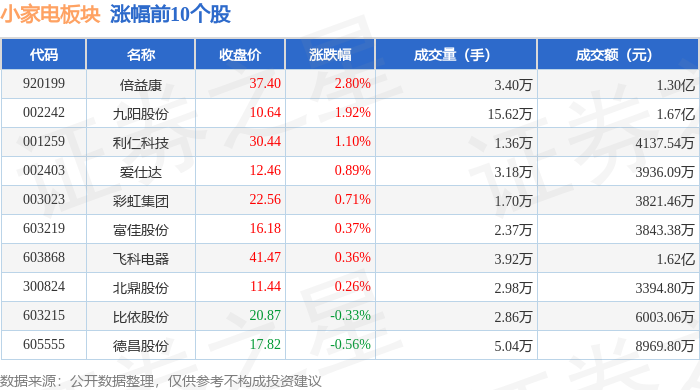
Market Overview - The small home appliance sector experienced a decline of 1.04% on December 29, with Supor leading the drop [1] - The Shanghai Composite Index closed at 3965.28, up 0.04%, while the Shenzhen Component Index closed at 13537.1, down 0.49% [1] Stock Performance - Notable gainers in the small home appliance sector included: - Beiyikang: Closed at 37.40, up 2.80% with a trading volume of 34,000 shares and a turnover of 130 million yuan [1] - Jiuyang: Closed at 10.64, up 1.92% with a trading volume of 156,200 shares and a turnover of 167 million yuan [1] - Liren Technology: Closed at 30.44, up 1.10% with a trading volume of 13,600 shares and a turnover of 41.38 million yuan [1] - Supor, however, saw a significant decline, closing at 44.48, down 3.24% with a trading volume of 55,600 shares and a turnover of 250 million yuan [2] Capital Flow - The small home appliance sector experienced a net outflow of 20.17 million yuan from institutional investors, while retail investors saw a net outflow of 27.48 million yuan [2] - Conversely, speculative funds recorded a net inflow of 47.65 million yuan [2] Individual Stock Capital Flow - Key stocks with significant capital flow included: - Ecovacs: Net inflow of 27.24 million yuan from institutional investors, with a net outflow of 45.32 million yuan from retail investors [3] - Lek Electric: Net inflow of 25.88 million yuan from institutional investors, with a net outflow of 43.15 million yuan from retail investors [3] - Stone Technology: Net inflow of 22.51 million yuan from institutional investors, with a net outflow of 37.08 million yuan from retail investors [3]


科沃斯“闪击”石头科技,反转成“乌龙大案”
Tai Mei Ti A P P· 2025-12-27 02:04
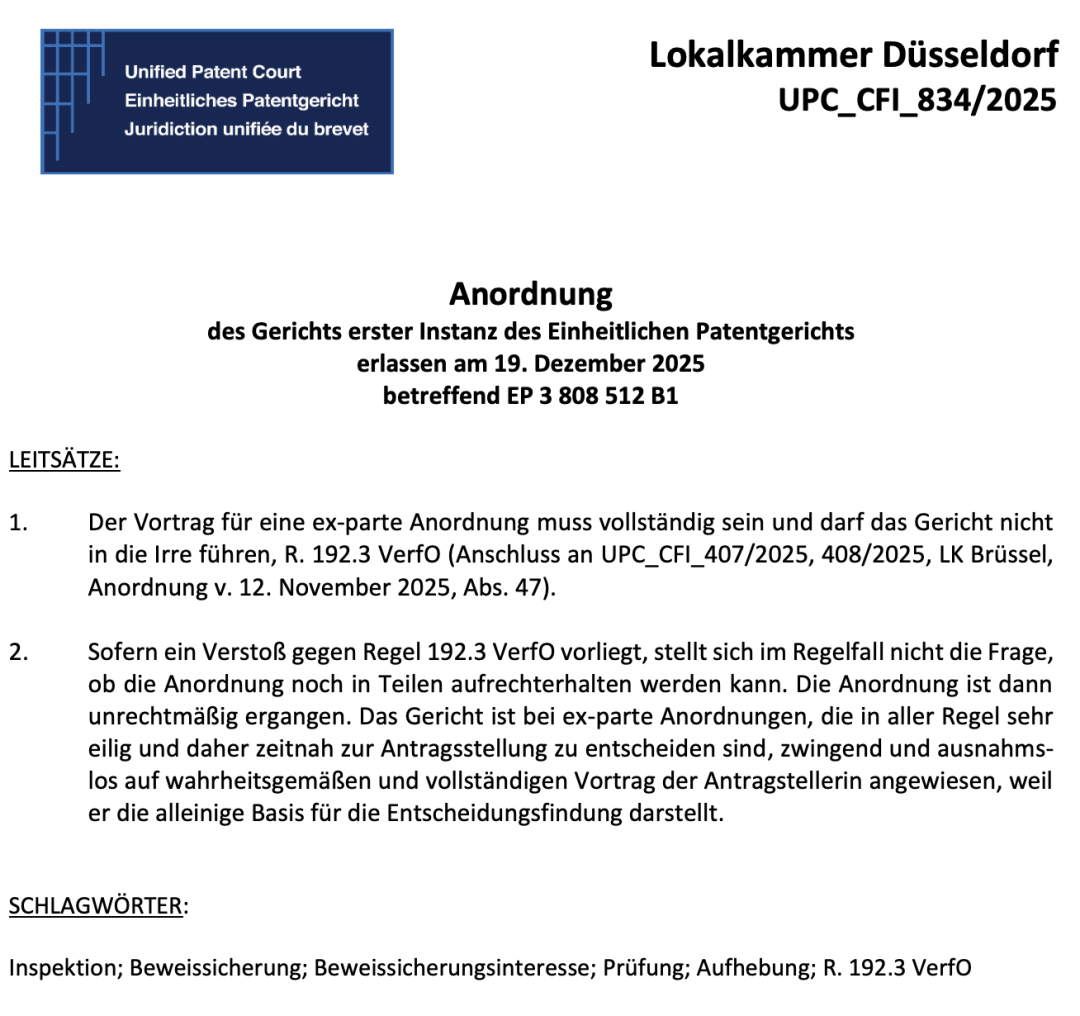
Core Viewpoint - The European Unified Patent Court (UPC) ruled that Ecovacs' request for an ex-parte order against Roborock during the IFA event was unlawful and subsequently revoked the order, highlighting the misuse of the UPC's emergency protection mechanism [1][4][13]. Group 1: Event Background - Ecovacs and Roborock are prominent domestic vacuum cleaner companies that have gained significant market share in Europe in recent years [4]. - During the IFA 2025, Ecovacs claimed that Roborock infringed its EP3808512 patent and sought evidence preservation from the UPC [10]. - The UPC is a supranational court established to address patent litigation across EU member states, providing jurisdiction that surpasses national courts [4]. Group 2: Legal Mechanism - An ex-parte order allows the court to issue orders without hearing the defendant's side, aimed at protecting urgent patent infringement cases [6][7]. - The UPC's emergency measures are designed to prevent the loss of critical evidence that may occur if immediate action is not taken [8][9]. Group 3: Court's Ruling - The UPC determined that Ecovacs' application for the ex-parte order was based on misleading and incomplete factual statements, violating the UPC's procedural rules [15][18]. - The court emphasized that if the facts had been fully disclosed, the ex-parte order would not have been issued, indicating a lack of urgency in the case [19][20]. Group 4: Principles of Ex-Parte Orders - The UPC operates under four key principles for issuing ex-parte orders: truthful representation, urgency, necessity, and proportionality [21][28]. - Ecovacs failed to demonstrate urgency as Roborock's products were already available for purchase on platforms like Amazon, undermining the claim of immediate need for evidence preservation [25][26]. Group 5: Industry Implications - The incident reflects the competitive nature of the cleaning appliance industry, where companies may leverage patent disputes to gain market advantages [35][40]. - The outcome of patent disputes can significantly impact market access, as seen when Roborock successfully sought a sales ban on Ecovacs' products in Germany [40].
家电行业专题研究:拥抱龙头,重视出海
Xin Lang Cai Jing· 2025-12-26 12:24
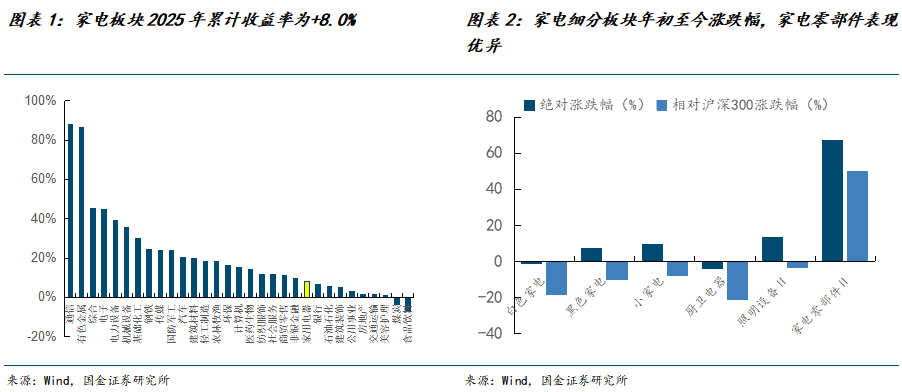
Group 1: Domestic Demand and Market Outlook - The home appliance sector is expected to show a "high first half and stable second half" trend in 2025, driven by policy continuation and consumption peaks [1] - In the first three quarters of 2025, air conditioner shipments increased by 8.4%, refrigerators by 2.4%, and washing machines by 4.1% year-on-year [1][13] - For 2026, the continuation of subsidies is anticipated to mitigate the impact of high base effects and demand pull-forward, with projected declines in overall appliance sales of -4% to -7.3% under various subsidy scenarios [1][16][19] Group 2: Export Performance and Global Market Trends - Home appliance exports have slowed down due to tariff policies and global supply chain adjustments, but still show resilience and structural highlights [2] - In 2025, the export growth rate for air conditioners is expected to be weaker than that of washing machines and refrigerators, primarily due to adverse weather conditions affecting overseas demand [2][39] - The U.S. market is projected to benefit from a rate cut, which may enhance demand for home appliances, while the European market is expected to maintain a slow recovery [42][44][50] Group 3: Investment Themes - The narrative in the black appliance sector is shifting from "market share chasing" to "profit and pricing power," with Chinese brands like Hisense and TCL expected to convert market share into higher profits [3][55] - White appliances are seen as having strong growth potential due to their historical resilience through cycles, with leading brands like Midea and Haier expected to maintain stable growth and generous dividends [3][83] - The global competition in new consumer products, particularly in smart imaging and robotic vacuum cleaners, is expected to favor Chinese brands, highlighting their competitive advantages [3] Group 4: Financial Metrics and Valuation - As of December 22, 2025, the home appliance sector's PE TTM is 16.27 times, remaining below the 10-year average of 32.8% [7] - The white appliance segment's current PE is 11.22, while black appliances stand at 25.94, indicating varying levels of market valuation [9] - The home appliance sector has seen a decline in public fund holdings, with a heavy allocation of only 2.46% in Q3 2025, reflecting concerns over demand in 2026 [9]



iRobot负债危机背后,中国服务机器人如何破局全球竞争?
Nan Fang Du Shi Bao· 2025-12-25 23:17
Core Viewpoint - iRobot has entered into a restructuring support agreement with its guarantor lenders and major supplier, Shenzhen Shanjun Robotics, which will acquire iRobot through a court-supervised process, marking a significant shift in the vacuum robot industry from foreign dominance to Chinese brand leadership [4]. Group 1: iRobot's Decline - At its peak, iRobot held an 80% global market share and sold over 50 million units, but has since lost its leading position due to over-reliance on a single product category and lack of innovation [5]. - iRobot's early patent barriers have diminished, and the company failed to adapt to technological advancements, leading to product issues in complex environments [5][6]. - The company's heavy reliance on a single contract manufacturer has weakened its supply chain resilience and quality control, contributing to its operational difficulties [6]. Group 2: Financial Performance - iRobot's revenue is projected to be $682 million in 2024, with 11 consecutive quarters of losses, unable to cover supply chain expenses through cash flow [7]. - The company's reliance on a "light asset model" has proven detrimental, as it lacks control over manufacturing and supply chain, leading to higher costs and reduced bargaining power [7]. Group 3: Competitive Landscape - Chinese brands like Ecovacs and Roborock have adopted a full-stack approach, integrating manufacturing capabilities and reducing costs, allowing them to price products competitively while maintaining healthy profit margins [8][9]. - Ecovacs has built a robust supply chain and invested heavily in R&D, resulting in significant product innovation and market responsiveness, contrasting with iRobot's slower innovation cycle [8][10]. Group 4: Industry Trends - The vacuum robot market is shifting from "incremental proliferation" to "stock competition," with emerging cleaning categories showing higher growth rates than traditional vacuum robots [9]. - Companies like Ecovacs and Roborock are diversifying their product lines, leading to substantial revenue growth and establishing a competitive edge in the smart home ecosystem [9][10]. Group 5: Technological Advancements - Chinese companies have transitioned from being global contract manufacturers to technology leaders, investing significantly in R&D to develop proprietary technologies and reduce reliance on foreign patents [10][11]. - The introduction of innovative products, such as integrated cleaning systems, has marked a new era in the vacuum robot industry, with Chinese firms leading in patent applications and technological advancements [11].

科沃斯CEO钱程:智能家居不是“产品堆砌”,而是“场景融合”
2 1 Shi Ji Jing Ji Bao Dao· 2025-12-25 12:41
Core Insights - The integration of AI large models in the home appliance and consumer electronics sectors is driving product innovation and market growth, redefining high-quality and intelligent living [1] - The focus is shifting from merely accumulating products to creating integrated scenarios in smart homes, with an emphasis on continuous technological innovation and collaboration [1] Company Performance - In the first half of 2025, the company's revenue reached 8.676 billion yuan, representing a year-on-year growth of 24.37% [1] - Research and development expenditure amounted to 507 million yuan, a year-on-year increase of 13.80%, accounting for 5.84% of total revenue [1] Market Trends - The Chinese cleaning appliance industry is projected to achieve sales of 42.3 billion yuan in 2024, reflecting a year-on-year growth of 24.4% [2] - AI applications, such as intelligent recognition, obstacle avoidance, and voice control, are key drivers for the upgrade and market penetration of cleaning appliances [2] Technological Advancements - The company is focusing on the deep integration of AI large models with vertical scenarios, which is seen as a critical competitive point for embodied intelligence [4] - Advances in sensing and control technologies are expected to transform cleaning robots from mere tools to intelligent companions [4] Strategic Collaborations - The company has announced a strategic partnership with Alibaba Cloud for a full-stack AI collaboration, enhancing its ability to apply AI capabilities in products [6] - The company is also actively pursuing partnerships with top tech firms and investing in various fields, including lightweight robotic arms and visual recognition [6] Global Market Strategy - The company is implementing localized strategies in different global markets by understanding local user needs and adapting products accordingly [7] - Specific products have been developed for different markets, such as the GOAT intelligent lawn mower for single-family homes in Europe and North America, and lighter models for compact living spaces in Japan and South Korea [7]
扫地机器人:海外市场格局迈入新阶段,期待2026CES引领技术风向
Donghai Securities· 2025-12-25 07:32
Investment Rating - The industry investment rating is "Overweight" [1] Core Insights - The global smart vacuum cleaner market is expected to see significant growth, with a projected shipment of 20.6 million units in 2024, representing a year-on-year increase of 11.2%. The total sales revenue is anticipated to reach $9.31 billion, up 19.7% year-on-year [5] - Chinese brands are solidifying their dominance in the global vacuum cleaner market, with the top five brands all being Chinese. Roborock leads with a market share of 21.7% in the first three quarters of 2025 [4][6] - iRobot, a pioneer in the vacuum cleaner industry, has filed for bankruptcy and will be acquired by Shikawa Robotics, marking a new phase in the industry. This acquisition may lead to a redistribution of market shares, focusing competition among Chinese brands [4][10] Summary by Sections Market Overview - The global smart vacuum cleaner market is projected to ship 17.424 million units in the first three quarters of 2025, reflecting an 18.7% year-on-year growth [4] - The average price of vacuum cleaners is expected to rise by 7.6% to $452 in 2024 due to technological upgrades [5] Competitive Landscape - The top five brands in global shipments are all Chinese, with Roborock and Ecovacs leading the market. Roborock achieved a shipment of 3.788 million units in the first three quarters of 2025 [6] - During major sales events like Black Friday, Roborock captured 40% of the market share in North America and 42% in Europe [6] Technological Innovations - The 2025 CES showcased significant innovations in vacuum cleaner technology, including models with advanced robotic arms capable of picking up objects, expanding their functionality beyond just cleaning [4][16] - Upcoming CES 2026 is expected to feature AI-powered vacuum cleaners with enhanced obstacle recognition and liquid detection capabilities, indicating a trend towards smarter home cleaning solutions [19] Investment Recommendations - The report suggests focusing on domestic vacuum cleaner companies such as Ecovacs and Roborock, which are well-positioned to capitalize on the growing market and technological advancements [4]
如何做“爆款”,科沃斯太懂了
Feng Huang Wang· 2025-12-25 03:28
Core Insights - The commercialization capability of technology combined with scene applications and stable growth in R&D investment are fundamental elements for Ecovacs' entry into embodied intelligence [1][5] Group 1: Market Trends and Events - CES 2026 will focus on AI hardware, consumer electronics innovation, and automotive technology, with AI hardware expected to be a major topic, particularly edge AI devices and robots [1] - Ecovacs will showcase its embodied intelligence products at CES 2026, marking its continued presence in the service robot sector since its first participation in 2018 [1] Group 2: Product Development and Innovation - Ecovacs has mastered the art of creating "hit products" through technical innovation and integration of scene applications, particularly in the competitive vacuum cleaner market [3] - The X8 product integrates a "washing machine structure + intelligent robot capability," addressing the issue of secondary pollution from cleaning cloths [3][4] - The X11 team has upgraded the OZMO ROLLER 2.0 technology, enhancing cleaning capabilities and user experience, leading to significant sales growth in the X series [4] Group 3: Financial Performance and R&D Investment - Ecovacs' revenue reached 12.877 billion yuan, a year-on-year increase of 25.93%, with net profit growing by 130.55% to 1.418 billion yuan [7] - The company invested 885 million yuan in R&D in 2024, a 7.3% increase, with a total of 2,545 authorized patents, including 713 invention patents [5][6] Group 4: Supply Chain and Manufacturing - Ecovacs has established a complete and mature robot supply chain system, producing nearly 30,000 service robots daily, with over half of the components sourced locally [6][7] - The company plans to invest 200 million yuan in a new manufacturing project for core components in Huzhou, aiming for an annual output of 20 million parts [9] Group 5: Competitive Landscape and Future Outlook - Ecovacs is positioned as a strong competitor in the embodied intelligence sector, leveraging its extensive experience in product development and supply chain management [2][10] - The company aims to enhance its product offerings and market presence in the high-end segment, with a focus on meeting evolving consumer demands [5][11]
财经观察美“扫地机器人鼻祖”破产,谁在重塑行业未来?
Huan Qiu Wang· 2025-12-24 22:39
Core Insights - iRobot, a pioneer in the robotic vacuum industry, has filed for bankruptcy due to rising costs and intensified global competition, leading to its acquisition by Chinese supplier Shenzhen Shanjun Robotics [1][2] - The situation reflects a significant restructuring within the global robotic vacuum industry, highlighting the challenges faced by American companies in the consumer electronics sector [1][3] Company Overview - iRobot, founded in 1990, was once a market leader with over 60% market share, particularly known for its Roomba vacuum [2] - The company has faced financial difficulties, with assets and liabilities between $100 million and $500 million, and has seen a workforce reduction of over 30% in the past three years [2][3] - iRobot's stock price plummeted over 70% following the bankruptcy announcement, with a market value decline of approximately 45% this year [2] Industry Dynamics - The U.S. robotic vacuum industry is experiencing systemic disconnection, with iRobot's management compensation misaligned with performance and increasing competition from more cost-effective and rapidly iterating products [3] - Trade policies, such as a 46% tariff on imports from Vietnam, have added approximately $23 million to iRobot's costs, further straining its operations [3] - Despite Roomba maintaining a 42% market share in the U.S. and 65% in Japan, the competitive landscape is shifting significantly [3] Chinese Market Position - Chinese manufacturers dominate the global robotic vacuum market, with companies like Roborock leading in shipments, accounting for 21.7% of the market [4][5] - The Chinese robotic vacuum industry is characterized by high growth, with exports expected to increase by over 20% this year, and a diverse product range across various price segments [5][6] - Chinese brands are gaining traction in Europe, with high consumer ratings and significant market presence, particularly during the holiday shopping season [7][8] Technological Advancements - The rapid iteration of technologies such as laser navigation and AI in Chinese products has addressed earlier shortcomings in user experience, driving demand [6] - Chinese companies hold over 90% of global patents in the robotic vacuum sector, positioning them as leaders in research and development [6] Consumer Trends - European consumers are increasingly favoring Chinese robotic vacuums for their high technology content and competitive pricing, with many considering them as primary gift options [7][8] - The supply chain efficiency of Chinese manufacturers, coupled with improved logistics, has enhanced their competitiveness in international markets [9]
iRobot负债危机背后 中国服务机器人如何破局全球竞争
Nan Fang Du Shi Bao· 2025-12-24 15:57
Core Viewpoint - iRobot has entered into a restructuring support agreement with its lender and major supplier, Shenzhen Sanchuan Robotics, which will acquire iRobot through a court-supervised process, leading to iRobot becoming a wholly-owned private company and delisting from stock exchanges [1] Group 1: iRobot's Decline - At its peak, iRobot held an 80% global market share and sold over 50 million units, but has since lost its dominant position due to over-reliance on a single product category and lack of innovation [2] - iRobot's early patent advantages have diminished as competition from Chinese companies has intensified, leading to significant market pressure [2] - The company has lagged in adopting new technologies, such as laser radar and SLAM, while competitors have introduced innovative features, resulting in a decline in product appeal [2][4] Group 2: Supply Chain and Manufacturing Issues - iRobot's dependence on a single manufacturing partner has weakened its supply chain resilience and quality control, contributing to its operational difficulties [3] - The company's cost structure is adversely affected by its reliance on external suppliers for core components, leading to longer product development cycles and reduced competitiveness [6] Group 3: Competitive Landscape - Chinese companies like Ecovacs and Roborock have adopted a full-stack approach, integrating manufacturing and supply chain capabilities, which has allowed them to maintain cost advantages and higher profit margins compared to iRobot [4][5] - Ecovacs has significantly reduced its bill of materials (BOM) costs to below $110 per unit, while iRobot's costs are around $140 per unit, allowing Ecovacs to price its products more competitively [4] Group 4: Innovation and Market Trends - The shift in the cleaning appliance market is moving from "incremental proliferation" to "stock competition," with emerging categories like floor washing machines and window cleaning robots showing higher growth rates than traditional vacuum robots [6] - Ecovacs and Roborock have expanded their product lines to include various cleaning devices, resulting in substantial revenue growth, while iRobot has struggled to innovate and diversify its offerings [6][8] Group 5: R&D Investment and Technological Advancements - Chinese brands have significantly increased their R&D investments, with Ecovacs and Roborock each planning to spend nearly $1.5 billion in 2024, which is a 56.93% increase year-on-year [7] - The focus on R&D has led to breakthroughs in technology, allowing Chinese companies to file over 5,000 patents related to cleaning robots, establishing a strong technological barrier [8]