
Proya(603605)

Search documents
大消费板块集中爆发,低估值滞涨股揭晓
Zheng Quan Shi Bao Wang· 2025-11-10 10:54
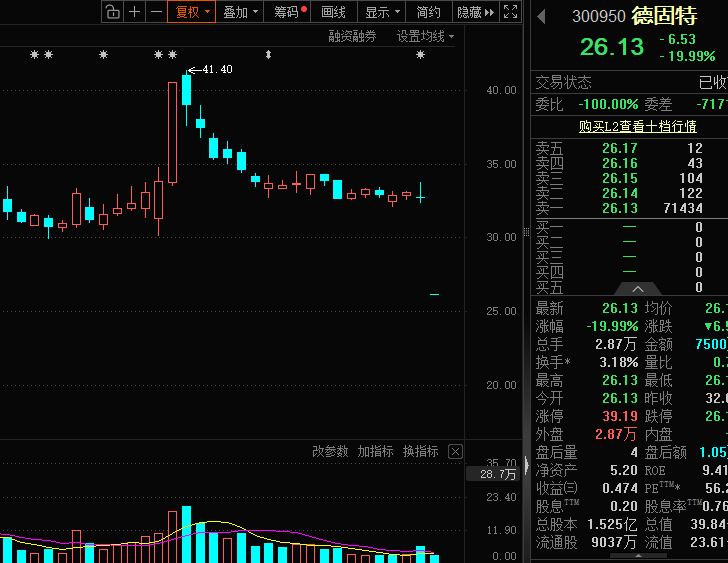
Core Viewpoint - The major asset restructuring plan of Degute (300950) is likely to be terminated, leading to a significant drop in its stock price, marking its first "limit down" since listing. This event coincides with a broader rally in the consumer sector, highlighting potential investment opportunities in undervalued stocks [1][3][4]. Group 1: Degute's Restructuring and Market Reaction - On November 10, Degute's stock hit a "limit down" for the first time, closing with a sell-off of 71,400 shares, attributed to the potential termination of its major asset restructuring plan [1][3]. - The company announced on November 7 that it would discuss terminating the restructuring due to difficulties in meeting the demands of all parties involved [3]. - Other stocks also faced significant declines, including *ST Changyao, which approached historical lows, and several others in the consumer sector [3]. Group 2: Consumer Sector Performance - On November 10, the Shanghai Composite Index rose by 0.53%, surpassing the 4000-point mark, with the consumer sector showing strong performance across various sub-industries such as beauty care, food and beverage, retail, and tourism [4]. - Leading stocks in the beauty care sector, such as Aimeike, saw intraday gains exceeding 8%, while several food and beverage stocks, including Huanlejia, hit "limit up" [4]. Group 3: Investment Opportunities in Consumer Stocks - As of November 10, the food and beverage, beauty care, and retail sectors have shown year-to-date gains of less than 10%, underperforming the Shanghai Composite Index [6]. - Analysts suggest that the food and beverage sector is nearing a bottom, with expectations of recovery as negative factors have largely been released and policy impacts are diminishing [6]. - A report indicates that 123 consumer stocks with rolling P/E ratios below 30 and underperforming the index have been identified, with several large-cap stocks like Kweichow Moutai and Gree Electric listed among them [7][8]. Group 4: Stocks with Growth Potential - Among the identified low P/E consumer stocks, 43 have an upside potential exceeding 20%, with companies like Proya and Xueda Education showing significant growth prospects [9][10]. - Proya, a leading beauty brand, has a projected upside of 49.05%, driven by its international expansion and potential mergers [9][11]. - Xueda Education is expected to grow by 48.6%, benefiting from its clear business expansion strategy in personalized education [9][11].


大消费板块集中爆发,低估值滞涨股揭晓(附名单)
Zheng Quan Shi Bao Wang· 2025-11-10 10:43
Group 1 - The core viewpoint of the articles indicates a significant rebound in the consumer sector, with various sub-sectors such as beauty care, food and beverage, retail, and tourism showing strong stock performance as of November 10, 2023 [1][2] - The Shanghai Composite Index closed with a gain of 0.53%, surpassing the 4000-point mark, driven by a collective surge in consumer stocks [1] - The Ministry of Finance's report on November 7, 2023, highlighted ongoing efforts to boost consumption through fiscal policies, including subsidies for personal consumption loans [1][2] Group 2 - The food and beverage sector is nearing a bottom in its fundamental performance, with expectations for recovery increasing as negative impacts have largely been released [2] - The service consumption sector is undergoing a transformation, supported by policy initiatives, and is expected to become a key investment focus [2] - The "14th Five-Year Plan" emphasizes the importance of enhancing consumer power and expanding the supply of quality consumer goods and services [2] Group 3 - A total of 123 consumer stocks with rolling P/E ratios below 30 and underperforming the Shanghai Composite Index have been identified, indicating potential valuation advantages [3] - Among these, nine stocks with market capitalizations exceeding 100 billion yuan include major players like Kweichow Moutai and Gree Electric [3] - The stock with the largest decline is Ganyuan Food, which has dropped 33.79% year-to-date, with a reported net profit decline of 43.66% in the first three quarters [3][4] Group 4 - There are 43 stocks among the identified consumer stocks that have an upside potential exceeding 20%, with Poya leading at 49.05% [6][8] - Xueda Education and Haoyue Care follow closely with expected increases of 48.6% and 47.01%, respectively, driven by their strong market positions and growth strategies [6][7] - Poya has submitted a prospectus for a Hong Kong IPO to accelerate international expansion and support potential mergers and acquisitions [6][8]




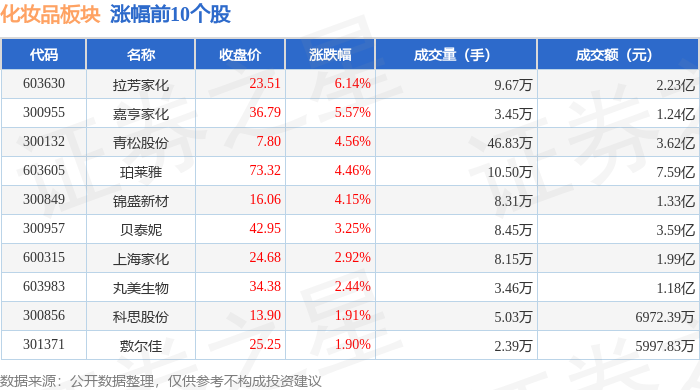
化妆品板块11月10日涨3.13%,拉芳家化领涨,主力资金净流入1.52亿元
Zheng Xing Xing Ye Ri Bao· 2025-11-10 08:49
Core Viewpoint - The cosmetics sector experienced a notable increase of 3.13% on November 10, with Lafang Jiahua leading the gains [1] Group 1: Market Performance - The Shanghai Composite Index closed at 4018.6, up 0.53%, while the Shenzhen Component Index closed at 13427.61, up 0.18% [1] - Lafang Jiahua's stock price rose by 6.14% to 23.51, with a trading volume of 96,700 shares and a transaction value of 223 million [1] - Other notable performers included: - Jiahen Jiahua: 5.57% increase, closing at 36.79 with a transaction value of 124 million [1] - Qingsong Co.: 4.56% increase, closing at 7.80 with a transaction value of 362 million [1] - Proya: 4.46% increase, closing at 73.32 with a transaction value of 759 million [1] Group 2: Fund Flow Analysis - The cosmetics sector saw a net inflow of 152 million from institutional investors, while retail investors experienced a net outflow of 179 million [1] - Key fund flows for selected companies included: - Lafang Jiahua: 22.32 million net inflow from institutional investors, with a net outflow of 11.42 million from retail investors [2] - Beitaini: 34.32 million net inflow from institutional investors, with a net outflow of 13.48 million from retail investors [2] - Shanghai Jahwa: 24.72 million net inflow from institutional investors, with a net outflow of 30.62 million from retail investors [2]


2025年美护板块三季报总结:竞争加剧,头部强化
Haitong Securities International· 2025-11-10 08:33
Investment Rating - The report suggests a positive investment outlook for the beauty and personal care sector, recommending a "buy" rating for high-growth companies with strong brand power and innovative product offerings [2][3]. Core Insights - The beauty and personal care sector is experiencing a slow recovery, with significant differentiation among sub-sectors. Personal care products and innovative channels continue to perform strongly, while the cosmetics sector shows signs of slowing growth due to domestic brand competition [1][2][3]. - For 2026, the overall beauty and personal care market is expected to remain stable, but further differentiation among companies is anticipated. The report emphasizes the importance of selecting high-growth targets with product and channel innovations [2][3]. Summary by Sections Overall Market Performance - In the first three quarters of 2025, the beauty and personal care sector saw revenues and net profits increase by 2.7% and 4.9% respectively, with personal care outperforming cosmetics and medical aesthetics [12][31]. - The cosmetics sector experienced a slight decline in revenue, with a 0.4% decrease year-on-year, while net profit fell by 2.3% [31][33]. Personal Care Sector - The personal care segment achieved revenues of 52 billion yuan and net profits of 5 billion yuan, reflecting a year-on-year increase of 33.7% and 5.7% respectively. The third quarter alone saw a revenue increase of 41.1% [12][16]. - Companies like Ruoyuchen reported impressive growth, with a 123% increase in revenue and a 73% increase in net profit in the third quarter [12][28]. Cosmetics Sector - The cosmetics sector's revenue for the first three quarters was 308 billion yuan, with a net profit of 30 billion yuan, showing a decline of 0.4% and 2.3% respectively. The third quarter saw a revenue drop of 0.5% but a significant profit increase of 50.8% [12][31]. - The report highlights the importance of individual company strategies and product life cycles in determining performance within the cosmetics sector [13][48]. Medical Aesthetics Sector - The medical aesthetics segment reported revenues of 75 billion yuan and net profits of 27 billion yuan, with a slight revenue decline of 0.7% but a profit increase of 14.5% year-on-year [12][52]. - The third quarter saw a revenue increase of 1.8% and a remarkable profit growth of 96.6%, although underlying performance was affected by increased competition and integration challenges [52][56]. Investment Recommendations - The report recommends focusing on high-growth companies with strong brand power, such as Ruoyuchen, Shangmei, and Maogeping, as well as companies with stable fundamentals and potential for marginal improvement like Dengkang Oral and Shanghai Jahwa [2][3]. - It also suggests monitoring companies that are expected to reach a turning point, such as Runben and Jinjian Biological, which may present investment opportunities [2][3].

双11收官在即,预计上美股份毛戈平表现稳健:——化妆品医美行业周报20251109-20251110
Shenwan Hongyuan Securities· 2025-11-10 08:11
Investment Rating - The report maintains a positive outlook on the cosmetics and medical beauty sector, with specific recommendations for companies like Maogeping and Shangmei Co. [4][9] Core Insights - The cosmetics and medical beauty sector underperformed the market during the reporting period, with the Shenwan Beauty Care Index declining by 3.1% [5] - The upcoming Double 11 shopping festival is expected to boost sales for Shangmei Co. and Maogeping, with strong performance anticipated on platforms like Douyin and Tmall [4][9] - Key companies such as Proya and Shanghai Jahwa reported mixed results, with Proya's revenue for Q3 2025 at 1.736 billion yuan, down 11.63% year-on-year, while Shanghai Jahwa's revenue grew by 28% to 1.483 billion yuan [10][15] Summary by Sections Industry Performance - The cosmetics and medical beauty sector showed a decline, with the Shenwan Cosmetics Index down 2.6% and the Shenwan Personal Care Index down 0.9% [5] - The top-performing stocks included *ST Meigu (+12.3%) and Jinsong New Materials (+6.2%), while Huaxi Biological and Beitaini saw declines of 7.8% and 7.4%, respectively [5] Company Performance - Proya's Q3 2025 revenue was 1.736 billion yuan, a decrease of 11.63% year-on-year, with a net profit of 227 million yuan, down 23.64% [10] - Shanghai Jahwa reported Q3 revenue of 1.483 billion yuan, an increase of 28%, with a net profit of 140 million yuan [15] - Ruoyuchen's Q3 revenue reached 819 million yuan, up 123.4% year-on-year, with a net profit of 33 million yuan [18] Market Trends - The 8th China International Import Expo showcased major international beauty brands, highlighting trends such as high-end market targeting and AI technology in beauty research and development [27] - The report indicates that the Chinese market is evolving into a global innovation hub for beauty products, with a focus on sustainability and green transformation [27] E-commerce Insights - The report provides data on the performance of domestic brands on platforms like Douyin and Tmall, with Shangmei Co. achieving significant growth in GMV [21] - The overall retail sales of cosmetics in September 2025 grew by 8.6%, driven by pre-Double 11 promotions [22][24]
美妆“抗老”宣传罚单频现,这个双十一谁还在“擦边”冒险?
3 6 Ke· 2025-11-10 06:53
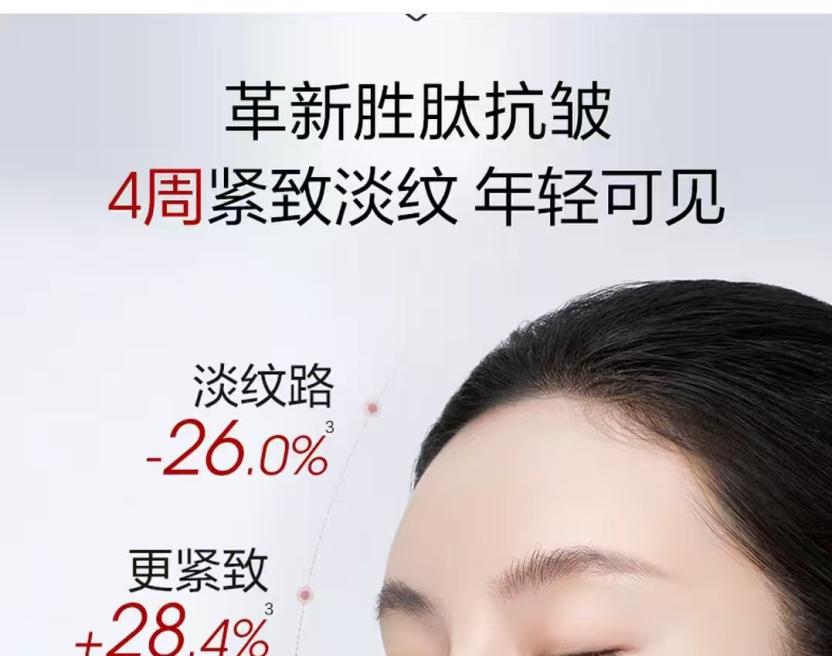
Core Viewpoint - The competition in the beauty and skincare sector during this year's Double Eleven shopping festival is intense, with brands aggressively promoting anti-aging claims despite regulatory risks [1][2][3]. Group 1: Marketing Strategies - Many beauty brands are using phrases like "anti-aging" and "anti-aging" to directly address consumer anxieties, making these terms central to their marketing campaigns [2][3]. - Brands like Proya and others are heavily promoting their products as capable of delivering anti-aging benefits, with specific claims about visible results within a short timeframe [8][11]. - New brands, such as Guyu, are also launching dedicated "anti-aging" live streams, emphasizing these claims during promotions [16]. Group 2: Regulatory Compliance - The National Medical Products Administration has not recognized "anti-aging" as an official claim category, which places brands in a precarious position regarding compliance [2][20]. - Several brands have faced administrative penalties for making unverified claims about their products' anti-aging effects, indicating a growing scrutiny from regulators [4][25]. - Despite previous penalties, many brands continue to push the boundaries of compliance, suggesting a calculated risk in pursuit of higher sales [5][26]. Group 3: Consumer Demand and Market Dynamics - There is a strong consumer demand for anti-aging products, which drives brands to use more appealing terms like "anti-aging" over compliant terms like "anti-wrinkle" [26]. - The perceived low cost of regulatory violations compared to the potential sales gains encourages brands to take risks with their marketing claims [26][27]. - The article suggests that a healthy market relies on brands respecting consumer trust and regulatory boundaries, rather than exploiting them for short-term gains [27][28].
化妆品医美行业周报:双11收官在即,预计上美股份毛戈平表现稳健-20251110
Shenwan Hongyuan Securities· 2025-11-10 06:53
Investment Rating - The report maintains a "Positive" outlook on the cosmetics and medical beauty industry, highlighting potential growth opportunities despite recent market underperformance [2]. Core Insights - The cosmetics and medical beauty sector has underperformed the market, with the Shenwan Beauty Care Index declining by 3.1% from October 31 to November 7, 2025 [3][4]. - The upcoming Double 11 shopping festival is expected to boost performance for companies like Shuangmei Co. and Maogeping, with strong sales anticipated on platforms like Douyin and Tmall [3][9]. - Key companies such as Proya, Shanghai Jahwa, and Ruifucheng have shown varying performance, with Proya's revenue for Q3 2025 at 1.736 billion yuan, down 11.63% year-on-year, while Shanghai Jahwa's revenue increased by 28% to 1.483 billion yuan [10][16]. Summary by Sections Industry Performance - The cosmetics and medical beauty sector has shown a decline, with the Shenwan Cosmetics Index down 2.6%, underperforming the Shenwan A Index by 3.3 percentage points [3][4]. - The top-performing stocks this week included *ST Meigu (+12.3%) and Jinsong New Materials (+6.2%), while Huaxi Biological and Beitaini saw declines of 7.8% and 7.4%, respectively [5]. Company Performance - Proya's Q3 2025 revenue was 1.736 billion yuan, a decrease of 11.63% year-on-year, with a net profit of 227 million yuan, down 23.64% [10][11]. - Shanghai Jahwa reported Q3 revenue of 1.483 billion yuan, up 28%, with a net profit of 140 million yuan [16]. - Ruifucheng's Q3 revenue reached 819 million yuan, a significant increase of 123.4% year-on-year, with a net profit of 33 million yuan [20]. Market Trends - The 8th China International Import Expo showcased international beauty brands, indicating a shift towards high-end markets and functional skincare products [31]. - The report highlights the increasing importance of e-commerce channels, with brands like Maogeping and Shuangmei Co. performing well on platforms like Tmall and Douyin [9][24]. E-commerce Data - In September 2025, the GMV for domestic brands on Douyin and Tmall showed significant growth, with Shuangmei Co. achieving a GMV of 8.1 billion yuan, up 47% year-on-year [24]. - The overall retail sales of cosmetics in September 2025 reached 368 billion yuan, reflecting an 8.6% year-on-year growth, driven by pre-Double 11 promotions [25][27].
珀莱雅涨2.04%,成交额1.98亿元,主力资金净流入35.58万元
Xin Lang Cai Jing· 2025-11-10 03:02
Core Insights - The stock price of Proya increased by 2.04% on November 10, reaching 71.62 CNY per share, with a total market capitalization of 28.362 billion CNY [1] - Proya's stock has declined by 13.42% year-to-date, with a 3.01% drop over the last five trading days [1] Financial Performance - For the period from January to September 2025, Proya achieved a revenue of 7.098 billion CNY, representing a year-on-year growth of 1.89%, and a net profit attributable to shareholders of 1.026 billion CNY, up by 2.65% [2] - Cumulative cash dividends since Proya's A-share listing amount to 2.125 billion CNY, with 1.540 billion CNY distributed over the last three years [3] Shareholder Information - As of September 30, 2025, Proya had 84,100 shareholders, an increase of 39.53% from the previous period, with an average of 4,708 circulating shares per shareholder, down by 28.23% [2] - The top ten circulating shareholders include Hong Kong Central Clearing Limited, which holds 27.1106 million shares, a decrease of 20.4089 million shares from the previous period [3]
行业周报:关注零售行业年度投资策略:保值、颜值、情绪价值-20251109
KAIYUAN SECURITIES· 2025-11-09 08:15
Core Insights - The retail industry is experiencing a shift from value preservation to emotional value, with a focus on high-growth segments for investment opportunities [5][28] - The report maintains a positive outlook on the retail sector, emphasizing the importance of consumer insights and differentiated product offerings [5][28] Retail Market Overview - The retail index reported a slight increase of 0.31% during the week of November 3 to November 7, 2025, underperforming the Shanghai Composite Index, which rose by 1.08% [7][16] - Year-to-date, the retail index has increased by 4.20%, lagging behind the Shanghai Composite Index's 19.27% growth [16][20] Investment Strategy for 2026 - The investment strategy highlights four main themes: 1. **Gold and Jewelry**: Focus on high-end and fashionable gold segments, with recommendations for brands like Lao Pu Gold and Chao Hong Ji [5][48] 2. **Retail E-commerce**: Emphasize the transformation of offline retail to enhance service and experience, with key players like Yonghui Supermarket and Ai Ying Shi [5][48] 3. **Cosmetics**: Target domestic brands that capture emotional value and innovate on safety ingredients, recommending brands like Juzi Biological and Pechoin [5][49] 4. **Medical Aesthetics**: Focus on differentiated product manufacturers and expanding medical institutions, with recommendations for brands like Ai Mei Ke and Ke Di-B [5][49] Sector Performance - The jewelry sector is undergoing significant changes due to rising gold prices and a decline in traditional wedding markets, leading to the emergence of brands with strong consumer insights [5][29] - The cosmetics sector is seeing a rise in domestic brands leveraging cultural roots and emotional value to capture market share [5][41] Company-Specific Insights - **Chao Hong Ji**: Reported a revenue increase of 28.4% year-on-year for the first three quarters of 2025, with a notable performance in Q3 [54] - **Yonghui Supermarket**: Experienced a revenue decline of 22.2% year-on-year for the first three quarters of 2025, but is undergoing significant transformation [50] - **Juzi Biological**: Achieved a revenue growth of 21.7% year-on-year for the first half of 2025, focusing on collagen products [50]


珀莱雅化妆品股份有限公司关于“珀莱转债”预计满足转股价格修正条件的提示性公告
Shang Hai Zheng Quan Bao· 2025-11-07 21:14
Core Viewpoint - The company, Proya Cosmetics Co., Ltd., has announced that its convertible bond, "Proya Convertible Bond," is expected to meet the conditions for a price adjustment due to various corporate actions affecting its stock price [1][10]. Group 1: Convertible Bond Issuance Overview - The company issued 7,517,130 convertible bonds on December 8, 2021, with a total value of 75,171.30 million yuan, at a face value of 100 yuan each, with a maturity of six years [1]. - The coupon rates for the bonds are structured to increase over the years, starting from 0.30% in the first year to 2.00% in the sixth year [1]. Group 2: Price Adjustment History - The initial conversion price was set at 195.98 yuan per share, which has been adjusted multiple times due to corporate actions: - Adjusted to 139.37 yuan on May 30, 2022, following the 2021 annual equity distribution [2]. - Adjusted to 138.92 yuan on September 9, 2022, due to the completion of a stock incentive plan [3]. - Adjusted to 98.61 yuan on May 29, 2023, after the 2022 annual equity distribution [4]. - Adjusted to 98.62 yuan on August 29, 2023, following the completion of stock repurchase [5]. - Adjusted to 98.24 yuan on October 23, 2023, due to the 2023 semi-annual equity distribution [6]. Group 3: Price Adjustment Mechanism - The bond's conversion price can be adjusted downward if the company's stock price falls below 85% of the current conversion price for at least 15 out of 30 consecutive trading days [8]. - The adjustment requires approval from the shareholders, with specific conditions on the minimum price after adjustment [9]. Group 4: Future Price Adjustment Conditions - The company has decided not to adjust the conversion price for the next six months, even if the conditions for adjustment are met [10]. - The next evaluation period for potential price adjustment will begin on October 27, 2025, with specific thresholds outlined for triggering the adjustment [11].