HUAYOU COBALT(603799)

Search documents
能源金属板块走高



Jin Rong Jie· 2026-01-15 01:45
Group 1 - The energy metals sector has seen an increase, with Huayou Cobalt rising over 5% [1] - Other companies such as Yuanhang Precision, Hanrui Cobalt, Tengyuan Cobalt, and Ganfeng Lithium also experienced gains [1]
金属行业 2026 年度策略系列报告之能源金属篇:柳暗花明,迈向新周期
Guolian Minsheng Securities· 2026-01-14 05:21
Group 1 - The report indicates that 2025 was a year of recovery for energy metals, with lithium, cobalt, and nickel entering an upward cycle after a period of bottoming out [9][15][17] - The lithium sector is expected to see a significant increase in demand driven by energy storage, with projections for global lithium supply reaching 215.9 million tons in 2026, with a growth rate of 26% [25][29] - Cobalt supply is anticipated to tighten due to the implementation of a quota system in the Democratic Republic of Congo, leading to a projected shortage of 3.6 million tons in 2026 [26][12] Group 2 - Nickel prices are expected to stabilize as Indonesia tightens its nickel ore export quotas, with a focus on maintaining high-grade nickel resources [27][12] - The report recommends several companies for investment, including Zangge Mining, Zhongmin Resources, and Yongxing Materials in the lithium sector, and Liqin Resources and Huayou Cobalt in the nickel-cobalt sector [12][28] - The overall industry outlook for 2026 is positive, with expectations of a comprehensive price increase across energy metals due to supply constraints and rising demand [12][11]


邱慈观专栏 | 能源转型下金属矿业的ESG实践标准解析
Xin Lang Cai Jing· 2026-01-14 03:19
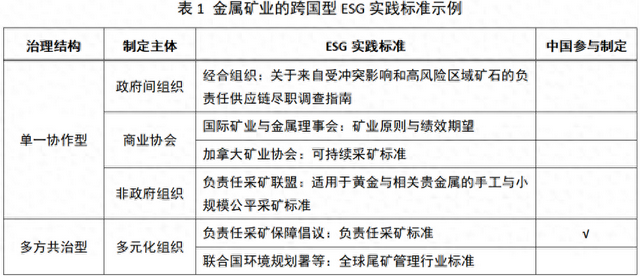
Core Viewpoint - The article emphasizes the structural transformation of China's energy system driven by the "dual carbon" policy, highlighting the increasing demand for metal minerals as strategic resources essential for energy security and low-carbon transition [1] Group 1: Demand and Supply Dynamics - The demand for metal minerals is projected to increase fivefold by 2050 under the 2°C temperature control target, indicating a shift from traditional industrial materials to strategic resources [1] - China's consumption of lithium and cobalt in 2022 accounted for 65.9% and 42.8% of global totals, respectively, while domestic production was only about 14% and 1%, necessitating overseas investments by domestic mining companies to enhance supply chain resilience [2] Group 2: Geopolitical and Regulatory Context - The increase in global mineral investment has intensified competition for resources, leading to geopolitical conflicts and resource nationalism in resource-rich countries, complicating cross-border mining investments [3] - The establishment of "soft regulations" based on international industry standards has emerged as a response to the limitations of "hard regulations" in governing corporate behavior in the mining sector [3] Group 3: ESG Standards in Metal Mining - Since the late 20th century, international ESG standards have developed to address controversies in metal mining, focusing on environmental pollution, mine safety, and labor rights, and expanding to include biodiversity and community engagement [4] - ESG standards can be categorized into single collaboration-type and multi-stakeholder governance-type, each differing in focus and requirements [5][6] Group 4: Participation and Adoption of ESG Standards - Chinese mining companies have low participation and adoption rates in international ESG standards, primarily relying on general industry standards rather than mining-specific ones, which limits their influence in international governance [7][8] - The adoption of NGO-led ESG standards is also limited due to their stringent requirements, which increase compliance costs and disclosure obligations for companies [9] Group 5: Best Practices and Future Directions - Chinese mining companies have demonstrated strong performance in community development projects, such as agricultural support and vocational training, which reflect a long-term commitment to sustainable practices [10] - To enhance their influence in international ESG standards, Chinese mining companies should actively participate in multilateral mechanisms and develop institutional standards based on domestic experiences [10][11] - Companies should establish a systematic approach to ESG best practices, integrating collaboration with local governments and communities into project design and evaluation frameworks [11] - Strengthening internal ESG governance is crucial, ensuring that ESG practices are embedded in risk management and decision-making processes, transitioning from passive compliance to proactive leadership in ESG standards [12]



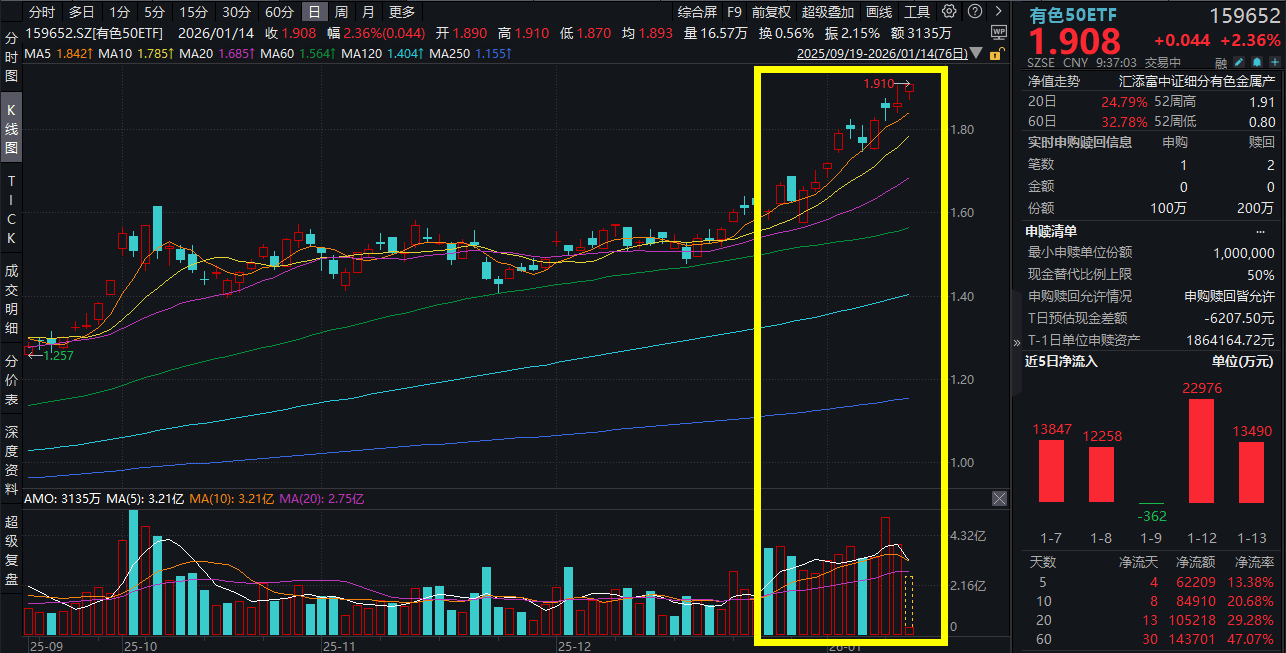
金银铜锡集体飙涨!兴业银锡涨超6%,有色50ETF(159652)大涨超2%再创新高!有色全面开花,三大金属热火朝天
Sou Hu Cai Jing· 2026-01-14 02:45
Core Viewpoint - The A-share market is experiencing a strong upward trend, particularly in the non-ferrous metals sector, with significant price increases in various metals and ETFs [1][3]. Non-Ferrous Metals Sector Performance - The non-ferrous metals sector is benefiting from multiple catalysts, including macroeconomic disturbances, rigid supply, and new demand dynamics [3]. - The non-ferrous 50 ETF (159652) has seen a price increase of over 2%, reaching new highs [1][5]. - Key stocks in the sector include Zijin Mining, which rose by 2.69%, and Yunnan Tin, which surged by 6.29% [2][5]. Precious Metals Insights - Gold prices are supported by geopolitical tensions and weak employment data, with forecasts suggesting potential for gold to exceed $4,500 per ounce [3]. - The World Gold Council reported a net purchase of 45 tons of gold by central banks in November, indicating strong demand [3]. Industrial Metals Dynamics - Copper prices are expected to continue rising due to supply constraints and regional mismatches, with a projected total market shortfall of over 100,000 tons by 2026 [6]. - The ongoing geopolitical risks and supply security concerns are driving copper prices to new historical highs [6]. Lithium Market Outlook - Policy changes are anticipated to lead to a short-term surge in lithium exports, positively impacting lithium carbonate prices [4][6]. - The demand for lithium remains robust, with expectations of continued strong performance in the battery sector [4]. Investment Strategy - The non-ferrous 50 ETF (159652) is highlighted as a comprehensive investment vehicle covering various metal sectors, with a high concentration of strategic assets [7][9]. - The ETF's copper content is 34%, and gold content is 12%, making it a leading option in its category [9]. Performance Metrics - The non-ferrous 50 ETF has shown a cumulative return of 99.61% since 2022, driven by earnings rather than valuation increases, with a current PE ratio of 26.27, down 52% from five years ago [11].




渤海证券研究所晨会纪要(2026.01.14)-20260114
BOHAI SECURITIES· 2026-01-14 02:37
Fixed Income Research - The issuance rates for credit bonds have generally increased, with changes ranging from 0 BP to 8 BP, leading to a significant increase in credit bond issuance volume due to a low base effect [2] - The net financing amount for credit bonds has increased, while the net financing for targeted tools has decreased; corporate bonds have a negative net financing amount, while other types have positive net financing [2] - The secondary market saw an increase in transaction amounts for credit bonds, with most types experiencing growth [2] - Credit spreads have narrowed for most mid-term notes, corporate bonds, and urban investment bonds, as credit bonds continue to perform better than interest rate bonds [2] - The overall conditions for a bear market in credit bonds are insufficient, with a long-term downward trend in yields expected [2] Company Research: WuXi AppTec (药明康德) - WuXi AppTec expects to achieve a revenue of approximately 45.456 billion yuan in 2025, representing a year-on-year growth of about 15.84%, with continuous operating business revenue expected to grow by approximately 21.40% [6][7] - The adjusted non-IFRS net profit is projected to be around 14.957 billion yuan, a year-on-year increase of about 41.33%, while the net profit attributable to shareholders is expected to reach approximately 19.151 billion yuan, reflecting a growth of about 102.65% [6][7] - The strong growth is attributed to the advantages of the CRDMO model, with a focus on integrated services and continuous optimization of production processes [7] - The company plans to focus on its CRDMO business model and has sold parts of its equity in joint ventures, contributing to its profit growth [7] Industry Research: Metal Industry - The steel industry is expected to maintain production levels due to acceptable profit margins, although demand is in a seasonal decline [13] - Copper prices are influenced by market sentiment and resource competition, with potential for high volatility [13] - Aluminum prices are supported by high copper prices and strategic resource concerns, while supply remains ample [13] - Gold prices are expected to remain strong due to geopolitical risks and mixed U.S. employment data [13] - The rare earth market is anticipated to strengthen due to export control measures and strategic importance [14]


抢出口潮席卷锂电全产业链,供给端持续收紧叠加需求激增,碳酸锂王者归来开启能源金属上涨新周期
Xin Lang Cai Jing· 2026-01-13 11:27
Group 1 - Ganfeng Lithium is a global leader in the lithium industry, with a comprehensive resource layout covering spodumene, salt lakes, and clay, and its lithium carbonate production capacity is among the top in the industry [1] - Tianqi Lithium controls the world's largest spodumene mine, Greenbushes, with a self-sufficiency rate of 100%, and its full industry chain layout enhances profitability amid rising lithium carbonate prices [2] - Salt Lake Industry holds the largest lithium resource in China at the Qarhan Salt Lake, with a low extraction cost of 30,000 to 40,000 yuan per ton, and plans to reach a production capacity of 40,000 tons of lithium carbonate by 2025 [3] Group 2 - Zangge Mining has a significant advantage in the Tibetan salt lake resource layout, with a planned capacity of 50,000 tons per year and a self-sufficiency rate exceeding 80% [4] - Shengxin Lithium Energy owns Asia's largest hard rock lithium mine and has a long-term supply agreement with CATL, ensuring stable sales amid rising lithium prices [5] - Rongjie Co. focuses on lithium resource development and processing, optimizing its mining technology to enhance resource utilization and reduce costs [6] Group 3 - Tibet Mining has exclusive mining rights to the Zabuye Salt Lake, one of Asia's largest lithium salt lakes, which provides a cost advantage as lithium carbonate prices rise [7][8] - Yahua Group ranks second in lithium extraction from lepidolite in A-shares, with an annual capacity of 45,000 tons, and has established long-term partnerships with several battery manufacturers [9] - Zhongmin Resources has a strong presence in both spodumene and salt lake lithium extraction, actively expanding overseas projects to enhance market competitiveness [10] Group 4 - Jiangte Motor, located in Yichun, known as "Asia's Lithium Capital," has a lepidolite extraction capacity of 30,000 tons per year and holds proprietary low-cost extraction technology [11] - Xizang City Investment has lithium carbonate reserves of 3.9 million tons from two salt lakes, utilizing a low-cost extraction method that positions it well for profit during price increases [12] - Yongxing Materials focuses on lithium salt production and has a diversified supply chain that allows it to respond quickly to market changes [13] Group 5 - Huayou Cobalt is a global leader in cobalt products and has developed an integrated supply chain for nickel, cobalt, and lithium resources, ensuring stable supply for battery materials [14] - Hanrui Cobalt has a synergistic business model for cobalt and lithium, ensuring raw material self-sufficiency and benefiting from the growth of the lithium battery industry [15] - Tengen Cobalt focuses on the research, production, and sales of cobalt and lithium products, maintaining stable sales through partnerships with leading battery manufacturers [16] Group 6 - Luoyang Molybdenum is the second-largest cobalt producer globally and is actively expanding its lithium resource layout, benefiting from the growth in lithium battery demand [17] - Greeenmei is a leader in battery recycling, achieving over 95% recovery rates and integrating lithium resource recovery into its business model [18] - Northern Rare Earth is the largest supplier of light rare earths and is diversifying into lithium and other energy metals, leveraging its resource advantages [19] Group 7 - Jinli Permanent Magnet has advanced technology that reduces the use of heavy rare earths and is expanding into lithium-related energy metal businesses [20] - Wanhua Chemical is actively involved in the lithium battery materials sector, providing chemical support for lithium carbonate production and benefiting from the growing demand in the lithium battery industry [21] - China Aluminum is leveraging its mining experience to develop lithium resources, ensuring quality and reducing operational costs amid rising lithium prices [22] Group 8 - Jiangxi Copper is expanding into lithium and cobalt, utilizing its mining expertise to enhance its energy metal business [23] - Huayu Mining is focusing on lithium resource development in Tibet, leveraging its regional advantages to enhance its lithium salt processing projects [24] - Shengda Resources is actively acquiring lithium resources and enhancing its energy metal business through strategic partnerships [25] Group 9 - Boqian New Materials, while primarily focused on nano-level metal powder materials, is involved in the lithium battery sector and is expected to see significant profit growth by 2026 [26] - Yongshan Lithium focuses on lithium salt product development and has optimized its production processes to enhance product quality and efficiency [27] - Dazhong Mining is transitioning into the lithium sector, utilizing its mining expertise to explore and develop lithium resources [28] Group 10 - Jinyuan Co. is transforming into the lithium battery sector, focusing on lithium resource development and processing through strategic acquisitions [29] - Weiling Co. is extending its business into the lithium battery supply chain, providing equipment and technical support for lithium mining and processing [30] - Tianhua Super Clean is deeply engaged in lithium battery materials, with a strong production capacity and established relationships with leading battery manufacturers [31]


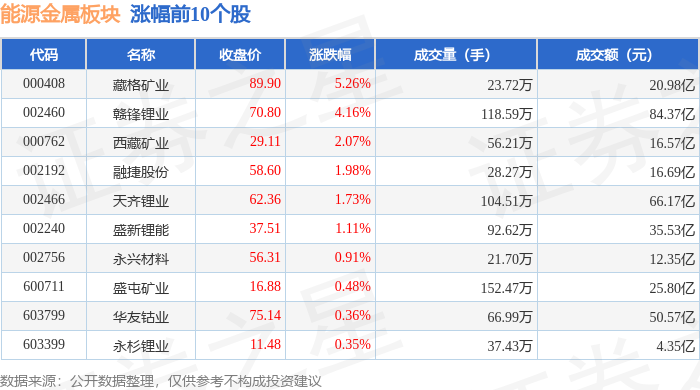
能源金属板块1月13日涨2.16%,藏格矿业领涨,主力资金净流入9.09亿元
Zheng Xing Xing Ye Ri Bao· 2026-01-13 08:56
Core Viewpoint - The energy metals sector experienced a significant increase of 2.16% on January 13, with Cangge Mining leading the gains, while the overall stock indices showed declines [1]. Group 1: Market Performance - The Shanghai Composite Index closed at 4138.76, down 0.64% [1]. - The Shenzhen Component Index closed at 14169.4, down 1.37% [1]. - Cangge Mining's stock price rose by 5.26% to 89.90, with a trading volume of 237,200 shares and a transaction value of 2.098 billion [1]. Group 2: Individual Stock Performance - Ganfeng Lithium's stock increased by 4.16% to 70.80, with a trading volume of 1,185,900 shares and a transaction value of 8.437 billion [1]. - Tibet Mining's stock rose by 2.07% to 29.11, with a trading volume of 562,100 shares and a transaction value of 1.657 billion [1]. - Rongjie Co., Ltd. saw a 1.98% increase in stock price to 58.60, with a trading volume of 282,700 shares and a transaction value of 1.669 billion [1]. Group 3: Capital Flow - The energy metals sector saw a net inflow of 909 million in main funds, while retail investors experienced a net outflow of 676 million [2][3]. - Ganfeng Lithium had a main fund net inflow of 472 million, but a net outflow of 223 million from retail investors [3]. - Tianqi Lithium experienced a main fund net inflow of 357 million, with retail investors showing a net outflow of 180 million [3].


3月19-20日 常州 2026锂电关键材料及应用市场高峰论坛
鑫椤锂电· 2026-01-13 07:38
Core Viewpoint - The lithium battery industry is poised for a significant growth cycle in 2026, characterized by strong demand recovery, accelerated global expansion, and disruptive technological advancements, leading to a "spiral rise" in both volume and price [3]. Group 1: Conference Overview - The 2026 Lithium Battery Key Materials and Applications Market Summit will be held on March 19-20, 2026, in Changzhou, Jiangsu, organized by Xinluo Information [4]. - The summit aims to address the supply-demand dynamics in the lithium battery sector, focusing on the critical materials needed for battery production and the expected supply shortages [5]. Group 2: Key Topics of Discussion - The conference will feature three main topics: 1. In-depth discussions on cutting-edge technologies and market supply-demand [5]. 2. Announcement of the "Top Ten Lithium Battery Material Brands of 2025," evaluated based on shipment volume, market share, and customer reputation [6]. 3. B2B procurement matchmaking to connect top battery manufacturers and material suppliers, enhancing resource matching and reducing procurement costs [7]. Group 3: Proposed Discussion Topics - Proposed topics for the main forum include: - Outlook on lithium ore resource supply for 2026 [9]. - Market environment discussions on lithium carbonate operations [9]. - Research and application of high-energy density power battery technology [9]. - Additional topics will cover trends in the global new energy vehicle market and the impact of policies on the lithium market [10][11]. Group 4: Participation and Costs - The participation fee for the conference is set at 2800 yuan per person, with a limited-time free attendance option available for the first 200 registrants [17].




华友钴业入选“2025中国企业ESG百强”榜单
Xin Lang Cai Jing· 2026-01-13 05:43
| 排名 | 公司名称 | 公司标识 | 得分星级 行业分类 | | | --- | --- | --- | --- | --- | | | 建设银行 SH601939 | 人工工生之前 | ★★★★★ | 金融 | | | 中国移动 (HK0941) | 中国移动 | ★★★★★ | 电信服务 | | | 农业银行 (HK1288) | 中国农业银行 (HD | 文文文文文 | 金融 | | 4 | 腾讯控股 HK0700 | Tencent 腾讯 | ★★★★★ | 信息技术 | | 5 | 中国银行 SH601988 | 中国娱行 | ★★★★★ | 金融 | 新浪财经ESG评级中心提供包括资讯、报告、培训、咨询等在内的14项ESG服务,助力上市公司传播ESG理念,提升ESG可持续发展表现。点 击查看【 ESG评级中心服务手册】 在全球可持续发展浪潮席卷而来的当下,ESG(环境、社会、公司治理)已成为衡量企业高质量发展的核心标尺,更是连接企业价值与社会价值的关键纽 带。随着国内 ESG 生态体系的加速完善,政策监管持续收紧、资本市场对 ESG 表现的关注度不断飙升,企业的可持续发展能力愈发成为其核心竞争 ...

碳酸锂期货12%涨停!赣锋锂业暴涨超8%,有色50ETF(159652)大涨2.8%,早盘净申购超7000万,近2日吸金超3亿元!金铜锂三大金属逻辑一文读懂
Sou Hu Cai Jing· 2026-01-13 03:47
Core Viewpoint - The A-share market is experiencing volatility with a strong performance in the non-ferrous metal sector, particularly driven by the surge in lithium carbonate futures and geopolitical tensions supporting gold prices [1][5][6]. Group 1: Market Performance - As of January 13, the non-ferrous 50 ETF (159652) saw a significant increase, rising over 2.8% and attracting more than 730 million yuan in capital inflow, totaling over 300 million yuan in the last two days [1]. - Key stocks in the non-ferrous sector showed varied performance, with Zijin Mining up 3.89%, Ganfeng Lithium soaring 8.71%, and Shandong Gold increasing by 5.49% [2][7]. Group 2: Sector Analysis - The non-ferrous sector is currently influenced by multiple factors including frequent macroeconomic disturbances, rigid supply-side conditions, and new demand-side dynamics [5]. - Lithium, as an energy metal, is expected to benefit from export tax adjustments, potentially leading to increased battery production and tighter supply-demand dynamics for lithium carbonate [5][8]. - Gold prices are supported by rising geopolitical tensions and weak employment data, with expectations for prices to remain above $4,500 per ounce [5][9]. - Copper prices are driven by structural supply concerns and regional mismatches, with expectations for continued price increases due to a projected supply gap of over 100,000 tons by 2026 [9]. Group 3: Investment Opportunities - The non-ferrous 50 ETF (159652) is highlighted as a comprehensive investment vehicle covering various metal sectors, with a high concentration of strategic assets [11]. - The ETF's index shows a leading concentration in copper and gold, with a copper content of 34% and gold content of 12%, making it attractive for investors looking to capitalize on the ongoing non-ferrous market cycle [11][13]. - The ETF has demonstrated superior performance with a cumulative return of 99.61% since 2022, driven by earnings rather than valuation expansion, indicating a strong investment case [13].