NSIG(688126)

Search documents
半导体板块反转拉升,半导体设备ETF万家(159327)盘中涨超2%,连续15天净流入
Xin Lang Cai Jing· 2026-01-27 03:58
Group 1 - The semiconductor sector experienced a strong rebound on January 27, 2026, with the China Securities Semiconductor Materials and Equipment Theme Index rising by 2.39% [1] - Notable individual stock performances included ChipSource Microelectronics increasing by 14.04%, and Jin Hai Tong and Kang Qiang Electronics hitting the daily limit up [1] - The semiconductor equipment ETF Wan Jia (159327) saw an increase of 2.03% and reached a new high in scale at 1.187 billion yuan with 536 million shares outstanding [1] Group 2 - The electronic industry achieved a 19.5% double-digit profit growth in 2025, indicating a robust demand for semiconductor manufacturing equipment, particularly high-end process and advanced packaging equipment [2] - Huatai Securities highlighted that the A-share market is shifting towards performance recovery, with semiconductor equipment identified as a key investment focus [2] - As of December 31, 2025, the top ten weighted stocks in the China Securities Semiconductor Materials and Equipment Theme Index accounted for 65.08% of the index, including companies like North Huachuang and Zhongwei Company [2]


硬科技 · 『芯』动力!科创芯片ETF华宝(589190)今日全“芯”上市, 锚定硬科技,聚焦高精尖
Xin Lang Cai Jing· 2026-01-27 01:27
Core Insights - The article highlights the strong performance of the Sci-Tech Innovation Board Chip Index, which has achieved a cumulative increase of over 161% since its base date, with an annualized return of 17.93%, significantly outperforming similar indices such as the Sci-Tech Innovation Entrepreneur Semiconductor and the National Chip Index [3][12][13]. Performance Metrics - The Sci-Tech Chip Index has a higher annualized Sharpe ratio and lower maximum drawdown compared to its peers, indicating a better risk-reward profile [3][12]. - The maximum drawdown for the Sci-Tech Chip Index is less severe at -56.81%, compared to -60.05% for the Sci-Tech Innovation Entrepreneur Semiconductor Index [4][12]. Industry Composition - The index is heavily weighted towards integrated circuits, which account for 72.77% of its composition, significantly higher than other similar indices [6][14]. - The index includes companies involved in semiconductor materials, equipment, design, manufacturing, packaging, and testing, reflecting the overall performance of the representative chip industry on the Sci-Tech Innovation Board [14][15]. Financial Growth - The index's net profit attributable to shareholders surged by 94.22% year-on-year, leading among similar indices [17]. - The R&D investment in the chip industry on the Sci-Tech Innovation Board exceeded 119.7 billion yuan, with an R&D intensity of 11.22%, far surpassing the overall A-share market level of 2.16% [7][17]. Top Holdings - The top ten weighted stocks in the index include: - Zhongke International (10.36%) - Haiguang Information (10.05%) - Cambricon Technologies (9.45%) - Lattice Semiconductor (7.73%) - Zhongwei Company (6.85%) [14][18].







存储芯片涨价潮愈演愈烈,科创芯片ETF(588200)有望持续受益
Xin Lang Cai Jing· 2026-01-26 03:04
Group 1 - The Shanghai Stock Exchange Sci-Tech Innovation Board Chip Index fell by 1.14% as of January 26, 2026, with mixed performance among constituent stocks, where Chipone Technology led with a 10.01% increase [1] - Samsung Electronics has raised the price of its NAND flash memory by more than 100% in the first quarter of this year, significantly exceeding market expectations, and is currently negotiating a new round of NAND pricing with clients for the second quarter, with expectations of continued price increases [1] - Zhongshan Securities forecasts that the AI-related industry will maintain a favorable outlook in 2026, with accelerated domestic production expected to create opportunities in the domestic semiconductor industry, and predicts over 40% growth in capital expenditure from cloud computing giants [1] Group 2 - The top ten weighted stocks in the Shanghai Stock Exchange Sci-Tech Innovation Board Chip Index as of December 31, 2025, include SMIC, Haiguang Information, Cambricon, and others, accounting for a total of 57.76% of the index [1] - The Sci-Tech Chip ETF (588200) tracks the Shanghai Stock Exchange Sci-Tech Innovation Board Chip Index, serving as a convenient tool for investing in the chip sector [2] - Investors without stock accounts can access investment opportunities in domestic chips through the Sci-Tech Chip ETF linked fund (017470) [3]
数观丨2026年半导体集成电路产业融资分析
Sou Hu Cai Jing· 2026-01-21 07:56
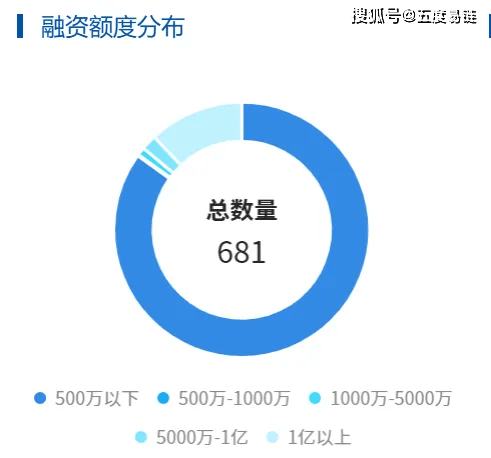
Core Insights - The domestic semiconductor integrated circuit industry is experiencing a financing boom from July 2025 to January 2026, characterized by frequent capital layouts, focused sectors, and regional clustering [1] - The industry is entering a critical phase of deep integration of capital and technology, driven by domestic substitution efforts and a global surge in computing power demand [1] National Financing Overview - A total of 681 financing events occurred across 610 companies, with 1,130 investment institutions participating, indicating a strong capital interest in the semiconductor sector [2] - There were 82 financing events exceeding 1 billion yuan, highlighting significant capital concentration in capital-intensive fields, with leading companies like Longxin Technology and Moer Thread attracting substantial investments [2] - The financing structure shows a "small amount dense, large amount concentrated" pattern, with over 84.9% of events being under 5 million yuan, providing essential funding for innovation [2] Financing Round Distribution - Strategic financing dominated with 307 events, accounting for 45.1%, followed by A rounds (156 events, 22.9%) and B rounds (59 events, 8.7%), indicating accelerated industry consolidation [4] - The high proportion of strategic financing reflects the trend of industry chain integration, with resources being allocated efficiently towards mature enterprises and high-potential early-stage projects [4] Regional Financing Landscape - The financing landscape is characterized by three major clusters: the Yangtze River Delta, the Guangdong-Hong Kong-Macao Greater Bay Area, and the Beijing-Tianjin-Hebei region, collectively accounting for over 80% of financing events [6] - The Yangtze River Delta leads with 377 financing events and 53.205 billion yuan, benefiting from a complete semiconductor industry chain [6] - The Guangdong-Hong Kong-Macao Greater Bay Area focuses on packaging, testing, and automotive electronics, while the Beijing-Tianjin-Hebei region excels in high-performance computing chips and semiconductor materials [6][8] Benchmark Enterprises Layout - Key enterprises in each region leverage their technological advantages and capital support to position themselves in core sectors, driving industry development [9] - In the Beijing-Tianjin-Hebei region, companies focus on high-end computing chips, while the Yangtze River Delta hosts firms covering storage and computing core sectors [12] - The Greater Bay Area's financing vitality relies on leading investment institutions targeting specialized chips and advanced materials [12] Industry Trend Summary - The financing market from July 2025 to January 2026 is characterized by high frequency, strong concentration, and precise sector focus, with capital supporting high-performance and domestic substitution sectors [15] - The industry is accelerating technology implementation and supply chain integration through capital empowerment, with a focus on companies possessing core technologies and production capabilities [15]

AI算力需求持续爆发拉动存储涨价潮,科创芯片ETF(588200)一键布局国产芯片投资机遇
Xin Lang Cai Jing· 2026-01-21 02:39
Group 1 - The semiconductor and chip sector experienced a significant rally, with the STAR Market chip index rising by 3.92% as of 10:14 AM on January 21, 2026, driven by strong performances from companies like Loongson Technology (up 20.00%) and Haiguang Information (up 12.46%) [1] - CITIC Securities believes that the storage chip market is currently in a price uptrend due to the explosive demand from AI and supply-side contractions, leading to a performance surge for global storage industry enterprises [1] - The construction of storage production lines and the increase in domestic production rates are expected to accelerate, creating investment opportunities in domestic semiconductor equipment and packaging/testing sectors [1] Group 2 - TSMC is projected to achieve record-high revenue in Q4 2025, with advanced process technology (7nm and below) accounting for 77% of its revenue, and 3nm process shipments reaching 28% [1] - The company anticipates a significant increase in capital expenditure for 2026, estimated between $52 billion and $56 billion, aimed at enhancing its technological advantages and capacity expansion in the high-end wafer foundry sector [1] - The ongoing demand for AI computing power is expected to strongly drive the semiconductor manufacturing sector [1] Group 3 - As of December 31, 2025, the top ten weighted stocks in the STAR Market chip index accounted for 57.76% of the index, including companies like SMIC, Haiguang Information, and Cambrian [2] - The STAR Chip ETF (588200) serves as a convenient tool for investors looking to gain exposure to the STAR Market chip sector [2] Group 4 - Investors without stock accounts can explore investment opportunities in domestic chips through the STAR Chip ETF linked fund (017470) [3]


A股盘前播报 | 日债风暴叠加格陵兰危机,“抛售美国”重现!美股债汇三杀
智通财经网· 2026-01-21 00:50
Market Overview - The Japanese long-term bond market is experiencing significant sell-offs, leading to a "sell America" trading pattern, causing declines in U.S. stocks, bonds, and the dollar [1] - The S&P 500 recorded its largest drop in October, with popular Chinese concept stocks also declining [1] - The 10-year U.S. Treasury yield rose above 4.29%, while the dollar fell nearly 0.5%, briefly dropping below 98 [1] Macro Policy - A comprehensive policy package aimed at boosting domestic demand has been announced, with a focus on promoting private investment and key sectors [2] - The National Development and Reform Commission is working on a strategic implementation plan for expanding domestic demand from 2026 to 2030 [2] - The Ministry of Finance has released five policies, including optimizing personal consumption loan subsidies [2] A-Share Market - Goldman Sachs maintains a "slow bull" outlook for A-shares, expecting over 3 trillion RMB in new capital inflows despite recent cooling in the margin trading market [3] - The Shanghai Composite Index has recently broken through significant thresholds, with domestic asset reallocation potentially accelerating [3] - An estimated 2 trillion RMB from individual investors and over 1 trillion RMB from institutional investors are expected to flow into the market [3] Urban Renewal and Infrastructure - The Ministry of Natural Resources and the Ministry of Housing and Urban-Rural Development have issued measures to support urban renewal actions [4] - The initiative allows for the development of state-supported industries using existing land and property resources, with transitional policies in place [4] - Urban renewal efforts are currently expanding to 35 cities, with potential for further pilot expansions, focusing on new infrastructure and regional development [4] Medical Device Industry - The National Healthcare Security Administration has clarified charging guidelines for robotic surgeries, which is expected to accelerate the commercialization of medical devices [11] - The medical device industry is anticipated to evolve towards a higher development stage, leveraging technological platforms and AI diagnostics [11] Commercial Aerospace - The commercial aerospace sector is witnessing a surge, with multiple satellite launches by banks occurring recently [12] - Currently, the completion rate for the deployment of two major satellite constellations in China is only about 1%, indicating significant growth potential in the coming years [12]


操盘必读:影响股市利好或利空消息_2026年1月21日_财经新闻
Xin Lang Cai Jing· 2026-01-21 00:46
Industry News - The Ministry of Finance and five other departments announced the continuation of tax and fee preferential policies for community family services such as elderly care, childcare, and housekeeping, effective from January 1, 2026, to December 31, 2027. Income from these services will be exempt from VAT and calculated at 90% for taxable income [24][26] - Recently, a surge in commercial space activities has prompted banks to participate actively. Several banks, including SPDB and CMB, successfully launched satellites aimed at enhancing their risk control capabilities. Satellite remote sensing technology will allow banks to monitor loan project progress and collateral status in real-time, addressing the limitations of traditional inspections [24][26] - Starting from January 20, 2026, domestic gasoline and diesel prices will increase by 85 yuan per ton, marking the first price hike for refined oil in 2026. The average increase for 92-octane gasoline, 95-octane gasoline, and 0-octane diesel will be 0.07 yuan per liter [24][26] - Japan plans to invest over $330 billion in artificial intelligence and semiconductor sectors [25] - A recent report indicates that the shipment share of ASIC AI servers is expected to rise to 27.8% in 2026, the highest since 2023, with growth rates surpassing those of GPU AI servers [25] - Shanghai has released an action plan to enhance the linkage between futures and spot markets for non-ferrous metals, aiming to improve resource allocation and global pricing influence [25] Company News - Hikvision reported a net profit of 14.188 billion yuan for 2025, representing a year-on-year increase of 18.46% [26][34] - Hu Silicon Industry announced that its second-largest shareholder, the National Integrated Circuit Industry Investment Fund, reduced its stake by 2% between January 7 and January 19, completing the reduction plan [26] - Liou Co. announced the completion of its suspension review and will resume trading [29] - Kailong High-Tech is planning to acquire control of Jinwangda, leading to a suspension of its stock [29] - Yifan Transmission intends to purchase 87.07% of Beijing Helish's shares, which is expected to constitute a major asset restructuring [29] - Tonghu Microelectronics forecasts a net profit of 1.1 billion to 1.35 billion yuan for 2025, representing a year-on-year increase of 62.34% to 99.24% [29] - Baile Tianheng's application for the listing of iza-bren for the treatment of recurrent or metastatic esophageal squamous cell carcinoma has been accepted and included in the priority review list [29] - Guosheng Technology expects a net loss of 325 million to 650 million yuan for 2025 due to low component prices affecting revenue [29] - Kangxin New Materials plans to acquire 51% of Yubang Semiconductor for 392 million yuan, marking a strategic shift towards the semiconductor industry [29]


上海硅产业集团股份有限公司关于董事、高级管理人员增持公司股份结果的公告
Shang Hai Zheng Quan Bao· 2026-01-20 19:28
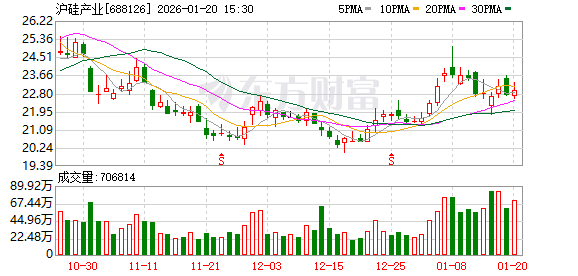
Core Viewpoint - The announcement details the shareholding activities of Shanghai Silicon Industry Group Co., Ltd., including both the increase in shares by executives and the reduction in shares by a major shareholder, reflecting confidence in the company's future and strategic adjustments by stakeholders [2][3][8][9]. Group 1: Share Increase by Executives - The executives of Shanghai Silicon Industry Group plan to increase their shareholding using personal or raised funds, with a total investment amount between RMB 6 million and RMB 12 million starting from January 21, 2025, for a period of 12 months [2]. - As of January 20, 2026, the executives have successfully increased their holdings by 291,695 shares, totaling RMB 6,022,778.18, exceeding the lower limit of the planned increase [3]. Group 2: Share Reduction by Major Shareholder - The National Integrated Circuit Industry Investment Fund held 567 million shares, accounting for 20.64% of the total shares before the reduction plan [8]. - The fund planned to reduce its holdings by up to 54,943,543 shares, representing no more than 2% of the total shares, through block trading within three months from the announcement date [9]. - By January 19, 2026, the fund completed the reduction, resulting in a decrease in its ownership percentage from 20.64% to 17.16% due to subsequent share issuances [12].
沪硅产业:关于董事、高级管理人员增持公司股份结果的公告
Zheng Quan Ri Bao· 2026-01-20 14:21
Core Viewpoint - The company, Hu Silicon Industry, announced that its executives have collectively increased their shareholding, indicating confidence in the company's future performance [2] Group 1: Shareholding Increase - As of January 20, 2026, key executives including the president and vice presidents have cumulatively purchased 291,695 shares of the company [2] - The total amount spent on this share purchase was approximately RMB 6,022,778.18, surpassing the lower limit of the planned increase [2] - The share buyback plan has been successfully completed [2]
1月20日增减持汇总:暂无增持 沪硅产业等14股减持(表)



Xin Lang Cai Jing· 2026-01-20 13:57
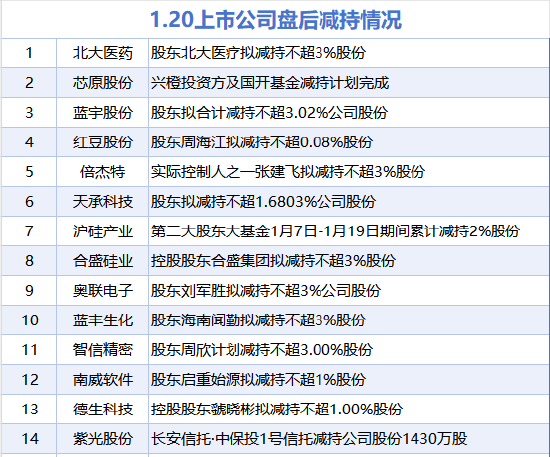
Core Viewpoint - On January 20, no A-share listed companies disclosed any increase in shareholding, while 14 companies announced share reductions [1][3]. Summary by Category Share Reduction Details - Beijing Medical intends to reduce its stake by no more than 3% [2][4] - Xinquan shares completed the reduction plan by its investors [2][4] - Blue Universe shareholders plan to collectively reduce their holdings by no more than 3.02% [2][4] - Hongdou shares' shareholder Zhou Haijiang plans to reduce his stake by no more than 0.08% [2][4] - Beijiete's actual controller Zhang Jianfei intends to reduce his stake by no more than 3% [2][4] - Tiancheng Technology shareholders plan to reduce their holdings by no more than 1.6803% [2][4] - Hu Silicon Industry's second-largest shareholder, the Big Fund, reduced its stake by 2% from January 7 to January 19 [2][4] - Hesheng Silicon Industry's controlling shareholder plans to reduce its stake by no more than 3% [2][4] - Aolian Electronics' shareholder Liu Junsheng intends to reduce his stake by no more than 3% [2][4] - Bluefeng Biochemical's shareholder Hainan Wenqin plans to reduce his stake by no more than 3% [2][4] - Zhixin Precision's shareholder Zhou Xin plans to reduce his stake by no more than 3% [2][4] - Nanwei Software's shareholder Qizhong Shiyuan intends to reduce his stake by no more than 1% [2][4] - Desheng Technology's controlling shareholder Hao Xiaobin plans to reduce his stake by no more than 1% [2][4] - Zimi shares' Long'an Trust plans to reduce its holdings by 14.3 million shares [2][4]