ZTE(000063)

Search documents
A股,午后大反转!重磅驱动,突然来袭!
券商中国· 2025-08-20 07:43
Core Viewpoint - The A-share market experienced a significant rebound driven by the artificial intelligence sector, contrasting with declines in major Asian and US stock indices [1][4]. Group 1: Market Performance - A-share market saw a strong afternoon rally, with the technology sector leading the charge, particularly AI-related stocks [2]. - The ChiNext AI ETF surged over 4%, and the semiconductor equipment index rose more than 3%, indicating robust investor interest [2]. - The Shanghai Composite Index closed up 1.04%, marking a three-day streak of new highs, while the ChiNext 50 index increased by 3.23%, reaching a near two-and-a-half-year high [2]. Group 2: AI Developments - DeepSeek announced an upgrade to its online model version V3.1, expanding context length to 128k, which enhances its reasoning and multi-language capabilities [5]. - The release of AutoGLM 2.0 by Zhizhu, powered by domestic models GLM-4.5 and GLM-4.5V, allows for reasoning, coding, and multi-modal processing across various devices [5][6]. - AutoGLM 2.0 represents a significant advancement, transitioning from a conversational agent to an execution-oriented assistant capable of performing diverse tasks autonomously [6]. Group 3: Market Sentiment - Analysts noted an increase in market risk appetite, with a notable rebound in the A-share market despite declines in global markets [3][7]. - The liquidity in the market is currently robust, and the ongoing narrative around technology is attracting more buying interest, especially with new developments in AI [7].





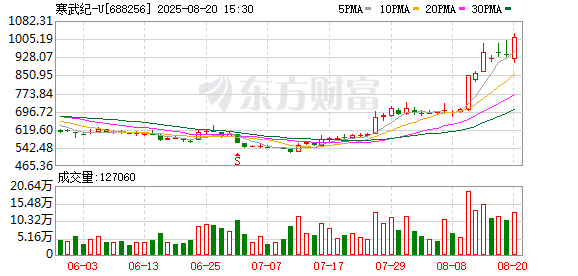
A股集体翻红 超3600股上涨 寒武纪股价再度突破1000元
2 1 Shi Ji Jing Ji Bao Dao· 2025-08-20 07:41
Market Performance - The A-share market experienced a rebound on August 20, with the Shanghai Composite Index rising by 1.04%, the Shenzhen Component Index by 0.89%, and the ChiNext Index by 0.23, all reaching new highs for the year [2] - The total trading volume in the Shanghai and Shenzhen markets exceeded 2.4 trillion yuan, marking the sixth consecutive trading day with volumes above 2 trillion yuan, with over 3,600 stocks rising [2] Sector Performance - The leading sectors included liquor, semiconductors, AI glasses, and minor metals, while sectors such as chemical pharmaceuticals, CRO, and vitamins saw declines [3] Notable Stocks - The STAR Market saw a significant increase of over 3%, with the semiconductor industry chain rebounding across the board. Chipmaker Chipone Technology hit a 20% limit up, reaching a new high since its listing [5] - In the computing power concept stocks, Inspur Information and Qunxing Toys hit the limit up, while companies like Unisplendour, ZTE, and Zhongke Shuguang also saw gains [7] - Cambrian Technology surged over 8%, with its stock price surpassing 1,000 yuan, becoming the second stock in the market to reach this milestone [7] Corporate Developments - Reports indicated that China FAW Group is planning to acquire a strategic stake in Leap Motor, with an initial offer to purchase around 10% of the company's shares [7]



沪深两市今日成交额合计2.41万亿元,东方财富成交额居首
Xin Lang Cai Jing· 2025-08-20 07:18
8月20日,沪深两市成交额合计2.41万亿元,较上一交易日缩量约1801.35亿元。其中,沪市成交额1.02 万亿元,深市成交额1.39万亿元。东方财富成交额居首,为178.18亿元。其后是北方稀土、中兴通讯、 四川长虹、寒武纪-U,成交额分别为162.63亿元、132.23亿元、129.54亿元、123.84亿元。 ...



中兴通讯A股成交额达100亿元,现涨4.74%
Ge Long Hui· 2025-08-20 06:39
格隆汇8月20日|中兴通讯(000063)A股成交额达100亿元,现涨4.74%。 (责任编辑:宋政 HN002) 【免责声明】本文仅代表作者本人观点,与和讯网无关。和讯网站对文中陈述、观点判断保持中立,不对所包含内容 的准确性、可靠性或完整性提供任何明示或暗示的保证。请读者仅作参考,并请自行承担全部责任。邮箱: news_center@staff.hexun.com ...
中金:芯片及服务器的功率密度提升 液冷替代风冷为AI时代大势所趋
智通财经网· 2025-08-20 05:50
Group 1 - The core viewpoint is that the increasing power density of AI chips and servers is driving the transition from air cooling to liquid cooling systems, which are expected to become the dominant solution in the AI era [2][4] - Vertiv predicts that by 2029, the power of a single AIGPU cabinet will exceed 1MW and a single AIPOD will exceed 500kW, posing challenges for cooling systems [2][4] - As rack density rises to 20kW, the advantages of liquid cooling become more pronounced, particularly in terms of energy efficiency and reduced system power consumption [2][4] Group 2 - The liquid cooling market in China is projected to grow by 67.0% year-on-year in 2024, reaching a market size of $2.37 billion, with a CAGR of 46.8% expected from 2024 to 2029 [4][5] - The global AI server liquid cooling market is estimated to reach $3.07 billion in 2025 and $8.58 billion in 2026 [4][5] - The liquid cooling industry is characterized by various technologies, with cold plate liquid cooling leading the way, while immersion and spray cooling are still in the early stages of technological exploration [3][4] Group 3 - The industry chain is rapidly evolving, with upstream components (cold plates, CDU, quick connectors) and midstream players (server manufacturers, solution providers) accelerating their layouts, while downstream cloud providers are adopting liquid cooling at scale [4][5] - Companies such as Vertiv (VRT.US), and others in the supply chain, are recommended for attention due to their technological leadership and active engagement in liquid cooling technology [5]



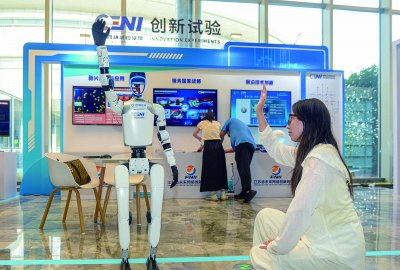
第九届未来网络发展大会探展——人在江宁,“飞”阅玄武湖
Nan Jing Ri Bao· 2025-08-20 00:56
Core Insights - The 9th Future Network Development Conference showcased innovative technologies and achievements in the field of future networks, with participation from major telecom operators, leading communication equipment companies, and internet giants [3][6] - A significant highlight was the demonstration of deterministic network drone remote control, which addresses communication bottlenecks that hinder the rapid development of the low-altitude economy [3][4] - The conference also featured advancements in computing power scheduling platforms aimed at optimizing the use of computing resources across regions, addressing inefficiencies in current computing resource distribution [4][5] Group 1: Technological Innovations - The deterministic network capabilities of CENI allow for remote control of drones over hundreds to thousands of kilometers, enabling a single operator to control hundreds of drones simultaneously [4] - The "super wide highway" developed by ZTE enhances data transmission capacity, effectively doubling the number of data lanes, which supports Jiangsu's role as a major data scheduling center [5] - China Telecom introduced its upgraded network large model, which significantly improves network fault handling efficiency, reducing troubleshooting time by 30% compared to traditional methods [6] Group 2: Industry Implications - The advancements presented at the conference highlight the strong industrial support capabilities of technologies like intelligent networks and deterministic networks, which are essential for the high-quality development of the digital economy [6] - The integration of artificial intelligence models with data infrastructure demonstrates a seamless connection between technology and industry, providing strong momentum for the transformation and upgrading of traditional industries [6]

A股两融余额时隔10年重返2.1万亿元
Shang Hai Zheng Quan Bao· 2025-08-19 19:25
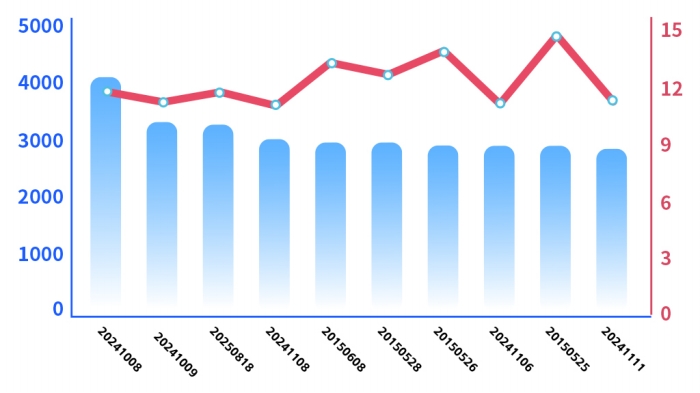
Group 1 - The total margin trading balance in the A-share market has surpassed 2.1 trillion yuan, reaching 21,023.09 billion yuan, marking a new high since June 26, 2015 [2] - On August 18, the margin trading amount exceeded 300 billion yuan, hitting 327.31 billion yuan, which is the highest this year and ranks as the third highest in history [3] - The number of investors participating in margin trading reached 630,200, an increase of 11.67% from the previous day, indicating a growing interest in leveraged trading [3] Group 2 - The electronic industry saw the largest increase in margin financing balance, with an increase of 230.58 billion yuan, while 28 out of 31 industries experienced an increase in financing balance [3] - The total margin balance has increased by over 110 billion yuan since August, reflecting investors' positive outlook on the market [4] - Historical analysis shows that rapid inflows of margin trading have occurred four times since 2014, with the current inflow potentially linked to improved fundamental expectations [4]


中兴通讯股价小幅回落 股东户数连续11期下降
Jin Rong Jie· 2025-08-19 17:09
截至2025年8月19日15时,中兴通讯股价报37.80元,较前一交易日下跌1.33%。当日成交额达79.58亿 元,换手率为5.23%。 中兴通讯属于通信设备行业,是全球领先的综合通信解决方案提供商,业务涵盖运营商网络、政企业 务、消费者业务等领域。 数据显示,中兴通讯最新股东户数为459606户,已连续11期下降。8月18日,中兴通讯获得逾6亿元融资 净流入。 8月19日,中兴通讯主力资金净流出91125.97万元,占流通市值比为0.6%。近五日主力资金净流入 194945.66万元,占流通市值比为1.28%。 风险提示:以上信息仅供参考,不构成任何投资建议,市场有风险,投资需谨慎。 ...
夯实“全国一体化算力网”标准底座 鹏城实验室牵头制定IEEE算力网国际标准正式发布
Shen Zhen Shang Bao· 2025-08-19 16:40
Group 1 - The core viewpoint of the article is the official release of the IEEE standard for sharing data and models for artificial intelligence across multiple computing centers, led by Pengcheng Laboratory [1] - The standard, identified as IEEE Std 3404-2025, aims to address interoperability, security, and efficiency issues in cloud collaboration among wide-area computing centers [1] - The development of this standard involved collaboration with top research institutions and leading companies, including Peking University, Huawei Technologies, and ZTE Corporation [1] Group 2 - Pengcheng Laboratory has already developed over 15 standards related to computing networks, which have been initiated and published in various international and domestic standard organizations [1] - The collaborative effort includes participation from organizations such as the National Data Standardization Technical Committee and the AITISA Alliance [1]
中兴通讯热设计专家周爱兰:热界面材料将成为6G时代核心技术之一
DT新材料· 2025-08-19 16:04
Core Viewpoint - The article discusses the rising importance of Thermal Interface Materials (TIM) in the context of 5G and upcoming 6G technologies, highlighting their role in managing heat in communication systems as power density increases [1][2]. Group 1: 5G and 6G Development - The construction of global 5G networks is entering a critical phase, with 5G-ADVANCED (5.5G) moving towards commercialization, laying the groundwork for 6G [1]. - As communication speeds increase, the power consumption of base stations will also rise, leading to greater thermal management challenges [1]. Group 2: Importance of Thermal Interface Materials - TIMs serve as "invisible bridges" that fill the micro-gaps between chips and heat sinks, becoming strategic materials essential for the stability of communication systems [1]. - The reduction in the size of base stations necessitates higher integration of antennas and filters, which in turn limits the size of heat sinks, complicating heat dissipation [1]. Group 3: Innovations in Thermal Interface Materials - There are four main categories of innovative TIMs: thermal gels, phase change materials (PCM), carbon-based materials, and liquid metals [2]. - ZTE has implemented a 7.8 W/mK gel solution in its BBU baseband unit, achieving 2 million hours of fault-free operation [2]. - Huawei's use of PCM in its 5G base station RF chips has resulted in a 9.6°C reduction in temperature fluctuations under sudden loads, enhancing output power stability by 40% [2]. Group 4: Future Trends and Events - As 6G terahertz communication pushes chip thermal flux density to the level of 1000 W/cm², TIMs will transition from auxiliary materials to core technologies [2]. - ZTE's wireless thermal design expert will present on the demand and outlook for TIMs in communication base stations at the 2025 Polymer Industry Annual Conference [2].