
Midea Group(000333)

Search documents
周观点 | 特斯拉计划2027年销售机器人 关注机器人板块【国联民生汽车 崔琰团队】
汽车琰究· 2026-01-25 13:40
Market Performance - The automotive sector outperformed the market this week, with a 2.6% increase in A-share automotive stocks from January 19 to January 25, ranking 14th among Shenwan sub-industries, compared to a decline of 0.6% in the CSI 300 index [1] - Sub-sectors such as automotive services, commercial vehicles, automotive parts, motorcycles, and others saw increases of 6.9%, 4.8%, 4.0%, 1.4%, and 0.7% respectively, while passenger vehicles decreased by 1.4% [1] Investment Recommendations - Recommended core stocks include Geely Automobile, Xpeng Motors, BYD, Bertley, Top Group, New Spring Co., and Chunfeng Power [2] - For passenger vehicles, Geely, Xpeng, and BYD are recommended, with Jianghuai Automobile suggested for attention [5] - In the parts sector, recommendations include Bertley and Horizon Robotics for intelligent driving, and Top Group and New Spring Co. for new forces in the industry chain [5] - For motorcycles, recommended companies are Chunfeng Power and Longxin General [6] - In the tire sector, SAILUN and Senqilin are recommended [7] - For commercial vehicles, recommended companies include Weichai Power and China National Heavy Duty Truck for heavy trucks, and Yutong Bus for passenger vehicles [8] Strategic Collaborations - Changan Automobile signed a comprehensive strategic cooperation agreement with Midea Group to deepen the "people-car-home" smart ecosystem collaboration, allowing users to control 20 types of Midea smart appliances via voice and to check vehicle status remotely [4][11] Robotics Sector Insights - Tesla plans to sell humanoid robots to the public by 2027, with deliveries to enterprises expected to start in the second half of 2026. This development is anticipated to catalyze the robotics sector [3][10] - The focus is on the production and technological iteration of Tesla's robots, with domestic manufacturers like Yushutech expected to enter the IPO phase soon, which could serve as a strong catalyst for the sector [3][10] - Key hardware segments such as dexterous hands and lightweight components are expected to see significant changes, and the valuation of leading automotive robotics manufacturers is anticipated to undergo reconstruction [3][10][23] Policy and Market Trends - The new national subsidy policy for 2026 aims to stimulate demand by extending the scope of vehicle replacement subsidies, which is expected to improve the structure of subsidized models [12][18] - The subsidy for scrapping and replacing vehicles will be based on a percentage of the vehicle price, with electric vehicles receiving up to 20,000 yuan and fuel vehicles up to 15,000 yuan [14][16] - The overall discount rate for vehicles in December 2025 increased compared to November, indicating a competitive market environment [53][54] Motorcycle Market Dynamics - The sales of motorcycles above 250cc reached 69,000 units in December 2025, showing a year-on-year increase of 1.8% and a month-on-month increase of 12.9% [30] - The domestic sales of motorcycles above 250cc in December were 28,000 units, up 32.8% year-on-year, while exports showed a decline [31] Heavy Truck Market Recovery - The heavy truck market saw sales of approximately 95,000 units in December 2025, a year-on-year increase of about 13%, supported by the expanded scope of the vehicle replacement subsidy policy [34] - The average subsidy for scrapping and updating eligible trucks is 80,000 yuan, which is expected to stimulate demand significantly [34][36]





家电行业 2026W04 周报:家电基金持仓略有下降,欧盟对割草机进口展开登记
GUOTAI HAITONG SECURITIES· 2026-01-25 10:45
Investment Rating - The report assigns an "Overweight" rating to the home appliance industry [4]. Core Insights - The report highlights a slight decline in fund holdings in the home appliance sector, with a 2.6% allocation in actively managed equity funds for Q4 2025, down 0.2 percentage points from Q3 [2][4]. - December retail sales for home appliances showed a year-on-year decline of 18.7%, indicating ongoing pressure despite a high base in the previous year [2][4]. - The European Union has mandated registration for imports of robotic lawn mowers from China, with potential anti-dumping duties estimated between 21.4% and 57.4% [2][4]. Summary by Sections Investment Recommendations - The report suggests that national subsidies are expected to transition smoothly, and leading companies in both black and white appliances are recommended for their stable operations and high dividends, including Midea Group (13.1X PE), Haier Smart Home (11.4X), TCL Electronics (12.7X), and Hisense Visual (12.7X) [4]. - It emphasizes the core drivers of smart home appliances' overseas expansion, recommending leading robotic vacuum manufacturers Roborock (20.3X) and Ecovacs (22.5X) [4]. - Companies with stable performance and upward potential include Ninebot (19.9X), Anfu Technology (56.8X), Hailong Cold Chain (15.9X), and Beiding Co. (35.3X) [4]. - The report also notes that home appliance companies are diversifying into new areas, recommending Rongtai Health (21.3X) and Wanlong Magnetic Plastic (21.9X) [4]. Market Data - In December 2025, the production of home air conditioners was 14.782 million units, down 18.7% year-on-year, with domestic sales at 5.397 million units, down 26.7% [2][4]. - The total domestic sales for the year reached 10.521 million units, a slight increase of 0.7% year-on-year, while total exports were 9.318 million units, down 3.4% [2][4]. - The overall retail sales for home appliances in December 2025 amounted to 97.1 billion yuan, with a cumulative annual total of 1,169.5 billion yuan, reflecting an 11.0% year-on-year increase [2][4].





家电周报:亿田智能发布2025年业绩预告,石头科技发布新品-20260125
Shenwan Hongyuan Securities· 2026-01-25 09:28
Investment Rating - The report maintains a positive outlook on the home appliance industry, particularly on leading companies in the white and black goods sectors, highlighting their low valuations, high dividends, and stable growth potential [2][3]. Core Insights - The report identifies three main investment themes: 1. **Dividend and Growth**: Leading companies in the white and black goods sectors are characterized by low valuations, high dividends, and stable growth, providing a high safety margin and significant price elasticity. The impact of the trade-in policy is expected to continue positively into 2026 [2][3]. 2. **Technological Transition**: Key upstream component manufacturers are diversifying into emerging technology sectors such as robotics, data center temperature control, and semiconductors, seeking cross-industry transformation [2][3]. 3. **Market Demand**: Both domestic and international markets show promising demand, with established companies expanding production bases globally to mitigate trade fluctuations and capture growth in emerging markets [2][3]. Sales Data Summary - **Air Conditioning**: In December 2025, online retail sales volume was 720,000 units, a year-on-year decrease of 38.5%, while offline sales volume was 162,000 units, down 42.9%. The average online retail price decreased by 4.2% to 2,981 yuan per unit, and the offline average price fell by 20.1% to 3,801 yuan per unit [2][3][35]. - **Kitchen Appliances**: - **Range Hoods**: Online sales volume was 443,000 units, down 16.8%, while offline sales were 57,000 units, down 32.1%. The online average price increased by 14.4% to 1,739 yuan per unit, while the offline average price decreased by 14.4% to 3,813 yuan per unit [3][41]. - **Dishwashers**: Online sales volume was 49,000 units, down 10.2%, and offline sales were 5,000 units, down 44.2%. The online average price decreased by 1.1% to 4,245 yuan per unit, while the offline average price increased by 1.4% to 7,990 yuan per unit [3][41]. Company Updates - **Yitian Intelligent**: Forecasts a net loss of 186 to 152 million yuan for 2025, compared to a profit of 26.54 million yuan in 2024 [5][11]. - **Roborock Technology**: Launched new products including the G30S Pro and P20 Ultra, featuring advanced cleaning technologies and high efficiency [5][12]. - **Stock Performance**: The home appliance sector outperformed the CSI 300 index, with notable gains from companies like Aojiahua (10.1%) and Hisense Visual (5.7%) [5][6][8]. Macro Economic Environment - As of January 23, 2026, the USD to RMB exchange rate was 6.9929, reflecting a decrease of 0.51% since the beginning of the year [46][48]. - In December 2025, the total retail sales of consumer goods reached 45,135.90 billion yuan, a year-on-year increase of 0.86% [48][49].


家电行业 2026W04 周报:家电基金持仓略有下降,欧盟对割草机进口展开登记-20260125
GUOTAI HAITONG SECURITIES· 2026-01-25 07:47
Investment Rating - The report assigns an "Accumulate" rating for the home appliance industry [4]. Core Insights - The report highlights a slight decline in fund holdings in the home appliance sector, with a 2.6% allocation in actively managed equity funds for Q4 2025, down 0.2 percentage points from Q3 [2][4]. - The report notes that the production of household air conditioners in December 2025 was 14.782 million units, a year-on-year decrease of 18.7%, with domestic sales down 26.7% and exports down 13.2% [2][4]. - The report mentions that the EU has mandated registration for imports of robotic lawn mowers from China, with potential anti-dumping duties estimated between 21.4% and 57.4% [2][4]. Summary by Sections Investment Recommendations - The report suggests that national subsidies are expected to transition smoothly, and recommends several companies for investment based on their stable operations and high dividends, including Midea Group (13.1X), Haier Smart Home (11.4X), TCL Electronics (12.7X), and Hisense Visual (12.7X) [4]. - It highlights the core drivers for smart home appliances' overseas expansion, recommending leading robotic vacuum companies Roborock (20.3X) and Ecovacs (22.5X) [4]. - The report also recommends companies with stable performance and upward potential, such as Ninebot (19.9X), Anfu Technology (56.8X), Hailong Cold Chain (15.9X), and Beiding Co. (35.3X) [4]. - Additionally, it points out companies expanding into new business lines, recommending Rongtai Health (21.3X) and Wanlong Magnetic Plastic (21.9X) [4]. Market Data - The report provides data on the top five holdings in the home appliance sector, with Midea Group valued at 19.9 billion, Haier Smart Home at 6 billion, and others showing varying changes in market value [4]. - It notes that the overall retail sales of home appliances in December 2025 were 97.1 billion, a year-on-year decrease of 18.7% [2][4]. - The report indicates that the total domestic sales volume for the air conditioning industry in 2025 was 10.521 million units, a slight increase of 0.7% year-on-year, while total exports were 9.318 million units, down 3.4% [2][4].
美的集团亚太区域总裁蒋轩:广货家电如何在东南亚争第一
2 1 Shi Ji Jing Ji Bao Dao· 2026-01-23 23:08
Core Insights - Midea aims to become a global leader in white goods and HVAC, targeting over 400 billion yuan in revenue by 2024 [1] - The company has significantly increased its overseas OBM revenue, which now accounts for over 45% of its TO C business, with notable contributions from the Asia-Pacific region [1] - Midea's manufacturing base in Thailand has become its largest overseas facility, with nine factories, and is positioned as a key hub for both manufacturing and sales in the ASEAN market [8] Group 1: Global Expansion Strategy - Midea's transition from product export to a full-chain approach of R&D, manufacturing, and branding is a strategic upgrade to enhance its global presence [2] - The company has established Thailand as its "second home" for manufacturing due to favorable political and labor conditions, as well as its ability to serve both local and export markets [7] - Midea's acquisition of Toshiba's local factories has facilitated its manufacturing expansion in Thailand, allowing it to address tariff challenges and diversify its supply chain [7] Group 2: Cost and Efficiency - Production costs in Thailand are higher than in China, but Midea has found that the overall cost advantage lies in local manufacturing due to tariff differences [4][6] - The company is focusing on local talent development to improve operational efficiency and reduce costs associated with expatriate management [6] Group 3: Market Penetration and Brand Strategy - Midea's multi-brand strategy is crucial for penetrating diverse ASEAN markets, leveraging both its own brand and acquired international brands like Toshiba [9] - The company is investing significantly in after-sales service to build brand reputation and customer trust, learning from past experiences of other Chinese brands in the region [10] Group 4: Sales and Distribution Channels - Midea is employing a tiered approach to build its after-sales service network, including authorized service points and exclusive service providers to ensure quality and efficiency [11][12] - The company is focusing on enhancing brand awareness and conversion rates through targeted marketing strategies, with a current investment split of 50% on awareness, 30% on consideration, and 20% on conversion [14][15] Group 5: Future Global Strategy - Midea's future global strategy will emphasize regional operations to meet local demands while ensuring inter-regional collaboration [18][19] - The company recognizes the need to adapt its R&D, supply chain, and product quality to align with local market requirements, moving beyond a purely export-oriented mindset [18][19]

兴证策略:2025年四季度主动权益基金管理规模小幅下降 四季度存量基金的赎回压力仍然较大
Sou Hu Cai Jing· 2026-01-23 12:38
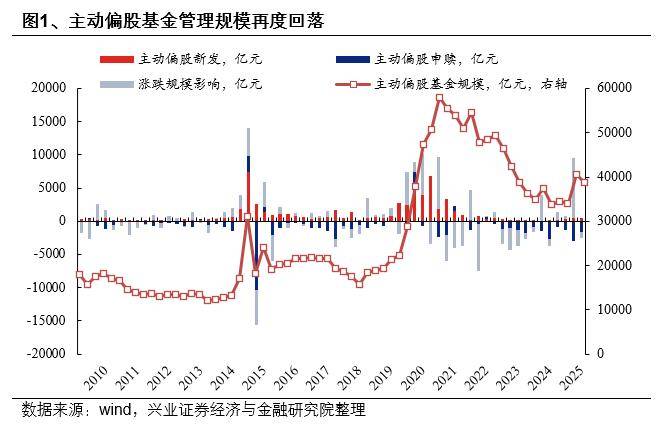
Group 1 - The active equity fund management scale decreased slightly in Q4 2025, primarily due to significant redemption pressure from existing funds, resulting in a net redemption of 165.6 billion yuan [1] - The total management scale of three types of active equity funds (ordinary stock, mixed equity, and flexible allocation) decreased by 189.8 billion yuan, with new active equity fund issuance at 56.2 billion yuan [1] - The active equity fund's position in Q4 2025 decreased by 0.83 percentage points to 86.62%, remaining at the second-highest level in history [2] Group 2 - In terms of sector allocation, the proportion of the ChiNext board increased by 1.24 percentage points to 24.98%, while the main board and Sci-Tech Innovation board saw declines [5][8] - The allocation to the main board decreased by 0.30 percentage points to 58.21%, indicating a further increase in underweight [8] - Active equity funds increased their positions in cyclical and financial real estate sectors while reducing exposure to technology growth and pharmaceuticals [11] Group 3 - The active equity funds increased their allocation in the non-ferrous metals, communication, and non-bank financial sectors, with increases of 2.26 percentage points, 1.85 percentage points, and 0.87 percentage points respectively [13] - The funds reduced their positions in electronics, pharmaceuticals, media, power equipment, and computers, with reductions of 1.72 percentage points, 1.54 percentage points, and 1.16 percentage points respectively [13] - Excluding thematic/sector funds, the active equity funds still increased their positions in non-ferrous metals, communication, and non-bank financial sectors [14] Group 4 - The allocation to the TMT sector slightly decreased in Q4 2025, with the configuration coefficient at 1.48, indicating room for further improvement [29] - Within the TMT sector, active equity funds increased their holdings in communication equipment and components while reducing positions in consumer electronics and semiconductors [32] - The dividend sector's allocation stabilized and increased, with the low-volatility dividend index rising by 1.7 percentage points to 4.3% [37] Group 5 - The top five stocks in active equity funds in Q4 2025 included Zhongji Xuchuang, Xinyi Sheng, Dongshan Precision, China Ping An, and Zijin Mining, with respective increases in holding ratios [43] - The top ten holdings accounted for 4.83%, 4.01%, and 3.97% of the total market value of the funds [46] - The concentration of individual stocks in active equity funds increased slightly, while the concentration of industries showed a mixed trend [49] Group 6 - The Hong Kong stock allocation of active equity funds decreased to 15.98%, down from 19.09%, with a total holding value of 302.9 billion yuan [51] - The funds increased their positions in the healthcare, materials, and energy sectors while reducing exposure to consumer discretionary and information technology sectors [54] - Tencent maintained its position as the largest holding in Hong Kong stocks, with a market value of 57.3 billion yuan [56]






美的集团1月23日斥资1.1亿元回购143.06万股A股
Zhi Tong Cai Jing· 2026-01-23 10:42
Core Viewpoint - Midea Group announced a share buyback plan, investing RMB 110 million to repurchase 1.4306 million A-shares at a price range of RMB 76.74 to 76.99 per share [1] Group 1 - The company will execute the buyback on January 23, 2026 [1] - In conjunction with the buyback, the company will issue a total of 75,400 A-shares under the eighth and ninth stock option incentive plans [1]
里昂:升美的集团目标价至95港元 评级跑赢大市
Xin Lang Cai Jing· 2026-01-23 10:28
Group 1 - The core viewpoint of the report is that Midea Group (00300.HK) may experience positive surprises in overseas sales due to OEM orders [1] - The historical average price-to-earnings ratio of 12.5 times is being utilized for valuation [1] - The target price for H-shares has been raised from HKD 90 to HKD 95, with a rating of outperforming the market [1]
美的集团(00300)1月23日斥资1.1亿元回购143.06万股A股
智通财经网· 2026-01-23 10:13
Core Viewpoint - Midea Group announced a share buyback plan, indicating confidence in its stock value and commitment to returning capital to shareholders [1] Group 1: Share Buyback Details - The company will repurchase 1.1 billion RMB worth of A-shares, totaling 1.4306 million shares [1] - The buyback price per share is set between 76.74 and 76.99 RMB [1] Group 2: Stock Option Plans - On the same day, Midea Group issued a total of 75,400 A-shares as part of its eighth and ninth stock option incentive plans [1]
美的集团(00300.HK)1月23日耗资1.1亿元回购143万股A股
Ge Long Hui· 2026-01-23 10:06
Group 1 - The core point of the article is that Midea Group announced a share buyback plan, intending to repurchase 1.43 million A-shares at a cost of RMB 110 million [1] - The buyback will occur on January 23, 2026, with a price range of RMB 76.74 to 76.99 per share [1] Group 2 - The announcement reflects Midea Group's strategy to enhance shareholder value through share repurchase [1] - The total amount allocated for the buyback indicates the company's confidence in its financial position and future prospects [1] - The specific number of shares and the price range suggest a targeted approach to managing its capital structure [1]