
Midea Group(000333)

Search documents
索尼退场,日本电视全军覆没
3 6 Ke· 2026-01-23 00:36
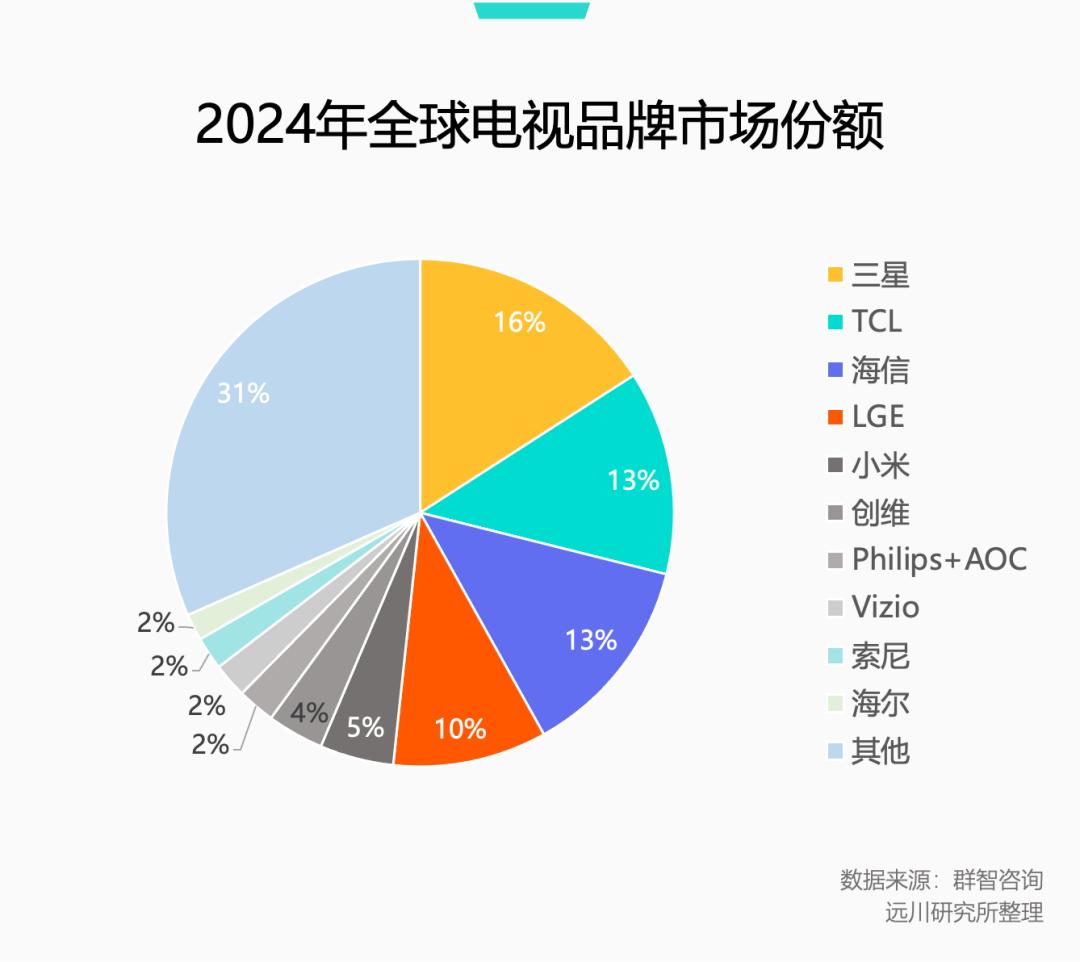
Core Viewpoint - Sony has announced a joint venture with TCL to manage its home entertainment business, with TCL holding a 51% stake, effectively transferring Sony's television operations and the BRAVIA brand to TCL, marking a significant shift in the consumer electronics market [1][5]. Group 1: Sony's Strategic Shift - Sony lacks display panel production capabilities, which are crucial for maximizing profits in the television market, relying on LG and TCL for panel supply and Mediatek for picture quality chips [1]. - Sony's television market presence is minimal, consistently ranking in the "others" category, and its television segment is less profitable compared to its other businesses like CIS chips, gaming, and music [1][5]. - The move signifies Sony's exit from the competitive global television market, following a trend where Japanese brands have been selling off their consumer electronics divisions [5][7]. Group 2: TCL's Positioning - For TCL, acquiring Sony's brand equity is a strategic asset that, combined with its own panel production capabilities, positions it to challenge Samsung's dominance in the global market [5]. - TCL is currently the only domestic television brand in China with display panel production capabilities, which is essential for maintaining competitive pricing and product quality [18][27]. Group 3: Decline of Japanese Brands - The exit of Sony marks the end of Japan's independent television brands, with other major players like Sharp, Toshiba, and Panasonic also having exited or significantly downsized their television operations [5][15]. - The decline of Japanese television brands is attributed to their loss of panel production capabilities, which has resulted in a lack of pricing power in the market [16][23]. - The financial crisis of 2008 and subsequent strategic missteps led to a shift in focus for Japanese companies from consumer electronics to higher-margin components, further diminishing their presence in the television market [7][12][13].







“旭易”东升 基金重仓股变迁 折射中国资本市场深刻变化
Shang Hai Zheng Quan Bao· 2026-01-22 18:42
Group 1 - The A-share market experienced fluctuations at relatively high levels in Q4 2025, with a slight decrease in overall equity positions of public funds compared to Q3 2025 [1][2] - The average equity positions for stock and mixed funds were 89.06% and 81.05%, respectively, showing a minor decline from the previous quarter [2] - Major holdings in public funds included leading light module companies, with Zhongji Xuchuang and Xinyi Sheng surpassing Ningde Times and Tencent Holdings to become the top two heavyweights [1][4] Group 2 - Several actively managed equity funds significantly increased their positions, with notable examples including Bosera Huixing and GF Chengxiang, which raised their equity positions by 12.31 and 10.3 percentage points, respectively [2] - Fund managers expressed optimism about the A-share market for 2026, citing potential dual benefits from domestic and international liquidity [3][9] - The focus on technology sectors continued, with managers identifying investment opportunities in storage chips, solid-state batteries, and humanoid robots [7][10] Group 3 - The top 50 heavyweights in public funds were primarily concentrated in information technology, consumer goods, and investment sectors, with 18 stocks in the information technology sector [4][6] - AI-related stocks gained prominence, with Zhongji Xuchuang, Xinyi Sheng, and Hanwujing entering the top seven heavyweights due to the AI boom [4][6] - The number of innovative drug companies in the top 50 heavyweights decreased from eight to five by the end of Q4 2025, indicating a shift in investment focus [5] Group 4 - Fund managers anticipate that the AI investment theme will continue to be a primary focus, with expectations for rapid growth in AI applications in the coming years [9][10] - The investment strategy is shifting towards AI applications, including smart driving, edge AI, and humanoid robots, as the industry matures [9][10] - The overall sentiment among fund managers is that the AI-driven technology market will remain a significant area of investment for the next several years [9][10]





头部家电企业剧透2026年发展规划:AI、全球化是关键词
Zheng Quan Ri Bao· 2026-01-22 16:29
Group 1 - In 2025, retail sales of home appliances reached 1.1695 trillion yuan, and communication equipment reached 1.0076 trillion yuan, both surpassing the trillion yuan mark [2] - The shift in consumer structure towards greener products is evident, with over 90% of sales in the 12 categories of appliances under the trade-in policy being energy-efficient or water-efficient products [2] - Major home appliance companies are planning to consolidate their advantages in 2026 through technological innovation, business streamlining, and global expansion [2] Group 2 - Gree Electric's Vice President stated that the company is replacing welding work with self-developed robots and is enhancing its capabilities in smart industrial fields [3] - Midea Group's Chairman emphasized maintaining strategic focus on robotics, energy, and medical businesses, which have vast market potential, while also streamlining redundant operations [3] - Haier Smart Home is committed to a global and high-end strategy, indicating a shift from scale expansion to quality and efficiency [4] Group 3 - The market opportunities created by policies are accelerating the transformation of home appliance companies from scale expansion to quality and efficiency [4] - Leading companies are leveraging the policy window to build core competitiveness through technological innovation and strategic focus, aiming for sustainable development amid intense market competition [4]

极寒天气,是时候换一种方式温暖北方老家了
凤凰网财经· 2026-01-22 12:57
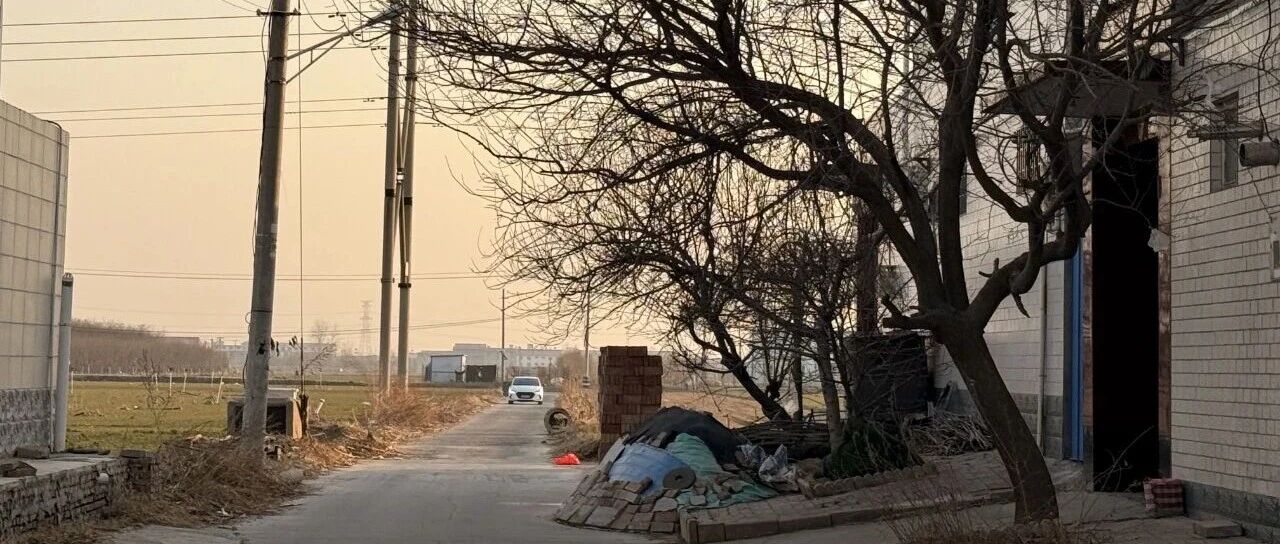
华北平原的冬晨,在雪后醒得格外沉默。五点多,天还浸在青黑里,昨夜的积雪压在屋檐、树梢和 院墙上,把村庄包裹成一片静谧的纯白。风穿过光秃秃的树枝,带起细细的雪沫。 王秀英醒来时,看向床边墙上的温度显示器: 20.5℃ , 这个数字让她安心 。 趿着鞋走向厨房 , 拧开水龙头, "哗"的一声,清亮温暖的水流冲进洗手池。 这个简单的动作,在 数年前 大雪封门的清晨,曾是一种奢望。 温度骤降,厨房水管会在一两个小 时内冻得结结实实。没有水,做不了饭,喝不上热水,连洗漱都成问题。 最近,随着一股强冷空气来袭,北方多地再次迎来强降雪和断崖式降温。 不期而至的 极端天气 , 成了村里许多取暖设备的试金石。王秀英听说,邻居 家有的因为室外机结冰严重无法化霜,有的在 低温下制热效果大打折扣,不得不重新搬出电暖器救急。 而自家院里那台室外机,却在积雪中平稳 运行了一整夜 。 村庄在寒冷中醒来,但 像王秀英一样 用上新设备的 人们已不再忙乱焦虑。一种更稳定、更可靠的 温暖,正守护着这片雪后的清晨。 早年的辛苦劳作让王秀英的膝盖出了些毛病,她的丈夫前几年也被诊断出毛细血管相关的疾病。医 生对二人的嘱咐是,必须时刻保暖。 大雪骤降,两 ...
美的与长安汽车共探“人-车-家”价值融合
Xin Hua Cai Jing· 2026-01-22 12:41
Core Viewpoint - Midea Group and Changan Automobile have signed a strategic cooperation agreement to focus on the "human-vehicle-home" smart ecosystem, aiming to enhance the interconnectivity between smart homes and smart cars, facilitating comprehensive collaboration from consumer scenarios to enterprise production [1]. Group 1: Strategic Cooperation - The partnership aims to leverage Changan's extensive vehicle lineup and production capacity of nearly 3 million units annually to enhance data and service systems for the "human-vehicle-home" ecosystem [1]. - Midea has previously established collaborations with leading automotive companies such as BYD and Changan since launching its "human-vehicle-home" ecosystem strategy in August of the previous year [1]. Group 2: Industry Trends - The concept of "human-vehicle-home" is evolving from mere remote control of devices to a seamless smart experience across various life scenarios, with vehicle-home interconnectivity becoming a necessity [2]. - Midea is attempting to create new value by focusing on connection, scenarios, and services, rather than just adding functionalities [2]. Group 3: Technological Integration - Midea provides standardized open interfaces and development tools to partners, allowing them to utilize Midea's comprehensive smart home services without being "tied down," thus lowering the psychological barriers and costs for partners to join the ecosystem [2]. - The integration of AI and proactive service capabilities is expected to enhance user experience, such as automatically entering "home mode" when a vehicle approaches within one kilometer of the home [2]. Group 4: Ecosystem Development - Midea is building a more inclusive and sustainable smart ecosystem through open collaboration with partners like Changan, transforming various lifestyle concepts into reality [3].

强势股追踪 主力资金连续5日净流入88股
Zheng Quan Shi Bao Wang· 2026-01-22 09:44
Core Viewpoint - The report highlights the significant inflow of main capital into various stocks, with specific companies showing remarkable performance in terms of net capital inflow and stock price changes [1][2]. Group 1: Main Capital Inflow - A total of 88 stocks have experienced a net inflow of main capital for five consecutive days or more, indicating strong investor interest [1]. - Hangzhou Bank leads with 16 consecutive days of net inflow, followed by Yunnan Baiyao with 14 days [1]. - Midea Group has the highest total net inflow amounting to 1.582 billion yuan over seven days, while Hangzhou Bank follows closely with 1.489 billion yuan over 16 days [1]. Group 2: Performance Metrics - The stock with the highest net inflow ratio relative to trading volume is Fenglong Co., which has surged by 359.76% over the past 16 days [1]. - Other notable stocks include Guotai Junan Securities with a net inflow of 1.109 billion yuan over 11 days and China Ping An with 1.074 billion yuan over six days, although their stock prices have seen declines of 2.46% and 3.28% respectively [1]. - The report includes a detailed table of stocks with their respective net inflow amounts, inflow ratios, and cumulative price changes, providing a comprehensive overview of market trends [1][2].





白色家电板块1月22日跌0.09%,深康佳A领跌,主力资金净流入5.14亿元
Zheng Xing Xing Ye Ri Bao· 2026-01-22 09:01
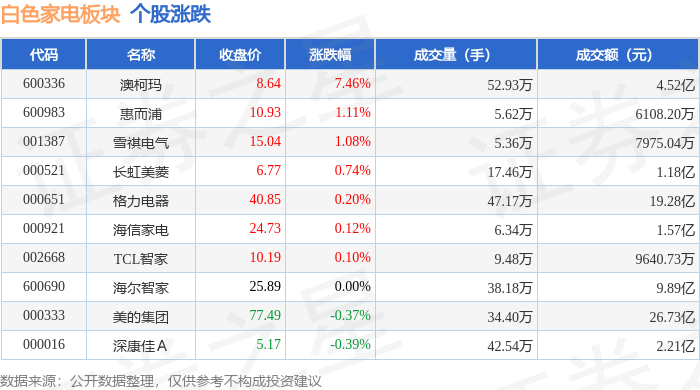
Market Overview - The white goods sector experienced a slight decline of 0.09% on January 22, with Deep Konka A leading the drop [1] - The Shanghai Composite Index closed at 4122.58, up 0.14%, while the Shenzhen Component Index closed at 14327.05, up 0.5% [1] Individual Stock Performance - Aokema (600336) saw a significant increase of 7.46%, closing at 8.64 with a trading volume of 529,300 shares and a turnover of 452 million yuan [1] - Whirlpool (600983) and Xueqi Electric (001387) also reported modest gains of 1.11% and 1.08%, respectively [1] - Gree Electric (000651) and Hisense Home Appliances (000921) had minimal changes, with Gree Electric up 0.20% and Hisense up 0.12% [1] - Midea Group (000333) experienced a slight decline of 0.37%, closing at 77.49 with a trading volume of 344,000 shares and a turnover of 2.673 billion yuan [1] Capital Flow Analysis - The white goods sector saw a net inflow of 514 million yuan from institutional investors, while retail investors contributed a net inflow of 41.26 million yuan [1] - However, speculative funds experienced a net outflow of 555 million yuan [1] Detailed Capital Flow for Key Stocks - Midea Group had a net inflow of 47.4 million yuan from institutional investors, but a net outflow of 48.3 million yuan from speculative funds [2] - Gree Electric reported a net inflow of 74.51 million yuan from institutional investors, with a net outflow of 101 million yuan from speculative funds [2] - Haier Smart Home (600690) had a net inflow of 47.07 million yuan from institutional investors, while retail investors saw a net outflow of 60.53 million yuan [2] - Deep Konka A experienced a net outflow of 32.93 million yuan from institutional investors, but a net inflow of 24.88 million yuan from retail investors [2]


2025年度并购报告,广东赢麻了
投中网· 2026-01-22 06:06
Group 1 - In 2025, the Chinese M&A market saw a total of 5,086 announced transactions, a decrease of 20.27% year-on-year, while the total transaction amount reached 2,373.515 billion yuan, an increase of 29.08% [7] - The completed transactions in 2025 amounted to 3,342, a slight increase of 0.45% year-on-year, with a total transaction value of 1,485.131 billion yuan, up 54.41% year-on-year, indicating a structural optimization trend in the market [9][10] - The Guangdong province continued to lead the M&A market in China, benefiting from the dual innovation drive of the Guangdong-Hong Kong-Macao Greater Bay Area, with electronic information, traditional manufacturing, healthcare, and energy mining being the hot sectors [10][31][32] Group 2 - In 2025, private equity funds showed a recovery in exit numbers, with 469 exits, a year-on-year increase of 22.77%, and a total capital recovery of 64.215 billion yuan, up 8.54% year-on-year [17] - Notable exits included TCL Technology's acquisition of a 21.53% stake in Shenzhen Huaxing Optoelectronics for 11.562 billion yuan and Silex Group's acquisition of Chongqing Liangjiang New Area Longsheng New Energy for 3.509 billion yuan [20][21] Group 3 - In 2025, there were 20 M&A transactions exceeding 10 billion yuan, with the largest being China Shipbuilding Industry's acquisition of China Shipbuilding Heavy Industry for 115.15 billion yuan, marking a significant milestone in China's shipbuilding industry [23] - Major domestic M&A cases included Guotai Junan's merger with Haitong Securities for approximately 97.609 billion yuan and Shandong Hongchuang's acquisition of Shandong Hongtu for 63.518 billion yuan [24][25] Group 4 - The cross-border M&A market in 2025 saw a total of 144 transactions, with outbound M&A accounting for 79 and inbound M&A for 65, reflecting a year-on-year decline of 13.77% [26] - Notable cross-border transactions included Midea Group's acquisition of Teka Group for 8.287 billion yuan and Zijin Mining's acquisition of Newmont Golden Ridge for 7.315 billion yuan [27][29] Group 5 - The M&A market in 2025 was characterized by a structural differentiation of "quantity reduction and price increase," with a notable shift from quantity dividends to quality dividends [10] - The electronic information sector led the number of transactions with 579 deals, accounting for 17.32%, while the financial sector had the largest disclosed transaction value at 203.596 billion yuan, representing 13.71% of the total [34][36]




张坤等知名基金经理罕见发声!
天天基金网· 2026-01-22 05:20
Group 1 - The core viewpoint of the article highlights the strategic adjustments made by prominent fund managers at E Fund in their investment portfolios for Q4 2025, focusing on sectors like AI, healthcare, consumer goods, and technology [2][4][6][10] Group 2 - Zhang Kun adjusted the structure of investments in the healthcare, consumer, and technology sectors while maintaining a stable position in top holdings, which include Tencent Holdings, Kweichow Moutai, and Alibaba-W [4][5] - Zhang Kun expressed confidence in the improvement of living standards and social security in China over the next decade, suggesting a narrowing gap with developed countries [4] - The AI wave is seen as a significant driver for innovation, with strong domestic demand expected to attract global resources and talent [4][5] Group 3 - Chen Hao focused heavily on AI-related sectors, increasing allocations in power equipment, new energy, non-bank financials, and chemicals, which yielded positive returns [7][8] - Chen Hao anticipates a transition of the AI industry from an acceleration phase in 2025 to a stable growth phase in 2026, emphasizing the importance of structural opportunities and the integration of AI with local applications [7][8] Group 4 - Xiao Nan reduced allocations in high-end and sub-high-end liquor sectors while increasing investments in the livestock industry, anticipating inflation-driven cost increases over the next two years [10] - The top holdings in Xiao Nan's consumer sector fund remained unchanged, including Kweichow Moutai and Midea Group [10]




长安+美的推“车控家”功能,首搭启源车型
Nan Fang Du Shi Bao· 2026-01-22 04:04
Group 1 - The core viewpoint of the articles is the strategic partnership between Changan Automobile and Midea Group, focusing on the development of the "Car Control Home" feature to enhance smart connectivity between vehicles and home devices [1][2] - The "Car Control Home" feature will first be available in Changan's new models, Q05 and A06, allowing users to control home appliances remotely through voice commands, creating a seamless integration of home and vehicle management [1] - Future developments will enable users to utilize the Midea App for "Home Control Car" functionalities, providing real-time vehicle status updates and pre-trip preparations, enhancing the overall user experience [1] Group 2 - The signing of the agreement signifies a deeper collaboration between Changan Automobile and Midea Group in areas such as digitalization, smart manufacturing, green energy, logistics coordination, and public welfare, with a focus on vehicle-home connectivity and marketing strategies [2] - The partnership aims to transition vehicle-home connectivity from "technical collaboration" to "experience implementation," creating a more convenient and comfortable smart living environment for users [2]