Midea Group(000333)

Search documents
里昂:升美的集团目标价至95港元 评级“跑赢大市”
Zhi Tong Cai Jing· 2026-01-21 09:15
Group 1 - The core viewpoint of the report is that Midea Group's overseas sales may surprise due to OEM orders, leading to an upgrade in the H-share target price from HKD 90 to HKD 95, with a rating of outperforming the market [1] - The report notes that some Midea distributors have indicated an increase in factory prices, suggesting an upcoming rise in average selling prices across the industry [1] - Historical data has limited usefulness in assessing the relationship between price and sales, especially in the context of rising copper prices, making the situation more complex [1] Group 2 - By 2026, the outlook is expected to differ, with all home appliance companies acknowledging an unclear growth prospect, yet the industry is anticipated to experience a recovery [1]

里昂:升美的集团(00300)目标价至95港元 评级“跑赢大市”
智通财经网· 2026-01-21 09:11
Group 1 - The core viewpoint of the article is that Midea Group's overseas sales may surprise due to OEM orders, leading to an upgrade in the H-share target price from HKD 90 to HKD 95, with a rating of outperforming the market [1] - The report notes that some Midea distributors have indicated an increase in factory prices, suggesting an upcoming rise in average selling prices across the industry [1] - Historical data has limited usefulness in assessing the relationship between price and sales, especially in the context of rising copper prices, which complicates the situation [1] Group 2 - By 2026, the outlook is expected to differ, with all home appliance companies acknowledging an unclear growth prospect, yet the industry is anticipated to experience a recovery [1]
家电巨头,宣布成立新能源事业部!
鑫椤锂电· 2026-01-21 08:19
Core Insights - The article discusses the establishment of a new energy division by Midea Group, focusing on energy storage, heat pumps, and AI technologies, led by Executive President Wang Jianguo [1] - Midea Group has a strategy of not manufacturing complete vehicles but concentrating on components, having previously acquired Hunan Sanxiang Bus in 2004, which ceased production in 2008 [1] - Midea's subsidiary, KUKA Robotics, highlights the company's strength in the industrial robot sector, essential for automotive manufacturing [2] - Midea's Weiling components have begun supplying major automotive companies like Li Auto, XPeng, and NIO, with strategic collaborations for high-voltage fast charging technology [2] - The company is also expanding its collaboration with NIO to develop components such as air conditioning compressors and vehicle refrigerators [3] Market Insights - The article mentions a report on the global lithium battery application market trends and competitive strategies from 2025 to 2029, indicating a focus on future market dynamics [4]

睿远基金旗下产品最新重仓股曝光:傅鹏博加仓寒武纪,赵枫买回美的
Sou Hu Cai Jing· 2026-01-21 03:57
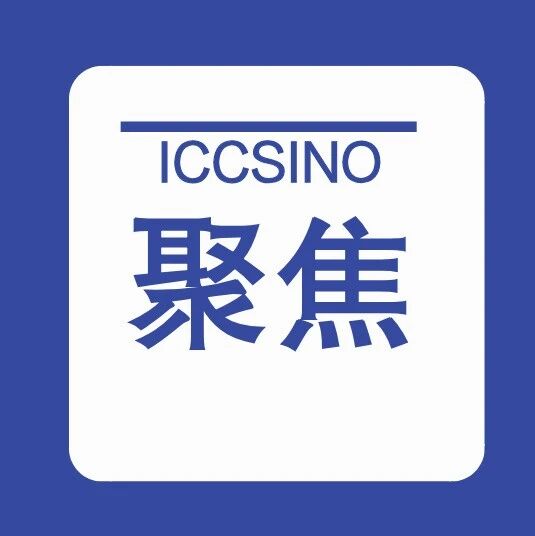
Core Viewpoint - The report highlights significant changes in the investment strategies of Ruiyuan Fund's star fund managers, with notable adjustments in stock holdings and performance metrics for the fourth quarter of 2025. Group 1: Fund Performance and Adjustments - Ruiyuan Growth Value Mixed Fund experienced a net redemption of 136.2 million shares, marking the second-highest redemption in its history, with total net assets decreasing from 23.629 billion yuan to 21.087 billion yuan [3][4] - The fund's stock allocation increased slightly from 89.93% to 90.48%, while the proportion of Hong Kong stocks in the fund's net value decreased from 27.92% to 20.14% [3][4] - Ruiyuan Balanced Value Three-Year Holding Fund's stock allocation reached a three-year high of 90.66%, with a slight increase in the proportion of Hong Kong stocks to 41.99% [10] Group 2: Stock Holdings and Changes - The top ten holdings of Ruiyuan Growth Value Mixed Fund included New Yisheng, Shenghong Technology, and Ningde Times, with New Yisheng seeing a 22.73% reduction in holdings [4][5] - Ruiyuan Balanced Value Three-Year Holding Fund saw significant changes, with the re-entry of Midea Group into the top ten holdings and reductions in holdings of companies like Lixun Precision and China Ping An [10][12] - The fund managers noted a shift in focus towards sectors like photovoltaic and semiconductor high-end equipment manufacturing, while reducing exposure to companies with weak fundamentals [6][10] Group 3: Future Outlook and Strategy - The fund managers expressed optimism about the market, anticipating that the return on equity assets will remain attractive compared to other asset classes, with potential returns exceeding 10% for leading companies [11][13] - They plan to focus on companies with strong fundamentals and competitive advantages, particularly those expanding overseas, as this is expected to drive future growth [13][14] - The report indicates a structural market environment with limited risks of significant downturns, while opportunities for excess returns remain [8][13]




美云智数总裁金江:美的累计打造超1.3万个智能体 约千分之二可商业化
Mei Ri Jing Ji Xin Wen· 2026-01-20 12:41
Core Insights - The AI agent market is expected to accelerate its commercialization and application in various sectors by 2026, with a focus on unlocking the next wave of AI business value [3][4] - Midea Group has launched the Meiqing AIGC 3.1 platform and intelligent factory solutions, emphasizing the importance of AI strategy and the development of AI agents [2][5] Group 1: Midea Group's AI Strategy - Midea Group aims to enhance its AI strategy significantly by 2025, focusing on building AI agent capabilities [2] - The company has developed over 13,000 AI agents in the past three years, with 158 agents contributing 95% of the value output, although only 0.2% have been commercialized [2][5] - Midea plans to achieve cost reductions of 600 million yuan (approximately 84 million USD) through AI by 2025 and over 900 million yuan (approximately 126 million USD) by 2026 [2][5] Group 2: Market Trends and Predictions - The AI agent industry is projected to grow from 5.1 billion USD in 2024 to 47.1 billion USD by 2030, with a compound annual growth rate of 44.8% [5] - Predictions for 2026 include a shift in AI competition from parameter comparison to practical implementation, with the year being termed as the "Year of the Billion AI Agents" [3][4] Group 3: Product Development and Market Positioning - Midea Group plans to release 20 to 30 new AI agent products, expanding its offerings to over 40 agents for external sales [3][4] - The newly launched AI products will target general scenarios as well as specific applications in manufacturing, research and development, marketing, and supply chain [4] - Midea aims to establish a competitive edge by focusing on domain-specific AI agents, recognizing the barriers to understanding application scenarios [5]
美云智数总裁金江:美的累计打造超1.3万个智能体,约千分之二可商业化
Mei Ri Jing Ji Xin Wen· 2026-01-20 12:19
Core Insights - The core viewpoint of the articles emphasizes the accelerating commercialization of AI agents, with a focus on how companies are leveraging AI to unlock new business value and enhance operational efficiency in various sectors [1][2][4]. Group 1: AI Agent Development and Commercialization - In 2026, the competition in AI agents will shift towards unlocking the next wave of commercial value, with a significant increase in the number of AI agents being developed and deployed [2][4]. - Midea Group has launched the Meiqing AIGC 3.1 platform and intelligent agent factory solutions, highlighting the importance of AI strategy and the construction of agent capabilities [1][3]. - Midea has created over 13,000 AI agents in the past three years, with 158 agents contributing 95% of the value output, although only 0.2% have been commercialized [1][4]. Group 2: Financial Impact and Projections - Midea Group aims to reduce costs by 600 million yuan in 2025 and over 900 million yuan in 2026 through AI initiatives [1][4]. - The AI agent market is projected to grow from $5.1 billion in 2024 to $47.1 billion by 2030, with a compound annual growth rate of 44.8% [4]. Group 3: Strategic Focus and Future Plans - Midea's strategy involves a phased approach to AI capabilities, progressing from embedding AI in processes to collaborative work with AI, and ultimately to full automation through agents [4]. - The company plans to release 20 to 30 new AI agent products, expanding its offerings to over 40 agents for external sales, focusing on general and manufacturing-specific applications [2][3].
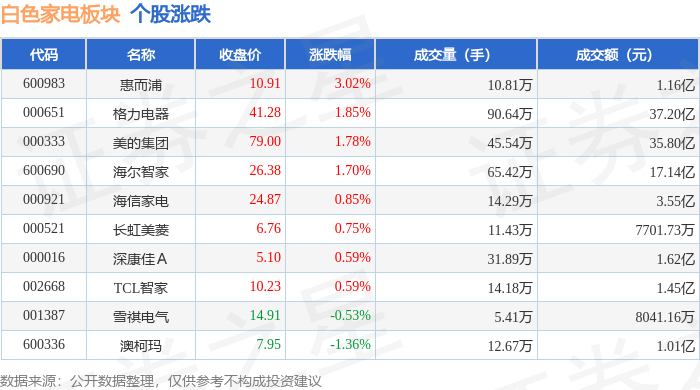
白色家电板块1月20日涨1.72%,惠而浦领涨,主力资金净流入8.44亿元
Zheng Xing Xing Ye Ri Bao· 2026-01-20 08:51
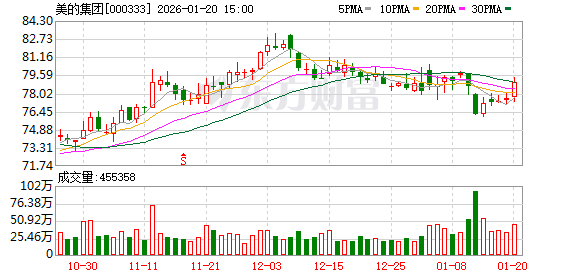
Core Viewpoint - The white goods sector experienced a rise of 1.72% on January 20, led by Whirlpool, while the overall market indices showed slight declines [1]. Group 1: Market Performance - The Shanghai Composite Index closed at 4113.65, down 0.01% [1]. - The Shenzhen Component Index closed at 14155.63, down 0.97% [1]. - The white goods sector saw a net inflow of 844 million yuan from main funds, while retail investors experienced a net outflow of 378 million yuan [1]. Group 2: Individual Stock Performance - Whirlpool (600983) closed at 10.91 yuan, up 3.02%, with a trading volume of 108,100 hands and a transaction value of 116 million yuan [1]. - Gree Electric (000651) closed at 41.28 yuan, up 1.85%, with a trading volume of 906,400 hands and a transaction value of 3.72 billion yuan [1]. - Midea Group (000333) closed at 79.00 yuan, up 1.78%, with a trading volume of 455,400 hands and a transaction value of 3.58 billion yuan [1]. - Haier Smart Home (600690) closed at 26.38 yuan, up 1.70%, with a trading volume of 654,200 hands and a transaction value of 1.71 billion yuan [1]. - Hisense Home Appliances (000921) closed at 24.87 yuan, up 0.85%, with a trading volume of 142,900 hands and a transaction value of 355 million yuan [1]. Group 3: Fund Flow Analysis - Gree Electric saw a main fund net inflow of 4.26 billion yuan, while retail investors had a net outflow of 2.02 billion yuan [2]. - Midea Group had a main fund net inflow of 4.05 billion yuan, with retail investors experiencing a net outflow of 793.78 million yuan [2]. - Haier Smart Home recorded a main fund net inflow of 1.16 billion yuan, while retail investors had a net outflow of 1.58 billion yuan [2]. - Hisense Home Appliances faced a net outflow of 441.9 million yuan from main funds, but retail investors had a net inflow of 258.89 million yuan [2].




中央空调行业面临深度调整与转型阵痛,美的以“技术深潜”破局行业寒冬
Zhong Jin Zai Xian· 2026-01-20 03:50
Core Insights - The central air conditioning industry is facing significant challenges in 2025, with domestic sales declining by 6.7% year-on-year in the first three quarters, indicating a tough market environment [1] - Amidst this downturn, Midea has achieved remarkable growth, with sales increasing by over 144% year-on-year, successfully breaking into the high-end market [1] - Midea's success is attributed to its focus on user comfort, utilizing advanced technologies to meet increasingly demanding consumer expectations [1] Technology Innovations - Midea's ultra-low frequency steady-state technology addresses issues of temperature differences and noise caused by frequent starts and stops, ensuring smooth operation [3] - The continuous jet heating technology alleviates concerns about performance degradation during extreme weather, providing reliable comfort throughout the seasons [3] - The industry-first dual air outlet design resolves problems of uneven heating and uncomfortable direct airflow, achieving a more uniform heating experience [3] Investment in R&D - Midea's innovations are supported by over 18 billion yuan invested in research and development over the past five years, establishing a strong foundation for its technological advancements [3] - The company also boasts a comprehensive service network covering all counties nationwide, ensuring robust support for its products [3] Market Strategy - Midea's resurgence highlights a fundamental truth: in a market characterized by existing competition, the largest opportunities lie not in distant new markets but in addressing unresolved consumer pain points nearby [5]

国补高基数下12月社零同增0.9%
HTSC· 2026-01-20 02:02
Investment Rating - The report maintains a "Buy" rating for the consumer discretionary sector, highlighting structural investment opportunities [5][10]. Core Insights - The report indicates that in December, the total retail sales of consumer goods increased by 0.9% year-on-year to 4.5 trillion yuan, with a month-on-month decline of 0.4 percentage points, primarily due to high base effects from durable goods like automobiles and home appliances [7][9]. - The report emphasizes the importance of the new round of trade-in policies for 2026, which focus on core home appliance categories and expand into new categories like smart glasses and products for the elderly, supporting demand in these segments [7]. - The report suggests that consumer sentiment remains strong, particularly in sectors like emotional consumption, technology consumption, and undervalued high-dividend stocks, recommending a focus on domestic brands and global brand expansion [10]. Summary by Sections Retail Sales Performance - In December, retail sales of food and beverages grew by 2.2% and 0.7% respectively, with urban and rural retail sales increasing by 0.7% and 1.7% year-on-year [8]. - Online retail sales of physical goods in December increased by 0.8% year-on-year, with a total annual growth of 5.2%, accounting for 26.1% of total retail sales [8]. Consumer Categories - The report notes a structural differentiation in consumer categories, with home appliances, building materials, and furniture experiencing declines of 18.7%, 11.8%, and 2.2% respectively due to high base effects and trade-in policy impacts [9]. - Conversely, communication equipment saw a significant increase of 20.9% year-on-year, while emotional and self-care products like sports and entertainment goods and cosmetics grew by 9.0% and 8.8% respectively [9]. Investment Recommendations - The report identifies four main investment themes: 1. Rise of domestic brands and global brand expansion, recommending companies like Pop Mart, Shangmei, and Anta Sports [10]. 2. Technology consumption empowered by AI, recommending companies like Midea Group and Haier Smart Home [10]. 3. Emotional consumption, recommending companies like Gu Ming and Yum China [10]. 4. Undervalued high-dividend blue-chip leaders, recommending companies like Li Ning and Shenzhou International [10]. Company-Specific Insights - For Smoore International (6969 HK), the report forecasts a revenue of 10.21 billion yuan for Q1-3 2025, with a year-on-year growth of 21.8%, and maintains a "Buy" rating with a target price of 27.00 HKD [48]. - For Juzhibio (2367 HK), the report highlights the approval of a new collagen product, projecting significant sales potential and maintaining a "Buy" rating with a target price of 85.00 HKD [49]. - For Pop Mart (9992 HK), the report notes a revenue increase of 245-250% in Q3 2025, driven by strong performance in both domestic and international markets, maintaining a "Buy" rating with an updated target price of 410 HKD [51].


家电行业周报(26年第3周):12月家电内外销景气持续承压,美国家电需求回归稳健增长
Guoxin Securities· 2026-01-20 00:45
Investment Rating - The report maintains an "Outperform the Market" rating for the home appliance industry [5][6][12]. Core Views - The home appliance sector is expected to recover in 2026, driven by the continuation of national subsidies and stabilization of exports, suggesting a positive outlook for leading white goods companies [1][12][18]. - December retail performance for home appliances showed signs of bottoming out, with significant declines in major appliances but a relatively stable performance in small appliances [1][19]. - The report highlights the resilience of leading companies in the home appliance sector, with a focus on white goods, which are expected to maintain steady growth despite high base effects [12][13]. Summary by Sections 1. Key Recommendations - Recommended companies include Midea Group, Haier Smart Home, TCL Smart Home, Gree Electric Appliances, and Hisense Home Appliances for white goods; Hisense Visual for black goods; and Roborock, Bear Electric, and Ecovacs for small appliances [4][12][13]. 2. December Retail Performance - In December, the retail sales of major appliances saw declines exceeding 20%, while small appliances showed slightly better demand, with air fryers experiencing growth [1][19]. - The offline sales channels for major appliances faced declines of over 40%, while kitchen small appliances remained relatively stable [1][19]. 3. Export Performance - In December, China's home appliance exports decreased by 8.1% year-on-year, with air conditioners facing a significant decline of 20.7% [2][37]. - Other categories like refrigerators and washing machines showed modest growth, indicating a mixed performance across different product lines [2][37]. 4. U.S. Market Insights - U.S. retail sales for home appliances showed a slight increase of 0.8% in November, indicating a gradual return to stable growth despite challenges such as tariffs and inflation [3][43]. - The inventory levels in U.S. appliance stores are returning to normal, suggesting improved market conditions [3][43]. 5. Company Earnings Forecasts - The report provides earnings forecasts for key companies, indicating expected EPS growth for Midea Group, Gree Electric Appliances, and Haier Smart Home, among others, with all rated as "Outperform the Market" [5][76].