Midea Group(000333)

Search documents
制冷设备行业2026年度投资策略:产业并购活跃,布局全球化与前沿冷却技术
Donghai Securities· 2025-12-31 01:46
1. Report Industry Investment Rating The provided content does not include the report industry investment rating. 2. Core Views - The Chinese refrigeration and air - conditioning equipment industry is at a critical turning point. The domestic household market is in a stable development stage dominated by stock replacement demand, and growth is driven by the improvement of energy - efficiency standards. The report analyzes structural growth opportunities and long - term evolution trends by benchmarking overseas leading companies [2]. - Overseas expansion should focus on local in - depth development and value extension of the industrial chain. It is a systematic project, and mergers and acquisitions are strategic choices. Chinese enterprises are moving from the initial stage of "Made in China, Sold Globally" to the new stage of globalization of "brand, technology, and management" [2]. - The commercial refrigeration field, especially the data center refrigeration track, is a short - term growth highlight. The capital expenditure of overseas HVAC giants is directed towards data center infrastructure, and there is a market for high - end refrigeration solutions due to the need to improve energy efficiency and reduce PUE [2]. - Investment suggestions: In the household refrigeration equipment field, pay attention to industry leaders such as Midea Group; in the special - purpose refrigeration equipment field, focus on companies like Invic and Shenling Environment; for upstream components, pay attention to Hanzhong Precision Machinery, Binglun Environment, and Sanhua Intelligent Control [2]. 3. Summary by Relevant Catalog 3.1 Traditional Refrigeration Equipment Overview - **Global Refrigeration and Air - Conditioning Market**: The global refrigeration and air - conditioning market has shown steady growth. From 2018 to 2024, the global air - conditioner sales increased from 232.5 million units to 261.2 million units, with a compound annual growth rate of 2.0%. The proportion of household air - conditioners in 2024 was 73.7%, and the central air - conditioning market grew faster, with a compound annual growth rate of 4.0% from 2018 to 2024. It is predicted that by 2028, the global air - conditioner sales will reach 293.3 million units, with a compound annual growth rate of 2.9% from 2024 to 2028. Asia, North America, and Europe are important regional markets, and China is the largest single air - conditioning market [22]. - **Household Air - Conditioning**: In the 2024 cold year, China's household air - conditioner production accounted for 80.8% of the global total. Many domestic enterprises are increasing overseas layout. In the 2024 cold year, overseas production capacity increased by nearly 7 million units. In the 2025 cold year, domestic household air - conditioner exports were about 99.29 million units, a year - on - year increase of 16.7%, with the highest export proportion to Asia [28]. - **Central Air - Conditioning and Chiller Units**: There are various types of central air - conditioning and chiller units. The export of screw and centrifugal chiller units for data centers is strong. The Asian market has a large - scale demand and is gradually recovering, while the North American market has a prominent growth rate due to its small base. The domestic market is waiting to stabilize, and leading enterprises are strengthening their competitive advantages [33]. 3.2 Household Market: Domestic Sales Review and Challenges for Leading Companies - **Price Wars and Market Competition**: After several price wars, the concentration of the domestic household refrigeration and air - conditioning market has increased. The competition has evolved from scale and price to technology, product, channel, service, and ecosystem. In 2025, the domestic sales volume of household air - conditioners increased by 8.7% year - on - year, but the growth driven by policies and climate is difficult to sustain. The long - term driving force is stock replacement and structural upgrading [35][36]. - **Energy - Efficiency Upgrade**: China has introduced multiple air - conditioner energy - efficiency standards, which have promoted the transformation from fixed - frequency to variable - frequency air - conditioners. Leading enterprises have advantages in technology and industrial layout for energy - efficiency improvement [39]. - **Challenges for Leading Companies**: In 2024 - 2025, a new round of price wars occurred. Xiaomi's entry has challenged the traditional hardware - profit model. Leading companies are facing challenges in terms of efficiency and sustainable profit growth. They are promoting digital reform, channel and logistics innovation to enhance competitiveness [40][43][44]. 3.3 Overseas Expansion of Domestic Enterprises - **Difficulties and Solutions**: There are differences in regional usage habits overseas. The US market has high access barriers, and the European market has low air - conditioner penetration and high energy - efficiency requirements. Overseas acquisitions are an important way to enter the market. Chinese enterprises are accelerating overseas production capacity construction in Southeast Asia and other regions [52][54]. - **Southeast Asian Market**: Exports to ASEAN are on an upward trend. In 2024, China's cumulative exports of white goods to ASEAN reached $14.87 billion, a year - on - year increase of 19.8%. The demand in the ASEAN market is driven by urbanization and industrialization [63]. 3.4 Overview of Overseas Representative Enterprises' Operations - **Business Models and Strategies**: Overseas HVAC representative enterprises have different business models and strategies. Johnson Controls has transformed from an equipment manufacturer to a builder of smart building ecosystems; Trane Technologies has upgraded its services and transformed its strategy; Daikin has acquired relevant enterprises to supplement its data center refrigeration business [73][82]. - **Performance of Leading Enterprises**: Leading international enterprises such as Trane Technologies, Johnson Controls, Carrier Global, and Vertiv have shown different performance. They are all focusing on high - growth areas such as data center refrigeration [83][86][87][88]. 3.5 Commercial Market: Pay Attention to Refrigeration Demand in Data Centers - **Demand for Data Center Refrigeration**: The development of AI and other industries is expected to drive the construction of data centers. The demand for data center capacity is expected to increase at a compound average growth rate of 19% from 2023 to 2030. Reducing the energy consumption of refrigeration equipment is crucial for the green and low - carbon development of data centers [94]. - **Refrigeration Technologies**: There are various data center refrigeration technologies, including water - cooled, air - cooled, indirect evaporation cooling, "glacier" phase - change cooling, and liquid cooling. Liquid cooling has advantages in energy consumption, and the development of liquid - cooling technology is a trend [96][104]. - **Investment Suggestions**: Enterprises in different segments are recommended, including traditional HVAC enterprises such as Midea Group, precision temperature - control equipment enterprises such as Invic, special - purpose air - conditioner manufacturers such as Shenling Environment, and upstream component enterprises such as Hanzhong Precision Machinery, Binglun Environment, and Sanhua Intelligent Control [112][113].



顺德第一大企业:营收首次超过4000亿元,创始人是广东首富
Sou Hu Cai Jing· 2025-12-30 15:48
Core Insights - Shunde, known as "Fengcheng," is a key industrial hub in Guangdong, with a total industrial output exceeding 1 trillion yuan, featuring two major industrial clusters worth 300 billion yuan each in home appliances and machinery [1] - The 2025 Shunde Top 100 Enterprises list reflects the region's economic strength, with 138 companies achieving a total revenue of 12,222.29 billion yuan, and 67 companies appearing on all three major rankings [2] Industry Overview - Manufacturing is the backbone of Shunde's economy, with 82.01% of the top 100 enterprises being manufacturing firms, generating 7,908.07 billion yuan in revenue, accounting for 64.71% of the total [3] - Private enterprises, including those with Hong Kong, Macau, and Taiwan investments, make up 86.23% of the list, contributing 10,875.73 billion yuan, or 88.98% of total revenue [3] Regional Distribution - The highest number of listed companies is from Beijiao Town, with 28 companies generating 8,283.63 billion yuan, followed by Ronggui Street (24 companies, 1,555.45 billion yuan) and Daliang Street (22 companies, 633.42 billion yuan) [3] Financial Performance - The entry threshold for the 2025 Shunde Top 100 Enterprises is 786 million yuan, a decrease of 39 million yuan from the previous year, with total revenue surpassing 1.1 trillion yuan, marking a 27.04% year-on-year increase to 11,988.84 billion yuan [7] - The top three companies are Midea Group (4090.84 billion yuan), Country Garden (2527.57 billion yuan), and Hisense Home Appliances (927.46 billion yuan) [7] Company Highlights - Midea Group, established in 1968, has over 400 subsidiaries and 38 R&D centers globally, serving over 500 million users [7] - Hisense Home Appliances is a major player in the HVAC, refrigeration, and kitchen appliance sectors, with multiple brands under its umbrella [9] - China Liansu, recognized as a leader in the pipeline industry, has expanded its overseas operations in several countries, enhancing its global footprint [11]

家用电器行业投资策略周报-20251230
CAITONG SECURITIES· 2025-12-30 13:17
Core Insights - The report maintains a positive outlook on the home appliance sector, particularly focusing on the cost reduction potential of aluminum replacing copper in air conditioning systems [2][5] - The adoption of aluminum-copper technology is seen as a significant step towards reducing production costs amid rising copper prices and resource scarcity [10][15] Group 1: Aluminum-Copper Technology Impact - The use of aluminum instead of copper in air conditioning units can lead to substantial cost savings, with estimates suggesting a reduction of 208 to 277 RMB per unit when replacing 50% of copper, and up to 416 to 554 RMB when replacing 100% [11][12] - Copper currently constitutes about 26% to 33% of the cost in standard air conditioning units, with high-end models reaching over 40% [11][12] - The global market has seen significant adoption of aluminum-copper products, particularly in Japan where approximately 40% to 50% of air conditioners use aluminum heat exchangers [15][16] Group 2: Domestic Market Challenges - Despite the cost advantages, the domestic promotion of aluminum-copper air conditioners faces challenges, including inferior thermal conductivity and corrosion resistance compared to copper [19][20] - Consumer perception is a major barrier, as negative opinions about aluminum's reliability persist, complicating market acceptance [19][20] - The first domestic aluminum-copper air conditioner was launched by Wanbao in collaboration with JD.com, targeting the mid-to-low-end market, which may help accelerate industry-wide material transitions [16][17] Group 3: Industry Performance and Trends - The home appliance sector has shown mixed performance, with the overall index increasing by 0.44%, while specific segments like white goods and black goods experienced varied changes [21][22] - Recent data indicates a decline in domestic sales growth for air conditioners, refrigerators, and washing machines, reflecting broader market challenges [33][47] - The report highlights the importance of monitoring raw material prices, with copper and aluminum prices showing significant fluctuations that could impact production costs [29][31]


罗永浩炮轰,空调售后成“暴利江湖”?
商业洞察· 2025-12-30 09:23
Core Viewpoint - The article discusses the high costs associated with air conditioning maintenance and repair services, highlighting the lack of regulation in the air conditioning after-market, which has become a lucrative but problematic area for consumers and companies alike [2][4][15]. Group 1: High Costs of Air Conditioning Maintenance - The cost for seasonal cleaning and filter replacement for central air conditioning units can reach approximately 15,000 yuan, with filter replacement accounting for 70% of this cost [4][7]. - Consumers have expressed frustration over the high service fees, with some stating that the cost of maintenance can exceed the price of purchasing new units, especially as air conditioning prices have dropped significantly due to market competition [5][10]. - The average cleaning costs for other brands like Midea and Gree range from 100 to 300 yuan, indicating that the prices for maintenance services can vary widely across different brands [10][11]. Group 2: Issues in the After-Market - The air conditioning after-market is plagued by issues such as price opacity, inflated repair costs, and unnecessary upselling, leading to consumer distrust [15][16]. - Reports indicate that third-party service providers often charge significantly more than official brand service teams, sometimes up to 3-4 times higher [15][18]. - The lack of regulation in the after-market allows for a variety of service quality, with many third-party companies operating outside of formal oversight [18]. Group 3: Competitive Landscape and Service Improvements - Major appliance brands like Gree and Midea are increasingly focusing on enhancing their after-sales service networks, with Gree boasting over 15,000 authorized service points [20][22]. - The article notes a shift in service strategies, with brands like Midea and Xiaomi introducing longer warranty periods and comprehensive service packages to improve customer satisfaction [22][24]. - As the price competition in the air conditioning market reaches its limits, companies are recognizing the importance of service quality as a key differentiator in maintaining market share [23][24].


三大智能家居APP暗战:谁更适合用户?
和讯· 2025-12-30 09:23
Core Viewpoint - The article discusses the evolving definitions and standards of smart home technology, highlighting the recent "New National Standard" released by the National Standards Commission, which categorizes smart home products into five levels (L1-L5) based on their intelligence and user experience. The article compares three leading companies—Haier, Midea, and Xiaomi—each with distinct approaches to their smart home applications [1][5]. Group 1: Haier - Haier's smart home app aims to be the "first entry point for smart homes," featuring a new 3D interactive view that transforms a flat device list into an engaging 3D home model, enhancing user experience from "controlling appliances" to "managing life" [1]. - The app integrates over 55 brands and 167 categories of devices, extending smart living from indoor to outdoor scenarios through partnerships, such as with Changan and Chery [1]. - Haier offers a comprehensive service model that includes installation, maintenance, and design, providing a seamless user experience [1]. Group 2: Midea - Midea's app positions itself as a leader in the AI smart home era, introducing the Smart Home Agent concept and the "Xiao Mei AI Family Assistant," which aims for a "no-feel" control experience through self-sensing and decision-making capabilities [2]. - The company actively collaborates with major smartphone manufacturers and automotive companies to expand the interconnectedness of "people, vehicles, and homes," focusing on deep AI integration [2]. - Midea's strategy emphasizes making smart home technology smarter and more invisible, enhancing user comfort [2]. Group 3: Xiaomi - Xiaomi's app serves as the core control platform for its smart ecosystem, characterized by a simple interface and intuitive operation, allowing users to easily access frequently used functions [3]. - Although the 3D view feature is still under development, the app has strengthened its scene capabilities with new modes for security, environment, lighting, and shading, catering to comprehensive user needs [3]. - The app acts as an efficient "connector" and "adaptation center," integrating both Xiaomi's products and third-party devices, thus reducing complexity and cost for users looking to build a mixed-brand smart home [3]. Group 4: Conclusion - The competition among the three apps reflects deeper industry interpretations of "smart home" and the battle for user engagement, with Haier focusing on ecosystem building, Midea on control, and Xiaomi on adaptability [5]. - Users may find that there is no "best" option, but rather one that is "more suitable" based on their preferences for brand integration, AI experiences, or mixed-brand compatibility [5].

家电行业2026年度投资策略:重视红利、拥抱出海、把握家电+转型机遇
HUAXI Securities· 2025-12-30 09:17
Core Insights - The report emphasizes the strong resilience of leading white goods companies, highlighting their high dividend yields, with Gree Electric at 7.3%, Midea Group at 5.1%, Hisense Home Appliances at 4.9%, and Haier Smart Home at 4.6% [6][22] - The "Home Appliance +" strategy indicates opportunities in extending the appliance industry into robotics, with companies like Midea Group and Fuhua Co. making significant advancements [6][58] - The export market shows potential, particularly in the U.S. real estate sector, with expectations of demand recovery due to anticipated interest rate cuts and housing stimulus policies [6][70] Section Summaries 2025 Home Appliance Review - The home appliance index has shown a modest increase of 7.7% year-to-date, underperforming the CSI 300 index by approximately 9.7 percentage points [11][14] - The market style in 2025 has favored growth stocks, while the home appliance sector has leaned towards value, leading to a mismatch in market expectations [13][14] - The public fund allocation in the home appliance sector is at a historical low of 2.94%, indicating potential for future growth as external demand remains optimistic [18][19] Dividends - Leading white goods companies maintain high dividend yields, with Gree Electric at 7.3%, Supor at 6.1%, and Midea Group at 5.1%, reflecting strong earnings resilience [24][29] - The report suggests that the dividend rates for companies like Midea and Haier may continue to increase, supported by robust profit growth [24][30] Domestic Sales - The national subsidy policy has positively impacted consumer confidence, with a clear trend towards structural upgrades in appliance consumption [34] - The sales growth of home appliances has been driven by the "trade-in" policy, although growth rates have shown a declining trend in the latter part of the year [34][39] - The air conditioning market has maintained stable pricing, with a continued trend towards mid-to-high-end products [39] "Home Appliance +" - Midea Group has made significant investments in robotics, with humanoid robots already in practical application within factories [58] - Fuhua Co. is expected to launch its grain storage robots in 2026, indicating a diversification into new growth areas [59] - Key component manufacturers like Huaxiang Co. and Hanyu Group are positioned to benefit from the robotics trend, focusing on core components such as reducers and harmonic drives [64][65] Exports - The U.S. real estate market is expected to recover, with potential interest rate cuts and housing stimulus policies likely to boost demand for home appliances [71][84] - Retail inventory levels in the U.S. are high, which may affect sales performance in the short term, but long-term housing demand remains strong [76][83] - The report anticipates that if mortgage rates fall below 6%, there could be a significant recovery in demand within the real estate chain [84]



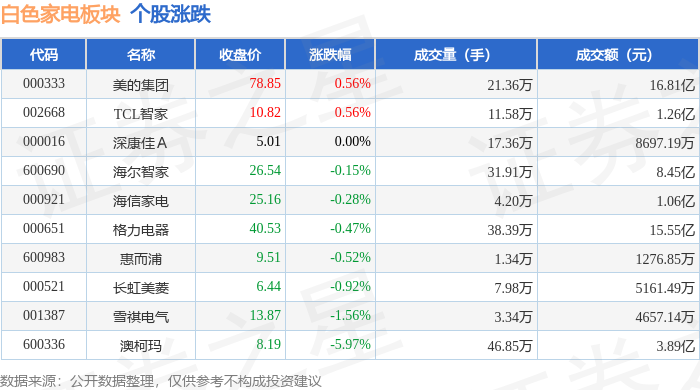
白色家电板块12月30日涨0.12%,美的集团领涨,主力资金净流出4.18亿元
Zheng Xing Xing Ye Ri Bao· 2025-12-30 08:56
证券之星消息,12月30日白色家电板块较上一交易日上涨0.12%,美的集团领涨。当日上证指数报收于 3965.12,下跌0.0%。深证成指报收于13604.07,上涨0.49%。白色家电板块个股涨跌见下表: | 代码 | 名称 | 主力净流入(元) | 主力净占比 游资净流入 (元) | | 游资净占比 散户净流入 (元) | | 散户净占比 | | --- | --- | --- | --- | --- | --- | --- | --- | | 001387 | 雪祺电气 | -13.83万 | -0.30% | -156.71万 | -3.36% | 170.54万 | 3.66% | | 600983 | 惠而浦 | -53.67万 | -4.20% | 98.39万 | 7.71% | -44.73万 | -3.50% | | 002668 | TCL智家 | -88.87万 | -0.71% | 346.85万 | 2.76% | -257.98万 | -2.05% | | 000921 海信家电 | | -366.29万 | -3.47% | 673.84万 | 6.39% | -307.55万 ...
美的集团(000333)重大事项点评:新能源事业部成立 经营底盘稳健支撑多元化推进
Xin Lang Cai Jing· 2025-12-30 08:45
Core Viewpoint - The company has announced the establishment of a new energy division, integrating its renewable energy and related businesses to enhance resource allocation efficiency and project advancement capabilities [1][2]. Group 1: Business Performance - In Q3 2025, the company's revenue reached 111.93 billion yuan, a year-on-year increase of 10.1%, although there was a slight quarter-on-quarter slowdown attributed to the reduction in national subsidies [2]. - The company's ToC (business-to-consumer) revenue in Q3 grew by 13% year-on-year, with expectations of double-digit growth for the quarter [2]. - The ToB (business-to-business) revenue in Q3 increased by 18% year-on-year, with projections for continued double-digit growth [2]. - The company's net profit attributable to shareholders in Q3 was 11.87 billion yuan, reflecting an 8.95% year-on-year growth, indicating a recovery in profitability [2]. Group 2: Cost and Cash Flow - The company's operating cash flow in Q3 was 19.79 billion yuan, a decrease of 6.99 billion yuan year-on-year, but still 1.7 times the net profit attributable to shareholders [3]. - The decline in operating cash flow was primarily due to weaker cash inflows and changes in working capital compared to the previous year [3]. - The company managed to reduce inventory by 1.6 billion yuan compared to Q2, while accounts receivable turnover days increased by 1.04 days year-on-year [3]. Group 3: Future Outlook - The company is expected to achieve stable revenue and profit growth driven by robust performance in the consumer segment and accelerated growth in the business segment, alongside brand and channel upgrades [4]. - The company’s external sales of air conditioning, refrigeration, and washing machines are anticipated to maintain high growth, supporting future double-digit growth in ToC external sales [4]. - The integration of building technology, renewable energy, commercial energy storage, and automation is projected to contribute to future growth in the ToB segment [4]. - The company has adjusted its EPS forecasts for 2025, 2026, and 2027 to 5.84, 6.44, and 7.05 yuan respectively, with a target price of 93.4 yuan based on a DCF valuation method [4].
陕西商南多元招商提质效
Huan Qiu Wang· 2025-12-30 06:34
Group 1: Investment and Project Development - In the first ten months of the year, the county signed 30 new projects with a total investment of 4.601 billion yuan, and actual domestic investment reached 946 million yuan, a year-on-year increase of 28.95% [1] - The county is focusing on four major industrial chains and leveraging its advantages in vanadium, silicon, and magnesium to attract quality projects in new materials, new energy, and intelligent equipment manufacturing [1] - A total of over 80 key projects have been planned and reserved, with promotional materials created to showcase the county's resource advantages and business environment [1] Group 2: Innovative Recruitment Strategies - The county has adopted a "leadership-led + industrial chain docking" recruitment model, conducting over 15 door-to-door recruitment trips to key industrial regions [2] - The county's leadership has personally visited over 50 enterprises, focusing on potential projects in various sectors, including deep processing and aquaculture [2] - A procurement agreement was signed with Midea's global innovation center, marking a shift from attracting enterprises to attracting orders that drive industry [2] Group 3: Foreign Investment Facilitation - The county provides comprehensive support for foreign investment projects, collaborating with international business associations to facilitate local enterprises' expansion [3] - Several foreign investment projects are currently in progress, including a large solid waste recycling industrial park and quartz sand production lines [3] - The county is actively building a stable and efficient platform for foreign investment cooperation [3] Group 4: Community Engagement and Event-Driven Investment - The county successfully hosted the Fourth Hometown Development Conference, attracting 36 hometown enterprises and signing 11 projects with a total investment of 766 million yuan [4] - Participation in major investment events has led to the signing of 18 projects at the Silk Road Expo, with a total investment of 3.715 billion yuan [4] - A comprehensive service mechanism has been established to support the entire process of project management, ensuring timely responses to enterprise needs [4]




A股三大指数午后再度走高,A500ETF南方(159352)成分股三花智控涨停,一键布局核心资产投资机遇
Xin Lang Cai Jing· 2025-12-30 06:21
Core Viewpoint - The A500 ETF Southern (159352) is experiencing significant market activity and positive performance, reflecting a broader bullish sentiment in the Chinese stock market, particularly as it approaches key resistance levels like the 4000-point mark on the Shanghai Composite Index [1][2]. Group 1: A500 ETF Performance - As of December 30, 2025, the A500 ETF Southern (159352) increased by 0.48%, with a turnover rate of 18.06% and a total transaction volume of 8.405 billion yuan, indicating active market participation [1]. - In the past five trading days, the A500 ETF Southern saw net inflows on four occasions, totaling 6.774 billion yuan [1]. - The A500 ETF closely tracks the CSI A500 Index, which is recognized as a "barometer of China's new productive forces," covering approximately 90 sub-industries and focusing on industry leaders and ESG criteria [1]. Group 2: Index Composition and Strategy - The top ten weighted stocks in the CSI A500 Index include major companies such as CATL, Kweichow Moutai, and Ping An Insurance, highlighting the index's focus on significant market players [1]. - The index employs a unique construction logic that prioritizes industry leaders and excludes negative ESG performers, aligning with national strategic industries and providing a diversified investment vehicle [1]. - The A500 ETF Southern offers a low management fee of 0.15% and a custody fee of 0.05%, making it an attractive option for investors seeking high precision and low-cost investment channels [2]. Group 3: Market Outlook - Guotai Junan Securities predicts that the Chinese stock market will stabilize and surpass critical levels, with the potential for a "transformation bull market" as the Shanghai Composite Index reaches new highs [2]. - The A500 ETF Southern is noted for its low tracking error and significant excess return rates, reinforcing its position as a reliable investment tool in the current market environment [2].