
WLY(000858)

Search documents
酒价内参12月30日价格发布,习酒君品上涨12元领涨
Xin Lang Cai Jing· 2025-12-30 01:17
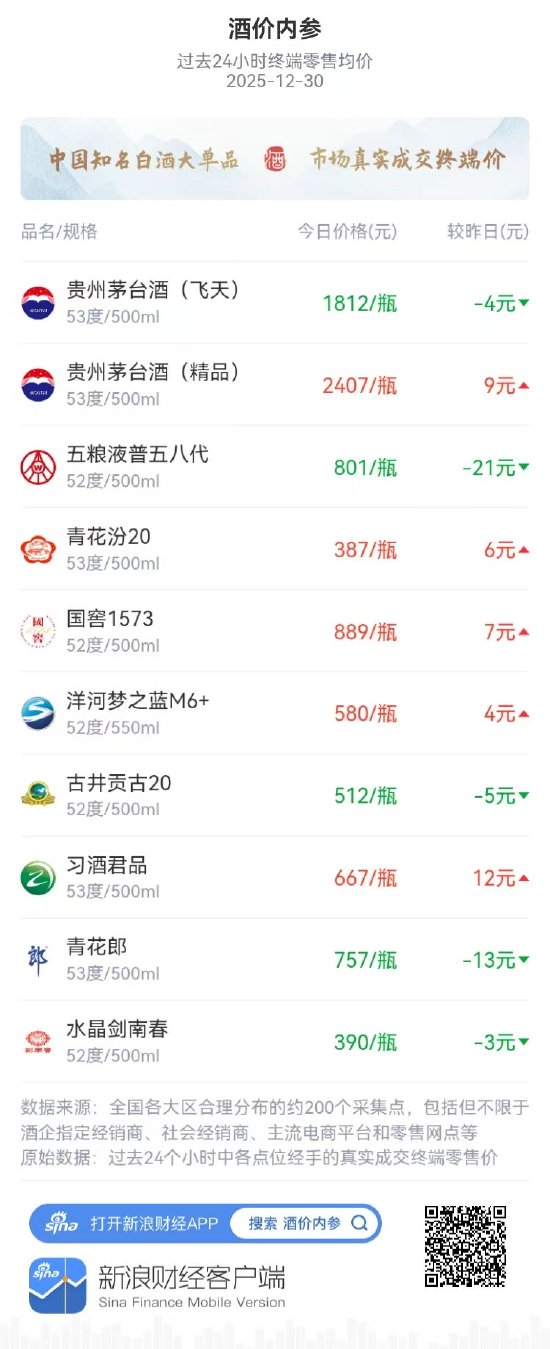
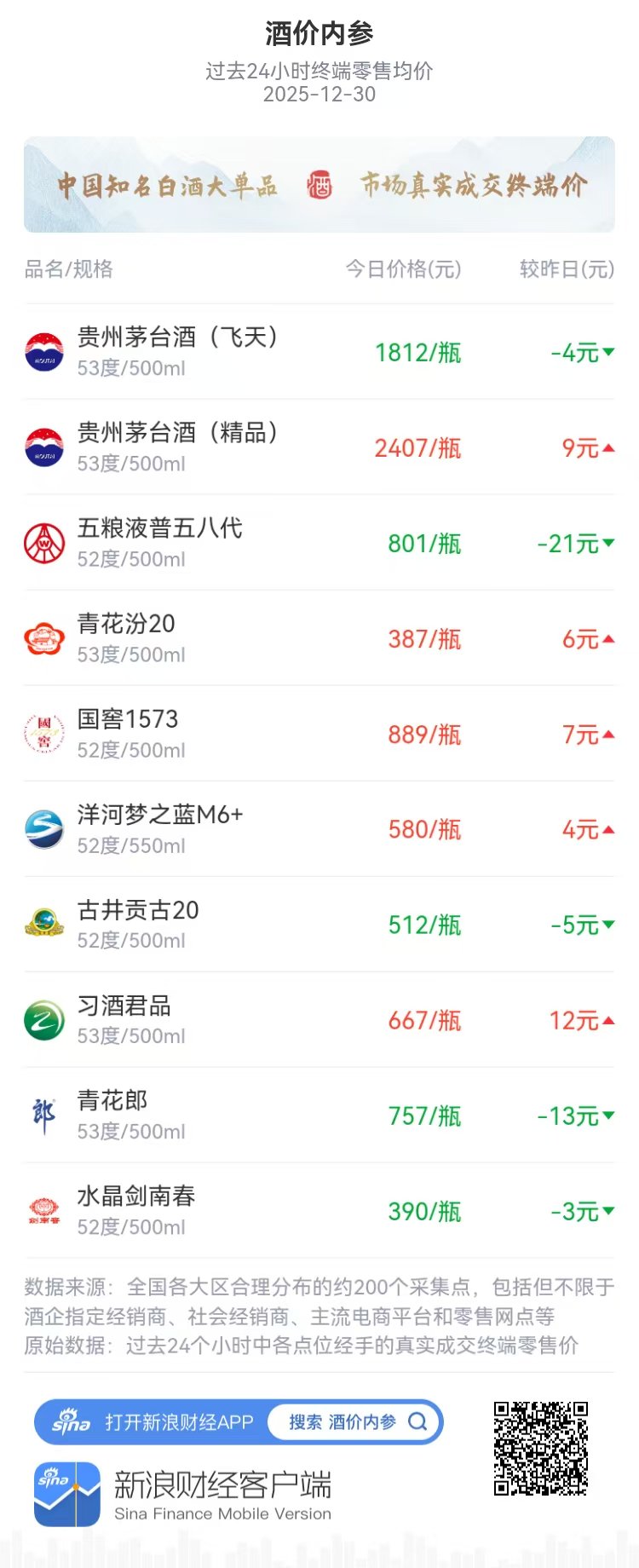
Core Insights - The core viewpoint of the article highlights the recent trends in the Chinese liquor market, particularly focusing on the retail prices of the top ten liquor products, which have shown a slight overall decline after a period of volatility [1][6]. Price Trends - The average retail price of the top ten liquor products is currently 9,202 yuan, down by 8 yuan from the previous day [1][6]. - The market is experiencing a mixed performance with significant fluctuations in individual product prices, reflecting typical year-end trading behaviors influenced by capital and sentiment [7]. Price Increases - Notable price increases include: - Xijiu Junpin, which rose by 12 yuan per bottle, leading the market after three consecutive declines [7]. - Guizhou Moutai (premium) increased by 9 yuan per bottle, marking its third consecutive rise, now priced above 2,400 yuan [7]. - Other increases include: - Guojiao 1573: up 7 yuan per bottle - Qinghua Fen 20: up 6 yuan per bottle - Yanghe Dream Blue M6+: up 4 yuan per bottle [7]. Price Decreases - Significant price declines include: - Wuliangye Pu 58th generation, which dropped by 21 yuan per bottle, nearing the 800 yuan threshold [7]. - Qinghua Lang fell by 13 yuan per bottle after a previous increase of 45 yuan over eight days [7]. - Other decreases include: - Gujing Gonggu 20: down 5 yuan per bottle - Feitian Moutai: down 4 yuan per bottle - Shuijing Jian Nan Chun: down 3 yuan per bottle [7]. Market Dynamics - The article discusses the competitive landscape in the liquor industry, particularly the strategic moves by Langjiu to penetrate the Jiangsu market, which has been traditionally dominated by Yanghe [8]. - The competition among major brands such as Sichuan liquor, Guizhou liquor, and Anhui liquor indicates a shrinking market for smaller enterprises, necessitating larger brands to capture market share from competitors [8].





酒价内参12月30日价格发布,青花汾20上涨6元
Xin Lang Cai Jing· 2025-12-30 01:17
Core Insights - The core viewpoint of the article is that the Chinese liquor market, particularly for the top ten baijiu products, is experiencing a high-level consolidation with slight price adjustments, indicating a stable market as the year ends [1][6]. Price Trends - The average retail price for the top ten baijiu products is 9,202 yuan, down by 8 yuan from the previous day [1][6]. - Price fluctuations are noted, with some products increasing while others decrease, reflecting a typical year-end market behavior characterized by capital and emotional trading [7]. Product Performance - Notable price increases include: - Xijiu Junpin: up 12 yuan/bottle - Guizhou Moutai (Premium): up 9 yuan/bottle, reaching 2,400 yuan/bottle - Guojiao 1573: up 7 yuan/bottle - Qinghua Fen 20: up 6 yuan/bottle - Yanghe Dream Blue M6+: up 4 yuan/bottle [7][10]. - Significant price decreases include: - Wuliangye Pu 58th Generation: down 21 yuan/bottle, nearing the 800 yuan/bottle mark - Qinghua Lang: down 13 yuan/bottle - Gujing Gonggu 20: down 5 yuan/bottle - Feitian Moutai and Shuijing Jianan Chun: down 4 yuan and 3 yuan/bottle respectively [7][10]. Market Dynamics - The data for the "Liquor Price Reference" is sourced from approximately 200 collection points across major regions, including designated distributors and mainstream e-commerce platforms, aiming to provide objective and traceable market price data [2][6]. - In industry dynamics, Langjiu has announced a strategic focus on Jiangsu as a key development market, planning aggressive market penetration over the next three years, which may challenge Yanghe's traditional dominance in the region [3][8].
酒价内参12月30日价格发布,水晶剑南春下跌3元
Xin Lang Cai Jing· 2025-12-30 01:17
Core Insights - The core viewpoint of the article is that the Chinese liquor market, particularly the top ten liquor products, is experiencing a high-level consolidation with slight price adjustments, indicating a stable market as the year ends [1][6]. Price Trends - The average retail price of the top ten liquor products is 9,202 yuan, down by 8 yuan from the previous day [1][6]. - The market shows mixed performance with significant price fluctuations among various products, reflecting typical year-end trading behaviors influenced by capital and sentiment [7]. Price Increases - Notable price increases include: - Xijiu Junpin: up 12 yuan per bottle, leading the market after three consecutive declines [7]. - Guizhou Moutai (Premium): up 9 yuan per bottle, marking its third consecutive increase, now priced at over 2,400 yuan [7]. - Guojiao 1573: up 7 yuan per bottle, showing stable performance [7]. - Qinghua Fen 20: up 6 yuan per bottle [7]. - Yanghe Dream Blue M6+: up 4 yuan per bottle [7]. Price Decreases - Significant price decreases include: - Wuliangye Pu 58th Generation: down 21 yuan per bottle, struggling to maintain the 800 yuan mark [7]. - Qinghua Lang: down 13 yuan per bottle, after a previous increase of 45 yuan over eight days [7]. - Gujing Gonggu 20: down 5 yuan per bottle [7]. - Feitian Moutai and Shuijing Jianan Chun: down 4 yuan and 3 yuan per bottle, respectively [7]. Market Dynamics - The liquor industry is witnessing competitive dynamics, particularly with Langjiu's aggressive strategy in Jiangsu, aiming to capture market share from Yanghe, which has seen a decline in influence [8]. - The competition among major brands indicates a trend where leading companies must actively seek new growth opportunities while defending their core markets against emerging competitors [8].
酒价内参12月30日价格发布 市场高位整理整体价格小幅回调
Xin Lang Cai Jing· 2025-12-30 01:12
Core Viewpoint - The Chinese liquor market is experiencing a high-level consolidation with slight price adjustments, indicating a stable end to the year after significant fluctuations in mid-December [1]. Price Trends - The overall retail price for the top ten liquor products is 9,202 yuan, down 8 yuan from the previous day [1]. - The market shows mixed performance with significant price changes among various products, reflecting typical year-end trading behaviors influenced by capital and sentiment [1]. Price Increases - Xijiu Junpin saw a price increase of 12 yuan per bottle, leading the market after three consecutive declines [1]. - Guizhou Moutai's premium product rose by 9 yuan per bottle, marking its third consecutive increase and surpassing 2,400 yuan per bottle [1]. - Other products with price increases include: - Guojiao 1573: up 7 yuan per bottle [1]. - Qinghua Fen 20: up 6 yuan per bottle [1]. - Yanghe Dream Blue M6+: up 4 yuan per bottle [1]. Price Decreases - Wuliangye Pu 58th generation experienced a notable decline of 21 yuan per bottle, barely maintaining the 800 yuan threshold [1]. - Qinghua Lang saw a decrease of 13 yuan per bottle after a previous increase of 45 yuan over eight days [1]. - Other products with price decreases include: - Gujing Gonggu 20: down 5 yuan per bottle [1]. - Feitian Moutai: down 4 yuan per bottle [3]. - Shuijing Jian'nan Chun: down 3 yuan per bottle [4].
五粮液目标价涨幅超95%;177股获推荐
2 1 Shi Ji Jing Ji Bao Dao· 2025-12-29 22:20
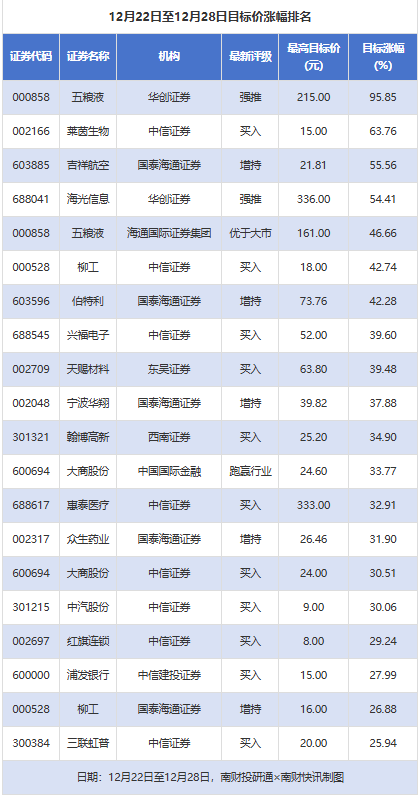
Group 1 - The core viewpoint of the news highlights the target price increases for several listed companies, with Wuliangye (000858) leading with a target price increase of 95.85% [1][2] - The companies with the highest target price increases include Wuliangye (95.85%), Lain Biotechnology (63.76%), and Juneyao Airlines (55.56%), representing the liquor, chemical products, and aviation industries respectively [1][2] - A total of 177 listed companies received broker recommendations during the period from December 22 to December 28, with Lingyi iTech (002600) and China Shenhua (601088) receiving the most recommendations at four each [3][4] Group 2 - The companies with the highest number of broker recommendations include Lingyi iTech (4 recommendations), China Shenhua (4 recommendations), and Dashang Co. (600694) with 3 recommendations [3][4] - Five companies had their ratings upgraded during the same period, including Beijing Junzheng (300223) from "Hold" to "Buy" by Zhongyou Securities [5] - A total of 80 first-time coverage ratings were issued, with notable mentions including Zhongqi Co. (301215) receiving a "Buy" rating from CITIC Securities and Yanzhong Energy (600188) also receiving a "Buy" rating from Western Securities [6]
“茅五泸汾洋”重挫,食品饮料ETF华宝(515710)收跌0.84%!茅台董事长喊话“穿越周期”,配置时机渐显?
Xin Lang Cai Jing· 2025-12-29 14:18
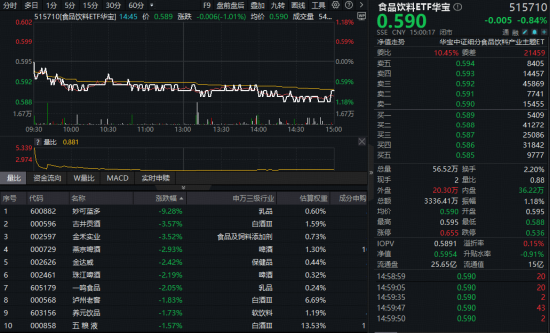
Group 1: Market Performance - The food and beverage sector experienced a decline on December 29, with the Food and Beverage ETF Huabao (515710) opening lower and dropping over 1% during the day, ultimately closing down 0.84% [1][8] - Major consumer goods and some liquor stocks performed poorly, with Miaokelan falling by 9.28%, and both Gujing Gongjiu and Jinhai Industrial dropping over 3% [1][8] Group 2: Industry Insights - The chairman of Moutai Group announced at a conference that the primary marketing task for Moutai liquor in 2026 is to focus on consumer needs and promote market-oriented transformation [1][10] - The overall liquor industry is currently in a deep adjustment phase, facing challenges such as high channel inventory and slowing growth rates, but Moutai is optimistic about navigating these challenges [3][10] - The valuation of the food and beverage sector is at a historical low, with the PE ratio of the underlying index for the Food and Beverage ETF Huabao at 20.19, placing it in the 5.77% percentile of the last decade, indicating a potential opportunity for long-term investment [3][11] Group 3: Future Outlook - Analysts predict that the demand for liquor will remain subdued in 2025, continuing the trend of weak seasonal demand, which may lead to further declines in liquor prices [4][11] - The liquor sector is entering a more favorable configuration zone, with expectations that any improvement in supply and demand could act as a catalyst for recovery [5][11] - The Food and Beverage ETF Huabao is recommended for investors looking to allocate to core assets in the food and beverage sector, with a significant portion of its holdings in leading liquor stocks [5][12]

茅台定调2026市场营销工作/曾从钦谈“五对关系”/精酿啤酒失宠年轻一代······
Xin Lang Cai Jing· 2025-12-29 10:54
Group 1 - Moutai has set its marketing focus for 2026 on consumer-centric strategies and market-oriented reforms to ensure fair and quick access to its products [1][2] - The company aims to enhance service levels, improve channel ecosystems, and achieve a balanced supply-demand relationship [1][2] - Wuliangye is navigating a deep adjustment period in the liquor industry, emphasizing the need to balance short-term and long-term strategies while ensuring reasonable returns for distributors [3] Group 2 - Shanxi Xinghuacun has launched the first "Old Workshop Tavern" as part of its "Baijiu+" ecosystem, expanding its restaurant offerings to cover various consumer scenarios [4] - Zunyi has been awarded the title of "Chinese Sauce-flavored Baijiu Industry Landmark," highlighting its significance in the industry [5] - The establishment of the Renhuai Baijiu Industry Science and Technology Service Team aims to provide comprehensive support across the entire baijiu production chain [6] Group 3 - The craft beer sector is experiencing a decline among younger consumers, with a 10.3% drop in sales and a 7% decrease in purchase rates among the 21-34 age group since 2019 [6] - Generation Z consumers prioritize flavor and natural ingredients, showing a preference for experiential venues over traditional beer bars [6]
18只白酒股下跌 贵州茅台1402.00元/股收盘
Bei Jing Shang Bao· 2025-12-29 09:48
Core Viewpoint - The recent performance of the liquor sector, particularly the leading companies, indicates a strategic shift towards inventory control and channel adjustments to ensure long-term health in the industry [1] Group 1: Market Performance - The Shanghai Composite Index closed at 3965.28 points, up 0.04% [1] - The liquor sector index closed at 2184.11 points, down 1.16%, with 18 liquor stocks declining [1] - Notable individual stock performances include: - Kweichow Moutai at 1402.00 CNY/share, down 0.86% [1] - Wuliangye at 108.06 CNY/share, down 1.57% [1] - Shanxi Fenjiu at 175.00 CNY/share, down 1.52% [1] - Luzhou Laojiao at 117.21 CNY/share, down 1.83% [1] - Yanghe Brewery at 61.47 CNY/share, down 1.06% [1] Group 2: Industry Insights - CITIC Securities reports that leading liquor companies are holding important meetings to express their commitment to adjustments, reforms, and channel rebalancing, which is beneficial for the industry's long-term health [1] - Since the fourth quarter of this year, major liquor companies have implemented measures such as controlling shipments, reducing burdens on distributors, and promoting sales to lower channel inventory [1] - Considering the stabilization of sales and various factors including the consumption scenarios during the Spring Festival, actual liquor sales during the 2026 Spring Festival are expected to remain stable [1]
中国白酒产业未来绿色“酿造”
Xin Hua She· 2025-12-29 09:21
Core Viewpoint - The article highlights the commitment of Wuliangye, a leading Chinese liquor company, to green development through the establishment of a new wastewater treatment plant and ecological wetland, aligning with China's environmental goals and sustainable practices [2][4]. Group 1: Wastewater Treatment Plant - Wuliangye has recently launched a new wastewater treatment plant within its industrial park, utilizing an AI-driven smart water management system for automated and precise control of the treatment process [2]. - The plant, with an investment of approximately 1 billion yuan, has a daily wastewater treatment capacity of 23,000 cubic meters and can generate over 50 million kilowatt-hours of electricity annually, reducing coal consumption by about 9,635 tons and greenhouse gas emissions by approximately 30,000 tons each year [2]. - The electricity generated not only meets the plant's own needs but also allows for excess power to be fed into the grid [2]. Group 2: Ecological Wetland - Adjacent to the wastewater treatment facility, Wuliangye has developed a 23,000 square meter ecological wetland, which helps reduce chemical oxygen demand (COD) by approximately 420 tons and total phosphorus by about 4 tons annually, while providing over 4 million cubic meters of water replenishment to the nearby Songgong River [4]. - The wetland employs natural filtration methods using quartz sand, volcanic rock, and aquatic plants to further purify treated wastewater before its final discharge or use for ecological replenishment [2]. Group 3: Broader Industry Context - The Chinese liquor industry, including Wuliangye, is increasingly focusing on reducing reliance on fossil fuels and enhancing sustainability through initiatives like "coal-to-gas" and "gas-to-electric" transitions, as well as biomass cogeneration projects to manage waste [4]. - The industry is responding to national goals for carbon peak by 2030 and carbon neutrality by 2060, with other companies like Shui Jing Fang also setting ambitious carbon reduction targets [4]. - Wuliangye emphasizes that a healthy ecosystem is essential for producing quality liquor, positioning green development as a necessary path forward for the industry [4].

五粮液获“金骏马最具投资价值上市公司”奖
Zheng Quan Ri Bao Wang· 2025-12-29 08:14
Core Viewpoint - The news highlights the successful conclusion of the "2025 Securities Market Annual Conference" in Beijing, focusing on the theme of "Reform and Innovation in Capital Markets," with significant discussions on the future of capital market reforms and innovations in the context of high-quality development [1] Group 1: Company Performance - Wuliangye has demonstrated strong operational resilience and the ability to navigate through economic cycles, with total revenue increasing from 66.209 billion yuan in 2021 to 89.175 billion yuan in 2024, and net profit attributable to shareholders rising from 23.377 billion yuan to 31.853 billion yuan during the same period [2] - The company has maintained a high cash dividend policy, having distributed cash dividends for 18 consecutive years, with a total payout amounting to 126.4 billion yuan, which is 33 times the funds raised since its listing [2] - Wuliangye's dividend payout ratio has exceeded 50% for five consecutive years, with a record high of 70% and a total cash dividend of 22.3 billion yuan planned for 2024, signaling a commitment to long-term and stable returns for shareholders [2] Group 2: Industry Position - As a leading representative of China's strong-aroma liquor sector, Wuliangye has established core competitive advantages in quality control and brand management, aligning its mission with creating good returns for investors [1] - The company aims to further enhance its value in the capital market in 2025, focusing on steady performance, shareholder returns, and high-quality governance, contributing to the overall value enhancement of the Chinese liquor industry [3]