SHUANGHUI(000895)

Search documents
高端轻食品牌“简颂”发布新品 深耕健康赛道丰富产品矩阵
Zhong Guo Zhi Liang Xin Wen Wang· 2025-10-21 07:05
Core Insights - The launch of "Jiansong," a high-end light food brand under Shuanghui, emphasizes the theme of "pleasing oneself" with new product lines including salad chicken breast, chicken small breast, and luncheon meat [1][2] - The event showcased a water Tai Chi performance to visually convey the brand's health philosophy of "light health and sustainability" [1] - "Jiansong" leverages Shuanghui's production capabilities, including a self-owned farm producing 300 million chickens annually, to ensure high-quality, antibiotic-free chicken meat [1] Product Innovations - The "Jiansong" salad chicken breast utilizes six core processes such as 360° vacuum tumbling and low-temperature marination to enhance flavor and texture while maintaining a clean ingredient label [1] - The reduced-salt chicken luncheon meat employs innovative "emulsification + granulation" technology and low-temperature cooking to retain classic flavors while meeting consumer demand for lower sodium content [2] Strategic Focus - The introduction of "Jiansong" products marks a strategic deepening for Shuanghui in the health light food sector, indicating a refinement and expansion of its product lines [2] - Shuanghui plans to continue focusing on the core meat industry, aiming to launch more healthy, safe, nutritious, and delicious products to meet the diverse dietary needs of consumers [2]

品牌工程指数 上周收报1956.62点
Zhong Guo Zheng Quan Bao· 2025-10-19 22:33
Core Viewpoint - The market experienced a correction last week, but certain stocks within the brand index showed resilience, indicating potential investment opportunities in sectors like electronics, new energy, new consumption, and real estate as uncertainties ease [1][4]. Market Performance - The market indices saw declines: Shanghai Composite Index down 1.47%, Shenzhen Component down 4.99%, ChiNext down 5.71%, and CSI 300 down 2.22%. The brand index fell 3.58% to 1956.62 points [2]. - Notable gainers in the brand index included Shanghai Jahwa up 9.42%, Changbai Mountain up 7.19%, and Darentang up 5.34%. Other stocks like Luzhou Laojiao and Yiling Pharmaceutical also saw gains exceeding 4% [2]. Stock Performance Since H2 - Since the beginning of the second half of the year, Zhongji Xuchuang has surged 156.40%, leading the gains, followed by Sunshine Power at 114.27%. Other significant performers include Lanke Technology and Yiwei Lithium Energy, both up over 60% [3]. Market Outlook - Looking ahead, the market is expected to maintain upward momentum as uncertainties gradually diminish. Liquidity is anticipated to remain supportive, with domestic interest rates low and overseas liquidity remaining loose, encouraging investment in Chinese equity assets [4][5]. - The current market environment is characterized by a shift in investment styles, with a focus on sectors that offer higher investment certainty, particularly in electronics, new energy, new consumption, and real estate [5].


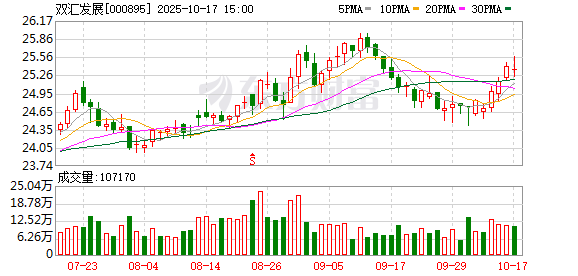
双汇发展:公司将加强整合全球资源
Zheng Quan Ri Bao· 2025-10-17 14:13
Core Insights - The company aims to strengthen the integration of global resources and deepen consumer demand exploration [2] - The focus will be on enhancing product research and development, as well as channel construction [2] - The company plans to expand its sales network to promote stable development [2]

食品饮料行业10月16日资金流向日报
Zheng Quan Shi Bao Wang· 2025-10-16 09:22
Market Overview - The Shanghai Composite Index rose by 0.10% on October 16, with seven sectors experiencing gains, led by coal and banking, which increased by 2.35% and 1.35% respectively [1] - The food and beverage sector ranked third in terms of daily gains [1] - The steel and non-ferrous metals sectors saw the largest declines, with decreases of 2.14% and 2.06% respectively [1] Capital Flow Analysis - The net outflow of capital from the two markets reached 54.29 billion yuan, with five sectors experiencing net inflows [1] - The banking sector had the highest net inflow, amounting to 939 million yuan, contributing to its 1.35% increase [1] - The telecommunications sector followed with a daily increase of 0.74% and a net inflow of 895 million yuan [1] - A total of 26 sectors experienced net capital outflows, with the non-ferrous metals sector leading with a net outflow of 9.24 billion yuan, followed by the electronics sector with a net outflow of 7.40 billion yuan [1] Food and Beverage Sector Performance - The food and beverage sector increased by 0.97% with a total net inflow of 362 million yuan [2] - Out of 124 stocks in this sector, 42 stocks rose, including one that hit the daily limit, while 79 stocks declined [2] - The top three stocks with the highest net inflows were Kweichow Moutai (4.81 billion yuan), Gujing Gongjiu (856.26 million yuan), and Wuliangye (852.26 million yuan) [2] - The sector also had 17 stocks with net outflows exceeding 10 million yuan, with the largest outflows from Beiningmei (50.08 million yuan), Qingdao Beer (40.81 million yuan), and Shuanghui Development (32.34 million yuan) [2][4] Food and Beverage Sector Capital Inflow Rankings - Kweichow Moutai: +1.57%, turnover rate 0.37%, net inflow 481.21 million yuan [2] - Gujing Gongjiu: +2.56%, turnover rate 0.80%, net inflow 85.63 million yuan [2] - Wuliangye: +0.55%, turnover rate 0.51%, net inflow 85.23 million yuan [2] Food and Beverage Sector Capital Outflow Rankings - Beiningmei: -2.77%, turnover rate 4.46%, net outflow -50.08 million yuan [4] - Qingdao Beer: +0.03%, turnover rate 0.71%, net outflow -40.81 million yuan [4] - Shuanghui Development: +0.99%, turnover rate 0.31%, net outflow -32.34 million yuan [4]





食品加工板块10月16日涨0.49%,*ST春天领涨,主力资金净流出1.06亿元
Zheng Xing Xing Ye Ri Bao· 2025-10-16 08:20
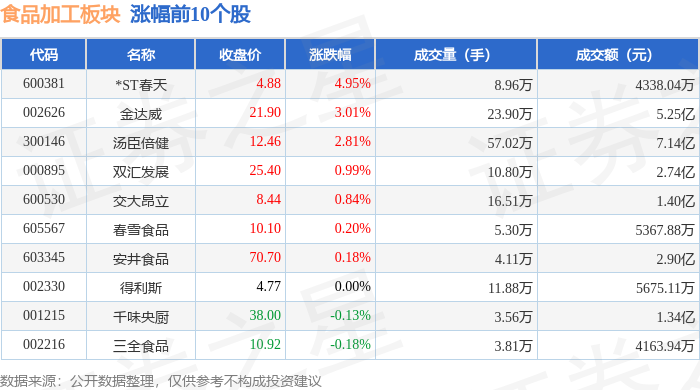
Market Overview - The food processing sector increased by 0.49% on October 16, with *ST Chuntian leading the gains [1] - The Shanghai Composite Index closed at 3916.23, up 0.1%, while the Shenzhen Component Index closed at 13086.41, down 0.25% [1] Stock Performance - *ST Chuntian (600381) closed at 4.88, up 4.95% with a trading volume of 89,600 shares and a turnover of 43.38 million yuan [1] - Quandawei (002626) closed at 21.90, up 3.01% with a trading volume of 239,000 shares and a turnover of 52.5 million yuan [1] - Tangchen Beijian (300146) closed at 12.46, up 2.81% with a trading volume of 570,200 shares and a turnover of 714 million yuan [1] - Shuanghui Development (000895) closed at 25.40, up 0.99% with a trading volume of 108,000 shares and a turnover of 274 million yuan [1] - Other notable stocks include Jiaoda Anli (600530) and Chunxue Food (605567), with minor increases of 0.84% and 0.20% respectively [1] Capital Flow - The food processing sector experienced a net outflow of 106 million yuan from institutional investors, while retail investors saw a net inflow of 69.89 million yuan [2] - The overall capital flow indicates a mixed sentiment, with institutional investors withdrawing funds while retail investors are actively buying [2] Individual Stock Capital Flow - Anjiu Food (603345) had a net inflow of 18.59 million yuan from institutional investors, while retail investors had a net outflow of 34.42 million yuan [3] - Jiaoda Anli (600530) saw a net inflow of 16.91 million yuan from institutional investors, but retail investors had a net outflow of 9.50 million yuan [3] - *ST Chuntian (600381) had a net inflow of 11.76 million yuan from institutional investors, with retail investors also experiencing a net outflow [3]


食品加工板块10月15日涨1.39%,金达威领涨,主力资金净流入7052.26万元
Zheng Xing Xing Ye Ri Bao· 2025-10-15 08:37
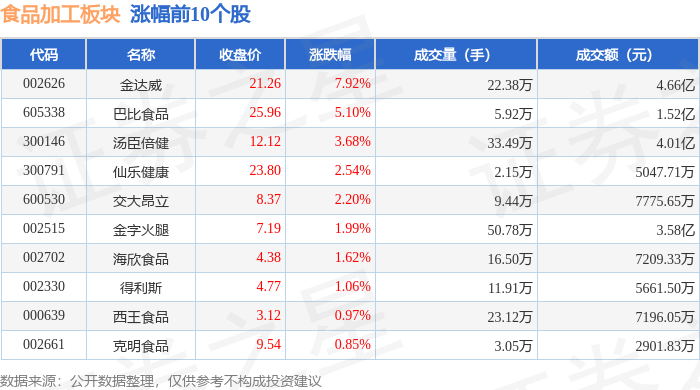
Core Insights - The food processing sector experienced a rise of 1.39% on October 15, with Jindawei leading the gains [1] - The Shanghai Composite Index closed at 3912.21, up 1.22%, while the Shenzhen Component Index closed at 13118.75, up 1.73% [1] Summary by Category Stock Performance - Jindawei (002626) closed at 21.26, with a significant increase of 7.92% and a trading volume of 223,800 shares, amounting to a transaction value of 466 million yuan [1] - Other notable performers included: - Baba Foods (605338) at 25.96, up 5.10% [1] - Tangchen Beijian (300146) at 12.12, up 3.68% [1] - Xianle Health (300791) at 23.80, up 2.54% [1] Capital Flow - The food processing sector saw a net inflow of 70.52 million yuan from institutional investors, while retail investors experienced a net outflow of 86.83 million yuan [2] - The main capital inflow and outflow for selected stocks included: - Jindawei had a net inflow of 33.91 million yuan from institutional investors, but a net outflow of 35.84 million yuan from retail investors [3] - Tangchen Beijian had a net inflow of 33.86 million yuan from institutional investors, with a slight net inflow from retail investors [3] Trading Volume and Value - The trading volume for Jindawei was 223,800 shares, contributing to a transaction value of 466 million yuan [1] - Baba Foods had a trading volume of 59,200 shares, with a transaction value of 152 million yuan [1] - The overall trading activity in the food processing sector indicates a healthy interest from institutional investors despite the outflow from retail investors [2][3]


2025年1-4月中国鲜、冷藏肉产量为1372.4万吨 累计增长9.9%
Chan Ye Xin Xi Wang· 2025-10-15 01:19
Core Viewpoint - The report by Zhiyan Consulting highlights the growth potential of China's meat processing industry, projecting significant increases in production and market opportunities from 2025 to 2031 [1]. Industry Summary - According to the National Bureau of Statistics, China's fresh and chilled meat production is expected to reach 3.5 million tons in April 2025, representing a year-on-year growth of 11.5% [1]. - From January to April 2025, the cumulative production of fresh and chilled meat in China is projected to be 13.724 million tons, with a cumulative growth rate of 9.9% [1]. Company Summary - Listed companies in the meat processing sector include Shuanghui Development (000895), Roniu Mountain (000735), Huaying Agriculture (002321), New Hope (000876), Tangrenshen (002567), and Yisheng Shares (002458) [1].





食品加工板块10月14日涨0.04%,盖世食品领涨,主力资金净流出1.25亿元
Zheng Xing Xing Ye Ri Bao· 2025-10-14 08:39
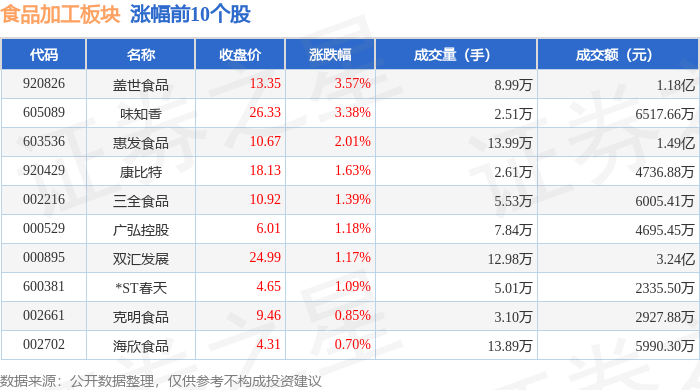
Market Overview - On October 14, the food processing sector rose by 0.04% compared to the previous trading day, with Gai Shi Food leading the gains [1] - The Shanghai Composite Index closed at 3865.23, down 0.62%, while the Shenzhen Component Index closed at 12895.11, down 2.54% [1] Stock Performance - Gai Shi Food (code: 920826) closed at 13.35, up 3.57% with a trading volume of 89,900 shares and a turnover of 118 million yuan [1] - Wei Zhi Xiang (code: 605089) closed at 26.33, up 3.38% with a trading volume of 25,100 shares and a turnover of 65.18 million yuan [1] - Hui Fa Food (code: 603536) closed at 10.67, up 2.01% with a trading volume of 139,900 shares and a turnover of 149 million yuan [1] - Other notable performers include Kang Bi Te (code: 920429) up 1.63% and Shuanghui Development (code: 000895) up 1.17% [1] Capital Flow - The food processing sector experienced a net outflow of 125 million yuan from institutional investors, while retail investors saw a net inflow of 140 million yuan [2] - The overall capital flow indicates a mixed sentiment, with institutional investors pulling back while retail investors are more active [2] Individual Stock Capital Flow - ST Chuntian (code: 600381) had a net inflow of 3.86 million yuan from institutional investors, while it faced a net outflow of 3.76 million yuan from speculative funds [3] - Hui Fa Food (code: 603536) saw a net inflow of 2.40 million yuan from institutional investors, but a net outflow of 2.55 million yuan from retail investors [3] - Shuanghui Development (code: 000895) had a net inflow of 1.87 million yuan from institutional investors, with a significant outflow of 38.42 million yuan from speculative funds [3]


食品加工板块10月13日跌1%,金字火腿领跌,主力资金净流出1.49亿元
Zheng Xing Xing Ye Ri Bao· 2025-10-13 12:38
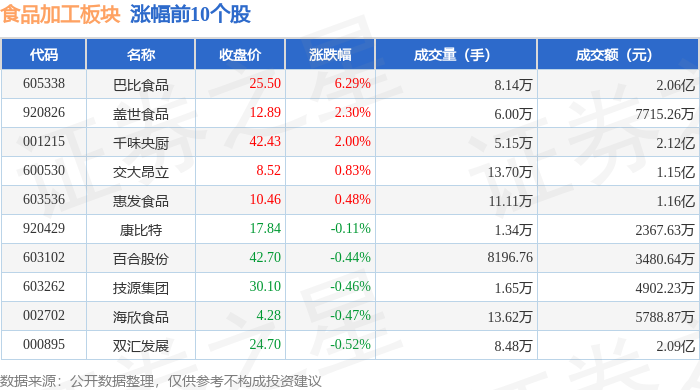
Core Insights - The food processing sector experienced a decline of 1.0% on October 13, with Jinzi Ham leading the drop [1] - The Shanghai Composite Index closed at 3889.5, down 0.19%, while the Shenzhen Component Index closed at 13231.47, down 0.93% [1] Stock Performance - Baba Foods (605338) saw a significant increase of 6.29%, closing at 25.50 with a trading volume of 81,400 shares and a transaction value of 206 million [1] - Jinzi Ham (002515) reported a notable decline of 6.02%, closing at 7.34 with a trading volume of 1,203,900 shares and a transaction value of 883 million [2] - Other notable performers included Qianwei Yangchu (001215) with a 2.00% increase and a closing price of 42.43, and Guangming Meat Industry (600073) with a 4.33% decrease [1][2] Capital Flow - The food processing sector experienced a net outflow of 149 million from institutional investors, while retail investors saw a net inflow of 15.51 million [2] - Major stocks like Baba Foods and Qianwei Yangchu attracted net inflows from retail investors, while Jinzi Ham and Longda Food faced significant outflows from institutional investors [3]
金工定期报告20251013:预期高股息组合跟踪
Soochow Securities· 2025-10-13 10:02
- Model Name: Expected High Dividend Portfolio; Model Construction Idea: The model uses a two-stage approach to construct the expected dividend yield indicator. The first stage calculates the dividend yield based on the annual report's profit distribution, and the second stage predicts and calculates the dividend yield using historical dividends and fundamental indicators. Additionally, two short-term factors affecting dividend yield—reversal factor and profitability factor—are used to assist in screening, and the selection is made from the CSI 300 constituent stocks to construct the expected high dividend portfolio. The portfolio holds 30 stocks each period and rebalances monthly[3][8] - Model Construction Process: 1. Exclude suspended and limit-up stocks from the CSI 300 constituent stocks to form the candidate stock pool[13] 2. Exclude the top 20% of stocks with the highest short-term momentum (i.e., the top 20% of stocks with the highest 21-day cumulative gains) from the stock pool[13] 3. Exclude stocks with declining profitability (i.e., stocks with a negative year-on-year growth rate of quarterly net profit)[13] 4. Rank the remaining stocks in the stock pool by expected dividend yield and select the top 30 stocks with the highest expected dividend yield to construct the portfolio equally weighted[9] - Model Evaluation: The model's historical performance is outstanding, with a cumulative return of 358.90% and a cumulative excess return of 107.44% relative to the CSI 300 Total Return Index. The annualized excess return is 8.87%, with a maximum rolling one-year drawdown of only 12.26% and a monthly excess win rate of 60.19%[11] Model Backtest Results - Expected High Dividend Portfolio, average return in September 2025: -5.35%, underperformed the CSI 300 Index by 8.09% and the CSI Dividend Index by 3.87%[3][14] - Best performing stocks in September 2025: CITIC Special Steel (3.81%), Yutong Bus (-0.35%), Industrial and Commercial Bank of China (-1.75%), Shuanghui Development (-1.90%)[15] Factor Construction and Evaluation - Factor Name: Expected Dividend Yield Factor; Factor Construction Idea: The factor is constructed by predicting dividend distribution using the method of dividend distribution combined with fundamental indicators. Two short-term factors affecting dividend yield—reversal factor and profitability factor—are used to assist in screening[14] - Factor Construction Process: 1. Calculate the dividend yield based on the annual report's profit distribution[8] 2. Predict and calculate the dividend yield using historical dividends and fundamental indicators[8] - Factor Evaluation: The factor is used to assist in screening and constructing the expected high dividend portfolio, which has shown outstanding historical performance[3][8] Factor Backtest Results - Expected Dividend Yield Factor, average return in September 2025: -5.35%, underperformed the CSI 300 Index by 8.09% and the CSI Dividend Index by 3.87%[3][14]