TZE(002129)

Search documents
TCL中环误判形势年亏近百亿 高开工参与竞争存货跌价33亿
Chang Jiang Shang Bao· 2025-07-06 22:38
Core Viewpoint - TCL Zhonghuan has faced significant financial losses in 2024, attributed to aggressive expansion strategies and market conditions in the photovoltaic industry, leading to a substantial decline in revenue and profit margins [1][2][5]. Financial Performance - In 2024, TCL Zhonghuan reported an operating income of approximately 28.4 billion yuan, a year-on-year decline of over 50% [1][4]. - The company incurred a net loss of about 9.8 billion yuan, making it the largest loss among 68 photovoltaic companies listed in A-shares [3][4]. - The first quarter of 2024 saw revenues drop to 6.1 billion yuan, with a net loss of approximately 1.9 billion yuan [2][4]. Market Position and Strategy - Despite holding a market share of 18.9% in silicon wafers, TCL Zhonghuan's gross margin was -20.53%, indicating a loss on each unit sold [1][9]. - The company maintained a high production strategy, resulting in inventory accumulation, with total inventory reaching 8.233 billion yuan, the highest in its history [8][9]. - In 2024, the company achieved a silicon wafer shipment of approximately 125.8 GW, a year-on-year increase of 10.5% [8]. Business Structure and Challenges - TCL Zhonghuan's revenue structure is heavily reliant on silicon wafers, which accounted for 58.58% of total revenue in 2024, while its solar module revenue was only 20.45% [9]. - The company faced challenges in its battery module business, including a lack of competitive products and slow adaptation to N-type product transitions [9][10]. - The overseas subsidiary, Maxeon, has also struggled, experiencing significant losses for two consecutive years [10].

美国取消相关对华经贸限制,工信部组织14家光伏巨头座谈丨一周热点回顾
Di Yi Cai Jing· 2025-07-05 00:29
Group 1: US-China Trade Relations - The US has lifted export restrictions on EDA software, ethane, and aircraft engines to China, following recent trade talks [1] - The Chinese Ministry of Commerce confirmed that both sides are working to implement the consensus reached during the June 5 call between the two countries' leaders [1][2] - The lifting of restrictions is seen as a positive signal for further cooperation and outcomes in US-China trade relations [2] Group 2: National Unified Market Construction - The Central Economic Commission of China has emphasized the need to deepen the construction of a national unified market, focusing on "five unifications and one openness" [3] - Specific measures include addressing low-price disorderly competition and promoting the integration of domestic and foreign trade [3][4] - The strategic upgrade reflects a shift from internal integration to external collaboration, aiming for long-term high-quality development [4] Group 3: Health Insurance and Innovative Drugs - The National Healthcare Security Administration has introduced measures to support the development of innovative drugs, including the establishment of a commercial health insurance directory for innovative drugs [5][6] - This directory will include high-value innovative drugs that exceed basic medical insurance coverage, alleviating pressure on the medical insurance fund [6] - The initiative aims to create a sustainable payment pathway for high-value innovative drugs while ensuring basic medical insurance focuses on essential coverage [6] Group 4: Foreign Investment Tax Incentives - The Chinese government has announced a tax credit policy for foreign investors reinvesting profits in domestic projects, effective from January 1, 2025, to December 31, 2028 [7] - This policy aims to encourage foreign investment by allowing a 10% tax credit on reinvested profits, which is a significant incentive compared to previous policies [7] - The move is part of broader efforts to stabilize foreign investment amid declining actual foreign capital usage in China [7] Group 5: Solar Industry Regulation - The Ministry of Industry and Information Technology has convened a meeting with 14 solar companies to address low-price competition in the solar industry [8][9] - The government aims to enhance product quality and facilitate the orderly exit of outdated production capacity to promote sustainable development [8] - The recent actions signal a strong commitment from the highest levels of government to tackle the issue of unhealthy competition in the solar sector [9] Group 6: Major Infrastructure Projects - The National Development and Reform Commission has allocated over 300 billion yuan to support the third batch of "two heavy" construction projects for 2025, totaling 800 billion yuan for the year [10][11] - These projects focus on critical areas such as ecological restoration, transportation infrastructure, and urban underground networks [10] - The coordinated fiscal and monetary policies aim to provide sufficient funding for these major projects, which are crucial for stabilizing investment growth [11] Group 7: Manufacturing Sector Performance - The manufacturing PMI for June rose to 49.7%, indicating a slight improvement in manufacturing activity, with production and new orders both showing positive trends [12][13] - Despite the increase, the PMI remains below the 50% threshold, suggesting that the recovery in the manufacturing sector is still fragile [12][13] - External uncertainties and fluctuating demand continue to pose challenges for the manufacturing industry, necessitating supportive macroeconomic policies [13] Group 8: US Tax and Spending Legislation - The US Congress has passed the "Big and Beautiful" tax and spending bill, which includes significant tax cuts and is expected to increase the federal deficit by approximately $3.3 trillion over the next decade [14][15] - The legislation has raised concerns among investors regarding its long-term fiscal implications, including potential cuts to federal assistance and increased national debt [14][15] - The market's reaction indicates growing apprehension about the sustainability of US fiscal policies and their impact on global investment strategies [15]





多家公司回应!工信部出手反内卷,召开高规格光伏专项座谈会
2 1 Shi Ji Jing Ji Bao Dao· 2025-07-04 04:04
Core Viewpoint - The recent meeting held by the Ministry of Industry and Information Technology (MIIT) aims to address the challenges faced by the photovoltaic (PV) industry and promote high-quality development, emphasizing the need to combat low-price disorderly competition and support the exit of outdated production capacity [1][2][5]. Group 1: Meeting Overview - The meeting was chaired by MIIT Minister Li Lecheng and included representatives from 14 major PV companies and industry associations, discussing the current state of the industry and providing policy suggestions [1][2]. - Li Lecheng highlighted the achievements of China's PV industry, noting its transformation from weak to strong, and emphasized the importance of maintaining confidence and implementing comprehensive measures for sustainable development [2][3]. Group 2: Industry Challenges and Responses - The meeting addressed the serious supply-demand imbalance in the PV industry, which has led to intense competition and price wars, urging companies to focus on technological innovation and quality [6][7]. - Several company representatives expressed support for the government's initiatives to regulate low-price competition and optimize production capacity, viewing it as an opportunity for leading firms to gain structural advantages [6][7]. Group 3: Future Expectations - There is a growing anticipation within the industry for substantive measures from the government to address the challenges faced by the PV sector, with expectations of targeted policies to facilitate supply-side reforms [7]. - Following the meeting, stock prices of several A-share PV companies have surged, indicating positive market sentiment regarding potential policy changes [7].


A股硅片概念盘初走高,亿晶光电涨停,协鑫集成、隆基绿能、晶澳科技、TCL中环等跟涨。
news flash· 2025-07-04 01:37
Group 1 - The A-share silicon wafer sector saw an initial rise, with Yichin Optoelectronics hitting the daily limit up [1] - Other companies such as GCL-Poly Energy, LONGi Green Energy, JA Solar Technology, and TCL Zhonghuan also experienced gains [1]

光伏重磅!组织14家巨头座谈,工信部发声治理低价无序竞争
2 1 Shi Ji Jing Ji Bao Dao· 2025-07-04 00:00
Group 1 - The Ministry of Industry and Information Technology held a meeting focusing on accelerating the high-quality development of the photovoltaic industry, with participation from 14 major companies and industry associations [1][2] - Key representatives included leaders from major companies such as Tongwei Group, GCL-Poly, and LONGi Green Energy, highlighting the importance of collaboration within the industry [1] - The meeting emphasized the achievements of the photovoltaic industry in China, noting its transformation from weak to strong, and its leading position in terms of scale, technology, and market application [1][2] Group 2 - The Minister stressed the need for a comprehensive understanding of the photovoltaic industry's development situation and the importance of maintaining confidence while addressing challenges [2] - There is a focus on eliminating low-price disorderly competition and promoting product quality, with an aim to achieve sustainable development in the industry [2][4] - The industry is facing complex challenges, including strong demand but pressured supply, declining prices, and the need to overcome "involution" competition to maintain a healthy development environment [3][4] Group 3 - Recent discussions have highlighted the need to break the cycle of "involution" competition, which has led to price wars and market distortion, negatively impacting high-quality development [4] - The Central Financial Committee's recent meeting addressed the need for regulatory measures to guide enterprises towards improving product quality and phasing out outdated production capacity [4]
机器学习因子选股月报(2025年7月)-20250630
Southwest Securities· 2025-06-30 04:35
Quantitative Factor and Model Analysis Quantitative Models and Construction 1. **Model Name**: GAN_GRU Model **Model Construction Idea**: The GAN_GRU model combines Generative Adversarial Networks (GAN) for generating realistic price-volume sequential features and Gated Recurrent Units (GRU) for encoding these sequential features into predictive signals for stock selection [2][9]. **Model Construction Process**: - **GRU Component**: - Input features include 18 price-volume features such as closing price, opening price, turnover, and turnover rate [10][13]. - Training data consists of the past 400 trading days' features, sampled every 5 trading days, forming a 40x18 feature matrix to predict the cumulative return over the next 20 trading days [14]. - Data preprocessing includes outlier removal and standardization at both time-series and cross-sectional levels [14]. - The GRU network consists of two layers (GRU(128, 128)) followed by an MLP (256, 64, 64), with the final output being the predicted return (pRet) [18]. - **GAN Component**: - The generator (G) uses an LSTM model to preserve the sequential nature of the input features, while the discriminator (D) employs a CNN to process the two-dimensional price-volume feature "images" [29][32]. - The generator's loss function is: $$ L_{G} = -\mathbb{E}_{z\sim P_{z}(z)}[\log(D(G(z)))] $$ where \( z \) represents random noise, \( G(z) \) is the generated data, and \( D(G(z)) \) is the discriminator's output probability [20][21]. - The discriminator's loss function is: $$ L_{D} = -\mathbb{E}_{x\sim P_{data}(x)}[\log D(x)] - \mathbb{E}_{z\sim P_{z}(z)}[\log(1-D(G(z)))] $$ where \( x \) is real data, \( D(x) \) is the discriminator's output for real data, and \( D(G(z)) \) is the output for generated data [23][25]. - Training alternates between updating the discriminator and generator parameters until convergence [26]. **Model Evaluation**: The GAN_GRU model effectively captures both sequential and cross-sectional price-volume features, leveraging the strengths of GANs and GRUs for stock selection [2][9][29]. --- Quantitative Factors and Construction 1. **Factor Name**: GAN_GRU Factor **Factor Construction Idea**: The GAN_GRU factor is derived from the GAN_GRU model's output, representing the encoded price-volume sequential features as a stock selection signal [2][9]. **Factor Construction Process**: - The factor is derived from the predicted return (pRet) output of the GAN_GRU model [18]. - The factor undergoes industry and market capitalization neutralization, followed by standardization [18]. **Factor Evaluation**: The GAN_GRU factor demonstrates strong predictive power across various industries, with consistent performance in both IC and excess returns [36][40]. --- Model Backtest Results 1. **GAN_GRU Model**: - **IC Mean**: 11.54% - **ICIR**: 0.89 - **Turnover Rate**: 0.83 - **Recent IC**: 8.34% - **1-Year IC Mean**: 11.09% - **Annualized Return**: 37.71% - **Annualized Volatility**: 24.95% - **IR**: 1.56 - **Max Drawdown**: 27.29% - **Annualized Excess Return**: 24.95% [36][37]. --- Factor Backtest Results 1. **GAN_GRU Factor**: - **IC Mean**: 11.54% - **ICIR**: 0.89 - **Turnover Rate**: 0.83 - **Recent IC**: 8.34% - **1-Year IC Mean**: 11.09% - **Annualized Return**: 37.71% - **Annualized Volatility**: 24.95% - **IR**: 1.56 - **Max Drawdown**: 27.29% - **Annualized Excess Return**: 24.95% [36][37].





高盛:中国太阳能-低价持续
Goldman Sachs· 2025-06-25 13:03
Investment Rating - The report assigns a "Buy" rating to Longi and "Neutral" ratings to Daqo and Xinjiang Daqo New Energy, while TZE and Tongwei are rated as "Sell" [28][17][20]. Core Insights - The profitability inflection for the solar industry is expected to be delayed due to slower demand growth, with normalized earnings projected to remain low. The industry is anticipated to reach a cyclical bottom in 2025E, with a demand growth slowdown in China expected to average +6% CAGR from 2025E to 2030E, compared to +55% from 2020 to 2024 [1][15]. - The report highlights that the solar industry's capacity utilization is expected to decline to 59% from 2025E to 2030E, which is 15 percentage points lower than previous estimates. This is attributed to existing capacity cuts and a deceleration in demand growth [10][15]. - The report emphasizes the importance of a healthy balance sheet and strong R&D capabilities for companies navigating the cyclical bottom of the industry [1][14]. Industry Capex Trend and Capacity Addition - Capex spending in the solar industry is projected to decline further, with a forecasted -55% year-over-year decrease in solar capex for 2025E, compared to a previous estimate of -34% [2]. - The report notes that 30GW of module capacity has been terminated, including 15GW by Longi, and 12GW of module capacity has been delayed from listed players [2]. Demand Dynamics - Solar demand growth is expected to slow significantly, with a projected 25% decrease in global demand from 2026E to 2030E compared to previous estimates. This is primarily due to new regulations that limit on-grid access for large-scale solar projects and remove guaranteed on-grid volumes and prices for renewable projects [7]. - The report anticipates a rebound in China’s demand by 14% year-over-year in 2027E after a decline of -17% in 2026E, driven by better economics for commercial and industrial battery energy storage systems [7]. Capacity and Utilization - The report estimates a 17% cut in end-2024 module capacity by the end of 2026E, influenced by market access constraints and cash burn [3][10]. - The capacity utilization in China is projected to be 53% in 2025E and 52% in 2026E, with a slight recovery to 59% by 2027E [8]. Company-Specific Insights - Longi is highlighted as a leading integrated module player with strong R&D capabilities, expected to benefit from upstream price contractions and improved ROE due to Back Contact technology [16][17]. - TZE is rated as "Sell" due to anticipated headwinds from a shrinking addressable market and a stretched balance sheet amid aggressive downstream investment plans [19][20].

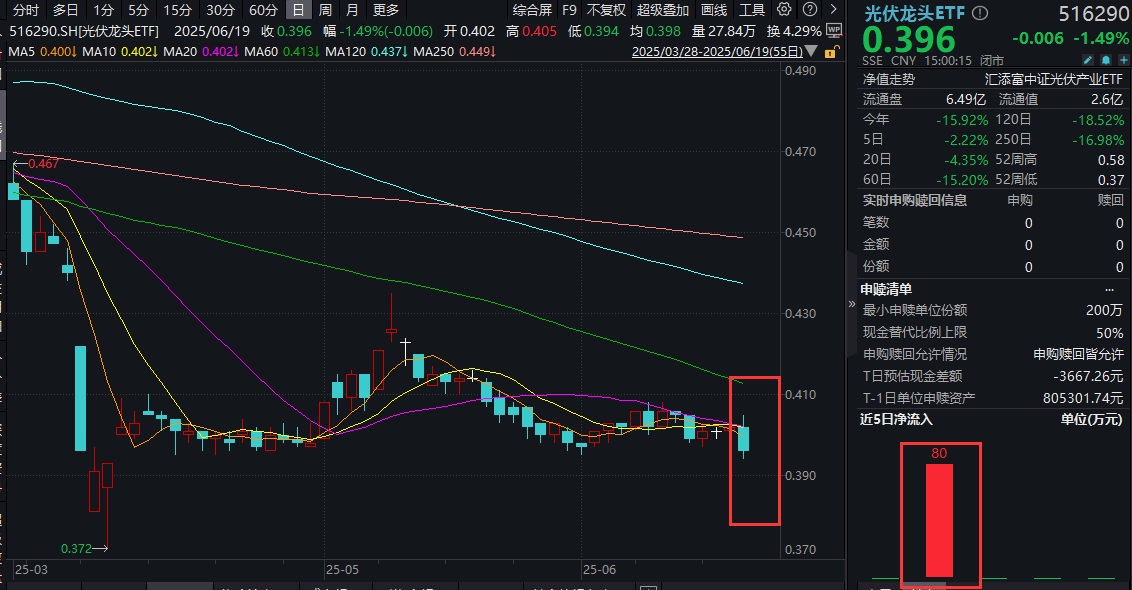
光伏三季度“减产令”升级!“反内卷”呼声再加大,低费率的光伏龙头ETF(516290)跌1.49%,光伏产业出清走到哪里了?
Sou Hu Cai Jing· 2025-06-19 10:27
Core Viewpoint - The Chinese photovoltaic (PV) industry is facing a critical supply-side reform, with expectations of production cuts and stricter policies to curb below-cost sales, aiming to improve industry profitability and stability [3][4][5]. Industry Summary - A significant decline was observed in the A-share market on June 19, with a total trading volume of 1.28 trillion yuan and over 4,600 stocks falling [1]. - The photovoltaic sector, particularly low-fee ETFs, experienced a downturn, with the leading ETF (516290) dropping by 1.49% [1][6]. - Major companies in the PV sector, such as 阳光电源 (Sungrow Power), 德业股份 (Deye), and 晶澳科技 (JA Solar), reported declines exceeding 3% in their stock prices [6]. Production and Policy Changes - The China Photovoltaic Industry Association held a meeting focusing on "production limits to maintain prices," indicating a projected reduction in operating rates by 10%-15% in Q3 [2][3]. - A third-party audit group will conduct comprehensive audits to identify evidence of below-cost sales, with various measures planned against non-compliant companies [2][3]. Technological Advancements - The industry is witnessing a push for supply-side reform, with leading companies advocating for market-driven consolidation and technological upgrades to phase out outdated capacities [4][5]. - New technologies, such as TOPCon and perovskite, are gaining attention, with several companies showcasing advancements in efficiency and production capabilities at the SNEC conference [5]. Market Outlook - The PV sector is expected to experience a fundamental recovery, with signs of a potential turning point in market sentiment as production cuts and technological advancements take effect [7]. - The low-fee photovoltaic ETF (516290) is highlighted as a favorable investment option, with management fees significantly lower than the market average [7].


知情人士:光伏三季度“减产令”升级,开工率环降10%
第一财经· 2025-06-19 08:07
Core Viewpoint - The Chinese photovoltaic industry is facing significant challenges, including overcapacity, price fluctuations, and losses, leading to a clearer path towards "production reduction to maintain prices" [1][2]. Group 1: Industry Challenges - The photovoltaic industry is experiencing a supply-demand imbalance, with many companies facing financial losses. In the first quarter, 18 out of 21 listed companies reported net profit losses, with major manufacturers like Tongwei Co., Ltd. losing 2.61 billion yuan [1]. - The industry is under pressure to reduce production, with a projected decrease in operating rates by 10%-15% in the third quarter [1][2]. - The price of polysilicon has been declining due to weak downstream demand and significant price drops in silicon wafer products, leading to a challenging market environment [3]. Group 2: Regulatory Measures - The China Photovoltaic Industry Association is implementing measures to combat below-cost sales and promote self-discipline within the industry, including setting minimum price standards and enhancing technical standards [2]. - A third-party audit group will conduct comprehensive audits to identify and address low-price sales practices among companies [1][2]. Group 3: Market Dynamics - Recent data indicates that prices for 183N silicon wafers have fallen to around 0.9 to 0.91 yuan, with some quotes dropping below 0.9 yuan [2]. - The average prices for 183N and 210N battery cells have also decreased to 0.24 yuan and 0.255 yuan per watt, respectively [2]. - The number of polysilicon producers remains at 11, all operating at reduced capacity, but the market anticipates an increase in production due to capacity replacement [3].
对话TCL中环:以BC专利、轻质化创新实现差异化破局!揭示“以销定产”市场导向策略
Xin Lang Cai Jing· 2025-06-16 06:02
Core Viewpoint - The photovoltaic industry is facing challenges, but TCL Zhonghuan is showcasing innovative products and strategies to navigate through the downturn [1][3]. Group 1: Product Innovation and Strategy - TCL Zhonghuan is focusing on three core product directions: BC, TOPCon, and bifacial modules, with a market-oriented strategy of "production based on sales" [3][4]. - The company has made significant advancements in BC technology, achieving a stable efficiency of over 25% and a laboratory maximum of 27% [6]. - The lightweight components developed in collaboration with Lens Technology reduce weight by approximately 50% while enhancing strength, making them suitable for weight-restricted applications [8]. Group 2: Market Focus and Capacity Planning - The company aims for an annual target of 20GW for BC components, tripling last year's total shipment volume, with a focus on high-end residential markets in Europe, the US, and Australia [7]. - TCL Zhonghuan's production capacity for BC and TOPCon technologies will be flexibly allocated based on market demand and customer preferences [9]. Group 3: Quality and Industry Positioning - The company emphasizes the importance of product quality as a foundation for survival and growth, adhering to stringent quality standards to maintain consumer trust [11]. - TCL Zhonghuan's competitive edge lies in its technological reserves and innovation capabilities, aiming to differentiate itself through patented BC technology and lightweight innovations [14].