HIKVISION(002415)

Search documents
海康威视(002415) - 第六届监事会第五次会议决议公告
2025-08-01 12:00
证券代码:002415 证券简称:海康威视 公告编号:2025-030 号 杭州海康威视数字技术股份有限公司 第六届监事会第五次会议决议公告 本公司及监事会全体成员保证信息披露内容的真实、准确和完整,没有虚假 记载、误导性陈述或重大遗漏。 杭州海康威视数字技术股份有限公司(以下简称"海康威视"或"公司") 第六届监事会第五次会议,于 2025 年 7 月 16 日以传真、电子邮件及专人送达方 式向全体监事发出书面通知,于 2025 年 8 月 1 日以通讯表决方式召开。会议由 监事会主席陆建忠先生召集并主持。会议应出席监事 3 名,实际出席监事 3 名。 会议召开符合有关法律、行政法规、部门规章、规范性文件和公司章程的规定。 经全体与会监事审议并表决,通过如下决议: 一、以 3 票赞成、0 票反对、0 票弃权,审议通过《2025 年半年度报告及其 摘要》。 经核查,监事会认为董事会编制和审核公司 2025 年半年度报告的程序符合 法律、行政法规和中国证监会的规定,报告内容真实、准确、完整地反映了上市 公司的实际情况,不存在任何虚假记载、误导性陈述或者重大遗漏。 2025 年半年度报告全文详见巨潮资讯网(www ...

海康威视(002415) - 第六届董事会第六次会议决议公告
2025-08-01 12:00
杭州海康威视数字技术股份有限公司(以下简称"海康威视"或"公司") 第六届董事会第六次会议,于 2025 年 7 月 16 日以传真、电子邮件及专人送达方 式向全体董事发出书面通知,于 2025 年 8 月 1 日以通讯表决方式召开。会议由 董事长胡扬忠先生召集并主持。会议应出席董事 9 名,实际出席董事 9 名。会议 召开符合有关法律、行政法规、部门规章、规范性文件和公司章程的规定。经全 体与会董事审议并表决,通过如下决议: 一、以 9 票赞成、0 票反对、0 票弃权,审议通过《2025 年半年度报告及其 摘要》; 2025 年半年度报告中的财务信息已经董事会审计委员会审议通过。 证券代码:002415 证券简称:海康威视 公告编号:2025-029 号 杭州海康威视数字技术股份有限公司 第六届董事会第六次会议决议公告 本公司及董事会全体成员保证信息披露内容的真实、准确和完整,没有虚假 记载、误导性陈述或重大遗漏。 杭州海康威视数字技术股份有限公司 董 事 会 2025 年 8 月 2 日 2025 年半年度报告全文详见巨潮资讯网(www.cninfo.com.cn),摘要刊登于 《证券时报》《中国证券报》 ...
海康威视:上半年归母净利润56.57亿元,同比增长11.71%
Xin Lang Cai Jing· 2025-08-01 11:55
海康威视8月1日披露半年报,公司上半年实现营业收入418.18亿元,同比增长1.48%;归属于上市公司 股东的净利润56.57亿元,上年同期50.64亿元,同比增长11.71%;基本每股收益0.615元。 ...
海康威视:上半年净利润56.57亿元 同比增11.71%
Zheng Quan Shi Bao Wang· 2025-08-01 11:52
Core Viewpoint - Hikvision (002415) reported a slight increase in revenue and a significant rise in net profit for the first half of the year, indicating stable growth in its innovative business segments [1] Financial Performance - The company achieved operating revenue of 41.818 billion yuan, representing a year-on-year growth of 1.48% [1] - The net profit attributable to shareholders was 5.657 billion yuan, with a year-on-year increase of 11.71% [1] - Basic earnings per share stood at 0.61 yuan [1] Innovative Business Segments - Total revenue from innovative businesses reached 11.766 billion yuan, showing a year-on-year growth of 13.92% [1] - Innovative businesses accounted for 28.14% of the company's total revenue, indicating a continuous increase in their contribution [1] - Key innovative business areas such as Hikrobot, Ezviz, Hikvision Automotive Electronics, and Hikvision Microfilm have established leading positions in their respective fields, providing strong support for the company's growth [1]
海康威视(002415) - 2025 Q2 - 季度财报
2025-08-01 11:50
[Important Notices, Table of Contents, and Definitions](index=2&type=section&id=%E7%AC%AC%E4%B8%80%E8%8A%82%20%E9%87%8D%E8%A6%81%E6%8F%90%E7%A4%BA%E3%80%81%E7%9B%AE%E5%BD%95%E5%92%8C%E9%87%8A%E4%B9%89) [Important Notices and Risk Factors](index=3&type=section&id=%E9%87%8D%E8%A6%81%E6%8F%90%E7%A4%BA%E4%B8%8E%E9%A3%8E%E9%99%A9%E5%9B%A0%E7%B4%A0) This section outlines eleven major operational risks, including economic transitions, geopolitical issues, and supply chain vulnerabilities - The company advises investors to be aware of 11 primary risks[6](index=6&type=chunk)[7](index=7&type=chunk)[8](index=8&type=chunk) - **Macro and Market Risks**: Domestic economic transition, global economic downturn, and geopolitical uncertainty - **Operational and Technological Risks**: Rapid technological updates, increasing internal management complexity, and potential supply chain disruptions - **Financial and Compliance Risks**: Declining customer payment capacity, stricter legal compliance, exchange rate fluctuations, cybersecurity, and intellectual property disputes [Definitions](index=5&type=section&id=%E9%87%8A%E4%B9%89) This section defines key terms used in the report, specifying the components of the company's innovative businesses - The report defines key terms, clarifying that "innovative businesses" include EZVIZ Network, Hikrobot, Hikauto, HIKMICRO, HIKSEMI, and others[13](index=13&type=chunk) [Company Profile and Key Financial Indicators](index=6&type=section&id=%E7%AC%AC%E4%BA%8C%E8%8A%82%20%E5%85%AC%E5%8F%B8%E7%AE%80%E4%BB%8B%E5%92%8C%E4%B8%BB%E8%A6%81%E8%B4%A2%E5%8A%A1%E6%8C%87%E6%A0%87) [Company Profile](index=6&type=section&id=%E5%85%AC%E5%8F%B8%E7%AE%80%E4%BB%8B) This section provides basic corporate information, including stock ticker, legal representative, and contact details | Item | Information | | :--- | :--- | | Stock Name | HIKVISION | | Stock Code | 002415 | | Stock Exchange | Shenzhen Stock Exchange | | Legal Representative | Hu Yangzhong | [Key Accounting Data and Financial Indicators](index=7&type=section&id=%E4%B8%BB%E8%A6%81%E4%BC%9A%E8%AE%A1%E6%95%B0%E6%8D%AE%E5%92%8C%E8%B4%A2%E5%8A%A1%E6%8C%87%E6%A0%87) The company's revenue reached RMB 41.82 billion, and net profit attributable to shareholders grew by 11.71% | Indicator | Current Period | Prior Year Period | YoY Change | | :--- | :--- | :--- | :--- | | Operating Revenue (RMB) | 41,818,040,088.44 | 41,209,096,206.36 | 1.48% | | Net Profit Attributable to Shareholders (RMB) | 5,657,349,798.68 | 5,064,118,857.29 | 11.71% | | Net Cash Flow from Operating Activities (RMB) | 5,343,019,637.89 | -189,636,040.90 | 2917.51% | | Basic Earnings Per Share (RMB/Share) | 0.615 | 0.539 | 14.10% | | Weighted Average Return on Equity | 6.85% | 6.51% | 0.34% | | Total Assets (RMB) | 124,414,765,281.12 | - | -5.76% (vs. Prior Year-End) | | Net Assets Attributable to Shareholders (RMB) | 78,552,358,426.86 | - | -2.62% (vs. Prior Year-End) | [Non-recurring Profit and Loss Items and Amounts](index=8&type=section&id=%E9%9D%9E%E7%BB%8F%E5%B8%B8%E6%80%A7%E6%8D%9F%E7%9B%8A%E9%A1%B9%E7%9B%AE%E5%8F%8A%E9%87%91%E9%A2%9D) Non-recurring profit and loss totaled RMB 168 million, mainly from government subsidies offset by fair value losses | Item | Amount (RMB) | | :--- | :--- | | Government Subsidies | 267,638,685.22 | | Fair Value Gains/Losses on Financial Assets/Liabilities | (84,646,697.58) | | Other Non-operating Income and Expenses, Net | 29,239,300.73 | | **Total** | **168,349,470.31** | [Management Discussion and Analysis](index=9&type=section&id=%E7%AC%AC%E4%B8%89%E8%8A%82%20%E7%AE%A1%E7%90%86%E5%B1%82%E8%AE%A8%E8%AE%BA%E4%B8%8E%E5%88%86%E6%9E%90) [Analysis of Core Business Operations](index=9&type=section&id=%E4%B8%BB%E8%90%A5%E4%B8%9A%E5%8A%A1%E5%88%86%E6%9E%90) Innovative businesses drove growth with a 13.92% revenue increase, offsetting a slight decline in domestic operations - The company maintained steady overall performance, with **net profit growth (11.71%)** significantly outpacing revenue growth (1.48%), indicating successful efforts in enhancing efficiency and refined management[28](index=28&type=chunk) - Innovative businesses (robotics, smart home, automotive electronics, etc) have become the core growth engine, with revenue **growing 13.92% YoY** to account for **28.14% of total revenue**, effectively buffering fluctuations in the main business[33](index=33&type=chunk) | Business Segment | 2025 H1 Revenue (RMB billion) | YoY Change | | :--- | :--- | :--- | | **Main Business** | **30.052** | **-2.68%** | | Main Business Products & Services | 29.272 | -3.17% | | Main Business Construction Engineering | 0.780 | 19.82% | | **Innovative Businesses** | **11.766** | **13.92%** | | Robotics Business | 3.138 | 14.36% | | Smart Home Business | 2.752 | 12.40% | | Automotive Electronics Business | 2.352 | 46.48% | | Thermal Imaging Business | 2.008 | 9.73% | | Storage Business | 1.033 | -21.24% | | Other Innovative Businesses | 0.482 | 24.31% | | **Total** | **41.818** | **1.48%** | | Regional Segment | 2025 H1 Revenue (RMB billion) | % of Total Revenue | YoY Change | | :--- | :--- | :--- | :--- | | Domestic | 26.393 | 63.11% | -2.35% | | Overseas | 15.425 | 36.89% | 8.78% | | Domestic Main Business Groups | 2025 H1 Revenue (RMB billion) | YoY Change | | :--- | :--- | :--- | | Public Business Group (PBG) | 5.573 | -2.11% | | Enterprise Business Group (EBG) | 7.462 | -0.36% | | Small & Medium Business Group (SMBG) | 4.067 | -29.75% | [Year-on-Year Changes in Financial Data](index=10&type=section&id=%E4%B8%BB%E8%A6%81%E8%B4%A2%E5%8A%A1%E6%95%B0%E6%8D%AE%E5%90%8C%E6%AF%94%E5%8F%98%E5%8A%A8%E6%83%85%E5%86%B5) Financial expenses decreased significantly due to exchange gains, while operating cash flow improved from increased sales collections | Item | Current Period (RMB) | YoY Change | Reason for Change | | :--- | :--- | :--- | :--- | | Financial Expenses | -739,368,414.40 | -195.52% | Increased foreign exchange gains due to currency fluctuations | | Net Cash Flow from Operating Activities | 5,343,019,637.89 | 2917.51% | Increased cash collections from sales | | Net Cash Flow from Financing Activities | -8,550,575,930.17 | 36.00% | Decreased outflows for loan repayments and cash dividends | [Analysis of Asset and Liability Status](index=13&type=section&id=%E8%B5%84%E4%BA%A7%E5%8F%8A%E8%B4%9F%E5%80%BA%E7%8A%B6%E5%86%B5%E5%88%86%E6%9E%90) Total assets decreased by 5.76%, with notable shifts in cash and fixed assets due to dividend payments and project capitalization | Asset Item | Period-End Amount (RMB) | % of Total Assets | Change in Weight vs. Prior Year-End | Major Change Explanation | | :--- | :--- | :--- | :--- | :--- | | Cash and Cash Equivalents | 31,286,076,526.36 | 25.15% | -2.33% | Decrease in cash due to dividend payments | | Fixed Assets | 16,883,791,179.01 | 13.57% | 2.16% | Capitalization of the EZVIZ Smart Manufacturing Base in Chongqing | - As of the reporting period end, the company had **RMB 2.307 billion in restricted assets**, with endorsed or discounted notes receivable being the largest component at RMB 1.329 billion[52](index=52&type=chunk) [Analysis of Investment Status](index=14&type=section&id=%E6%8A%95%E8%B5%84%E7%8A%B6%E5%86%B5%E5%88%86%E6%9E%90) The company maintained stable investment levels, advanced major construction projects, and used hedging to manage currency risk | Project Name | Cumulative Investment as of Period-End (RMB) | Project Progress | | :--- | :--- | :--- | | Wuhan Technology Park Project | 1,661,710,924.66 | 87.41% | | EZVIZ Smart Manufacturing Chongqing Base Project | 1,545,873,682.60 | 100.00% | | Hikrobot Intelligent Manufacturing (Tonglu) Base Project | 627,625,959.41 | 58.60% | | **Total** | **4,422,104,440.56** | - | - The company engages in foreign exchange derivative investments for hedging purposes to mitigate currency fluctuation risks, reporting an **actual loss of RMB 41.58 million** during the period[59](index=59&type=chunk) [Risks and Countermeasures](index=18&type=section&id=%E5%85%AC%E5%8F%B8%E9%9D%A2%E4%B8%B4%E7%9A%84%E9%A3%8E%E9%99%A9%E5%92%8C%E5%BA%94%E5%AF%B9%E6%8E%AA%E6%96%BD) The company actively manages risks across macroeconomic, geopolitical, and operational domains through diversification and innovation - The company identifies and proactively manages multi-dimensional risks[66](index=66&type=chunk)[67](index=67&type=chunk)[68](index=68&type=chunk) - **External Environment Risks**: Mitigating domestic/international economic and geopolitical uncertainties through market diversification and flexible strategies - **Technological and Operational Risks**: Addressing challenges from technological updates and scale expansion through continuous R&D investment and process-based management - **Supply Chain and Financial Risks**: Ensuring operational stability by cultivating a diverse supply network, strengthening collection mechanisms, and using financial instruments for hedging [Corporate Governance, Environment, and Society](index=20&type=section&id=%E7%AC%AC%E5%9B%9B%E8%8A%82%20%E5%85%AC%E5%8F%B8%E6%B2%BB%E7%90%86%E3%80%81%E7%8E%AF%E5%A2%83%E5%92%8C%E7%A4%BE%E4%BC%9A) The company's governance remained stable with no management changes or plans for profit distribution or new incentive programs - The corporate governance structure was stable during the reporting period, with no changes in directors, supervisors, or senior management[73](index=73&type=chunk) - The company does not plan to distribute cash dividends, issue bonus shares, or convert capital reserves into share capital for the first half of the year[74](index=74&type=chunk) - No new or ongoing equity incentive plans or employee stock ownership plans were implemented during the reporting period[75](index=75&type=chunk) [Significant Events](index=21&type=section&id=%E7%AC%AC%E4%BA%94%E8%8A%82%20%E9%87%8D%E8%A6%81%E4%BA%8B%E9%A1%B9) [Significant Related-Party Transactions](index=22&type=section&id=%E9%87%8D%E5%A4%A7%E5%85%B3%E8%81%94%E4%BA%A4%E6%98%93) Routine related-party transactions for procurement and sales totaled RMB 1.61 billion, well within the approved annual limit | Transaction Type | Transaction Content | Transaction Amount (RMB 10,000) | Approved Credit Limit (RMB 10,000) | | :--- | :--- | :--- | :--- | | Purchases | Raw materials, services, etc | 151,829.52 | 615,100.00 | | Sales | Goods, services, etc | 8,884.62 | 87,000.00 | | Leases | Renting in/out properties | 5.63 | 1,000.00 | | **Total** | - | **160,709.77** | **703,100.00** | - The company conducts financial business with its related-party finance company, China Electronics Technology Finance Co, Ltd, with a period-end deposit balance of **RMB 4.0 billion** and a credit facility of **RMB 5.0 billion**[92](index=92&type=chunk)[93](index=93&type=chunk)[94](index=94&type=chunk) [Significant Guarantees](index=25&type=section&id=%E9%87%8D%E5%A4%A7%E6%8B%85%E4%BF%9D) The company's outstanding guarantees, exclusively for its subsidiaries, amounted to RMB 2.62 billion, or 3.33% of net assets | Guarantee Item | Amount (RMB 10,000) | | :--- | :--- | | Total Approved Guarantee Limit at Period-End | 1,208,500.00 | | Total Actual Outstanding Guarantee Balance at Period-End | 261,729.94 | | Ratio of Total Actual Guarantees to Company's Net Assets | 3.33% | [Other Significant Matters](index=27&type=section&id=%E5%85%B6%E4%BB%96%E9%87%8D%E5%A4%A7%E4%BA%8B%E9%A1%B9) The controlling shareholder completed a share buyback, and the company is executing its own share repurchase plan for capital reduction - The controlling shareholder, CETHIK Group, and its concerted party, CETC Investment, completed a share purchase plan, acquiring over **RMB 300 million** in company shares, demonstrating confidence in future development[107](index=107&type=chunk)[108](index=108&type=chunk) - The company is executing a **RMB 2.0-2.5 billion share repurchase plan** to cancel shares and reduce registered capital; as of July 31, 2025, it had repurchased 62,791,259 shares for a total of approximately **RMB 1.859 billion**[110](index=110&type=chunk)[111](index=111&type=chunk) [Significant Matters of Subsidiaries](index=29&type=section&id=%E5%AD%90%E5%85%AC%E5%8F%B8%E9%87%8D%E5%A4%A7%E4%BA%8B%E9%A1%B9) The spin-off and listing of the "Hikrobot" subsidiary on the ChiNext market is progressing steadily through regulatory reviews - The spin-off and listing of the subsidiary Hikrobot on the ChiNext market is progressing steadily, with multiple rounds of inquiry responses completed, marking a key milestone in the listing process[113](index=113&type=chunk) [Share Capital Changes and Shareholder Information](index=30&type=section&id=%E7%AC%AC%E5%85%AD%E8%8A%82%20%E8%82%A1%E4%BB%BD%E5%8F%98%E5%8A%A8%E5%8F%8A%E8%82%A1%E4%B8%9C%E6%83%85%E5%86%B5) [Changes in Share Capital](index=30&type=section&id=%E8%82%A1%E4%BB%BD%E5%8F%98%E5%8A%A8%E6%83%85%E5%86%B5) Total share capital remained unchanged, while the proportion of unrestricted shares increased slightly due to the release of locked-up shares | Share Type | Before Change | After Change | | :--- | :--- | :--- | | Restricted Shares | 127,528,512 (1.38%) | 118,437,948 (1.28%) | | Unrestricted Shares | 9,105,669,814 (98.62%) | 9,114,760,378 (98.72%) | | **Total Shares** | **9,233,198,326 (100.00%)** | **9,233,198,326 (100.00%)** | - The company continues its share repurchase program, having cumulatively repurchased **62,791,259 shares**, representing **0.6801% of total share capital**, via centralized bidding as of July 31, 2025[120](index=120&type=chunk) [Shareholder Number and Holdings](index=33&type=section&id=%E5%85%AC%E5%8F%B8%E8%82%A1%E4%B8%9C%E6%95%B0%E9%87%8F%E5%8F%8A%E6%8C%81%E8%82%A1%E6%83%85%E5%86%B5) The company had 413,933 common shareholders at the end of the period, with a stable ownership structure led by its top two shareholders - As of the reporting period end, the total number of common shareholders was **413,933**[126](index=126&type=chunk) | Shareholder Name | Shareholding Ratio | Number of Shares Held | | :--- | :--- | :--- | | CETHIK Group Co, Ltd | 37.01% | 3,416,996,509 | | Gong Hongjia | 10.42% | 962,504,814 | | Hangzhou Weixun Equity Investment Partnership | 4.88% | 450,795,176 | | Shanghai Gaoyi Asset Management Partnership | 3.66% | 338,000,000 | | CETC Investment Holdings Co, Ltd | 2.69% | 248,366,268 | [Bond-related Matters](index=36&type=section&id=%E7%AC%AC%E4%B8%83%E8%8A%82%20%E5%80%BA%E5%88%B8%E7%9B%B8%E5%85%B3%E6%83%85%E5%86%B5) The company has no bond-related matters to disclose for the reporting period - The company has no bond-related matters to disclose for this reporting period[135](index=135&type=chunk) [Financial Report](index=37&type=section&id=%E7%AC%AC%E5%85%AB%E8%8A%82%20%E8%B4%A2%E5%8A%A1%E6%8A%A5%E5%91%8A) This section presents the unaudited semi-annual consolidated and parent company financial statements and accompanying notes [Key Financial Statements](index=38&type=section&id=%E8%B4%A2%E5%8A%A1%E6%8A%A5%E8%A1%A8) This includes the balance sheet, income statement, cash flow statement, and statement of changes in equity for the period - The company's semi-annual financial report for 2025 is unaudited[137](index=137&type=chunk) Consolidated Income Statement Summary (Unit: RMB) | Item | Current Period | Prior Year Period | | :--- | :--- | :--- | | **Operating Revenue** | **41,818,040,088.44** | **41,209,096,206.36** | | Operating Costs | 22,919,499,439.04 | 22,732,341,841.73 | | R&D Expenses | 5,669,772,011.51 | 5,698,043,754.07 | | **Operating Profit** | **7,015,255,841.18** | **6,276,963,917.47** | | **Total Profit** | **7,040,890,604.57** | **6,301,520,592.43** | | **Net Profit** | **6,281,476,630.83** | **5,640,664,710.62** | | Net Profit Attributable to Parent Company Owners | 5,657,349,798.68 | 5,064,118,857.29 | Consolidated Balance Sheet Summary (Unit: RMB) | Item | June 30, 2025 | December 31, 2024 | | :--- | :--- | :--- | | **Total Assets** | **124,414,765,281.12** | **132,016,200,156.14** | | Total Current Assets | 93,969,952,990.69 | 102,480,513,627.12 | | Total Non-Current Assets | 30,444,812,290.43 | 29,535,686,529.02 | | **Total Liabilities** | **38,605,886,425.59** | **44,515,905,407.99** | | Total Current Liabilities | 35,577,697,402.73 | 37,645,004,001.91 | | Total Non-Current Liabilities | 3,028,189,022.86 | 6,870,901,406.08 | | **Total Equity** | **85,808,878,855.53** | **87,500,294,748.15** | | Equity Attributable to Parent Company Owners | 78,552,358,426.86 | 80,668,661,062.88 | [Notes to the Financial Statements](index=48&type=section&id=%E8%B4%A2%E5%8A%A1%E6%8A%A5%E8%A1%A8%E9%99%84%E6%B3%A8) This provides detailed explanations of accounting policies and annotations for key items in the consolidated financial statements - The notes to the financial statements provide detailed explanations and supplementary information for key financial statement items, crucial for understanding the company's financial position and performance[160](index=160&type=chunk) [List of Reference Documents](index=144&type=section&id=%E7%AC%AC%E4%B9%9D%E8%8A%82%20%E5%A4%87%E6%9F%A5%E6%96%87%E4%BB%B6%E7%9B%AE%E5%BD%95) This lists the available reference documents, including the signed report text and all publicly disclosed filings - Reference documents include[653](index=653&type=chunk) - The semi-annual report text signed by the legal representative - Financial statements signed and sealed by the company head, chief accounting officer, and head of the accounting department - Originals and drafts of all company documents publicly disclosed on designated media during the reporting period
海康威视:2025年上半年净利润56.57亿元,同比增长11.71%
Hua Er Jie Jian Wen· 2025-08-01 11:49
市场有风险,投资需谨慎。本文不构成个人投资建议,也未考虑到个别用户特殊的投资目标、财务状况或需要。用户应考虑本文中的任何 意见、观点或结论是否符合其特定状况。据此投资,责任自负。 风险提示及免责条款 海康威视公告,2025年上半年营业收入418.18亿元,同比增长1.48%。净利润56.57亿元,同比增长 11.71%。 ...
海康威视(002415) - 关于公司回购股份的进展公告
2025-08-01 11:47
证券代码:002415 证券简称:海康威视 公告编号:2025-032 号 杭州海康威视数字技术股份有限公司 关于公司回购股份的进展公告 本公司及董事会全体成员保证信息披露内容的真实、准确和完整,没有虚 假记载、误导性陈述或重大遗漏。 62,791,259 股,占公司目前总股本的 0.6801%,最高成交价为 32.70 元/股,最 低成交价为 27.06 元/股,成交总金额为 1,858,599,601.06 元(不含交易费用)。 本次回购股份资金来源为公司自有资金及股票回购专项贷款,回购价格未超 过回购方案中拟定的价格上限。本次回购符合相关法律法规及公司既定的回购股 份方案。 二、其他说明 杭州海康威视数字技术股份有限公司(以下简称"海康威视"或"公司") 于 2024 年 12 月 9 日、2024 年 12 月 25 日召开公司第六届董事会第四次会议、 2024 年第二次临时股东大会,审议通过了《关于回购公司股份方案的议案》,同 意公司通过深圳证券交易所交易系统以集中竞价交易方式回购公司部分已在境 内发行的人民币普通股(A 股)股票。回购资金总额不超过人民币 25 亿元(含), 不低于人民币 20 亿 ...
今日55只个股突破年线
Zheng Quan Shi Bao Wang· 2025-08-01 08:06
Market Overview - The Shanghai Composite Index closed at 3559.95 points, slightly down by 0.37%, with a total trading volume of 161.99 billion yuan [1] - A total of 55 A-shares have surpassed their annual line, indicating a positive market sentiment [1] Notable Stocks - The stocks with the highest deviation rates above the annual line include: - JieJia WeiChuang (300724) with a deviation rate of 14.08% and a daily increase of 20.00% [1] - AiLuo Energy (688717) with a deviation rate of 3.52% and a daily increase of 4.02% [1] - KuaiKe Electronics (301278) with a deviation rate of 3.30% and a daily increase of 3.57% [1] - Other stocks that have just crossed the annual line with smaller deviation rates include: - FuLing ZhaCai (涪陵榨菜) and TongWei Co. (通威股份) [1] Trading Data - The trading data for stocks that broke the annual line includes: - JieJia WeiChuang: Latest price 66.19 yuan, turnover rate 16.84% [1] - AiLuo Energy: Latest price 57.94 yuan, turnover rate 5.03% [1] - KuaiKe Electronics: Latest price 35.11 yuan, turnover rate 6.66% [1] - Additional stocks with notable performance include: - XinDian Software (688232) with a 4.61% increase and a deviation rate of 3.08% [1] - DongWang Times (600052) with a 4.47% increase and a deviation rate of 2.69% [1]



海康威视(002415)8月1日主力资金净流入4.46亿元
Sou Hu Cai Jing· 2025-08-01 07:27
天眼查商业履历信息显示,杭州海康威视数字技术股份有限公司,成立于2001年,位于杭州市,是一家 以从事计算机、通信和其他电子设备制造业为主的企业。企业注册资本923319.8326万人民币,实缴资 本923319.8326万人民币。公司法定代表人为胡扬忠。 通过天眼查大数据分析,杭州海康威视数字技术股份有限公司共对外投资了68家企业,参与招投标项目 5000次,知识产权方面有商标信息833条,专利信息5000条,此外企业还拥有行政许可579个。 来源:金融界 金融界消息 截至2025年8月1日收盘,海康威视(002415)报收于29.11元,上涨3.59%,换手率1.43%, 成交量130.56万手,成交金额37.93亿元。 资金流向方面,今日主力资金净流入4.46亿元,占比成交额11.75%。其中,超大单净流入3.25亿元、占 成交额8.56%,大单净流入1.21亿元、占成交额3.19%,中单净流出流出22033.43万元、占成交额 5.81%,小单净流出22551.19万元、占成交额5.94%。 海康威视最新一期业绩显示,截至2025一季报,公司营业总收入185.32亿元、同比增长4.01%,归属净 利润 ...
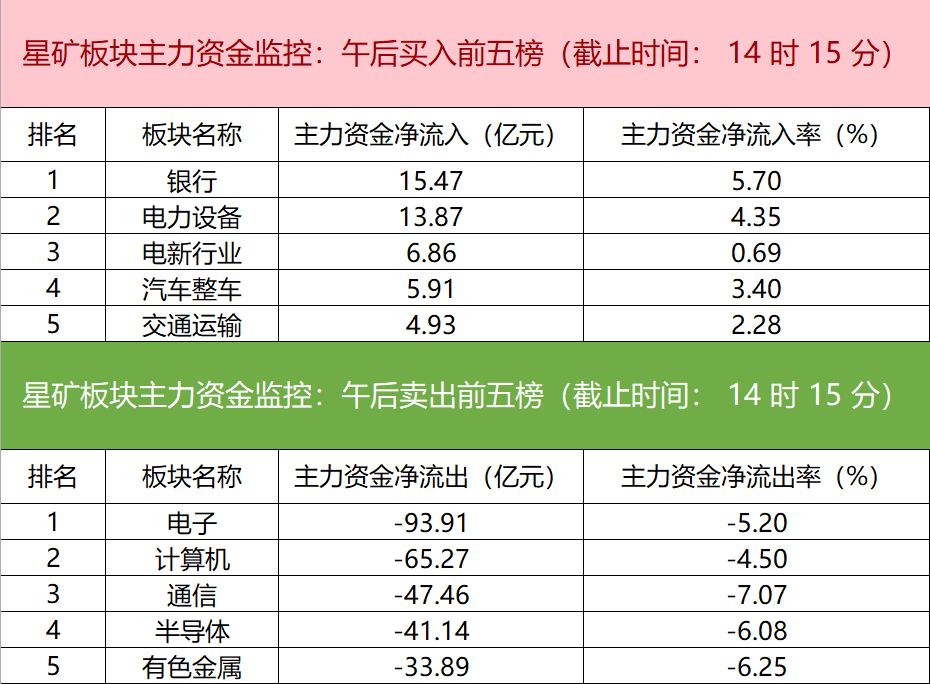
主力资金监控:电子板块净流出超93亿



news flash· 2025-08-01 06:22
Core Insights - The electronic sector experienced a significant net outflow of over 9.3 billion yuan, indicating a shift in investor sentiment away from this sector [1][3] - In contrast, the banking, power equipment, and new energy sectors saw net inflows, suggesting a preference for these industries among investors [1][2] Sector Summary Net Inflows - Banking sector led with a net inflow of 15.47 billion yuan, representing a 5.70% inflow rate [2] - Power equipment sector followed with a net inflow of 13.87 billion yuan, at a 4.35% inflow rate [2] - New energy industry recorded a net inflow of 6.86 billion yuan, with a 0.69% inflow rate [2] - Automotive sector had a net inflow of 5.91 billion yuan, reflecting a 3.40% inflow rate [2] - Transportation sector saw a net inflow of 4.93 billion yuan, with a 2.28% inflow rate [2] Net Outflows - Electronic sector faced the highest net outflow of 93.91 billion yuan, with a -5.20% outflow rate [3] - Computer sector had a net outflow of 65.27 billion yuan, at a -4.50% outflow rate [3] - Communication sector experienced a net outflow of 47.46 billion yuan, with a -7.07% outflow rate [3] - Semiconductor sector recorded a net outflow of 41.14 billion yuan, reflecting a -6.08% outflow rate [3] - Non-ferrous metals sector saw a net outflow of 33.89 billion yuan, with a -6.25% outflow rate [3] Stock Performance Top Net Inflows - Jiejia Weichuang topped the list with a net inflow of 5.66 billion yuan, showing a 18.01% inflow rate [4] - Zhongsheng Pharmaceutical followed with a net inflow of 4.61 billion yuan, at a 14.46% inflow rate [4] - Shuangliang Energy recorded a net inflow of 4.46 billion yuan, with a 31.97% inflow rate [4] - Hikvision had a net inflow of 4.43 billion yuan, reflecting a 12.94% inflow rate [4] - BAIC Blue Valley saw a net inflow of 4.15 billion yuan, with a 13.39% inflow rate [4] Top Net Outflows - Xinyi Liuhua led the outflows with a net outflow of 14.08 billion yuan, at a -16.94% outflow rate [5] - Northern Rare Earth followed with a net outflow of 10.02 billion yuan, reflecting a -12.81% outflow rate [5] - Tianfeng Securities experienced a net outflow of 8.83 billion yuan, with a -21.17% outflow rate [5] - WuXi AppTec had a net outflow of 7.87 billion yuan, at a -10.60% outflow rate [5] - Shenghong Technology recorded a net outflow of 7.17 billion yuan, reflecting a -11.48% outflow rate [5]