BYD(002594)

Search documents
崔东树:政策引导与市场驱动 预计2026年新能源乘用车将实现高质量发展
智通财经网· 2026-02-10 09:19
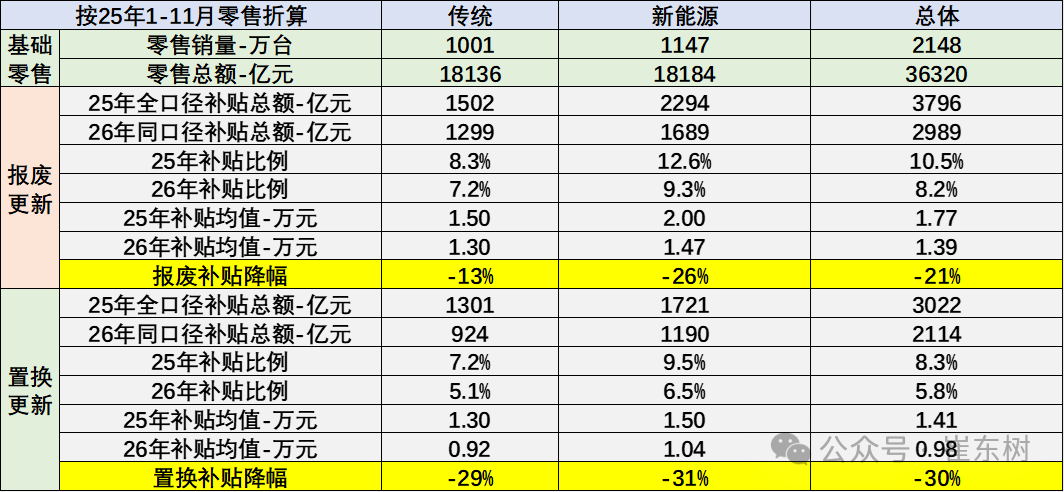
Core Insights - The 2026 vehicle replacement policy is a significant boost for the automotive market, promoting high-end development and enhancing fiscal efficiency through a shift from fixed subsidies to tiered subsidies based on vehicle value [1][3]. Group 1: Policy Impact - The new policy aims to stabilize large-scale consumption and release replacement potential, contributing to steady growth while promoting green and low-carbon initiatives [1][2]. - The average subsidy for passenger vehicle replacements is expected to decrease by approximately 30%, while the average subsidy for scrapping is projected to decline by about 20% [2][3]. - The transition to a tiered subsidy system is designed to improve fiscal efficiency, ensuring better allocation of funds and reducing waste from low-priced vehicles benefiting from subsidies [3][4]. Group 2: Market Trends - In 2025, over 11.5 million vehicles benefited from the replacement subsidy, with nearly 60% being new energy vehicles, indicating a strong market shift towards electrification [3]. - The commercial vehicle sector is expected to perform better in 2026 due to the continuity of favorable policies, while the passenger vehicle segment faces a decline in the number of new models [5][6]. - The number of new passenger vehicle models is decreasing from 92 in 2024 to 83 in 2026, reflecting a trend towards higher-end and larger vehicles [5][6]. Group 3: Product Development - New energy passenger vehicles are increasingly characterized by larger sizes and improved range, with a notable absence of small electric vehicles under 1090 kg in recent releases [8][10]. - The introduction of long-range electric vehicles, particularly those exceeding 700 km, is becoming more common, indicating a shift towards higher performance in the electric vehicle market [10][14]. - The energy density and efficiency of new energy vehicles are improving, with some models achieving a power consumption of around 10 kWh per 100 km [12][15]. Group 4: Tax and Subsidy Structure - The tax exemption directory for commercial vehicles shows growth in new models, particularly in trucks and buses, compared to the previous year [4][6]. - The structure of the subsidy system is evolving to favor higher-priced vehicles, ensuring that funds are allocated to more valuable replacements [3][4]. Group 5: Competitive Landscape - The competitive landscape is shifting as traditional fuel vehicles face increasing pressure from new energy vehicles, which are rapidly advancing in technology and market presence [1][3]. - The introduction of diverse new models in the narrow hybrid segment is establishing a solid foundation for future growth, with many new products featuring lower energy consumption [16].


固态电池最新情况
数说新能源· 2026-02-10 09:11
Group 1 - The core viewpoint of the article emphasizes the significant advancements in solid-state battery technology, with 2026 being defined as the "year of mass production" or "expansion cycle year" for solid-state batteries, reaching "quasi-mass production" levels [5] - The meeting involving key industry players, including BYD and CATL, was described as "exceeding expectations," which has boosted confidence within the industry [4] - The consensus on the technical path indicates that sulfide electrolytes are becoming the mainstream direction, with leading battery manufacturers favoring "self-generating anode" solutions for improvements in energy density, cost, safety, and cycle life [5] Group 2 - Major automotive manufacturers like Chery and Geely have confirmed plans for demonstration vehicle installations in 2027, indicating a strategic shift towards solid-state battery integration [8] - CATL is experiencing growth in the energy storage market, which is outpacing the growth in the power battery sector, highlighting a shift in market dynamics [11] - The article notes that leading battery manufacturers are likely to continue using "dry electrode" processes for positive electrodes, as they are deemed more compatible with sulfide electrolytes and solid-state batteries [5]


汽车股普涨 比亚迪股份涨约4%
Zhong Guo Qi Che Bao Wang· 2026-02-10 09:09
Group 1 - The core viewpoint of the article highlights a collective rise in Hong Kong automotive stocks, with notable increases in companies such as BYD, Chery, and NIO, following a recent meeting by the Ministry of Commerce regarding automotive consumption [1] Group 2 - BYD shares increased by approximately 4%, while Chery Automotive rose over 2%, and other companies like Leap Motor, NIO, and Geely saw gains exceeding 1% [1] - The Ministry of Commerce plans to implement policies to support and innovate the automotive sector, including optimizing the vehicle trade-in program and conducting pilot reforms in automotive consumption [1] - By 2026, the Ministry aims to enhance industry management systems and promote measures to expand and improve automotive consumption through a combination of existing and new policies [1]
比亚迪起诉!让特朗普退回关税
Guan Cha Zhe Wang· 2026-02-10 08:48
Core Viewpoint - BYD has filed a lawsuit against the U.S. government, questioning the legality of tariffs imposed by the Trump administration and seeking a refund for tariffs paid since April of the previous year [1][2]. Group 1: Legal Basis of the Lawsuit - BYD argues that the International Emergency Economic Powers Act (IEEPA) does not authorize the imposition of tariffs, as the term "tariff" is not mentioned in the text of the law [1]. - The lawsuit claims that the IEEPA is intended for financial sanctions and trade restrictions, not for the specific purpose of tariff imposition [1]. - BYD's legal argument centers on the assertion that the Trump administration overstepped its authority by using the IEEPA to impose tariffs on Chinese goods [1]. Group 2: Context of the Lawsuit - BYD is the first Chinese automotive company to file a lawsuit regarding U.S. tariffs, although thousands of global companies operating in the U.S. have made similar claims [1]. - The case has been escalated to the U.S. Supreme Court, with previous courts ruling that the tariffs lack legal authorization [2]. - The outcome of this case could significantly impact the legality of hundreds of billions in tariffs and the potential for refunds [2]. Group 3: BYD's Business Operations in the U.S. - Although BYD does not currently sell passenger vehicles in the U.S., its operations include buses, commercial vehicles, batteries, energy storage systems, and solar panels [3]. - BYD operates an electric bus and commercial vehicle factory in Lancaster, California, employing approximately 750 American workers [3]. - The Trump administration's stance on Chinese automotive companies has been inconsistent, expressing both concerns about competition and openness to Chinese companies establishing manufacturing in the U.S. [3].
Seres partners Abu Dhabi Motors unit to launch AITO EVs in UAE
Yahoo Finance· 2026-02-10 08:48
Core Insights - Chinese automaker Seres' electric vehicle brand AITO has entered a distribution partnership with Performance Plus Motors, a subsidiary of Abu Dhabi Motors, to launch operations in the UAE [1][2] - The collaboration is seen as a significant step in AITO's globalization strategy, particularly in the luxury new energy vehicle (NEV) market in the Middle East [2][5] Group 1: Partnership Details - Performance Plus Motors will manage sales, delivery, and after-sales operations for AITO vehicles in the UAE, including establishing brand experience and service centers [1] - ADM will provide local support through marketing, brand communications, customer service collaboration, market intelligence, and shared resources [2] Group 2: Operational Readiness - AITO has completed necessary local hardware and software modifications and received regulatory approvals for its vehicles in the UAE [3] - The flagship AITO 9 model has begun user test drives in the UAE, with vehicles already arriving at Dubai port ahead of the official launch [3] Group 3: Market Strategy - AITO has surpassed one million units in cumulative production over 46 months, with the AITO 9 leading China's RMB 500,000-plus vehicle segment for 21 consecutive months [4] - The UAE launch is part of AITO's broader strategy to expand into neighboring markets and enhance its international presence in the luxury intelligent NEV segment [5] Group 4: Support and Future Plans - ADM's existing facilities and logistics network will support vehicle deliveries and long-term operations for AITO in the UAE [4] - ADM CEO emphasized leveraging resources and operational advantages to support AITO's long-term development and explore new opportunities in the luxury NEV segment [6]
【新能源周报】新能源汽车行业信息周报(2026年2月2日-2月8日)
乘联分会· 2026-02-10 08:37
Industry Information - Beijing Economic and Technological Development Zone implements intelligent connected vehicle initiatives to enhance AI's role in data-driven technology [2] - Shenzhen releases a three-year consumption action plan focusing on green electricity consumption and charging infrastructure [2] - The largest high-speed supercharging station in China is operational in Hangzhou [2] - NIO achieves a milestone of 100 million battery swaps, with a network covering 8,627 stations nationwide [39] - CATL signs a comprehensive strategic agreement with Yunnan to promote green energy and transportation [10] Policy Information - The 2026 Central Document No. 1 emphasizes expanding rural consumption and supporting the adoption of new energy vehicles [26] - The Ministry of Transport plans to build over 10,000 charging guns in national highway service areas by 2026 [14] - The 2026 action plan for Beijing's traffic governance includes increasing the coverage of charging facilities [25] - Canada plans to abolish mandatory electric vehicle regulations and reintroduce consumer subsidies for electric vehicles [12] Company Information - BYD launches a new brand "Linghui" focused on the mobility market, aiming to provide affordable and advanced electric vehicles [33] - Xpeng Motors announces the launch of its AIOS 6.0 OTA update, featuring the industry's first proactive service cockpit [35] - Li Auto is set to open its 4,000th supercharging station, enhancing its charging network [39] - Xiaomi Motors updates its city driving assistance feature, lowering the mileage threshold for users [37] - NIO collaborates with a local company to enhance battery swapping services during the Spring Festival [39]


2026/2/2-2026/2/8汽车周报:理想、比亚迪均有技术催化,板块轮动+科技成长双轮驱动-20260210
Shenwan Hongyuan Securities· 2026-02-10 07:20
Investment Rating - The report maintains a positive outlook on the automotive industry, particularly on companies like Li Auto, Xpeng, BYD, and Great Wall Motors, driven by technological advancements and new product cycles [2]. Core Insights - The automotive market is experiencing a shift towards new technologies, with a focus on AI and smart vehicles, which is expected to drive growth in 2026 [2]. - The report highlights the importance of overseas market opportunities for companies like BYD and Geely, especially in light of domestic cost pressures [2]. - The report notes a significant decline in retail sales in January, with a year-on-year decrease of 22% and a month-on-month decrease of 31% [2]. - The report emphasizes the potential of the robot industry and the valuation flexibility within the supply chain, particularly with Tesla's Optimus V3 [2]. - The report identifies key players in the smart vehicle sector, including companies like Desay SV, Jingwei Hirain, and Bertel, which are expected to benefit from the growth in intelligent vehicles [2]. Industry Updates - The report indicates that the average daily retail sales of passenger vehicles in China were 50,000 units in the second week of January, marking a 22% decline compared to the same period last year [2]. - The report mentions a decrease in raw material prices for both traditional and new energy vehicles, with traditional vehicle raw material prices down by 2.8% week-on-week and 1.0% month-on-month, while new energy vehicle raw material prices fell by 6.7% week-on-week and 2.7% month-on-month [2]. - The total transaction value in the automotive industry for the week was 530.7 billion yuan, reflecting a 22.58% decrease compared to the previous week [2]. - The automotive industry index rose by 0.32% during the week, outperforming the Shanghai and Shenzhen 300 index, which fell by 1.33% [10]. Monthly Sales Updates - In January 2026, the sales of new energy vehicle companies showed a mixed trend, with BYD's sales at 210,510 units, down 30% year-on-year, while companies like Zeekr and NIO reported significant increases in sales [6][8]. - The report provides a detailed breakdown of sales figures for various new energy vehicle brands, highlighting the overall market contraction of 8% year-on-year and a 45% month-on-month decline [6][8]. Key Models Announced - The report lists several notable new vehicle models announced in the latest batch of vehicle approvals, including the Li Auto L9 Livis, Xpeng GX, and BYD Tang EV, among others [3][4][5].
比亚迪固态电池大消息来了!
鑫椤锂电· 2026-02-10 07:07
Core Viewpoint - The article discusses the advancements and future prospects of solid-state batteries, particularly focusing on BYD's developments in this area, including timelines for production and market integration [2]. Group 1: Solid-State Battery Developments - BYD is exploring multiple routes in solid-state battery technology, with sulfide solid-state batteries being a key focus, aiming for breakthroughs in battery life and fast charging, with small-scale production expected by 2027 [1]. - The CTO of BYD indicated that solid-state batteries could achieve cost parity with liquid-state batteries in the long term, with a demonstration phase planned from 2027 to 2029, primarily targeting mid-to-high-end electric vehicles [2]. - BYD's Chief Scientist predicts that solid-state batteries will mainly be used in high-end models, while lithium iron phosphate batteries will remain relevant for the next 15 to 20 years due to cost and material controllability [2]. Group 2: Market Research and Future Outlook - A market research report on solid-state batteries from 2025 to 2029 is available for pre-sale, indicating a growing interest in the investment potential of this technology [2].
3月19-20日 常州!2026锂电关键材料及应用市场高峰论坛
鑫椤锂电· 2026-02-10 07:07
Core Viewpoint - The lithium battery industry is poised for a significant growth cycle in 2026, characterized by strong demand recovery, accelerated global expansion, and disruptive technological advancements, leading to a "spiral rise" in both volume and price [3]. Group 1: Market Predictions - Global lithium battery production is expected to reach 2297 GWh by 2025, with a growth rate of 34.6% in 2026. The shipment growth rate for energy storage cells is projected to be as high as 70%, driven by both domestic and international demand [5]. - There is a notable supply gap in the current effective production capacity for battery cells and various materials, making supply chain stability and efficiency crucial for capitalizing on this growth opportunity [5]. Group 2: Conference Details - The 2026 Lithium Key Materials and Applications Market Summit will be held on March 19-20, 2026, in Changzhou, Jiangsu, organized by Xinluo Information [4]. - The summit will focus on two main topics: in-depth discussions on cutting-edge technologies and market supply-demand dynamics, and B2B procurement matchmaking to connect top battery manufacturers and material suppliers [6]. Group 3: Key Topics and Participants - The conference will feature specialized sessions on lithium carbonate futures, market volatility responses, global lithium resource potential, and opportunities from solid-state battery developments, with participation from various industry experts and companies [7][8]. - Notable participants include leading battery companies like CATL, BYD, and LGES, as well as material suppliers covering the entire supply chain from cathode and anode materials to electrolytes and separators [6].


沪深北交易所同日“亮剑”:再融资新政对A股影响(附精选股票)
Sou Hu Cai Jing· 2026-02-10 06:14
Core Viewpoint - The simultaneous release of refinancing optimization measures by Shanghai, Shenzhen, and Beijing stock exchanges marks a significant transformation in China's capital market, aimed at enhancing capital allocation efficiency and reshaping the A-share market landscape [1]. Group 1: Policy Framework and Differences - The policy frameworks of the three exchanges are highly similar, focusing on "supporting the strong, limiting the weak, promoting innovation, and enhancing convenience and regulation" [2]. - Shanghai Stock Exchange emphasizes "main board" characteristics, tailoring financing rules for large, mature technology companies [2]. - Shenzhen Stock Exchange adopts a bolder stance on supporting technology innovation, easing fundraising restrictions for growth-oriented enterprises [2]. - Beijing Stock Exchange focuses on "innovative small and medium-sized enterprises," addressing their financing challenges with flexible policies [2]. Group 2: Strategic Insights on Separate Announcements - The decision to release policies on the same day rather than a joint announcement reflects the nuanced wisdom of tiered regulation in China's capital market [3]. - Different market positioning allows each exchange to cater to the unique characteristics and needs of the enterprises they serve, avoiding a one-size-fits-all approach [3]. - The simultaneous release creates a strong policy resonance, reinforcing market perception of deepening capital market reforms while maintaining the distinct identities of each exchange [3]. Group 3: Deep Impacts on Market Perception - The new measures aim to shift the long-standing fear of "blood-sucking" effects of refinancing, which was believed to drain market funds and destabilize the market [4]. - The principle of "supporting the strong, limiting the weak" will act as a catalyst for market differentiation, favoring quality companies, especially in hard technology, while raising barriers for poorly performing firms [4]. - The policy directs resources towards "new productive forces," providing strong support for leading companies in sectors like semiconductors, AI, biomedicine, and high-end manufacturing [5]. - Allowing companies that have experienced stock price declines to raise funds through methods like private placements and convertible bonds offers a lifeline to solid businesses facing temporary challenges [6]. - A complete regulatory loop is established, tightening post-fundraising supervision while relaxing initial approvals, transforming refinancing from a mere "money-raising tool" to an "engine" for corporate development [7]. Group 4: Implications for Investors - The coordinated actions of the three exchanges signify the entry of China's refinancing mechanism into a "precise drip irrigation" era, providing tailored financing support for different types of enterprises [8]. - Investors are advised to focus on genuinely innovative and well-governed companies while avoiding those that merely chase trends without substance [8]. - The transformation of refinancing from a "blood-sucking machine" to a "blood-producing pump" is expected to enhance the value discovery function of the A-share market, leading to a healthier and more vibrant capital market [8].