
EVE(300014)

Search documents
谁在追逐欧洲电池产业的新浪潮 | 海斌访谈
Di Yi Cai Jing· 2025-11-04 08:49
Core Insights - European economies like the UK and Germany are either restarting or planning to restart subsidies for electric vehicles (EVs) in early 2024, indicating a renewed focus on the EV market [6][7] - Local battery manufacturers in Europe, such as Northvolt and ACC, have faced significant challenges, including quality issues and investment halts, while Chinese and American companies are increasingly entering the European market [3][4][11] - The competitive landscape in the European battery market is shifting, with expectations that Chinese companies could capture up to 80% of the market share, while local firms struggle to keep pace [20][21] Industry Developments - Northvolt, once a leading battery manufacturer in Europe, is facing bankruptcy due to severe product delivery and quality issues, leading to a potential acquisition by the American startup Lyten [3][10] - ACC, a joint venture involving Stellantis, Mercedes-Benz, and TotalEnergies, has suspended its investment plans in Germany and Italy, highlighting the difficulties faced by European battery firms [3][4] - The European battery market is witnessing a resurgence, with a 34% year-on-year increase in EV sales in September 2025, driven by renewed subsidies and local production requirements [6][7] Investment Trends - Significant investments are flowing into the European battery sector from both Chinese and American companies, indicating a strategic shift in the competitive landscape [8][19] - Companies like CATL and Envision are expanding their production capabilities in Europe, with CATL's factory in Hungary set to have a capacity of 100GWh and an investment of €7.34 billion [16][22] - Gotion High-Tech has launched a €1.2 billion battery super factory in Slovakia, with an initial capacity of 20GWh, targeting orders from Skoda, a Volkswagen subsidiary [15][22] Competitive Landscape - The competition among battery manufacturers is intensifying, with a focus on who can effectively build and operate battery factories [19] - Chinese battery manufacturers are adapting their strategies in Europe, often opting for joint ventures to align with local regulations and market conditions [21][22] - The market share of South Korean companies like LG Energy Solution and SK On has decreased, while Chinese firms are gaining ground, with CATL and others becoming dominant players [19][20]





A股电源设备股下跌,阳光电源跌超5%
Ge Long Hui A P P· 2025-11-04 05:15
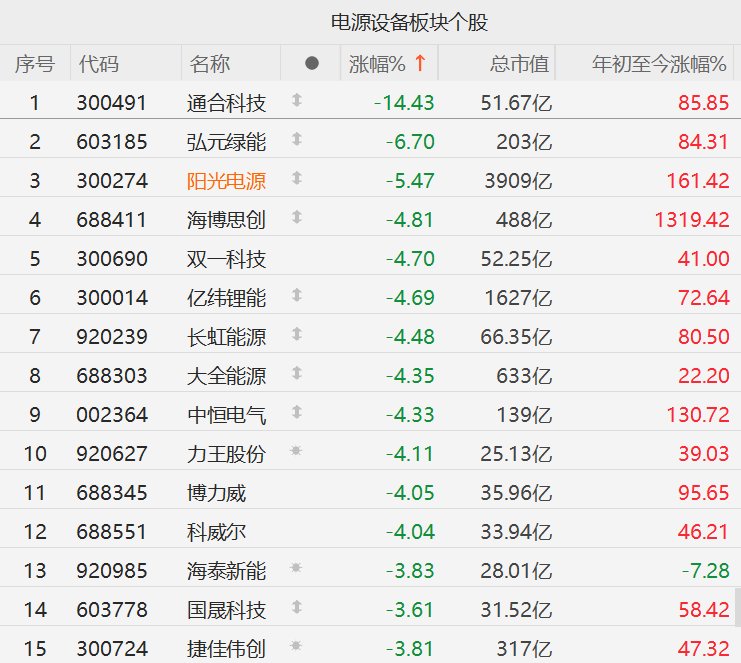
Core Insights - The A-share market has seen a decline in the power equipment sector, with significant drops in stock prices for several companies [1] Summary by Category Stock Performance - Tonghe Technology (300491) experienced a decline of 14.43%, with a total market capitalization of 5.167 billion [2] - Hongyuan Green Energy (603185) fell by 6.70%, with a market cap of 20.3 billion [2] - Sunshine Power (300274) decreased by 5.47%, with a market value of 26.068 billion [2] - Haibo Sichuang (688411) saw a drop of 4.81%, with a market capitalization of 48.8 billion [2] - Shuangyi Technology (300690) declined by 4.70%, with a market cap of 5.225 billion [2] - Yiyuan Lithium Energy (300014) fell by 4.69%, with a market value of 162.7 billion [2] - Changhong Energy (920239) decreased by 4.48%, with a market capitalization of 6.635 billion [2] - Daqian Energy (688303) saw a decline of 4.35%, with a market cap of 63.3 billion [2] - Zhongheng Electric (002364) dropped by 4.33%, with a market value of 1.39 billion [2] - Liwang Co. (920627) fell by 4.11%, with a market cap of 2.513 billion [2] - Boliview (688345) decreased by 4.05%, with a market capitalization of 3.596 billion [2] - Koweil (688551) saw a drop of 4.04%, with a market value of 3.394 billion [2] - Haitai New Energy (920985) declined by 3.83%, with a market cap of 2.801 billion [2] - Guosheng Technology (603778) fell by 3.61%, with a market value of 3.152 billion [2] - Jiejia Weichuang (300724) decreased by 3.81%, with a market capitalization of 31.7 billion [2] Year-to-Date Performance - Despite the recent declines, some companies have shown significant year-to-date gains, such as: - Tonghe Technology with an 85.85% increase [2] - Hongyuan Green Energy with an 84.31% increase [2] - Sunshine Power with a 161.42% increase [2] - Haibo Sichuang with a remarkable 1319.42% increase [2] - Zhongheng Electric with a 130.72% increase [2]





32 款制氢装备新品:AEM数量领跑,20%企业布局双制氢路线
势银能链· 2025-11-04 03:49
Core Viewpoint - The article discusses the advancements and competitive landscape in the green hydrogen equipment sector in China, highlighting the emergence of new products and technologies from various companies, as well as the evolving market dynamics and competitive strategies [13]. Product Launches and Innovations - In the first three quarters of 2025, 25 companies launched 32 new electrolysis hydrogen production equipment products, with AEM leading with 12 new products, followed by ALK with 10, and PEM with 9 [3][4]. - Notable companies involved in ALK new products include Huadian Science and Technology, BlueStar North Chemical Machinery, and SANY Hydrogen Energy, while PEM products were launched by companies like Huadian Science and Technology and Sinopec Hydrogen Energy Machinery [3][4]. - AEM products were introduced by Future Hydrogen, Jiangsu Hydrogen Port, and Hydrogen Hummingbird, among others [3][4]. Product Characteristics - The new products exhibit features such as high current density, wide power adjustment range, and cost reduction [7][8]. - For instance, Huadian Science and Technology's PEM electrolyzer has a current density of 30,000 A/m² and a hydrogen production capacity of ≥500 Nm³/h, with a direct current energy consumption of ≤4.35 kWh/Nm³ [9]. - The second-generation alkaline electrolyzer from Tianhe Hydrogen has a rated current density of 4,000 A/m² and a direct current consumption of as low as 3.898 kWh/Nm³, achieving a 30% reduction in equipment costs [8][9]. Competitive Landscape - The competitive landscape is characterized by a three-dimensional structure involving traditional enterprise transformation, central enterprise platform integration, and innovation from emerging companies [13]. - Companies are focusing on technological differentiation, high-quality products, standardized certification, and global expansion to build competitive advantages [13]. Market Trends - The market is witnessing a shift towards high-efficiency and low-cost hydrogen production technologies, with significant advancements in PEM and AEM technologies [7][11]. - The article emphasizes the importance of innovation and the need for companies to adapt to changing market demands and technological advancements to remain competitive [13].





亿纬锂能跌2.04%,成交额10.76亿元,主力资金净流出6072.82万元
Xin Lang Cai Jing· 2025-11-04 02:15
Group 1 - The stock price of EVE Energy Co., Ltd. has increased by 77.73% year-to-date, with a recent 5-day increase of 5.44% and a 60-day increase of 86.53% [2] - As of November 4, the stock price was reported at 81.75 CNY per share, with a market capitalization of 167.239 billion CNY [1] - The company has experienced a net outflow of 60.7282 million CNY in principal funds, with significant buying and selling activity observed [1] Group 2 - EVE Energy's main business segments include power batteries (45.26%), energy storage batteries (36.56%), and consumer batteries (18.03%) [2] - The company reported a revenue of 45.002 billion CNY for the first nine months of 2025, representing a year-on-year growth of 32.17%, while net profit decreased by 11.70% to 2.816 billion CNY [2] - The company has distributed a total of 3.643 billion CNY in dividends since its A-share listing, with 2.866 billion CNY distributed in the last three years [3] Group 3 - As of September 30, 2025, the number of shareholders increased by 34.21% to 187,500, while the average circulating shares per person decreased by 25.49% to 9,929 shares [2] - Major shareholders include Hong Kong Central Clearing Limited, which holds 48.9094 million shares, and several ETFs that have reduced their holdings [3]
18家电池企业Q3业绩追踪:新一轮上行周期开启
高工锂电· 2025-11-03 11:51
Core Viewpoint - The lithium battery industry continues to thrive in 2025, driven by the dual demand from the electric vehicle and energy storage markets, with overall shipment volumes and corporate performance showing synchronized improvement [1][5]. Industry Performance - In the first three quarters of 2025, the total shipment of lithium batteries in China exceeded 1.2 TWh, representing a year-on-year increase of 60%, with Q3 alone seeing shipments of 490 GWh, up 47% year-on-year [5]. - The growth in the power lithium battery market is primarily supported by the robust development of the electric vehicle industry, with domestic production and sales of new energy vehicles reaching 11.24 million and 11.23 million units respectively, marking increases of 35.2% and 34.9% year-on-year [5]. - The energy storage battery market also saw significant growth, with shipments reaching 165 GWh in Q3, a 65% increase year-on-year, driven by both policy support and market demand [6]. Company Performance - Among 18 A-share listed battery companies, two-thirds reported growth in both revenue and profit, showcasing strong resilience [2]. - CATL (宁德时代) achieved revenue of 283.1 billion yuan in Q3 2025, a year-on-year increase of 9.28%, with a net profit of 49.03 billion yuan, up 36.2% [2][10]. - EVE Energy (亿纬锂能) reported revenue of 45 billion yuan, a 32.17% increase, while Guoxuan High-Tech (国轩高科) saw a staggering 514.35% increase in net profit, reaching 2.53 billion yuan [10][11]. Market Dynamics - The industry is experiencing a divergence, with leading companies leveraging technology, scale, and global presence to maintain their competitive edge, while smaller firms face challenges in securing orders and maintaining profitability [3][8]. - The dominance of lithium iron phosphate batteries continues, accounting for 78% of total power battery shipments in Q3, with a year-on-year growth of 51% [5]. Technological Advancements - The lithium battery sector is transitioning from scale expansion to high-quality development, with innovations such as solid-state batteries opening new growth avenues [3][13]. - Companies like Funeng Technology (孚能科技) and Guoxuan High-Tech are making significant strides in solid-state battery technology, with plans for mass production and increased energy density [15][16]. Future Outlook - The lithium battery industry is expected to maintain its growth trajectory, driven by ongoing demand in power and energy storage markets, alongside continuous technological innovations [21]. - The upcoming 2025 High-Performance Lithium Battery Conference in Shenzhen will feature key industry leaders, highlighting the sector's focus on innovation and collaboration [1][21].
亿纬锂能(300014) - 关于注销部分募集资金专项账户的公告
2025-11-03 08:48
证券代码:300014 证券简称:亿纬锂能 公告编号:2025-140 惠州亿纬锂能股份有限公司 为规范募集资金管理,公司及子公司开设专户用于募集资金的存储和使用,分别 与保荐机构中信证券股份有限公司、存放募集资金的商业银行签订了募集资金监管协 议。相关专户具体情况如下: 1 / 2 | 序号 | 开户银行 | 专户账号 | 专户用途 | 备注 | | --- | --- | --- | --- | --- | | 1 | 中国建设银行股份有限 | 44050171864400002133 | 仅用于"面向 TWS 应用的豆 | 已注销 | | | 公司惠州开发区支行 | | 式锂离子电池项目"的募集资 | | | 2 | 中国民生银行股份有限 公司惠州分行营业部 | 632413146 | 金的存储和使用 | 已注销 | | 3 | 中国银行股份有限公司 | 740673803319 | 仅用于"面向胎压测试和物联 网应用的高温锂锰电池项目" | 已注销 | | | 惠州仲恺科技园支行 | | 的募集资金的存储和使用 | | | 4 | 中国建设银行股份有限 | 44050171864400002132 | ...
车圈圆桌派|正规军抢不过小作坊,动力电池回收亟待“疏堵”
Bei Ke Cai Jing· 2025-11-03 08:14
Core Insights - The Chinese market is approaching a large-scale retirement phase for power batteries, necessitating significant efforts in battery recycling and utilization [1][2] - The action plan approved by the State Council aims to establish a standardized, safe, and efficient recycling system for power batteries [2] Industry Challenges - The power battery recycling industry is facing several challenges, including an imbalance between input and output, with production costs consistently exceeding sales prices, leading to overall industry losses [3][4] - The market is experiencing overcapacity, with over 180,000 companies involved in battery recycling, but the volume of retired batteries has not yet increased sufficiently to support this many players [4][5] - The presence of small workshops, which account for approximately 80% of the total recycling volume, complicates the market, as they often operate without proper regulations and can offer higher prices than compliant companies [8][11] Technical and Regulatory Issues - There is a lack of unified standards for retired battery assessment and residual value evaluation, which hampers technological advancement in material separation and recovery [6][13] - The recycling network is underdeveloped, with many collection points lacking the necessary infrastructure to handle battery recycling properly [14][15] - Current management policies lack enforceability, and the absence of a robust regulatory framework allows non-compliant entities to thrive [13][10] Market Dynamics - The recycling market is characterized by fierce competition, with small workshops often outbidding compliant companies due to lower operational costs [11][21] - The economic viability of the recycling industry remains uncertain, with only a few companies achieving profitability amid high procurement costs and fluctuating metal prices [19][21] - The future of the industry is expected to trend towards consolidation, with a focus on technological advancements and regulatory compliance to ensure sustainable growth [21][22] Future Outlook - The market for battery recycling is projected to grow significantly, with estimates suggesting that the domestic recycling volume will exceed 300,000 tons by 2024, corresponding to a market size of over 48 billion yuan [3][4] - The dual paths of cascade utilization and recycling are anticipated to coexist, with both sectors expected to expand as the demand for electric vehicles and energy storage solutions increases [17][18] - The industry is calling for national support and policy frameworks to facilitate the development of a comprehensive recycling ecosystem [22]
正规军抢不过小作坊,动力电池回收亟待“疏堵”
Xin Jing Bao· 2025-11-03 08:13
Core Viewpoint - The Chinese market is entering a phase of large-scale retirement of power batteries, necessitating the establishment of a robust recycling system to ensure safe and efficient recovery of these batteries [1]. Group 1: Industry Challenges - The power battery recycling industry is facing significant challenges, including an imbalance between input and output, with production costs consistently exceeding selling prices, leading to overall industry losses [2][3]. - The market is experiencing oversupply, with over 300,000 tons of production capacity, while the actual demand for retired batteries has not yet materialized, resulting in chaotic competition and price instability [2][3]. - The presence of unregulated small workshops, which account for approximately 80% of the recycling volume, exacerbates the issue by lacking proper processing capabilities and contributing to environmental pollution [4][7]. Group 2: Regulatory and Technical Issues - Current regulations lack enforceability, and the absence of unified standards for retired battery assessment and material separation technology presents significant hurdles for the industry [3][7]. - The recycling network is underdeveloped, with many designated collection points failing to meet basic requirements for battery storage and handling [7][8]. - The lack of a comprehensive tracking system for battery life cycles and the need for stricter regulations are critical for improving the recycling process [6][9]. Group 3: Market Dynamics and Future Outlook - The market for power battery recycling is projected to exceed 48 billion yuan in 2024, with expectations to surpass 100 billion yuan by 2030, indicating a growing opportunity despite current challenges [1][2]. - The industry is expected to undergo consolidation, with a trend towards clustering as companies seek to adapt to modern market demands, although a clear oligopoly is unlikely due to the diverse nature of battery materials and recycling methods [12][13]. - The future of the recycling market is promising, contingent on the establishment of effective regulations and support from the government, which will facilitate the development of a sustainable recycling ecosystem [13].
炸裂与亏损交织的三季报,透露出储能行业很多“小秘密”……
3 6 Ke· 2025-11-03 01:47
Core Insights - The A-share listed energy storage companies have released their Q3 reports, revealing a mixed performance with some companies facing increased debt and losses despite overall industry growth [1][3]. Industry Performance - The energy storage sector has shown significant growth, with many companies reporting substantial increases in revenue and profit. For instance, Guoxuan High-Tech and Kelu Electronics saw net profit growth exceeding 10 times [3]. - In the first three quarters of this year, the cumulative shipment of energy storage cells reached 430 GWh, which is 130% of the total expected for 2024. Prices, after a decline in the first half, began to rise in the second half of the year [3]. - Notably, leading companies like CATL reported revenues of 283.07 billion yuan, a 9.28% increase, and a net profit of 49.03 billion yuan, up 36.2% [5]. Company-Specific Performance - CATL (宁德时代) led the sector with a revenue of 2830.72 billion yuan and a net profit of 490.34 billion yuan [5]. - Other notable performers include: - Sungrow Power (阳光电源): Revenue of 664.02 billion yuan, up 32.95%, and net profit of 118.81 billion yuan, up 56.34% [5]. - Guoxuan High-Tech (国轩高科): Revenue of 295.08 billion yuan, up 17.21%, and net profit of 25.33 billion yuan, up 514.35% [4]. - Nandu Power (南都电源): Revenue of 59.11 billion yuan, down 24.80%, with a net loss of 2.20 billion yuan [4][14]. Challenges and Risks - Some companies, despite the overall positive trend, reported declines in performance. For example, Nandu Power's revenue dropped due to strategic adjustments and increased losses in its lead-acid battery segment [14]. - High debt levels are a concern, with Nandu Power's debt ratio reaching 80.04% and Guoxuan High-Tech at 71.72% [19][20]. Kelu Electronics reported the highest debt ratio at 90.59% [20]. - The financial strain is exacerbated by aggressive expansion strategies, which have led to increased financial leverage and potential risks of cash flow issues [22][24].


品牌工程指数上周收于2029.9点
Zhong Guo Zheng Quan Bao· 2025-11-02 20:16
Market Performance - The market experienced fluctuations last week, with the China Securities Index closing at 2029.92 points, a decrease of 0.38% [1] - The Shanghai Composite Index rose by 0.11%, while the Shenzhen Component Index increased by 0.67% and the ChiNext Index went up by 0.50% [1] Strong Performing Stocks - Several constituent stocks performed strongly last week, with Kingsoft Office leading with an increase of 18.09%, followed by Sungrow Power with 15.03% [1] - Other notable performers included Tigermed, Sinopharm, and China Duty Free, which rose by 13.93%, 10.80%, and 7.87% respectively [1] Year-to-Date Performance - Since the beginning of the second half of the year, Zhongji Xuchuang has surged by 224.62%, ranking first in terms of growth, while Sungrow Power has increased by 181.89% [2] - Other significant gainers include Yiwei Lithium Energy and Zhaoyi Innovation, which rose by 82.17% and 74.36% respectively [2] Market Outlook - The market is expected to face continued fluctuations and structural adjustments in the short term, but the medium-term outlook remains positive, transitioning from liquidity-driven to fundamentals-driven growth [1][3] - The release of macroeconomic policies and the completion of Q3 earnings reports may lead to a temporary lack of new driving forces, resulting in increased sector rotation [3] Investment Perspective - Despite recent volatility, high-quality companies' fluctuations are viewed as buying opportunities, indicating that Chinese assets still hold significant investment potential [2] - The ongoing policy support is likely to drive economic recovery, which could further strengthen the stock market as corporate earnings improve [3]


