EASTMONEY(300059)

Search documents
涨超4.3%,金融科技ETF华夏(516100)冲击8连涨
Sou Hu Cai Jing· 2026-01-06 06:56
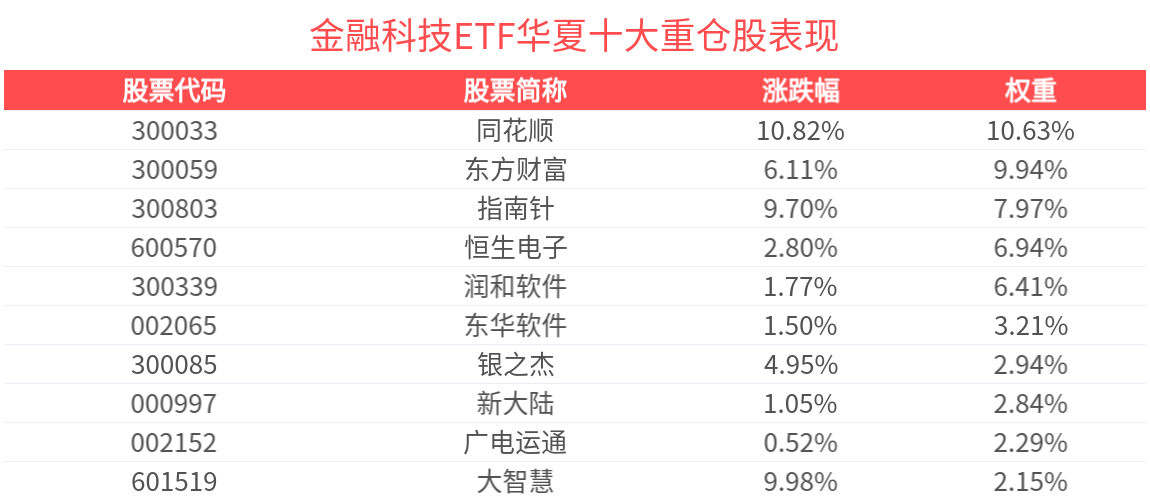
金融科技ETF华夏紧密跟踪中证金融科技主题指数,截至2025年12月31日,中证金融科技主题指数(930986)前十大权重股分别为东方财富(300059)、同花顺 (300033)、指南针(300803)、恒生电子(600570)、润和软件(300339)、东华软件(002065)、新大陆(000997)、广电运通(002152)、银之杰(300085)、四方精创 (300468),前十大权重股合计占比51.09%。 截至2026年1月6日 14:33,中证金融科技主题指数强势上涨4.38%,成分股星环科技20.00CM涨停,同花顺上涨10.82%,大智慧10CM涨停,指南针、财富趋 势等个股跟涨,金融科技ETF华夏(516100)上涨4.35%, 冲击8连涨。 资金流入方面,金融科技ETF华夏近19个交易日内有10日资金净流入,合计"吸金"2911万元。 相关分析指出,金融IT领域受数字人民币升级驱动迎来系统迭代需求,央行出台启动数字人民币2.0 版,推动数字人民币在付息并可以自主开展资产负债经 营管理;第三方支付领域在跨境业务获得多重政策支持,通过多种方式强化风险防控与效率,数字金融服务平台搭建及与多国地 ...




东方财富股价涨5.22%,新疆前海联合基金旗下1只基金重仓,持有5.35万股浮盈赚取6.63万元
Xin Lang Cai Jing· 2026-01-06 06:51
1月6日,东方财富涨5.22%,截至发稿,报24.99元/股,成交188.89亿元,换手率5.74%,总市值3949.43 亿元。 资料显示,东方财富信息股份有限公司位于上海市徐汇区宛平南路88号东方财富大厦,成立日期2005年 1月20日,上市日期2010年3月19日,公司主营业务涉及证券业务、金融电子商务服务业务、金融数据服 务业务及互联网广告服务业务等。主营业务收入构成为:证券服务76.99%,金融电子商务服务 20.65%,金融数据服务等2.36%。 从基金十大重仓股角度 数据显示,新疆前海联合基金旗下1只基金重仓东方财富。前海联合泓鑫混合A(002780)三季度减持 1.65万股,持有股数5.35万股,占基金净值比例为2.6%,位居第十大重仓股。根据测算,今日浮盈赚取 约6.63万元。 前海联合泓鑫混合A(002780)成立日期2016年11月30日,最新规模4244.72万。今年以来收益2.1%, 同类排名3574/8818;近一年收益50.15%,同类排名1890/8083;成立以来收益261.03%。 前海联合泓鑫混合A(002780)基金经理为张勇。 截至发稿,张勇累计任职时间8年283天, ...
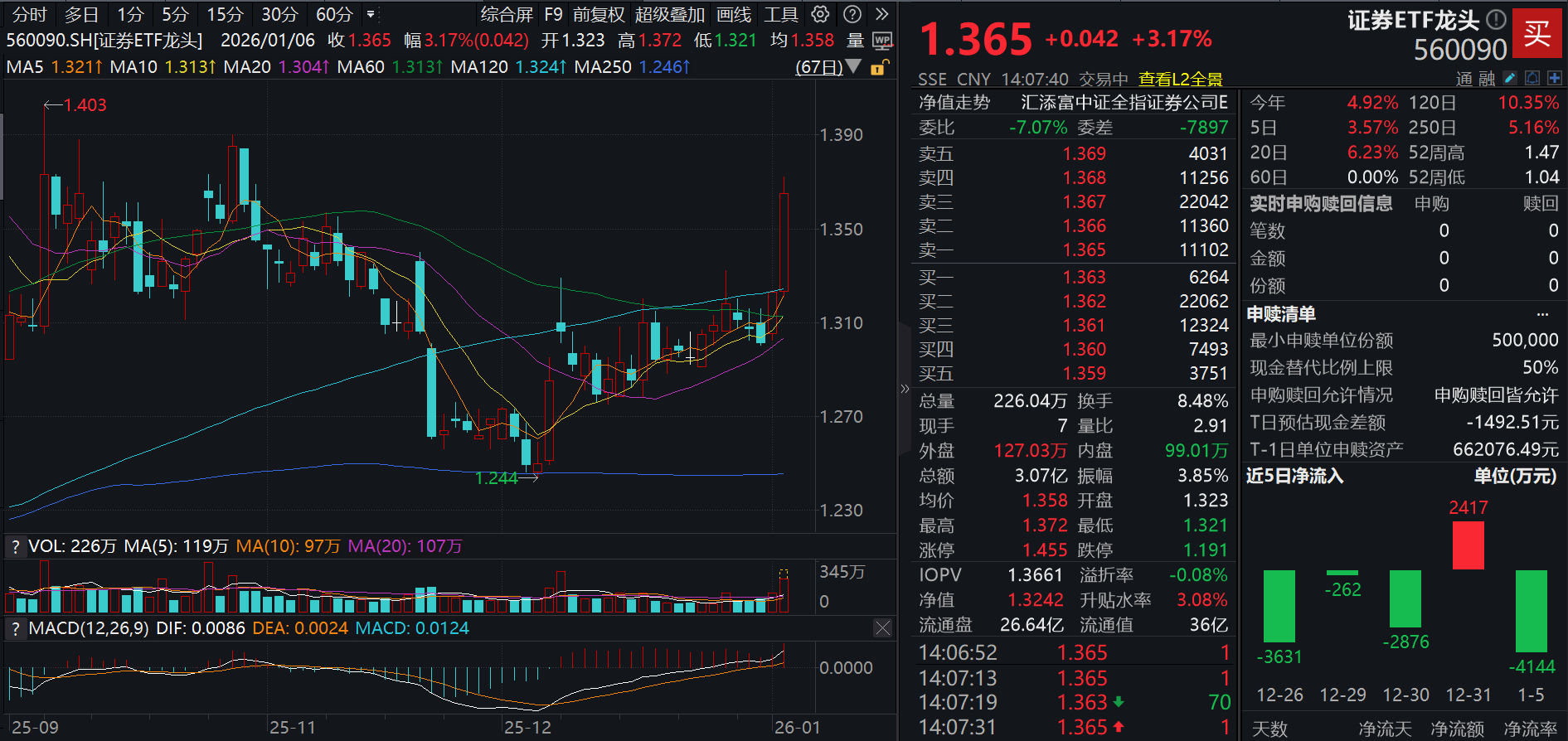
“春季躁动”启动?沪指涨超1%再创十年新高,“行情旗手”强势回归,华林证券涨停,证券ETF龙头(560090)持续冲高大涨3%!
Sou Hu Cai Jing· 2026-01-06 06:38
Core Viewpoint - The A-share market is experiencing a strong upward trend, with the Shanghai Composite Index surpassing a nearly 10-year high, indicating a bullish sentiment in the market and a potential for continued growth in the securities sector [1][2]. Group 1: Market Performance - On January 6, the A-share market showed a strong performance, with the Shanghai Composite Index rising over 1%, marking a new high not seen since July 2015, and aiming for a 13-day winning streak [1][2]. - The securities ETF (560090) saw a significant increase of over 3%, with trading volume exceeding 300 million yuan, indicating strong investor interest [1]. - Major securities firms such as Huayin Securities and Huatai Securities experienced substantial gains, with some stocks hitting the daily limit [1][2]. Group 2: Industry Outlook for 2026 - The securities sector is expected to see a "Davis Double" effect in 2026, with a projected overall profit growth of 12%, although there will be increased differentiation among individual firms [3][4]. - Policy support is anticipated to catalyze growth, with a focus on normalizing IPO issuances and expanding product offerings, which could enhance market liquidity [3][4]. - The trading environment is expected to provide a safety net, with improved institutional holdings and valuation levels, suggesting a favorable outlook for the securities industry [3][4]. Group 3: Investment Strategy - The securities ETF (560090) is highlighted as an efficient investment tool for gaining exposure to the securities sector, tracking the CSI All Share Securities Companies Index [4]. - The market is characterized by high trading activity and supportive policies, creating multiple catalysts for the securities sector [4].






炒股软件股集体飙升!同花顺大涨超11%,大智慧10CM涨停
Ge Long Hui· 2026-01-06 06:38
Group 1 - The A-share market has seen significant gains in stock trading software companies, with Tonghuashun rising over 11% [1] - Dazhihui reached a daily limit increase of 10% [1] - Zhinan Compass increased by over 9%, while Lakala and Dongfang Caifu rose by over 6%, and Zhongke Jincai increased by over 4% [1]



"涨"声不停,沪指冲击13连阳!互联网券商冲高,同花顺涨超8%,"旗手2.0"金融科技ETF汇添富(159103)涨超3%!AI浪潮催化,金融科技怎么看?
Sou Hu Cai Jing· 2026-01-06 06:00
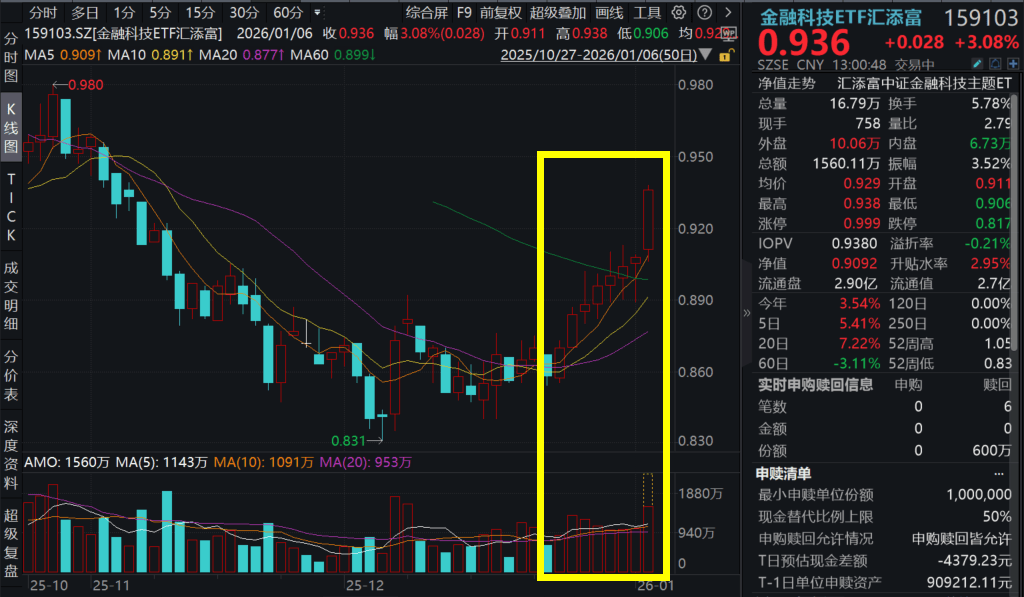
Core Viewpoint - The A-share market continues to show strong performance, with the Shanghai Composite Index rising over 1% and reaching a ten-year high, driven by the financial technology ETF Huatai-PineBridge (159103) which has surged 3.08% and is on track for an eight-day winning streak [1][5]. Group 1: Financial Technology ETF Performance - The financial technology ETF Huatai-PineBridge (159103) has seen significant trading volume, surpassing the previous day's total trading volume [1]. - The top ten constituent stocks of the ETF include notable companies such as Tonghuashun, Dongfang Caifu, and Zhinan Zhen, with substantial price increases, including a 15% rise for Xinghuan Technology and over 8% for Tonghuashun [2][5]. Group 2: Market Dynamics and Trends - The financial technology sector is benefiting from increased market activity, with a 63% year-on-year growth in average daily trading volume expected in 2025, reaching 1.73 trillion yuan [3]. - The A-share market opened strongly in 2026 with a trading volume of 2.56 trillion yuan on the first trading day, indicating a continuation of active trading conditions that favor internet financial services [3]. Group 3: AI Integration in Financial Technology - The financial IT sector is poised for rapid growth due to the integration of AI technologies, which are enhancing various financial applications and driving up valuations [4]. - Recent AI trends have shown that financial technology has outperformed most sectors during significant AI market rallies, indicating a strong correlation between AI advancements and financial technology performance [4]. Group 4: Investment Opportunities - The financial technology ETF Huatai-PineBridge (159103) is highlighted as a key investment opportunity, covering a range of high-growth sectors including internet brokerage, financial IT, AI applications, and cross-border payments [6].


格隆汇十大核心——东方财富大涨近5%
Ge Long Hui A P P· 2026-01-06 05:28
从个股来看,东方财富核心业务多元稳健、核心竞争力深厚、估值性价比突出......更多详情见下图: 格隆汇1月6日|A股券商股集体上涨,其中,入选了格隆汇2026年"下注中国"十大核心资产名单的东方 财富(300059.SZ)大涨近5%至24.88元。 从行业方面来看,近期市场景气度改善、交投活跃度维持高位,券商板块从估值到业绩均具备β属性, 全面受益。长期看资本市场新一轮改革周期开启,券商仍有较大发展增量空间。 炒股就看金麒麟分析师研报,权威,专业,及时,全面,助您挖掘潜力主题机会! MACD金叉信号形成,这些股涨势不错! ...
半日主力资金丨加仓非银金融股 抛售通信股




Xin Lang Cai Jing· 2026-01-06 03:59
主力资金早间净流入非银金融、有色金属、电子、基础化工等板块,净流出通信、美容护理等板块。 具体到个股来看,东方财富、山子高科、利欧股份获净流入24.19亿元、18.96亿元、17.46亿元。 净流出方面,中际旭创、宁德时代、航天发展遭抛售19.01亿元、11.94亿元、8.46亿元。 (本文来自第一财经) ...
A股,又见证历史!
中国基金报· 2026-01-06 02:33
Market Overview - The Shanghai Composite Index has reached a new ten-year high, surpassing the previous peak of 4034.08 points, closing at 4054.30 with a gain of 0.77% [4][5] - A total of over 4000 stocks rose in the market, indicating a broad-based rally [2] Sector Performance - Non-bank financial stocks, often seen as the "flag bearers" of the bull market, have shown significant gains, with stocks like Huayin Securities and Huatai Securities hitting their daily limits [12][13] - The semiconductor sector and precious metals have also performed well, while some concepts like optical modules and optical communication have seen pullbacks [5][6] Brain-Computer Interface Sector - The brain-computer interface concept stocks have remained active, with companies like Aipeng Medical and Xiangyu Medical hitting their daily limits with gains of 20% [9][10] - Neuralink's announcement of large-scale production of brain-computer interface devices by 2026 has been highlighted as a significant milestone for the AI industry, indicating a shift towards human-machine symbiosis [11] Stock Highlights - Notable stock performances include: - Aipeng Medical (300753) at 39.96, up 20.00% - Xiangyu Medical (688626) at 87.12, up 20.00% - Meihua Medical (301363) at 34.63, up 19.99% [10] - In the software trading sector, stocks like Zhinanzhen and Tonghuashun have surged over 8% [15][16] Summary of Key Stocks - Huayin Securities (002945) rose to 17.84, up 9.99% - Huatai Securities (601688) increased to 25.33, up 4.02% - Zhinanzhen (300803) reached 147.06, up 8.35% [14][16]






券商股集体爆发!华林证券涨停领涨,春季行情点燃资金入市热潮
Jin Rong Jie· 2026-01-06 02:27
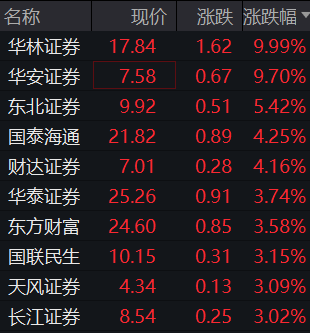
Core Viewpoint - The brokerage sector is experiencing significant activity, with several companies showing substantial stock price increases, driven by positive regulatory policies and expectations for future profitability in the industry [1][2][3]. Group 1: Stock Performance - Huayin Securities reached a limit up with a price of 17.84, increasing by 1.62, or 9.99% [2] - Hua'an Securities rose by 0.67 to 7.58, marking a 9.70% increase [2] - Northeast Securities increased by 0.51 to 9.92, reflecting a 5.42% rise [2] - Other notable performers include Wealth Trend, Guotai Haitong, and Huatai Securities, all showing increases of over 3% [1][2]. Group 2: Industry Outlook - According to Kaiyuan Securities, the regulatory environment is entering a "positive" cycle, with investment banking, public funds, and overseas business expected to support the brokerage industry's profitability through 2026 [2][3]. - Huazhong Securities highlights that 2026 marks the beginning of the "14th Five-Year Plan," with an optimized policy environment and high trading activity likely to drive both valuation and profitability in the brokerage sector [3]. - The expectation of a slow bull market is leading to an increase in the equity asset allocation ratio among brokerages, alongside enhanced capabilities in index investment and public fund distribution, presenting structural opportunities in wealth management [3].

刚刚,沪指再创10年新高!
证券时报· 2026-01-06 02:26
Core Viewpoint - The Shanghai Composite Index reached a new 10-year high on January 6, 2026, surpassing the previous peak from November 2025, indicating strong market momentum and investor confidence [1][2]. Market Performance - The Shanghai Composite Index opened at 4049.40, with a rise of 25.98 points or 0.65% [3]. - The total trading volume was 361.25 billion, with a total turnover of 206.8 million shares [3]. - The index experienced a fluctuation range of 29.93 points or 0.74% [3]. Sector Performance - The non-ferrous metals sector led the gains, with an intraday increase of nearly 3%, featuring stocks like Guoyan Platinum and Huachuang Holdings rising over 7% [3]. - Other sectors such as electronics, basic chemicals, and computers also showed strong performance [4]. - Concept stocks related to brain-machine interfaces, exoskeleton robots, titanium metals, storage chips, and lithium mining saw significant increases [4]. Financial Sector Highlights - The non-bank financial sector, particularly brokerage stocks, experienced rapid gains, with Huayin Securities hitting the daily limit and other firms like Huatai Securities also rising [5]. - Insurance stocks within the non-bank financial sector, such as Xinhua Insurance, saw intraday increases exceeding 4% [7]. Institutional Outlook - Most institutions remain optimistic about the market outlook for 2026, with expectations of a shift from a tech-dominated bull market to a more balanced one across various sectors [9]. - Key supporting factors for the market include limited negative impacts from overseas markets, potential profit recovery, and positive changes in capital trends [9]. - The core logic supporting the A-share market's strength includes ongoing macro policy support, accelerated industrial transformation, deepening capital market reforms, and continuous inflow of funds [9]. Investment Recommendations - Tianfeng Securities suggests focusing on industries with high overseas business exposure, such as electronics, home appliances, and automotive sectors, as well as potential bottom-reversal industries like food and beverage, agriculture, and healthcare [10]. - CITIC Securities emphasizes four key investment themes: global pricing power in manufacturing, opportunities from Chinese companies going global, continued tech trends in AI, and potential recovery in domestic demand [10][11]. - CICC highlights growth areas in AI, external demand, and cyclical reversals, recommending attention to sectors like chemicals, aquaculture, and new energy [11].