CHANGHAI(300196)

Search documents
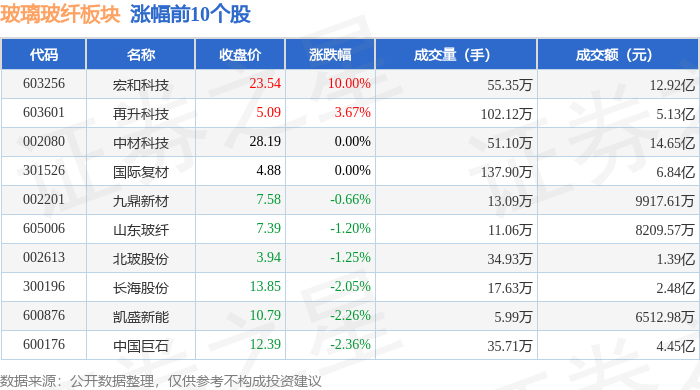
玻璃玻纤板块7月31日跌0.37%,三峡新材领跌,主力资金净流入3360.56万元
Zheng Xing Xing Ye Ri Bao· 2025-07-31 08:32
Group 1 - The glass and fiberglass sector experienced a decline of 0.37% on July 31, with Sanxia New Material leading the drop [1] - The Shanghai Composite Index closed at 3573.21, down 1.18%, while the Shenzhen Component Index closed at 11009.77, down 1.73% [1] - Key stocks in the glass and fiberglass sector showed varied performance, with Honghe Technology rising by 10.00% to a closing price of 23.54 [1] Group 2 - The main capital flow in the glass and fiberglass sector showed a net inflow of 33.61 million yuan, while retail investors contributed a net inflow of 20.8 million yuan [2] - The sector saw a net outflow of 241 million yuan from speculative funds [2] - Notable stock performances included Sanxia New Material, which closed at 3.05 with a decline of 3.48%, and Jinjing Technology, which closed at 5.08, down 3.24% [2]


研判2025!中国玻璃纤维电子布行业特点、技术迭代路径、市场规模及企业产能布局情况分析:有望实现高端领域从“跟跑”到“并跑”[图]
Chan Ye Xin Xi Wang· 2025-07-29 01:12
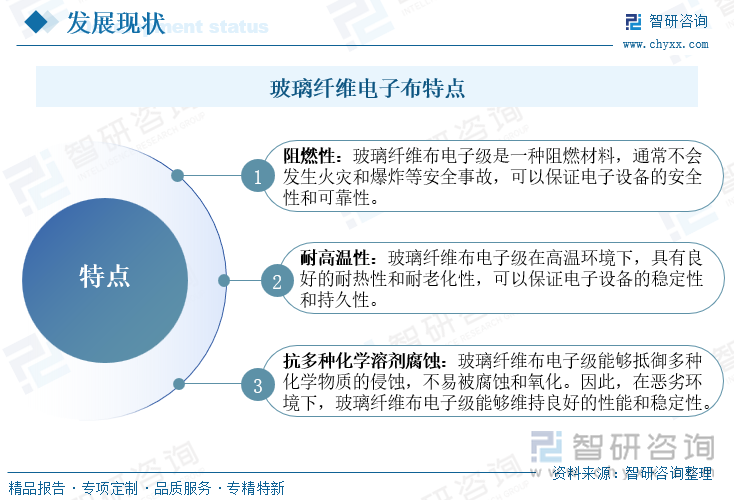
Industry Overview - Glass Fiber Electronic Cloth, also known as electronic cloth, is a high-performance fabric made from glass fiber, essential for the electronic information industry [1][8] - The demand for glass fiber electronic cloth in China is directly related to its status as a global PCB manufacturing center, driven by strong downstream applications such as consumer electronics, communication, automotive electronics, and AI computing [14][27] - The market size for glass fiber electronic cloth in China is projected to grow from 18.52 billion yuan in 2020 to 28.65 billion yuan in 2024 [14] Product Segmentation - Glass fiber electronic cloth can be categorized based on thickness into thick, thin, ultra-thin, and extremely thin types [4][5] - High-end products include ultra-thin cloth (thickness <28 micrometers) and super-thin cloth (28-35 micrometers), primarily used in high-end smartphones and IC substrates [5][7] - Different types of electronic cloth serve various applications, such as Low Dk/Df cloth for high-speed signal transmission and Low CTE cloth for advanced IC substrates [7][9] Technological Advancements - The industry is experiencing rapid technological iteration, with a focus on performance upgrades, material innovation, and process breakthroughs to meet the demands of high-frequency and high-speed applications in sectors like 5G and AI [11][29] - The transition from first-generation electronic cloth (Dk≈4.0) to third-generation quartz cloth (Dk<3.0) illustrates significant advancements in signal transmission capabilities [29] Market Dynamics - The global supply of electronic-grade glass fiber cloth is increasingly concentrated in China, with domestic companies accelerating the pace of high-end market localization [16][17] - Major players in the market include China Jushi, Owens Corning, and others, with significant production capacities being developed to meet rising demand [16][18] Company Performance - Honghe Technology, a key player in the industry, has seen fluctuations in revenue from 793 million yuan in 2021 to 780 million yuan in 2024, influenced by market conditions and competition [20][23] - The company has successfully developed ultra-thin and extremely thin cloth products, achieving international quality standards and gaining recognition from major global smartphone manufacturers [19][20] Future Trends - The market for glass fiber electronic cloth is expected to continue expanding, driven by the increasing demand for high-performance electronic materials in AI servers and advanced communication devices [27][28] - The shift towards high-end electronic cloth products, such as Low-Dk and Low-CTE materials, is anticipated to be a core growth driver in the coming years [27][29]


行业周报:雅江下游水电工程顺利开工,关注建材投资机会-20250727
KAIYUAN SECURITIES· 2025-07-27 09:29
Investment Rating - The investment rating for the construction materials industry is "Positive" (maintained) [1] Core Views - The construction materials index increased by 8.20% in the week from July 21 to July 25, 2025, outperforming the CSI 300 index by 6.51 percentage points [4][13] - The construction materials sector has shown strong performance over the past three months, with an increase of 16.12%, and over the past year, it has risen by 28.09%, both outperforming the CSI 300 index [4][13] - The report highlights significant investment opportunities in the construction materials sector, particularly due to the commencement of major projects like the Yarlung Tsangpo River downstream hydropower project, which is expected to boost demand for related construction materials [3] Summary by Sections Market Overview - The construction materials index has outperformed the CSI 300 index by 6.51 percentage points this week, with a year-to-date increase of 28.09% compared to the CSI 300's 21.06% [4][13] - The average PE ratio for the construction materials sector is 29.88 times, ranking it 17th lowest among all A-share industries, while the PB ratio is 1.28 times, ranking it 7th lowest [20][23] Cement Sector - As of July 25, 2025, the average price of P.O 42.5 bulk cement is 275.19 RMB per ton, reflecting a 2.02% decrease from the previous period [25][27] - The clinker inventory ratio has increased to 69.07%, up by 1.83 percentage points [26] Glass Sector - The spot price of float glass has risen to 1255.79 RMB per ton, an increase of 3.41% [78] - The inventory of float glass has decreased by 4.05%, with a total of 53.34 million weight boxes as of July 25, 2025 [80][81] - The price of photovoltaic glass has slightly decreased to 115.63 RMB per weight box, down by 0.34% [85]





市场一致预期估值表
GUOTAI HAITONG SECURITIES· 2025-07-23 05:44
Investment Rating - The report provides a comprehensive valuation table for various companies in the building materials industry, indicating a range of price-to-earnings (PE) and price-to-book (PB) ratios for 2025E and 2026E [1] Core Insights - The report highlights the expected growth in net profit for several companies, with notable increases such as 90 million CNY for Conch Cement in 2025E and 100 million CNY in 2026E, reflecting a strong market position [1] - The PE ratios for the companies vary significantly, with Conch Cement at 15.3 for 2025E and 13.8 for 2026E, while companies like Jidong Cement show a much higher PE of 37.2 for 2025E [1] - The report emphasizes the valuation metrics, with companies like China National Building Material having a low PB ratio of 0.34, indicating potential undervaluation [1] Summary by Category Cement - Conch Cement has a total market value of 138.1 billion CNY, with projected net profits of 90 million CNY in 2025E and 100 million CNY in 2026E, and a PE of 15.3 for 2025E [1] - Huaxin Cement is valued at 31.9 billion CNY, with net profits expected to reach 25 million CNY in 2025E and 30 million CNY in 2026E, showing a PE of 12.7 for 2025E [1] - Other notable companies include Tianshan Shares with a market value of 43.1 billion CNY and projected net profits of 15 million CNY in 2025E [1] Consumer Building Materials - Rabbit Baby is projected to have net profits of 7.5 million CNY in 2025E and 8.5 million CNY in 2026E, with a PE of 11.2 for 2025E [1] - China Liansu is valued at 14.5 billion CNY, with expected net profits of 22 million CNY in 2025E and 24 million CNY in 2026E, showing a low PE of 6.6 for 2025E [1] Glass and Fiberglass - Shandong Pharmaceutical Glass has a market value of 15.1 billion CNY, with projected net profits of 10.5 million CNY in 2025E and 11.5 million CNY in 2026E, and a PE of 14.3 for 2025E [1] - China Jushi is valued at 51.5 billion CNY, with net profits expected to reach 35 million CNY in 2025E and 40 million CNY in 2026E, showing a PE of 14.7 for 2025E [1] New Materials - Zhongfu Shenying has a market value of 19.3 billion CNY, with projected net profits of 0.5 million CNY in 2025E and 1.5 million CNY in 2026E, reflecting a very high PE of 385.0 for 2025E [1] - Jilin Carbon Valley is valued at 8.5 billion CNY, with expected net profits of 1 million CNY in 2025E and 1.3 million CNY in 2026E, showing a PE of 85.0 for 2025E [1]




玻璃纤维报告:AI算力与风电促增长,电子纱格局如何变?(附28页PPT)
材料汇· 2025-07-20 14:57
Group 1 - The rapid development of AI computing power is driving the upgrade of PCBs towards high-frequency and high-speed applications, leading to an explosion in demand for specialty electronic fabrics [3][5] - Specialty electronic fabrics are high-performance woven materials that optimize chemical composition and manufacturing processes to achieve specific electrical, thermal, or mechanical properties, supporting high-frequency signal transmission and reducing energy loss [3][10] - The market for AI/HPC server PCBs (excluding packaging substrates) is expected to grow at a CAGR of 32.5% from 2023 to 2028, significantly higher than other sectors [3][10] Group 2 - Low-DK electronic fabrics, characterized by low dielectric constant (DK) and low dielectric loss (DF), are crucial for AI servers and data center switches, enhancing signal efficiency in high-frequency environments [10][11] - The demand for Low-DK fabrics is projected to grow rapidly in 2024, driven by the transition to low-dielectric PCBs in AI server architectures and the global data center upgrade [10][11] - The global Low-DK electronic fabric market is expected to exceed $200 million by 2025 and reach $530 million by 2031, with a CAGR of 18.7% [11][16] Group 3 - Quartz fiber fabric (Q fabric), a high-performance material, is expected to see strong demand growth due to its application in advanced packaging technologies for AI hardware and data center switches [12][19] - The third-generation low-dielectric electronic fabric, Q fabric, utilizes high-purity silica to achieve ultra-low dielectric constant and loss, presenting significant technical barriers to mass production [12][19] - The core mission of Low-CTE electronic fabrics is to address thermal management issues in advanced chip packaging, with demand surging due to the explosive growth of AI computing power [19][20] Group 4 - Domestic manufacturers are accelerating capacity expansion in the specialty electronic fabric sector, responding to the growing demand from AI computing power upgrades [22][24] - Key suppliers of specialty electronic fabrics include Japanese, Taiwanese, and mainland Chinese companies, with domestic firms rapidly increasing production capabilities to meet market needs [22][24] - The competitive advantage of specialty electronic fabric suppliers lies in their ability to quickly innovate product performance and scale up production [22][24]



行业周报:中央城市工作会强调城市更新,关注建材投资机会-20250720
KAIYUAN SECURITIES· 2025-07-20 11:43
Investment Rating - The investment rating for the construction materials industry is "Positive" (maintained) [1] Core Views - The central urban work conference emphasized urban renewal, which is expected to drive demand for construction materials such as pipes, waterproofing, and coatings. This will lead to significant improvements in the real estate chain's fundamentals [3] - The report recommends several companies in the consumer building materials sector, including Sankeshu (channel expansion), Dongfang Yuhong (waterproofing leader), Weixing New Materials (high retail business ratio), and Jianlang Hardware. Beneficiary companies include Beixin Building Materials (gypsum board leader) [3] - The National Development and Reform Commission's action plan for the cement industry aims to control cement clinker capacity at around 1.8 billion tons by the end of 2025, which is expected to accelerate energy-saving and carbon reduction efforts [3] Market Performance - The construction materials index fell by 0.23% in the week from July 14 to July 18, 2025, underperforming the CSI 300 index by 1.32 percentage points. Over the past three months, the CSI 300 index rose by 7.17%, while the construction materials index increased by 4.36%, underperforming by 2.82 percentage points. In the past year, the CSI 300 index rose by 14.68%, and the construction materials index increased by 16.62%, outperforming by 1.94 percentage points [4][13] Cement Sector - As of July 18, 2025, the average price of P.O42.5 bulk cement nationwide was 280.87 CNY/ton, down 0.71% month-on-month. The clinker inventory ratio was 67.24%, up 1.35 percentage points [6][27] - The report highlights regional price variations, with Northeast China stable, North China up by 0.74%, and East China down by 1.90% [26] Glass Sector - The spot price of float glass as of July 18, 2025, was 1214.63 CNY/ton, an increase of 0.71% from the previous week. The inventory of float glass nationwide decreased by 175 million weight boxes, a decline of 3.05% [82][84] - The average price of photovoltaic glass remained stable at 116.02 CNY/weight box [89] Fiberglass Sector - The market price for non-alkali 2400tex direct yarn ranged from 3300 to 4100 CNY/ton, with variations depending on the manufacturer [6] Consumer Building Materials - As of July 18, 2025, the price of asphalt was 4570 CNY/ton, stable week-on-week, and up 2.93% year-to-date. The price of titanium dioxide was 13050 CNY/ton, down 1.14% month-on-month [6]


建材行业2024年报及2025年1季报总结
2025-07-16 06:13
Summary of Conference Call Records Industry Overview - The conference call primarily discusses the **consumption building materials industry** and its performance in 2024, highlighting a **7.2% year-on-year decline** in revenue for the sector [1] - The **real estate demand** remains weak, impacting the consumption building materials sector, which has seen continuous revenue pressure over the past few quarters [1] Key Points and Arguments - **Revenue Trends**: The revenue growth for the consumption building materials sector is expected to decline in 2024, with quarterly comparisons showing fluctuations: **0.2% growth**, **5.3% decline**, **10.7% decline**, **10.9% decline**, and **5.7% decline** from Q1 2024 to Q1 2025 [1] - **Profitability Issues**: The industry faces challenges such as **declining gross margins** due to reduced demand and increased expense ratios. Some companies have reported increased impairments on goodwill and assets [2] - **Improvement in Profitability**: In Q1 2024, some companies managed to stabilize and improve profitability through better gross margins and expense control, with half of the consumption building materials companies reporting year-on-year gross margin increases [2] - **Net Profit Performance**: Among 26 analyzed companies, **10 reported year-on-year net profit increases**, and **9 showed improvements in net profit margins** both year-on-year and quarter-on-quarter, particularly in waterproofing and coating sectors [3] - **Market Resilience**: Despite the downturn in new housing demand, the sector shows resilience supported by the high demand for second-hand housing, which could lead to revenue growth if new housing demand stabilizes [4] Additional Insights - **Future Growth Potential**: Companies with strong brand and channel capabilities are expected to have significant growth potential. Key players mentioned include **Sanhe Tree, Tubaobao, Beixing Building Materials, and others** [5] - **Cement Industry Outlook**: The cement sector is projected to see a bottoming out in Q1 2024, with expectations of gradual improvement in profitability throughout the year. The industry experienced a **35% year-on-year decline** in scale in 2024 [5] - **Price Trends**: Cement prices are expected to rise after a period of decline, with a **1.4% year-on-year drop** in demand noted in Q1 2024, but a recovery is anticipated post-Chinese New Year [6] - **Cost Management**: The decline in coal prices is expected to stabilize industry profitability, with a projected **6% year-on-year decline** in cement demand for 2025 [7] - **Investment and Dividends**: Companies with low cash flow and stable investment returns, such as **Tapai Group and Ningxia Building Materials**, are highlighted for their significant profit contributions [8] Conclusion - The consumption building materials and cement industries are navigating through challenging market conditions, with signs of potential recovery in profitability and demand stabilization. Key players are expected to leverage their market positions for future growth opportunities.


行业周报:住建部强调稳定房地产市场,关注建材投资机会-20250713
KAIYUAN SECURITIES· 2025-07-13 11:42
Investment Rating - The investment rating for the construction materials industry is "Positive" (maintained) [1] Core Views - The Ministry of Housing and Urban-Rural Development emphasizes the importance of stabilizing the real estate market, which is expected to lead to significant improvements in the fundamentals of the real estate chain. Recommended stocks in the consumer building materials sector include Sankeshu, Dongfang Yuhong, Weixing New Materials, and Jianlang Hardware. Beneficiary stocks include Beixin Building Materials [3] - The National Development and Reform Commission has issued a special action plan for energy conservation and carbon reduction in the cement industry, aiming to control cement clinker capacity at around 1.8 billion tons by the end of 2025, with a target of reducing comprehensive energy consumption per unit product by 3.7% compared to 2020 [3] - The "equal tariff" policy is expected to benefit fiberglass leaders with overseas production bases, allowing them to raise prices and consolidate profitability [3] Market Performance - The construction materials index rose by 3.34% in the week from July 7 to July 11, 2025, outperforming the CSI 300 index by 2.52 percentage points. Over the past three months, the CSI 300 index increased by 6.41%, while the construction materials index rose by 6.60%, indicating a slight outperformance of 0.18 percentage points [4][13] - In the past year, the CSI 300 index increased by 15.62%, and the construction materials index rose by 15.80%, also showing a slight outperformance of 0.18 percentage points [4][13] Cement Sector - As of July 11, 2025, the average price of P.O42.5 bulk cement nationwide was 282.89 CNY/ton, a decrease of 3.48% month-on-month. The clinker inventory ratio was 65.89%, down 2.29 percentage points [6][23][24] - The price of cement varied by region, with notable declines in Northeast (-4.76%), North China (-2.33%), East China (-2.98%), South China (-5.74%), Central China (-3.41%), and Southwest (-4.93%) regions [23][29] Glass Sector - The average price of float glass as of July 11, 2025, was 1205.63 CNY/ton, with a slight increase of 0.17%. The average price of photovoltaic glass remained stable at 116.02 CNY/weight box [6][71][78] - The inventory of float glass decreased by 970,000 weight boxes nationwide, a decline of 1.66% [73][74] Fiberglass Sector - The price of non-alkali 2400tex direct yarn ranged from 3400 to 4100 CNY/ton, with flexible pricing based on regional differences [6] Consumer Building Materials - As of July 11, 2025, the price of crude oil was 70.63 USD/barrel, down 0.39% week-on-week. The price of asphalt was 4570 CNY/ton, up 1.11% week-on-week [6]
行业周报:“反内卷”持续推进,关注建材投资机会-20250706
KAIYUAN SECURITIES· 2025-07-06 08:10
Investment Rating - The investment rating for the construction materials industry is "Positive" (maintained) [1] Core Views - The ongoing "anti-involution" initiative is expected to improve the fundamentals of the construction materials industry, with a focus on enhancing product quality and phasing out outdated production capacity [3] - The report highlights specific companies to watch, including SanKeTree, Dongfang Yuhong, Weixing New Materials, and Jianlang Hardware, as well as beneficiaries like Beixin Building Materials [3] - The cement sector is projected to benefit from energy-saving and carbon reduction initiatives, with a target to control cement clinker capacity to around 1.8 billion tons by the end of 2025 [3] Market Performance - The construction materials index increased by 3.96% in the week from June 30 to July 4, outperforming the CSI 300 index by 2.42 percentage points [4][13] - Over the past three months, the CSI 300 index rose by 8.01%, while the construction materials index only increased by 2.47%, indicating a lag of 5.55 percentage points [4][13] - In the past year, the CSI 300 index has risen by 16.06%, compared to an 11.69% increase in the construction materials index, resulting in a 4.38 percentage point underperformance [4][13] Cement Sector - As of July 4, 2025, the average price of P.O42.5 bulk cement was 293.11 RMB/ton, reflecting a 1.97% decrease from the previous period [6][24] - The clinker inventory ratio nationwide was 68.18%, down by 1.18 percentage points [6][25] - Regional price variations were noted, with the Northeast region remaining stable, while other regions like North China and Southwest saw declines of 4.13% and 6.58%, respectively [6][24] Glass Sector - The average price of float glass was 1201.35 RMB/ton as of July 4, 2025, showing a slight increase of 0.07% [6][74] - The inventory of float glass decreased by 1.17%, with a total of 58.31 million weight boxes reported [6][76] - The price of photovoltaic glass fell by 3.88%, with an average price of 116.02 RMB/weight box [6][81] Fiberglass Sector - The price of non-alkali 2400tex direct yarn ranged from 3400 to 4100 RMB/ton, with variations based on specific product types [6] - The fiberglass sector is expected to benefit from favorable tariffs for companies with overseas production bases [3] Consumer Building Materials - The report indicates that raw material prices for consumer building materials have remained relatively stable with slight fluctuations [6][5]
7月1日主题复盘 | 创新药反弹,国产芯片持续活跃,玻纤大涨
Xuan Gu Bao· 2025-07-01 08:19
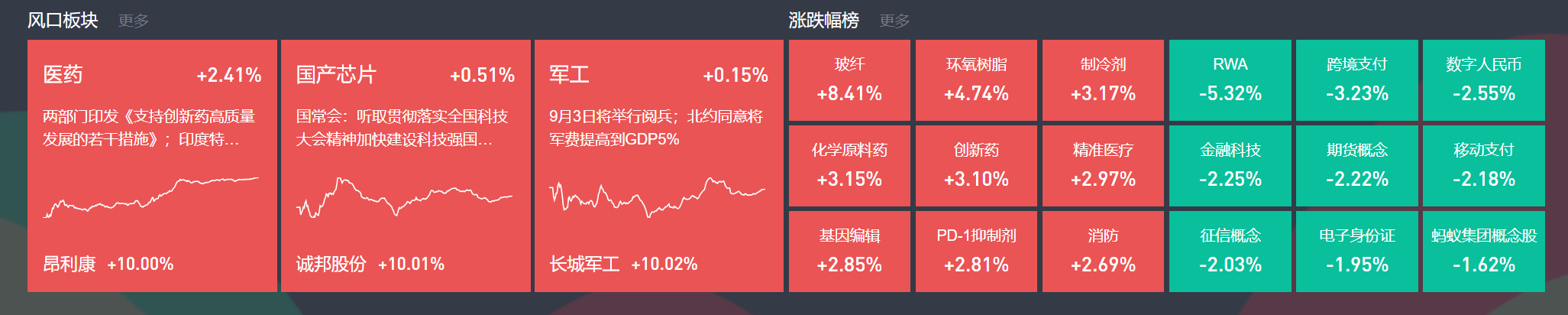
Market Overview - The market experienced fluctuations with mixed performance across the three major indices, with a total trading volume of 1.49 trillion [1] - The innovative drug sector saw a resurgence, with stocks like Angli康 and塞力医疗 hitting the daily limit [1] - Chip stocks continued their strong performance, with companies such as诚邦股份 and凯美特气 also reaching the daily limit [1] - Bank stocks rebounded, with建设银行 and浦发银行 reaching historical highs [1] - The military industry showed localized activity, with stocks like长城军工 and际华集团 hitting the daily limit [1] - Stablecoin concept stocks declined, with吉大正元 hitting the daily limit down [1] Key Highlights Pharmaceutical Sector - The pharmaceutical sector rebounded significantly, with昂立康 hitting the daily limit and reaching a historical high [3] - The National Healthcare Security Administration and the National Health Commission issued measures to support the high-quality development of innovative drugs, including increased support for R&D and inclusion in insurance directories [3][4] - Companies like阳普医疗, 塞力医疗, and山河药辅 also reached the daily limit [3] Chip Sector - The domestic chip sector remained strong, with stocks like诚邦股份, 凯美特气, and常青股份 hitting the daily limit [6] - Reports indicated that Texas Instruments is raising prices for various analog devices by 30%, with some data converters seeing price increases of 100% [6] - The semiconductor industry is entering a new growth cycle driven by AI innovations and electric vehicle developments, which is expected to boost demand for high-performance analog chips [6][8] Glass Fiber Sector - The glass fiber sector saw significant gains, with companies like宏和科技, 中材科技, and山东玻纤 hitting the daily limit [9] - Market rumors suggest that NVIDIA's upcoming Rubin cabinet may utilize quartz cloth with lower dielectric constants, enhancing its application prospects in AI servers [9][10] Military Sector - The military sector showed mixed performance, with some stocks experiencing gains while others remained stable [11] Other Sectors - The electric power, PCB, and brain science sectors showed localized activity, while solid-state batteries and blockchain concepts faced declines [11]