
WENS FOODSTUFF GROUP CO.(300498)

Search documents
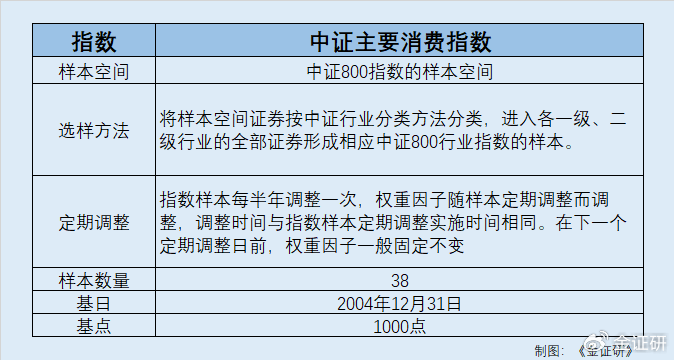
当政策红利遇上消费刚需 中证主要消费指数如何成为行业压舱石?
Sou Hu Cai Jing· 2026-01-14 06:27
Group 1 - The core viewpoint of the article emphasizes the importance of policies aimed at boosting consumption, highlighting the collaboration between business and financial sectors to enhance consumer spending [1][2] - The China Securities Major Consumption Index, which focuses on the consumption sector, has an average free float market capitalization exceeding 600 billion yuan, reflecting the overall performance of major consumption stocks in the A-share market [2][3] - The index includes 38 sample stocks, with a free float market capitalization ranging from 36.47 billion yuan to 8,885.48 billion yuan, indicating significant growth potential in the consumption sector [2][4] Group 2 - The index is heavily concentrated in the food and beverage sector, with a weight of 67.62%, and agriculture, forestry, animal husbandry, and fishery at 28.42%, together covering over 96% of the index's weight [4][5] - The top ten stocks in the index are supported by leading companies such as Kweichow Moutai, Yili, and Wuliangye, which have strong brand recognition and stable cash flows [5][6] - The ongoing policy support for consumption is expected to enhance the long-term value and growth potential of the consumption sector, making the China Securities Major Consumption Index a quality benchmark for investing in core consumption assets [7]





温氏股份斩获ESG AApi评级 以绿色实践引领养殖行业高质量发展
Quan Jing Wang· 2026-01-13 11:42
Core Viewpoint - The recent ESG rating results from Hainan Green Development Credit Rating Co., Ltd. highlight that Wens Foodstuff Group (300498.SZ) achieved an AApi rating, showcasing its exemplary performance in ecological farming and responsibility empowerment, setting a replicable development model for the industry [1] Group 1: ESG Rating and Industry Context - Wens Foodstuff Group leads the industry with its dual-driven model of "ecological farming + responsibility empowerment" [1] - ESG has evolved from a supplementary aspect of corporate development to a critical requirement for high-quality growth amid stricter environmental regulations and a shift towards quality consumption [1] Group 2: Green Circular Economy Initiatives - The company is deeply responding to national strategies on food security and carbon neutrality by establishing a green farming model that creates an ecological loop, integrating waste resource utilization into the entire production chain [1] - Wens Foodstuff Group implements a low-carbon circular system across its entire industry chain, focusing on a "pig-fertilizer/water-grain-feed" model [1] Group 3: Technological Innovations and Economic Impact - In 2024, Wens Foodstuff Group developed a resource-based technology system for the unique geographical conditions of the Southwest region, achieving over 95% harmless treatment rate of biogas slurry [2] - The company has reduced nitrogen and phosphorus emissions by over 1,200 tons annually through the application of this technology in 43 breeding farms in Yunnan and the Southwest region, generating direct economic benefits of 23.37 million yuan and increasing surrounding farmers' income by 34.90 million yuan [2] Group 4: Commitment to Food Safety and Sustainable Practices - Wens Foodstuff Group has fully implemented antibiotic-free feed and drinking water in its pig farming operations, and its four egg-laying farms have achieved certification for antibiotic-free egg products, with a total production of 56,100 tons [3] - The company adheres to a sustainable development strategy, integrating pollution prevention into all operational stages and enhancing environmental governance through innovation and technological advancements [3]
农业行业周报:建议关注生猪养殖行业的新一轮产能去化-20260113
Shanxi Securities· 2026-01-13 10:49
Investment Rating - The report maintains an investment rating of "Buy" for the agricultural sector, specifically highlighting companies such as Hai Da Group, Shengnong Development, and Wen's Shares [3]. Core Insights - The agricultural sector has shown a mixed performance, with the Shanghai and Shenzhen 300 Index increasing by 2.79% and the agricultural sector rising by 0.98% during the week of January 5 to January 11 [2][12]. - The report emphasizes the recovery in the pig farming industry, with a new round of capacity reduction expected. The average price of pigs has increased, and losses in pig farming have narrowed [2][22]. - The feed industry is experiencing a structural recovery, with most raw material prices at cyclical lows, and companies like Hai Da Group are expected to benefit from this trend [3]. Summary by Sections 1. Agricultural Sector Weekly Review - The agricultural sector ranked 28th among all sectors, with top-performing sub-industries including aquaculture, animal health, and poultry farming [2][12]. - Notable gainers in the agricultural sector include companies like Dahu Co. and Zhongshui Fisheries, with increases of 17.83% and 16.07% respectively [12]. 2. Industry Data 2.1 Pig Farming - As of January 9, the average price of pigs in Sichuan, Guangdong, and Henan was 13.10, 12.86, and 12.93 CNY/kg respectively, with an overall average pork price of 17.97 CNY/kg [22]. - Self-breeding pig farming reported a loss of 11.54 CNY per head, a reduction of approximately 23.05 CNY from the previous week [22]. 2.2 Poultry Farming - The weekly price for white feather broilers was 7.64 CNY/kg, a decrease of 1.04% from the previous week, while the profit from broiler farming was 0.45 CNY per bird, down 23.73% [37]. 2.3 Feed Processing - The average price of fattening pig feed was 3.36 CNY/kg, remaining stable, while chicken feed prices also held steady at 3.45 CNY/kg [43]. 2.4 Aquaculture - As of January 9, the price of sea cucumbers was 120.00 CNY/kg, reflecting a 33.33% increase, while shrimp prices remained stable at 320.00 CNY/kg [49]. 2.5 Planting and Grain Processing - As of January 9, corn prices were 2,351.86 CNY/ton, showing a slight decrease of 0.18%, while soybean prices remained stable at 4,048.42 CNY/ton [58].



温氏股份(300498.SZ):当前有投资布局与农牧业相关的智能化机器人技术
Ge Long Hui· 2026-01-13 07:12
Core Viewpoint - The company, Wens Foodstuff Group (300498.SZ), focuses on external equity investment primarily through its wholly-owned subsidiary, Wens Investment, with a core emphasis on the agricultural and livestock food industry chain and enabling technologies around it [1] Group 1 - The company aims to build an efficient and collaborative ecosystem within the Wens industry chain [1] - Current investment initiatives include intelligent robotic technology related to agriculture and animal husbandry [1] - The goal of these investments is to strengthen technological reserves within the industry chain and empower sustainable development of the main industry, such as AI-driven farming [1]

温氏股份:公司当前有投资布局与农牧业相关的智能化机器人技术
Mei Ri Jing Ji Xin Wen· 2026-01-13 04:34
Core Viewpoint - The company is focusing on investments in the agricultural and livestock food industry chain, particularly in empowering technologies related to this sector [2]. Group 1: Investment Strategy - The company's investment activities are primarily managed by its wholly-owned subsidiary, focusing on the agricultural and livestock food industry chain [2]. - The company aims to build an efficient and collaborative ecosystem within its industry chain [2]. Group 2: Technological Focus - Current investments include smart robotic technologies related to agriculture and livestock, aimed at enhancing technological reserves within the industry chain [2]. - The company is particularly interested in AI-driven farming solutions to support sustainable development in its main business [2]. Group 3: Financial Impact - The impact of these investments on the company's overall performance is currently minimal [2].
量价背离!温氏股份生猪肉鸡销量创新高,净利却砍半,猪周期下如何破局?
Bei Jing Shang Bao· 2026-01-13 03:22
温氏股份创立于1983年,凭借创始人温北英首创的"公司+农户"模式,公司实现快速扩张,现已发展成 一家以畜禽养殖为主业、配套相关业务的跨地区现代农牧企业集团,并于2015年11月在深交所挂牌上 市。其中,温氏股份生猪养殖与肉鸡养殖业务收入占比合计保持在90%以上,是公司主要的营收来源。 近日,温氏股份披露了2025年度业绩预告,预计公司2025年归母净利润为50亿—55亿元,比上年同期下 降40.73%—46.12%;扣非净利润为48亿—53亿元,比上年同期下降44.64%—49.86%。对于业绩预减的 原因,温氏股份表示,主要受畜禽产品价格整体下行影响,公司养殖业务利润同比下降。 从经营数据来看,2025年,温氏股份销售生猪4047.69万头(其中毛猪和鲜品3544.67万头,仔猪503.02 万头),远超其年初定下的3300万—3500万头全年销售目标,但毛猪销售均价同比下降17.95%至13.71 元/公斤,由于生猪销售价格同比出现较大幅度下降,公司生猪养殖业务利润同比下降。肉鸡业务同样 呈现"量增价跌"态势,温氏股份2025年销售肉鸡13.03亿只(含毛鸡、鲜品和熟食),数量较上年的 12.08亿只有 ...

上市猪企产能“越去越多”:A股养猪“四巨头”新增出栏超2200万头
Zhong Guo Jing Ying Bao· 2026-01-13 03:11
Core Insights - The leading pig farming companies in China have not achieved significant results in reducing production capacity despite calls for it over the past year or two. In 2025, major listed pig companies reported a total pig sales volume of 144.54 million heads, an increase of 22.08 million heads compared to 2024 [1][2]. Group 1: Sales Data and Growth - In 2025, Muyuan Foods sold 77.98 million pigs, an increase of 6.38 million heads from 2024. Wens Foodstuff Group sold 40.48 million pigs, with a notable growth of 34.11%, exceeding its annual operational plan of 33-35 million heads [1]. - New Hope reported a pig sales volume of 17.55 million heads, aligning with its previous operational targets, while Zhengbang Technology sold 8.54 million heads, marking a 105.87% year-on-year increase [2]. Group 2: Industry Trends and Price Dynamics - The overall pig output from 19 listed companies in 2025 is projected to reach 198.67 million heads, reflecting a year-on-year growth of 24.9%. Companies like Zhengbang Technology and Dongrui Co. saw output growth exceeding 60% [2]. - The increase in supply has led to a decline in pig prices, with the average price dropping to 12.17 yuan/kg by January 2026, a decrease of 1.78% week-on-week and 23.51% year-on-year [3]. Group 3: Capacity Management and Industry Recommendations - The "China Pig Industry High-Quality Development White Paper" indicates that the overcapacity issue stems from rapid expansion by large enterprises seeking scale effects. It suggests that market share for individual groups should not exceed 10%, and the top three companies should not exceed 30% [4]. - The report emphasizes the need for leading companies to stabilize the market by actively reducing production during periods of oversupply and releasing capacity in times of shortage [4]. Group 4: Structural Changes and Future Outlook - The current structure of pig farming is shifting towards larger enterprises, with only Muyuan Foods maintaining a market share around 10%. Analysts suggest a balanced development involving family-run farms, which currently account for about 30% of output [6]. - The number of breeding sows is crucial for determining pig output, and adjustments to the target breeding sow population are recommended to align with market conditions [7][8].


温氏股份增量不增利归母净利降40亿 股价萎靡市值比牧原股份少1562亿
Chang Jiang Shang Bao· 2026-01-13 03:04
2025年度,温氏股份经营业绩再度承压。近日,温氏股份发布2025年度业绩预告,公司预计全年实现归 母净利润50亿元—55亿元,较上年同期下降40.73%—46.12%;预计实现扣非净利润48亿元—53亿元, 较上年同期下降44.64%—49.86%。 2025年前三季度,温氏股份的经营业绩就表现出下滑趋势,当期营业收入约为758亿元,与上年同期基 本持平,但归母净利润下降约18%,为52.56亿元。 对比发现,业绩大滑坡出现在第四季度,如果最终经审计的归母净利润为预计数的下限,那么,2025年 第四季度,公司会出现亏损。 长江商报消息●长江商报记者 沈右荣 养殖巨头温氏股份(300498.SZ)抵御行业周期波动依旧乏力。 温氏股份的产品销量是增长的。2025年,公司销售生猪4047.69万头、肉鸡13.03亿只,分别较上年同期 增加逾千万头、上亿只。 增量不增利,核心因素是产品销售价格下降。2025年,公司的生猪和肉鸡销售价格同比均出现了下降。 过去一年,温氏股份股价表现萎靡,截至1月12日市值为1134亿元,较"猪茅"牧原股份少1562亿元。 增量不增利再现 养殖行业首份年度业绩预告出炉。温氏股份的业绩再 ...
温氏股份2025年净利预减
Bei Jing Ri Bao Ke Hu Duan· 2026-01-13 02:17
Core Viewpoint - Wens Foodstuff Group has projected a significant decline in net profit for 2025, primarily due to falling prices of livestock products impacting its breeding business [2][3]. Financial Performance - The company expects a net profit attributable to shareholders of 5 billion to 5.5 billion yuan for 2025, representing a year-on-year decrease of 40.73% to 46.12% [2]. - The non-recurring net profit is forecasted to be between 4.8 billion and 5.3 billion yuan, down 44.64% to 49.86% compared to the previous year [2]. - In 2025, Wens sold 40.4769 million pigs, exceeding its initial target of 33 million to 35 million pigs, but the average selling price dropped by 17.95% to 13.71 yuan per kilogram [2]. - The chicken business also faced challenges, with sales of 1.303 billion chickens, a slight increase from 1.208 billion the previous year, but the average selling price fell by 9.8% to 11.78 yuan per kilogram [2]. Industry Context - The Chinese pig industry is currently experiencing its sixth "pig cycle," with prices expected to decline throughout 2025, dropping from 15-16 yuan per kilogram at the beginning of the year to around 11-12 yuan per kilogram by the fourth quarter [3]. - Historical data shows that Wens has faced significant losses in previous years due to price fluctuations, including a loss of 13.404 billion yuan in 2021 and 6.39 billion yuan in 2023 [3]. Future Outlook - Analysts predict that while pig prices have slightly recovered from their lowest point in 2025, they remain at historical lows, with future supply expected to remain ample [4]. - The company is advised to enhance its "pig and chicken industry hedging" strategy to smooth out earnings and optimize production capacity and timing [5]. - Cost control is highlighted as a critical focus area, with the comprehensive cost of pig farming expected to decrease to around 5.9 yuan per kilogram in 2026 [5].

温氏股份增量不增利 归母净利大降40亿 股价萎靡市值比牧原股份少1562亿
Chang Jiang Shang Bao· 2026-01-13 00:01
Core Viewpoint - The company, Wens Foodstuff Group, is facing significant pressure on its operating performance for the fiscal year 2025, with expected net profit declines of 40.73% to 46.12% compared to the previous year [1][4]. Financial Performance - For 2025, Wens expects a net profit of 5 billion to 5.5 billion yuan, down from 9.28 billion yuan in the previous year, indicating a decrease of approximately 42.8 billion to 37.8 billion yuan [4]. - In the first three quarters of 2025, the company reported revenue of approximately 758 billion yuan, which is nearly flat year-on-year, but net profit fell by about 18% to 5.256 billion yuan [1][4]. - The fourth quarter is projected to be particularly challenging, with a potential net loss if the lower end of the profit forecast is realized [5][6]. Sales and Pricing - Despite an increase in product sales, with 40.4769 million pigs and 1.303 billion chickens sold in 2025, the company is experiencing a decline in net profit due to falling sales prices [6][7]. - The average selling price for pigs decreased by 17.95% to 13.71 yuan per kilogram, while the average price for chickens fell by 9.80% to 11.78 yuan per kilogram [6]. Industry Context - The livestock industry is characterized by significant cyclical fluctuations, and Wens has struggled to mitigate these cycles effectively [8]. - The company has been implementing cost-cutting measures, but the reduction in sales prices has led to a decline in profitability despite lower production costs [9][10]. Competitive Landscape - Wens Foodstuff Group's market performance has lagged behind its competitor, Muyuan Foods, which reported a net profit of 14.779 billion yuan in the first three quarters of 2025, a 41.01% increase year-on-year [11][13]. - The gap in market capitalization between Wens and Muyuan has widened, with Wens's market value at 113.4 billion yuan, which is 156.2 billion yuan less than Muyuan's [3][13].