EOPTOLINK(300502)

Search documents
中国核心科技资产走进东南亚
Di Yi Cai Jing Zi Xun· 2025-11-25 04:29
Core Viewpoint - The listing of the ChiNext 50 ETF Depository Receipts on the Thailand Stock Exchange marks a significant milestone in the internationalization of China's capital markets, providing Thai investors with direct access to China's core technology assets [2][3]. Group 1: Internationalization of ChiNext 50 ETF - The ChiNext 50 ETF Depository Receipts were listed on November 25, providing Thai investors with a new investment product focused on the ChiNext 50 Index [2][3]. - This is the first time a Chinese A-share listed ETF has been issued in Thailand in the form of Depository Receipts, indicating a growing interest in Chinese technology assets in Southeast Asia [2][3]. - The Shenzhen Stock Exchange aims to enhance the internationalization of the ChiNext market and facilitate global investors in sharing the benefits of China's technological innovation [2][3]. Group 2: Market Demand and Product Details - The demand for investment in Chinese core assets among Thai investors has surged, driven by China's high-quality economic development and capital market reforms [3]. - The Invesco China ChiNext 50 ETF, established in December 2022, has surpassed 50 billion in total assets and maintains a low fee structure of 0.2% [3][4]. - InnovestX, a leading Thai brokerage, partnered with Invesco to issue the Depository Receipts, enhancing the accessibility of the ChiNext 50 Index for local investors [3][4]. Group 3: Performance of ChiNext 50 Index - As of November 18, the ChiNext 50 Index has shown a cumulative increase of 56.49% this year, outperforming other broad-based indices [5]. - The average revenue growth rate for the ChiNext 50 constituent stocks was 21.07% year-on-year for the mid-year report, with net profit growth at 16.63% [5]. - In the third quarter, the revenue growth rate remained strong at 15.75%, while net profit growth increased to 22.58% [5]. Group 4: Sector Focus and Composition - The ChiNext 50 Index focuses on high-tech sectors such as new energy, advanced manufacturing, and biomedicine, making it an attractive investment for capturing China's technological development [4][6]. - The index excludes traditional cyclical industries, emphasizing a higher concentration of technology stocks, with significant weights in battery, communication equipment, and photovoltaic sectors [6]. - The top three sectors by weight in the ChiNext 50 Index are batteries (29.76%), communication equipment (18.62%), and photovoltaic equipment (8.22%) [6]. Group 5: Global Integration and Revenue - The leading companies in the ChiNext are deeply integrated into the global value chain, with 35.17% of their revenue coming from overseas markets in 2024, which is higher than many major broad-based indices [7]. - The average overseas revenue proportion for the top ten weighted stocks in the ChiNext 50 Index is 47.96%, indicating strong international market engagement [7].








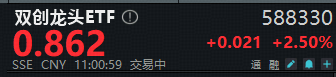
ETF盘中资讯 | Meta斥巨资购买谷歌的TPU!算力硬件大涨,光模块+PCB走强!中际旭创涨超6%,双创龙头ETF(588330)盘中上探3.45%
Sou Hu Cai Jing· 2025-11-25 04:10
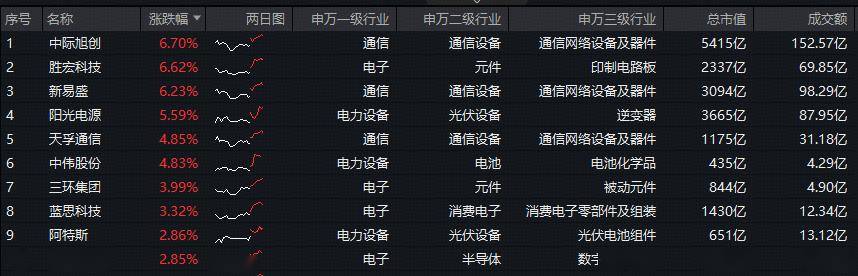
Group 1 - The technology growth sector is experiencing strong gains, with the ChiNext Index rising over 2.5% and the Sci-Tech Innovation Index increasing by more than 1.7% [1] - The Double Innovation Leader ETF (588330) saw a peak intraday increase of 3.45%, currently up 2.5%, with a trading volume exceeding 320 million yuan [1] - Key players in the optical module sector, including Zhongji Xuchuang and Xinyi Sheng, have seen stock increases of over 6%, while Tianfu Communication rose by more than 4% [1] Group 2 - The top ten components of the Double Innovation Leader ETF have shown significant price increases, with Zhongji Xuchuang up 6.70% and Shenghong Technology up 6.62% [2] - The report from HSBC indicates that the acceleration of AI server iterations is driving a dual cycle of technology and price increases for core components like PCBs and CCLs [3] - Citigroup previously projected that the supply-demand tension for AI PCBs will persist into next year, highlighting the ongoing demand in the sector [3] Group 3 - The Double Innovation Leader ETF is characterized by cross-market diversification, focusing on 50 large-cap strategic emerging industry companies from the Sci-Tech Innovation Board and ChiNext [4] - The ETF is positioned as a high-elasticity tool to capture technology market trends, with a low investment threshold allowing entry for less than 100 yuan [4] - The index that the ETF tracks has shown varied annual performance from 2020 to 2024, with a notable increase of 86.90% in 2020 [4]


中国核心科技资产走进东南亚
第一财经· 2025-11-25 04:10
Core Viewpoint - The listing of the Invesco Great Wall ChiNext 50 ETF Depository Receipts on the Thailand Stock Exchange marks a significant milestone in the internationalization of China's ChiNext index, providing Thai investors with direct access to China's core technology assets [3][4]. Group 1: Internationalization of ChiNext Index - The ChiNext 50 ETF Depository Receipts are the first of their kind from China's A-share market to be listed in Thailand, enhancing the international presence of the ChiNext index [3][4]. - The Shenzhen Stock Exchange aims to leverage this listing to further internationalize the ChiNext investment platform and facilitate global investors' access to China's technological innovations [3][4]. Group 2: Market Demand and Product Details - There is a growing demand among Thai investors for investment products related to China's core assets, driven by China's high-quality economic development and capital market reforms [4]. - The Invesco Great Wall ChiNext 50 ETF was established in December 2022 and currently has a total scale exceeding 50 billion, with a low fee structure of 0.2% [4][5]. Group 3: Performance of ChiNext 50 Index - As of November 18, 2025, the ChiNext 50 Index has shown a cumulative increase of 56.49%, outperforming other broad-based indices [6]. - The index's constituent stocks reported an average revenue growth of 21.07% and a net profit growth of 16.63% in the first half of 2025, with continued strong performance in the third quarter [6][7]. Group 4: Sector Focus and Composition - The ChiNext 50 Index focuses on high-tech sectors such as new energy, advanced manufacturing, and biomedicine, capturing the benefits of China's technological advancements [5][8]. - The top three sectors by weight in the ChiNext 50 Index are batteries (29.76%), communication equipment (18.62%), and photovoltaic equipment (8.22%) [8]. Group 5: Global Integration and Revenue - The leading companies in the ChiNext 50 Index are deeply integrated into the global value chain, with 35.17% of their revenue coming from overseas markets in 2024, which is higher than many broad-based indices [8]. - The average overseas revenue proportion for the top ten weighted stocks in the index is 47.96%, indicating a strong international market presence [8].


A股午评:创业板指涨超2%,算力硬件概念延续强势
2 1 Shi Ji Jing Ji Bao Dao· 2025-11-25 03:57
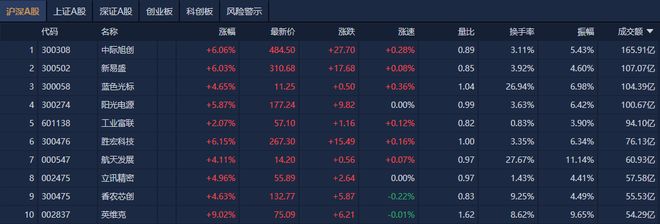
Market Overview - The market showed strong performance in the early session, with the Shanghai Composite Index rising over 1% and the ChiNext Index increasing over 2% [1] - By the end of the morning session, the Shanghai Composite Index was up 1.13%, the Shenzhen Component Index rose 2.04%, and the ChiNext Index gained 2.6% [1] Stock Performance - Nearly 4,900 stocks in the market experienced an increase [2] - The computing hardware sector continued to show strength, with stocks like TeFa Information achieving three consecutive trading limit ups, and Longi Green Energy and Huayou Cobalt hitting the daily limit [3] - The AI application sector saw a resurgence, with Shida Group achieving four consecutive trading limit ups and Rongji Software hitting six limit ups in seven days [3] - The anti-influenza sector was also active, with Guangji Pharmaceutical achieving two consecutive limit ups, and Te Yi Pharmaceutical and Peking University Pharmaceutical hitting the daily limit [3] Declining Stocks - The aquaculture sector experienced fluctuations, with stocks like Zhangzi Island and Zhongshui Fishery hitting the daily limit down [4] Trading Volume - The total trading volume in the Shanghai and Shenzhen markets reached 1.17 trillion yuan, an increase of 149.3 billion yuan compared to the previous trading day [5] Top Stocks by Trading Volume - Zhongji Xuchuang led with a trading volume exceeding 16.5 billion yuan, followed by Xinyi Sheng and BlueFocus with high trading volumes [6]



创业板50ETF-DR在泰上市,中国核心科技资产走进东南亚
Di Yi Cai Jing· 2025-11-25 03:42
Core Viewpoint - The launch of the ChiNext 50 Index Depository Receipts (DRs) on the Thailand Stock Exchange marks a significant milestone in the internationalization of the ChiNext 50 Index, providing Thai investors with direct access to China's core technology assets [1][2]. Group 1: Internationalization of ChiNext 50 Index - The ChiNext 50 Index has successfully expanded internationally, having previously listed on major European exchanges and now entering the Thai market [1]. - The listing of the ChiNext 50 ETF DRs is the first of its kind for A-share ETFs in Thailand, symbolizing the entry of Chinese core technology assets into the Southeast Asian market [1][2]. - The Shenzhen Stock Exchange aims to enhance the internationalization of the ChiNext market and facilitate global investors' access to China's technological innovations [1]. Group 2: Market Demand and Product Details - There is a growing demand among Thai investors for investment products related to Chinese core assets, driven by China's high-quality economic development and capital market reforms [2]. - The ChiNext 50 ETF, established in December 2022, has an overall scale exceeding 50 billion, with a low fee structure of 0.2% [2]. - InnovestX, a leading Thai brokerage, collaborates with Invesco to issue the DRs, which can be traded like stocks on the exchange [2]. Group 3: Performance of ChiNext 50 Index - As of November 18, the ChiNext 50 Index has shown a cumulative increase of 56.49%, outperforming other broad-based indices [4]. - The index's constituent stocks reported an average revenue growth of 21.07% and a net profit growth of 16.63% in the mid-year report for 2025 [4]. - In the third quarter, the revenue growth for the constituent stocks remained strong at 15.75%, with net profit growth rising to 22.58% [4]. Group 4: Key Constituents and Sector Focus - The top ten weighted stocks in the ChiNext 50 Index include leading companies such as CATL and Mindray, with an average revenue growth of 48.93% and net profit growth of 82.03% [5]. - The index focuses on high-tech sectors such as new energy, high-end manufacturing, and biomedicine, reflecting a higher concentration of technology compared to traditional industries [5][6]. - The three largest weighted sectors in the ChiNext 50 Index are batteries (29.76%), communication equipment (18.62%), and photovoltaic equipment (8.22%) [6].
创业50ETF(159682)涨2.76%,半日成交额2.79亿元
Xin Lang Cai Jing· 2025-11-25 03:40
Core Viewpoint - The article reports on the performance of the Chuangye 50 ETF (159682), highlighting its increase of 2.76% as of the midday close on November 25, with a trading volume of 279 million yuan [1] Group 1: ETF Performance - Chuangye 50 ETF (159682) closed at 1.379 yuan, with a trading volume of 2.79 billion yuan [1] - The ETF's performance benchmark is the return rate of the ChiNext 50 Index [1] - Since its establishment on December 23, 2022, the fund has achieved a return of 34.32%, while its return over the past month has been -8.44% [1] Group 2: Top Holdings - Key stocks in the Chuangye 50 ETF include: - Ningde Times, up 1.35% - Zhongji Xuchuang, up 6.06% - Dongfang Wealth, up 0.51% - Xinyi Sheng, up 6.03% - Sunshine Power, up 5.87% - Shenghong Technology, up 6.15% - Huichuan Technology, up 1.35% - Mindray Medical, up 0.73% - Yiwei Lithium Energy, up 1.82% - Tonghuashun, up 0.73% [1]
5G概念股走强,5GETF、5G通信ETF涨超5%
Mei Ri Jing Ji Xin Wen· 2025-11-25 03:21
Group 1 - 5G concept stocks have shown strong performance, with Huadian Co., Ltd. reaching the daily limit, New Yisheng rising over 7%, and Zhongji Xuchuang, Zhaoyi Innovation, and Dongshan Precision all increasing by over 6% [1] - The significant rise in heavy-weight stocks has positively impacted the 5G ETF and 5G Communication ETF, both of which have increased by over 5% [1] Group 2 - Some brokerage firms indicate that AI may represent the largest industrial opportunity since cloud computing, with hardware components like GPUs continuing to grow rapidly [2] - ASICs are expected to become the second growth engine next year, and the performance of the North American computing power industry chain is anticipated to maintain high growth rates in the coming quarters [2] - On the demand side, the growth in cloud revenue and capital expenditure from North American cloud companies is creating a positive feedback loop, with a clear AI development cycle still in an upward trajectory [2]



Meta斥巨资购买谷歌的TPU!算力硬件大涨,光模块+PCB走强!中际旭创涨超6%,双创龙头ETF(588330)上探3.45%
Xin Lang Ji Jin· 2025-11-25 03:19
Group 1 - The technology growth sector is experiencing strong gains, with the ChiNext Index rising over 2.5% and the Sci-Tech Innovation Index increasing by more than 1.7% [1] - The Double Innovation Leader ETF (588330) saw a peak intraday increase of 3.45%, currently up 2.5%, with a trading volume exceeding 320 million yuan [1] - Key stocks in the optical module sector, such as Zhongji Xuchuang and Xinyi Sheng, rose over 6%, while Tianfu Communication increased by more than 4% [1] Group 2 - HSBC's latest report indicates that the acceleration of AI server iterations is driving a dual rise in technology and pricing for core components like PCBs and CCLs [1] - Citigroup previously projected that the supply-demand tension for AI PCBs will persist until next year [1] - The report emphasizes the importance of technology leadership in the A-share market, with a focus on sectors like new energy vehicles and the internet [2] Group 3 - The Double Innovation Leader ETF is characterized by cross-market diversification, focusing on 50 large-cap strategic emerging industry companies from the ChiNext and Sci-Tech Innovation boards [2] - The ETF is designed to capture technology market trends with a low investment threshold, allowing entry for less than 100 yuan [2] - The index has a 20% limit on daily price fluctuations, enhancing its ability to act as a rebound leader [2]

AI硬件暴力反弹!5G通信ETF(515050)、创业板人工智能ETF华夏(159381)双双狂飙5.7%
Ge Long Hui· 2025-11-25 03:10
Group 1 - The technology sector led a strong rebound in A-shares, with AI hardware, particularly CPO, experiencing significant gains, including Guangku Technology rising over 16% [1] - Industrial Fulian clarified that it has not lowered its fourth-quarter profit target and that operations, including the shipment of GB200 and GB300 products, are proceeding as planned with strong customer demand [1] - A total of 310 A-share stocks saw financing purchases exceeding 100 million, with Zhongji Xuchuang, BlueFocus Communication, and Industrial Fulian ranking as the top three in financing amounts [1] Group 2 - The 5G Communication ETF rose by 5.7%, covering key components of AI computing systems, including optical modules and PCB, with significant weight in leading companies like Zhongji Xuchuang and Industrial Fulian [2] - The Huaxia Entrepreneurial AI ETF, which has the highest CPO content and lowest fee rate, increased by 5.82%, with major holdings including Zhongji Xuchuang and Xin Yisheng [2]
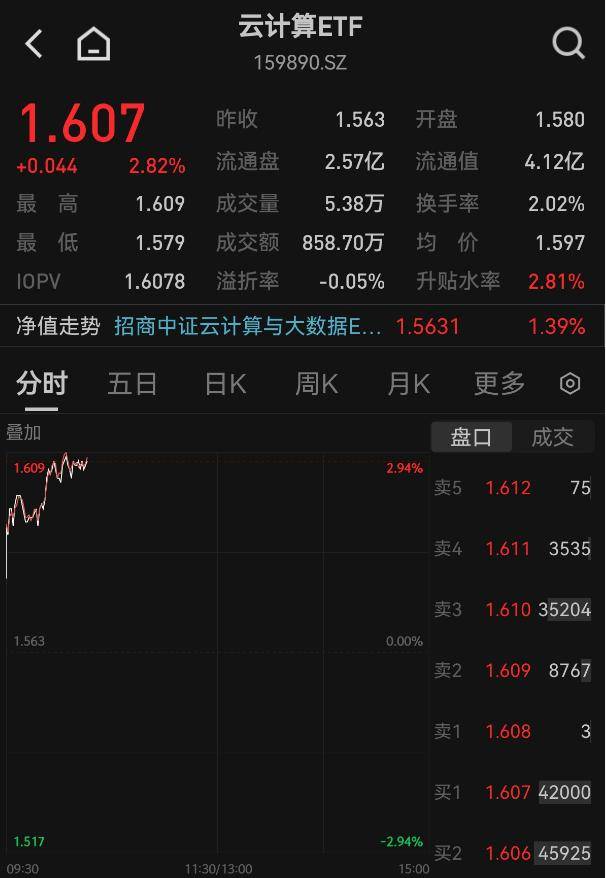
光模块龙头狂拉6%,云计算ETF(159890)飙涨2.82%!算力、模型、应用协同演进,AI算力主线强势回归?
Sou Hu Cai Jing· 2025-11-25 03:04
Core Viewpoint - The computing power sector has seen significant gains due to a series of domestic and international catalysts in the AI industry, with multiple stocks experiencing substantial increases in value [1][3]. Group 1: Market Performance - The cloud computing ETF (159890) surged by 2.82% on November 25, with major holdings such as Zhongji Xuchuang and Xinyi Sheng rising over 6% [1][2]. - Other stocks like Inspur Information and Yidian Tianxia also saw increases exceeding 3% and 7%, respectively, indicating a strong market response [1]. Group 2: Industry Catalysts - Recent AI industry catalysts include the mass production of NVIDIA's next-generation Rubin GPU, the launch of Google's new model Gemini, and clear capital expenditure guidance from cloud vendors [1][3]. - Google’s AI infrastructure head stated the necessity to double AI computing power every six months and achieve a thousandfold increase in the next 4 to 5 years to meet rising demand [3]. Group 3: Investment Outlook - Analysts from Guotai Junan and Zhongyuan Securities express optimism regarding the capital expenditure outlook of leading cloud vendors, highlighting high demand across the AI computing power supply chain [3]. - The industry is transitioning from 800G to 1.6T technology, with leading optical module manufacturers expected to benefit from stable customer relationships and scalable delivery capabilities [3]. Group 4: ETF Composition - The cloud computing ETF tracks an index that includes top companies like Zhongji Xuchuang and Xinyi Sheng, as well as major players in electronic terminals and software development, providing a comprehensive solution for the AI era [4].