Maxwell(300751)

Search documents
光伏设备板块震荡走高
Di Yi Cai Jing· 2026-01-22 04:44
Group 1 - JunDa Co., Ltd. reached the daily limit increase in stock price [1] - GoodWe Technologies saw a rise of over 10% in its stock price [1] - Other companies such as Maiwei Co., LianSheng Technology, Tianyi New Materials, Haiyou New Materials, and Dongfang Rises also experienced stock price increases [1]





中国工业 - 2026 年展望:复苏持续-China Industrials-2026 Outlook – Recovery Continues
2026-01-22 02:44
Summary of China Industrials 2026 Outlook Industry Overview - **Industry**: China Industrials - **Core Themes**: AI technology diffusion, industrial upgrades, and globalization are central to the industrial sector's recovery in 2026. The government is focused on enhancing productivity through equipment upgrades, particularly in high-end equipment [1][4]. Key Insights - **Industrial Cycle**: The industrial cycle is characterized by strong global demand for capital goods, driven by AI technology applications and supply chain security concerns. China's trend of localizing high-end equipment remains strong, with specific sectors like data centers, electronics, and robotics expected to show growth, while processing markets may experience muted demand [3][10]. - **AI Applications**: 2026 is anticipated to mark the beginning of significant capital expenditure on physical AI, which will benefit automation and robotics companies. The government is supporting this through initiatives aimed at increasing the deployment of AI-powered robotics [4][11][12]. - **Localization and Supply Chain**: The localization rates for automation and industrial robots are projected to rise, with expectations of reaching 60-70% by 2030. This trend is expected to benefit companies involved in automation and precision components [21][22][23]. Market Dynamics - **Overseas Expansion**: Equipment exports from China have grown significantly, outpacing overall export growth. Companies are motivated to expand into international markets to capture larger total addressable markets (TAM) and improve margins [24][25]. - **Margin Expansion**: The overall net margin for China's industrials is expected to increase from approximately 13.0% in 2025 to around 14.6% in 2027, driven by overseas growth and advancements in AI technology [26][27]. Stock Recommendations - **Preferred Stocks**: The report highlights several stocks that are expected to benefit from cyclical strength and structural tailwinds, including: - **Geekplus (2590.HK)**: OW - **Sany Heavy (600031.SS)**: OW - **Leaderdrive (688017.SS)**: OW - **Han's Laser (002008.SZ)**: OW - **Inovance (300124.SZ)**: OW - **Hengli (601100.SS)**: OW - **Wuxi Lead (300450.SZ)**: OW - **Envicool (002837.SZ)**: OW - **Underweight Stocks**: Stocks such as **CSCEC (601668.SS)**, **CRRC-H (1766.HK)**, and **Maxwell (300751.SZ)** are rated as underweight due to various market challenges [5][8][46]. Additional Considerations - **Geopolitical Factors**: The geopolitical landscape is influencing supply chain security, which is a critical factor for capital goods demand globally [3]. - **Investment in AI**: The anticipated investment in AI infrastructure is expected to redefine smart manufacturing and create new opportunities within the industrial sector [10][11]. - **Sector Performance**: The report indicates that most industrial stocks are trading at or above their historical five-year average P/E ratios, reflecting a positive outlook for continuous upgrades and AI-related demand [26][38]. This comprehensive analysis provides insights into the expected recovery and growth opportunities within the China Industrials sector for 2026, highlighting key themes, market dynamics, and stock recommendations.



业绩反转!“光伏黑马”2025年业绩预计扭亏为盈,光伏ETF华夏(515370)上涨0.2%
Mei Ri Jing Ji Xin Wen· 2026-01-22 02:21
Group 1 - The core viewpoint of the news highlights the performance of the photovoltaic sector, particularly the rise of the Huaxia Photovoltaic ETF and its constituent stocks, indicating a positive trend in the market [1] - On January 21, Hongyuan Green Energy announced its 2025 annual performance forecast, expecting a net profit attributable to shareholders of 180 million to 250 million yuan, marking a turnaround from losses [1] - The company anticipates a non-recurring gain of approximately 291 million yuan from the transfer of part of its stake in Inner Mongolia Xinyuan Silicon Material Technology Co., which is crucial for achieving positive overall performance [1] Group 2 - According to Zheshang Securities, 2026 is expected to be a turning point for the industry, driven by factors such as a rebound in prices, with a 47% quarter-on-quarter increase in polysilicon prices in Q3 2025 [1] - Leading companies like Longi Green Energy and JA Solar have announced equity incentive plans aimed at achieving profitability by 2026 [1] - The proportion of fund allocations has decreased to levels seen before the 2020 market rally, indicating potential for recovery, alongside the establishment of silicon material storage platforms expected to drive supply contraction and demand recovery [1]



“顶流”调仓!傅鹏博、李晓星,加仓这些股票
Zhong Guo Zheng Quan Bao· 2026-01-21 08:51
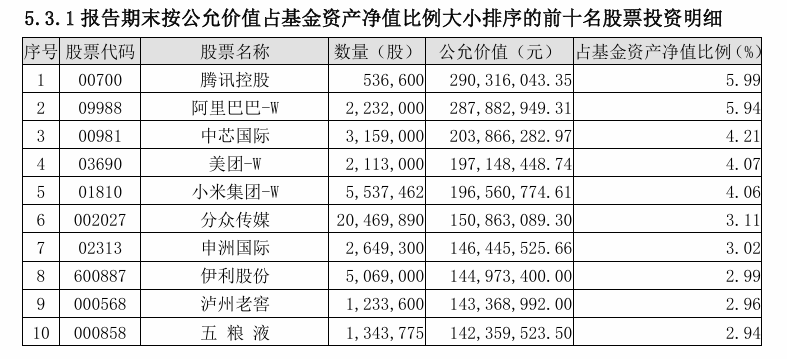
Group 1: Fund Manager Insights - Fund manager Fu Pengbo reduced holdings in companies with weak fundamentals and increased investments in data center liquid cooling, storage, and computing-related companies [1][2] - Fu noted that the annual reports of listed companies for 2025 will be pre-disclosed by the end of January 2026, with high-growth sectors like AI, non-ferrous metals, and lithium battery materials expected to show significant growth [1][3] - Li Xiaoxing increased positions in Hong Kong internet and consumer stocks while reducing holdings in some Hong Kong financial stocks, believing that overall opportunities in the equity market for 2026 outweigh risks [1][4] Group 2: Fund Performance and Adjustments - Fu's fund saw minor changes in its top ten holdings, with Maiwei Co. replacing China Mobile, and increased positions in Han's Laser while reducing stakes in companies like Ningde Times and Tencent [2][3] - Li's fund reported a stock position of 88.55% at the end of Q4 2025, a decrease of 4.54 percentage points from Q3 2025, with new entries in the top ten holdings including Tencent, Alibaba, and Meituan [4][5] Group 3: Market Outlook - Fu and Zhu believe that the stock market's activity is increasing, with a "spring excitement" arriving early, and expect high growth in sectors like AI and semiconductor manufacturing [3][6] - Li highlighted that AI remains the main line of global technological innovation, with significant capital expenditure growth in the AI sector, and domestic internet companies expected to maintain stable growth [6][7] - The consumer sector's performance needs dynamic observation, with many quality consumer stocks showing favorable dividend yields [6][7] Group 4: Sector-Specific Insights - The pharmaceutical sector experienced fluctuations in Q4 2025 due to previously high market expectations and capital flowing to other popular sectors, but long-term prospects for domestic innovative drugs remain positive [7] - The CRO and CDMO segments are showing clear signs of recovery in domestic and international demand, indicating an industry turning point [7]







商业航天行业系列五:太空光伏:逐日天穹,叩问千亿星辰市场
GF SECURITIES· 2026-01-21 06:27
Investment Rating - The industry investment rating is "Buy" [2] Core Insights - The report highlights that the development of reusable rocket technology has significantly reduced launch costs, creating a golden opportunity for space photovoltaics [5] - The competition in commercial space between China and the US is accelerating, with low Earth orbit (LEO) communication satellites driving short-term demand for solar wings [5] - AI giants are increasingly recognizing the potential of deploying computing power in space, which is expected to benefit space photovoltaics [5] - The report emphasizes the importance of gallium arsenide as the current mainstream technology for space photovoltaics, while also highlighting the potential of silicon-based batteries and perovskite technology in the long term [5] - Investment recommendations include focusing on HJT/perovskite equipment suppliers and companies covering various segments of the photovoltaic supply chain [5] Summary by Sections 1. Space Photovoltaics: The Main Energy Source in Space - Space photovoltaics convert solar energy into electrical energy in space environments, which are harsher than ground conditions [12][13] - Solar panels are the core component of spacecraft power systems, essential for converting solar energy into the electricity needed for satellite operations [12][13] 2. Downstream Scenarios: Commercial Space Boom Leading to a Trillion-Dollar Market - The report notes a significant increase in global satellite launches since 2020, with a projected 4000 launches by 2025, driven by reduced costs from reusable rockets [38] - The US currently dominates the satellite market, with 11,688 satellites in orbit, while China and Russia lag behind [38] - The competition for orbital resources is intensifying, with both the US and China making substantial satellite deployment plans [44][45] 3. Technology Pathways: Gallium Arsenide as the Current Mainstream, with Potential for Silicon-Based Batteries and Perovskite Breakthroughs - Gallium arsenide solar cells are currently the most efficient option for space applications, with over 30% efficiency [65] - The report discusses the evolution of solar cell technologies, including silicon and multi-junction cells, and the potential for future advancements in perovskite technology [65] 4. Investment Recommendations: Focus on HJT/Perovskite Core Equipment Suppliers - Companies such as Maiwei, Aotwei, and Jiejia Weichuang are highlighted as key players in the HJT/perovskite equipment supply chain [5] - The report suggests monitoring companies that cover the entire photovoltaic supply chain, including polysilicon, batteries, and modules [5]




睿远基金旗下产品最新重仓股曝光:傅鹏博加仓寒武纪,赵枫买回美的
Sou Hu Cai Jing· 2026-01-21 03:57
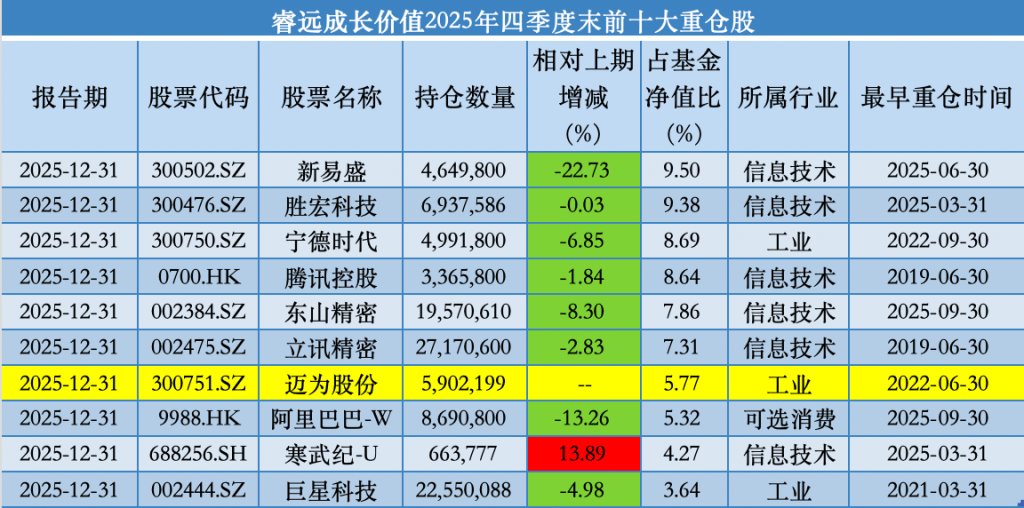
Core Viewpoint - The report highlights significant changes in the investment strategies of Ruiyuan Fund's star fund managers, with notable adjustments in stock holdings and performance metrics for the fourth quarter of 2025. Group 1: Fund Performance and Adjustments - Ruiyuan Growth Value Mixed Fund experienced a net redemption of 136.2 million shares, marking the second-highest redemption in its history, with total net assets decreasing from 23.629 billion yuan to 21.087 billion yuan [3][4] - The fund's stock allocation increased slightly from 89.93% to 90.48%, while the proportion of Hong Kong stocks in the fund's net value decreased from 27.92% to 20.14% [3][4] - Ruiyuan Balanced Value Three-Year Holding Fund's stock allocation reached a three-year high of 90.66%, with a slight increase in the proportion of Hong Kong stocks to 41.99% [10] Group 2: Stock Holdings and Changes - The top ten holdings of Ruiyuan Growth Value Mixed Fund included New Yisheng, Shenghong Technology, and Ningde Times, with New Yisheng seeing a 22.73% reduction in holdings [4][5] - Ruiyuan Balanced Value Three-Year Holding Fund saw significant changes, with the re-entry of Midea Group into the top ten holdings and reductions in holdings of companies like Lixun Precision and China Ping An [10][12] - The fund managers noted a shift in focus towards sectors like photovoltaic and semiconductor high-end equipment manufacturing, while reducing exposure to companies with weak fundamentals [6][10] Group 3: Future Outlook and Strategy - The fund managers expressed optimism about the market, anticipating that the return on equity assets will remain attractive compared to other asset classes, with potential returns exceeding 10% for leading companies [11][13] - They plan to focus on companies with strong fundamentals and competitive advantages, particularly those expanding overseas, as this is expected to drive future growth [13][14] - The report indicates a structural market environment with limited risks of significant downturns, while opportunities for excess returns remain [8][13]





未知机构:广发机械半导体设备跟踪推荐铠侠表示存储紧缺将继续积极关注半导体设备-20260121
未知机构· 2026-01-21 02:00
Summary of Semiconductor Equipment Industry Conference Call Industry Overview - The semiconductor equipment industry is experiencing a supply-demand imbalance, particularly in storage solutions, driven by the surge in artificial intelligence (AI) demand. This situation is expected to persist for some time, affecting both enterprise and consumer-grade solid-state drives (SSDs) [1][2]. Key Companies and Insights Kioxia - Kioxia's storage division manager, Jun Saito, indicated that the supply-demand tightness will continue, leading to shortages in both enterprise and consumer SSDs [1][2]. Jinhai Tong - Focuses on the translation sorting machine, benefiting from the launch of the 9000 series three-temperature sorting machine, which has significantly increased automotive electronics revenue. The company is also developing high-end sorting machines for AI chips, anticipating substantial order breakthroughs in 2026 with projected revenues of 14 billion and profits of 5 billion [3]. Huafeng Measurement and Control - The 8600 GPU testing machine is leading in testing channel count, frequency, and parallel processing capabilities domestically. Small-scale production validation has been completed, with a high likelihood of securing large orders in 2026 [3]. Jingce Electronics - The company has seen significant order growth, especially in Hefei, with expectations for continued growth in 2026. It leads in fields such as film thickness, OCD, and electron beam technologies, with advancements in 14nm technology expected this year [3]. Qiangyi Co., Ltd. - The company has engaged with major clients in the computing chip sector and has completed deliveries or initial validations of 2.5D MEMS probe cards for HBM, NOR Flash, and DRAM. With overseas probe card shortages, the company is expected to exceed performance expectations in 2026 [3]. Changchuan Technology - Deeply integrated with H, the storage testing machine is set for a breakout year, with expected revenues of 15 billion. The GPU testing machine holds a significant market share in H's computing chip testing, with strong order backlogs [4]. Jingzhida - A leader in high-speed FT testing machines, the company is actively validating its products with clients, expecting to double orders and revenue this year, driven by two storage products [4]. Weida Nano - Primarily serving two storage clients, the company has seen a doubling of new orders in 2025, with mature products gaining traction among new clients and expectations for order upgrades in 2026 [4]. Maiwei Co., Ltd. - Focused on etching and ALD in the semiconductor sector, the company anticipates approximately 8 billion in front-end equipment orders for 2025, with two-thirds attributed to storage. The target for front-end orders in 2026 is set at 20 billion, with an optimistic outlook for continued growth [4]. Additional Insights - The semiconductor equipment sector is poised for growth due to increased capital expenditures in domestic and international fabs, indicating a robust investment environment [1][2]. - The ongoing demand for AI and related technologies is expected to drive further advancements and opportunities within the industry [1][2].


商业航天深度报告:太空光伏大有可为,卫星太阳翼市场持续扩容
ZHONGTAI SECURITIES· 2026-01-21 00:25
Investment Rating - The report does not explicitly state an investment rating for the industry. Core Insights - The demand for satellite internet networking is urgent, and space computing opens new growth opportunities. The construction of satellite internet networks is driven by strong demand due to the advantages of wide coverage, strong disaster resistance, and rapid deployment. The International Telecommunication Union (ITU) has established principles for satellite frequency and orbit usage, leading to a competitive race for low Earth orbit resources. The construction and launch of satellite constellations in China are accelerating, with a significant gap compared to the US [4][16]. - Space computing is leading to increased demand for satellites. The traditional model of "ground computing" is evolving to "space computing," with satellites equipped with AI chips and edge computing modules to process data in orbit, significantly reducing transmission delays and processing times. Major companies are investing in space computing infrastructure, which is expected to drive the demand for satellites [17][19]. - Solar wings are the only efficient and long-term energy supply solution for near-Earth commercial space. Solar wings account for approximately 12%-24% of the satellite's value, and their area is continuously increasing, which enhances the overall power supply capacity of satellites. The transition from rigid to flexible solar wings is a key trend, with different technological routes being adopted in China and the US [4][28][38]. Summary by Sections Satellite Internet Networking - The urgent need for satellite internet networking is driven by the rapid release of rigid application demands in communication, navigation, and remote sensing. The construction of satellite internet networks is becoming increasingly critical due to limited low Earth orbit resources and the competitive landscape [11][16]. - The ITU's "first come, first served" principle has intensified the competition for satellite orbital resources, with China lagging in the completion rate of its satellite constellations compared to the US [16][18]. Space Computing - Space computing is transforming satellite demand by embedding AI capabilities into satellite systems, allowing for in-orbit data processing and reducing the need for ground-based data transmission. This shift is expected to significantly enhance the capabilities and applications of satellites [19][22]. Solar Wings - Solar wings are essential for providing continuous power to satellites, with their value accounting for a significant portion of the satellite's overall worth. The area of solar wings is increasing, which is expected to enhance the power supply capabilities of satellites [28][30]. - The transition from rigid to flexible solar wings allows for greater power generation efficiency and is particularly suited for high-power and multi-satellite launch scenarios. The flexible solar wings can achieve a higher power-to-weight ratio and better space utilization [38][45]. Technology Routes - There are notable differences in the solar wing battery technology routes between China and the US. The US primarily uses silicon solar cells due to their lower costs and established supply chains, while China is exploring gallium arsenide cells for their higher power-to-weight ratios and efficiency [51][62]. - Gallium arsenide cells are being actively explored for cost reduction, and perovskite cells are emerging as a potential next-generation solution for solar wings due to their low cost and high efficiency [65][69].


广发证券:太空算力远期市场空间广阔 太阳翼或为最优通胀环节
智通财经网· 2026-01-20 08:43
Group 1 - The core viewpoint is that the industry has a vast long-term market space due to the active layout of space computing by China and the US, combined with the cost and performance advantages of space computing itself [3][4] - Space computing is transitioning from a "ground-based calculation" model to a "space-based calculation" model, allowing for direct data processing in space [1][3] Group 2 - Space computing has operational cost advantages, with a significant focus on marginal energy costs, which are the core factor in overall operational expenses [2] - For example, a single space-based 40MW computing cluster can operate for 10 years at a total cost of $8.2 million, saving approximately $159 million compared to traditional computing clusters, with over $130 million saved in marginal energy costs [2] Group 3 - The demand for solar wings is expected to increase due to the expansion of power and area requirements driven by space computing, leading to the adoption of flexible technology routes [4] - Flexible solar wings can achieve a weight reduction of 20%-40%, a storage volume reduction of over 60%, and improved performance, making them a key component in the power system [4] Group 4 - Investment recommendations include focusing on companies related to space photovoltaics, such as: - Maiwei Co., Ltd. (300751.SZ), which is expected to become a core equipment supplier for space computing photovoltaic segments [5] - Gaomei Co., Ltd. (688556.SH), which aligns with the cost reduction route for space photovoltaics [5] - Jiejia Weichuang (300724.SZ), which is positioned to benefit from the expansion of flexible solar wings in the space computing sector [5]


未知机构:中泰机械太空光伏大有可为卫星太阳翼空间电站打开成长空间-20260120
未知机构· 2026-01-20 02:25
Summary of Conference Call Notes Industry Overview - The focus is on the space photovoltaic industry, particularly satellite solar wings and space power stations, which are expected to open up significant growth opportunities [1] - Satellite solar wings are identified as the core energy system for satellites, ensuring power supply [1] Key Insights and Arguments - The growth of the satellite industry is linked to an increase in the number of satellites and the area of solar wings, making solar wings a critical component in commercial space ventures [1] - Elon Musk has shifted from using relatively mature and inexpensive crystalline silicon solutions to more advanced P-type HJT (Heterojunction Technology) batteries that are radiation-resistant, lightweight, and more adaptable [1] - Musk plans to deploy 100GW of solar-powered AI satellites annually, indicating a vast market potential [1] - Space solar power stations are anticipated to create additional growth opportunities, as they can bypass atmospheric interference and achieve high-efficiency solar energy generation [1] - Countries like the United States, China (with the Daily Project), and Japan have initiated space photovoltaic power station plans, which are expected to further stimulate demand in the space photovoltaic sector [1] Additional Important Points - Recommendations for investment focus on specific companies: - **Maiwei Co., Ltd.**: Recognized as the first domestic equipment manufacturer contacted by SpaceX, specializing in customized HJT equipment for space photovoltaics, with expectations for large-scale supply [2] - **Yujing Co., Ltd.**: Concentrates on crystalline silicon and UTG (Ultra-Thin Glass) glass slicing, currently undergoing factory audits by SpaceX [2]