
Mindray(300760)

Search documents
424单、超1100亿资金:深市去年掀回购增持热潮
第一财经网· 2026-01-04 10:44
Core Viewpoint - The active share buyback and increase in holdings by listed companies since 2025 reflect their recognition of intrinsic value and confidence in long-term development, sending positive signals to the market and enhancing investor confidence, thus injecting strong momentum into the healthy development of the capital market [1][2]. Group 1: Share Buyback and Increase in Holdings - In 2022, a total of 424 share buyback and increase plans were disclosed by listed companies in the Shenzhen market, including 288 buyback plans with a maximum amount of 82.725 billion yuan and 136 increase plans with a maximum amount of 31.521 billion yuan [2]. - Major companies such as CATL, Midea Group, Weichai Power, and Lens Technology have announced their buyback progress, with CATL repurchasing 15.9908 million shares for a total of 4.386 billion yuan, Midea Group repurchasing 20.5646 million shares for 1.51 billion yuan, Weichai Power repurchasing 50.2525 million shares for 0.761 billion yuan, and Lens Technology repurchasing 740.96 million shares for 0.215 billion yuan [1]. Group 2: Industry Trends and Insights - The buyback and increase plans are concentrated in key industries, with electronics, biomedicine, machinery, and power equipment companies accounting for 40.97% of the total, while biomedicine, machinery, basic chemicals, and home appliances account for 37.78% of the increase plans, indicating optimistic expectations for future development in these sectors [2]. - Leading companies in various industries are playing a stabilizing role in the market, with significant buybacks and continuous increases guiding market trends [2][3]. - Cross-border buybacks have emerged as a new highlight, as demonstrated by China International Marine Containers Group's simultaneous buyback of A-shares and H-shares, reflecting recognition of company value [3].





迈瑞医疗在济南成立新公司,注册资本2000万
Zhong Guo Neng Yuan Wang· 2026-01-04 06:40
天眼查工商信息显示,近日,济南迈瑞科技有限公司成立,法定代表人为席彬,注册资本2000万人民 币,经营范围含仪器仪表制造、第一类医疗器械生产、仪器仪表销售、货物进出口、技术进出口、进出 口代理等。股东信息显示,该公司由迈瑞医疗(300760)全资持股。 ...
2025年中国健康服务行业发展历程、政策、发展现状、重点企业及趋势研判:健康服务业态日趋多元,精准化与个性化服务成为未来发展核心方向[图]
Chan Ye Xin Xi Wang· 2026-01-01 03:22
Core Insights - The health service industry aims to create a favorable organizational environment by providing safe, effective, convenient, and affordable basic medical and public health services to meet various health needs of residents. The demand for health-related products and services is rapidly increasing due to social progress and changes in lifestyle [1][7]. Industry Overview - The health service industry encompasses medical services, health management, health insurance, and related services, involving pharmaceuticals, medical devices, health products, and fitness products [4]. - The industry has experienced rapid growth in China, with the market size increasing from 6.37 trillion yuan in 2018 to an expected 9.55 trillion yuan by 2024, representing a compound annual growth rate of 6.98%. The "Healthy China 2030" plan projects the total market size to reach 16 trillion yuan by 2030, indicating significant growth potential [1][8]. Development History - The development of China's health service industry can be divided into four stages: 1. 1949-1990: Health check-ups were primarily hospital services focused on disease detection rather than prevention. 2. 1991-2000: Independent health check-up service institutions began to emerge in cities like Beijing. 3. 2001-2010: The introduction of Western health service concepts and rapid market demand growth led to the fast development of health service institutions. 4. 2011-present: Increased focus on medical information technology and service upgrades has improved the capabilities of health service institutions [4][5]. Relevant Policies - Recent government policies aim to optimize resource allocation, enhance preventive interventions, and improve service accessibility, which helps control the rapid growth of medical costs and reduce the disease burden on families and society. For instance, the National Health Commission issued a notice in February 2025 to address public health concerns and improve service efficiency [6]. Industry Structure and Key Companies - The operational models of health service institutions in China are diverse, including: 1. Hospital-based models leveraging brand and client resources. 2. Independent medical models with self-owned brands and facilities. 3. Health management models centered on health check-ups. 4. Comprehensive information platform models connecting online and offline services [8]. - Major companies in the health service industry include: - Meinian Health Industry Holdings Co., Ltd. - Tongce Medical Co., Ltd. - Ruici Medical Service Holdings Co., Ltd. - Ciming Health Checkup Management Group Co., Ltd. - Aikang Guobin Health Checkup Management Group Co., Ltd. [2][3][9]. Trends in Health Services - The future of health services will focus on personalized and precise care, moving from a "one-size-fits-all" approach to individualized health management based on personal data [11]. - Service delivery will become decentralized, extending beyond traditional healthcare facilities to community and home settings, enhancing accessibility and convenience [12]. - Payment models will evolve from fee-for-service to value-based care, with insurance companies and service providers collaborating to create innovative health products [13].




A股医药板块的“火热”与“寒意”
Xin Lang Cai Jing· 2025-12-31 16:01
Core Viewpoint - The A-share pharmaceutical sector in 2025 exhibits structural differentiation, with innovative drugs and CXO sectors thriving due to overseas demand and business development, while traditional Chinese medicine, medical devices, and pharmaceutical commerce face performance pressures [3][20]. Summary by Category Overall Market Performance - The A-share pharmaceutical and biotechnology sector saw an overall increase of 25.64% from January 1 to December 30, 2025, despite a slight decline in revenue and a stabilization in profits, with total revenue of 18,544.52 billion yuan, down 1.42% year-on-year, and net profit of 1,407.32 billion yuan, down 1.65% year-on-year [4][21]. Innovative Drug Sector - The innovative drug sector was a standout performer in 2025, with the chemical pharmaceutical segment rising by 32.58% and the medical services segment by 32.91% [4][21]. - Companies like BeiGene (百济神州) reported significant growth, achieving revenue of 27.595 billion yuan, a 44.2% increase year-on-year, surpassing the total revenue of 27.21 billion yuan for 2024 [4][22]. Business Development (BD) Trends - The business development landscape for innovative drug companies is evolving, with significant partnerships such as the 11.4 billion USD deal between Innovent Biologics and Takeda, and a 12.5 billion USD collaboration between Hengrui Medicine and GlaxoSmithKline [5][22][24]. - The total value of business development transactions reached approximately 94.158 billion USD in the first three quarters of 2025, significantly exceeding the total for 2024 [25]. CXO Sector Performance - The CXO sector, driven by the demand for innovative drug research, achieved a 32.91% increase in 2025, with total revenue of 1,365.72 billion yuan, up 3.63% year-on-year, and net profit of 209.12 billion yuan, up 36.47% year-on-year [10][27]. - Leading companies like WuXi AppTec (药明康德) and Kanglong Chemical (康龙化成) returned to growth, with WuXi AppTec reporting a revenue increase of 18.61% and net profit growth of 84.84% [28][31]. Traditional Chinese Medicine and Medical Devices - The traditional Chinese medicine sector experienced a modest increase of 6.75% in 2025, with total revenue of 2,590.69 billion yuan, down 4.33% year-on-year, and net profit of 294.99 billion yuan, down 1.53% year-on-year [36]. - The medical device sector reported a revenue of 1,792.10 billion yuan, down 2.24% year-on-year, with notable performance differences among sub-sectors, where companies like Mindray Medical (迈瑞医疗) showed strong overseas revenue growth [33][34].



医药行业2026年策略报告:坚定出海方向,把握结构性机遇-20251231
Huaxin Securities· 2025-12-31 11:05
Group 1 - The core investment theme for the pharmaceutical industry in 2025 is the overseas expansion of innovative drugs, which is expected to yield excess returns compared to the broader pharmaceutical sector and the CSI 300 index [2][21] - The innovative drug index has shown a significant increase, outperforming the pharmaceutical biological index by 37.48 percentage points, with a year-to-date increase of 65.99% [21] - Major transactions in the ADC and dual antibody fields are anticipated to continue, while there is a need to avoid repetitive competition in areas like small nucleic acids and focus on unmet clinical needs [3][4] Group 2 - The report emphasizes the importance of overseas markets for both innovative drugs and medical devices, suggesting that companies should seek growth opportunities beyond domestic market saturation [4][5] - The Chinese pharmaceutical industry is gradually becoming a global innovation center, with significant advancements in dual antibodies and ADCs, while also making strides in emerging fields like small nucleic acids and inhalation formulations [5][6] - The report highlights that the overseas authorization revenue has become a crucial funding source for innovative drug development, with a total upfront payment of $4.551 billion in the first three quarters of 2025 [29][32] Group 3 - The medical device sector is experiencing a shift towards overseas expansion, with a focus on high-value consumables and IVD products, as Chinese companies enhance their market share [7][55] - The export growth of high-value consumables is significant, with a recorded increase of 10.75% in the first half of 2025, particularly in the North American and European markets [57][66] - The report notes that the certification and market establishment processes for high-value consumables are long-term investments, requiring compliance with stringent regulations in the EU and the US [60][61] Group 4 - The recovery of financing in the domestic innovative drug sector has been robust, with a total of 324 financing events amounting to $5.51 billion in the first three quarters of 2025, marking a 67.6% increase year-on-year [70][72] - The CXO industry is experiencing varied recovery rhythms across different segments, with some areas like CDMO seeing order growth due to overseas financing recovery [74]



A股2025市值增长九强省盘点:广东TOP5企业市值增长均超千亿 工业富联贡献全省市值增量的19%
Xin Lang Cai Jing· 2025-12-31 09:36
Core Insights - In 2025, the market capitalization increment of A-share listed companies in Guangdong Province reached 42.7 billion, representing a growth of 27.95% compared to the beginning of the year [1] Group 1: Market Capitalization Growth - The top five companies contributing to market capitalization growth all exceeded 100 billion, with Industrial Fulian leading at an increment of 805 billion, marking a growth rate of 188.46% and contributing 18.85% to the total market capitalization increase in the province [1] - The remaining four companies in the top five, namely China Ping An, Shenghong Technology, Luxshare Precision, and Shunyi Technology, each had market capitalization increments below 300 billion, with their contributions to the overall growth rate not exceeding 7% [1] Group 2: Market Capitalization Decline - The companies experiencing the most significant market capitalization decline in Guangdong Province included Mindray Medical, Haitian Flavoring, Huali Group, Poly Development, and Transsion Holdings [1] - Mindray Medical's market capitalization decreased by 78.3 billion, which is significantly higher than the other four companies, each of which saw declines not exceeding 40 billion [1]




医药生物行业资金流出榜:药明康德、迈瑞医疗等净流出资金居前
Zheng Quan Shi Bao Wang· 2025-12-31 09:19
Market Overview - The Shanghai Composite Index rose by 0.09% on December 31, with 15 industries experiencing gains, led by defense and military industry at 2.13% and media at 1.54% [1] - The communication and agriculture, forestry, animal husbandry, and fishery sectors saw the largest declines, down 1.35% and 1.10% respectively [1] - The pharmaceutical and biotechnology sector fell by 0.45% [1] Capital Flow Analysis - The main capital outflow from the two markets totaled 32.27 billion yuan, with 9 industries seeing net inflows [1] - The defense and military industry had the highest net inflow of 6.06 billion yuan, followed by the media sector with 4.45 billion yuan [1] - A total of 22 industries experienced net capital outflows, with the electronics sector leading at 11.20 billion yuan, followed by the power equipment sector at 7.25 billion yuan [1] Pharmaceutical and Biotechnology Sector - The pharmaceutical and biotechnology sector saw a net outflow of 3.54 billion yuan, with 178 of the 478 stocks in the sector rising and 276 falling, including one stock hitting the daily limit down [2] - The top three stocks with net inflows in this sector were Meinian Health (84.95 million yuan), Huaren Health (75.69 million yuan), and Xingqi Eye Medicine (64.86 million yuan) [2] - The stocks with the largest net outflows included WuXi AppTec (468.14 million yuan), Mindray Medical (321.35 million yuan), and Hefei China (276.65 million yuan) [3]


医疗器械板块12月31日跌0.89%,浩欧博领跌,主力资金净流出9.32亿元
Zheng Xing Xing Ye Ri Bao· 2025-12-31 09:07
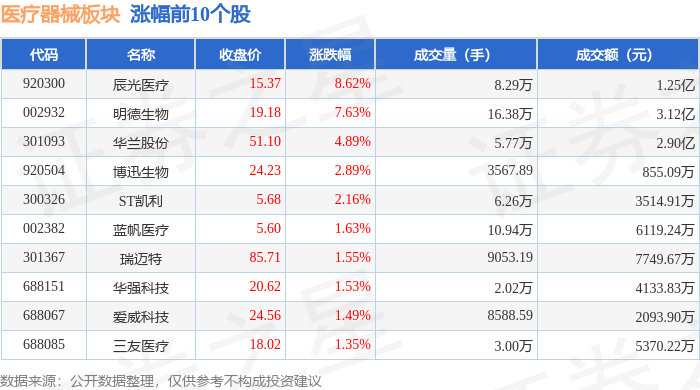
Market Overview - The medical device sector experienced a decline of 0.89% on December 31, with Haooubo leading the drop [1] - The Shanghai Composite Index closed at 3968.84, up 0.09%, while the Shenzhen Component Index closed at 13525.02, down 0.58% [1] Stock Performance - Notable gainers in the medical device sector included: - Chen Guang Medical (Code: 920300) with a closing price of 15.37, up 8.62% and a trading volume of 82,900 shares [1] - Mingde Biological (Code: 002932) closed at 19.18, up 7.63% with a trading volume of 163,800 shares [1] - Hualan Co., Ltd. (Code: 301093) closed at 51.10, up 4.89% with a trading volume of 57,700 shares [1] - Conversely, Haooubo (Code: 688656) saw a significant decline of 8.03%, closing at 153.80 with a trading volume of 20,700 shares [2] - Other notable decliners included: - Caina Co., Ltd. (Code: 301122) down 3.80% to 26.06 [2] - Meihua Medical (Code: 301363) down 3.80% to 24.05 [2] Capital Flow - The medical device sector saw a net outflow of 932 million yuan from institutional investors, while retail investors contributed a net inflow of 645 million yuan [2] - The sector's overall capital flow indicates a mixed sentiment, with institutional investors pulling back while retail investors increased their participation [2] Individual Stock Capital Flow - Key stocks with significant capital flow include: - Kefu Medical (Code: 301087) with a net inflow of 19.12 million yuan from institutional investors, representing 25.64% of its trading volume [3] - Kai Li Medical (Code: 300633) with a net inflow of 15.99 million yuan, accounting for 15.25% of its trading volume [3] - Chen Guang Medical (Code: 920300) also saw a net inflow of 12.83 million yuan from institutional investors, representing 10.29% of its trading volume [3]


迈瑞医疗接待205家机构调研,包括淡水泉(北京)投资管理有限公司、MY.Alpha Management HK Advisors Limited等
Jin Rong Jie· 2025-12-31 08:59
Core Viewpoint - Mindray Medical is facing temporary pressure in the domestic market due to multiple factors, but sees a historic opportunity for import substitution in the IVD market, aiming to double its market share in the next three years in the fields of chemiluminescence, biochemistry, and coagulation [1][3][4]. Market and Business Outlook - The domestic market has experienced a decline in capacity over the past two years, but the company believes this impact is temporary. The demand for quality improvement and cost control in medical institutions presents a significant opportunity for high-end breakthroughs and import substitution [3][4]. - The company expects positive growth in domestic business by 2026, with IVD leading the growth of three major product lines and emerging businesses achieving rapid growth [4]. Emerging Business Segments - Mindray's emerging businesses, including minimally invasive surgery, minimally invasive intervention, and animal healthcare, are projected to reach nearly 3.9 billion RMB in 2024, contributing over 10% to total revenue, and exceed 2.6 billion RMB in the first half of 2025, contributing over 15% [2][14]. - The minimally invasive surgery market is expected to grow significantly, with a projected market size of approximately 37.3 billion RMB in China by 2024, and a growth rate of 10.8% from 2024 to 2030 [15]. - The minimally invasive intervention market is also rapidly expanding, with a projected market size of approximately 32.5 billion RMB in China by 2024, driven by factors such as aging population and increasing prevalence of cardiovascular diseases [16]. Technological and Competitive Advantages - Mindray has established significant core advantages in the ultrasound market through nearly 30 years of investment, including a comprehensive product line, deep clinical insights, and a global platform [2][6][7]. - The company is leveraging AI technology and clinical expertise to create intelligent solutions that enhance operational efficiency and improve patient care [7][8]. Integration and Collaboration - The integration with Huatai Medical is progressing as planned, with a focus on enhancing operational efficiency and management standards while respecting the independence of Huatai [10][11]. - Mindray aims to deepen collaboration across various functions to strengthen Huatai's competitiveness in the cardiovascular field [11]. AI and Digital Solutions - Mindray's AI models have been successfully implemented in top hospitals, enhancing digital transformation and supporting precision medicine [12][13]. - The company is committed to integrating AI solutions with hardware and IT systems to maximize the effectiveness of its digital healthcare offerings [13].
迈瑞医疗(300760) - 2025年10月31日-12月31日投资者关系活动记录表
2025-12-31 06:45
Market Overview - The domestic market for medical devices has experienced a contraction over the past two years, impacting various business lines, although market share has been steadily increasing [2][3] - The IVD (In Vitro Diagnostics) sector is expected to lead growth among three major product lines, with significant market opportunities remaining, particularly in high-end hospital segments [3][4] Business Growth Projections - The domestic business is projected to achieve positive growth in 2026, with IVD driving this growth, while emerging businesses are expected to grow rapidly [3][4] - By 2024, the overall scale of emerging businesses is anticipated to reach approximately RMB 3.9 billion, contributing over 10% to total revenue [12][13] Competitive Landscape - The ultrasound imaging market is characterized by high specialization and significant barriers to entry, requiring extensive strategic investment and technological accumulation [4][5] - The entry of competitors like United Imaging is seen as a sign of a vibrant industry, with the market for ultrasound imaging expected to continue growing [4][5] Technological Innovations - The company has developed AI-driven solutions for chronic disease management, utilizing wearable sensors for continuous monitoring and data integration [6][7] - The launch of multiple AI models across various medical specialties has positioned the company as a leader in the medical AI domain, with applications in critical care and perioperative settings [10][11] Strategic Acquisitions - The integration of Huatai Medical is progressing as planned, with collaborative efforts in the cardiovascular field yielding positive results, including the development of a new atrial fibrillation solution [8][9] - The acquisition is expected to enhance the company's capabilities in the cardiovascular sector, leveraging existing strengths in medical imaging and diagnostics [15][16] Emerging Business Segments - The minimally invasive surgery market is projected to grow significantly, with a market size of approximately USD 33.8 billion globally and RMB 37.3 billion in China by 2024 [13][14] - The animal healthcare sector is also expanding, with a projected market size of nearly USD 4.4 billion in 2024, driven by the company's established technology and product offerings [16][17]