Citi(C)

Search documents
黄金涨势已终结?花旗:需求下滑与美联储降息共振 金价将跌破3000美元
智通财经网· 2025-06-17 03:43
在该银行所设定的基本情景中(这种情景出现的概率为 60%),预计未来一个季度黄金价格将维持在每盎 司 3000 美元以上,随后会有所下跌。目前现货黄金的价格约为 3396 美元。 在对其他金属的展望中,花旗银行表示对铝和铜都持极度乐观的态度。分析师们称,这种轻质金属"与 全球经济增长和市场情绪的回暖高度相关"。 智通财经APP获悉,据花旗称,由于创纪录的涨势逐渐消退,黄金价格预计在未来几个季度将回落至每 盎司 3000 美元以下。包括Max Layton在内的分析师在一份报告中表示:"我们的研究显示,到 2026 年 下半年,黄金价格将回落至每盎司 2500 至 2700 美元。"他们称,金价下跌可能是由于投资需求减弱、 全球经济增长前景改善以及美联储的降息举措所致。 今年黄金价格已上涨 30%,在 4 月份曾创下历史新高。由于美国总统特朗普破坏性的贸易政策以及中 东地区的危机刺激了避险需求,黄金价格持续攀升。此外,对美国财政赤字和资产的担忧,以及各大央 行为实现储备多元化而持续的购买行为,也支撑了黄金价格的上涨。 花旗分析师们表示:"我们预计,到 2025 年末和 2026 年,对黄金的投资需求将会减少,因 ...

花旗:黄金将在未来几个季度回落至3000美元以下
news flash· 2025-06-17 03:05
金十数据6月17日讯,花旗称,预计黄金将在未来几个季度内回落至每盎司3000 美元以下。包括Max Layton在内的分析师说:"到2026年下半年,黄金将回到每盎司约2500-2700美元水平。"投资需求减 弱、全球经济增长前景改善以及美联储降息等因素都可能导致黄金价格下滑。他们说:"我们认为黄金 的投资需求将在2025年末和2026年减弱,因为特朗普人气上升和美国经济增长的'看跌期权'开始生效, 特别是随着美国中期选举成为焦点。"此外,"我们认为美联储有很大的空间将限制性政策下调至中 性。"在该行的基本预测中(概率为60%),金价预计将在下一季度巩固在每盎司3000美元上方,然后 走低。 花旗:黄金将在未来几个季度回落至3000美元以下 ...
6月17日电,花旗称未来几个季度金价将回落至每盎司3000美元以下。
news flash· 2025-06-17 02:29
智通财经6月17日电,花旗称未来几个季度金价将回落至每盎司3000美元以下。 ...
每日投行/机构观点梳理(2025-06-16)
Jin Shi Shu Ju· 2025-06-17 01:34
Group 1: Oil Market Insights - Goldman Sachs maintains that oil supply in the Middle East is not expected to be disrupted, forecasting WTI crude prices to drop to $55 per barrel and Brent crude to $59 per barrel by Q4 2025, and further down to $52 and $56 per barrel in 2026 [1] - Citigroup analysts indicate that the efforts of the Trump administration to lower oil prices may be complicated by Israel's actions against Iran, which have already pushed Brent crude prices to $78.50 per barrel [2] - The Royal Bank of Canada expresses concerns over the increasing risks to oil supply due to ongoing conflicts between Israel and Iran, highlighting that energy infrastructure has become a target [5] - Credit Suisse notes that despite the ongoing conflict, market reactions have been surprisingly muted, with oil prices initially rising but then retracting [4] - Huatai Securities reports that oil prices have rebounded significantly, with WTI and Brent crude futures rising by 16.7% and 14.9% respectively since early June [10] Group 2: Economic and Market Outlook - China International Capital Corporation (CICC) expresses a more favorable outlook for non-U.S. regions in the second half of 2025, driven by a stable global economy and continued rate cuts by major central banks [6] - CITIC Securities anticipates that the A-share market will gradually shift upward amid a weak dollar trend and improved liquidity conditions [7] - CITIC Securities also highlights that geopolitical tensions in the Middle East may lead to significant volatility in oil prices, with Brent futures expected to fluctuate between $70 and $100 per barrel [8] - Huatai Securities suggests that the third quarter may experience high volatility, but sectors like dividends and essential consumption can still serve as core holdings [11]





Citigroup vs. JPMorgan: Which Banking Giant Offers the Better Upside?
ZACKS· 2025-06-16 16:51
Core Insights - Citigroup and JPMorgan Chase are significant players in the U.S. financial sector, each with distinct investment profiles, involved in investment banking, trading, and consumer finance while facing rising credit risks and macroeconomic uncertainty [1] Group 1: JPMorgan Chase - JPMorgan is expanding its affluent banking services by opening 14 new financial centers across California, Florida, Massachusetts, and New York, with plans to nearly double this number by 2026 and open over 500 branches by 2027 [2] - The Federal Reserve's steady interest rates are expected to support JPMorgan's net interest income (NII), projected to be $94.5 billion in 2025, reflecting a nearly 2% year-over-year increase [3] - JPMorgan holds the top position for global investment banking fees, although short-term prospects appear uncertain due to economic instability, with a projected decline in IB fees in the mid-teens range from $2.46 billion in the same quarter last year [4] - The company anticipates card net charge-off (NCO) rates to be 3.6% this year, potentially rising to 3.6-3.9% in 2026, indicating pressure on asset quality due to high rates and quantitative tightening [5] Group 2: Citigroup - Citigroup is focusing on leaner operations to reduce costs, including an organizational restructuring and the elimination of 20,000 jobs by 2025, while exiting consumer banking in 14 markets across Asia and EMEA [6][7] - The company is winding down its consumer banking operations in Korea and Russia and preparing for an IPO of its consumer banking and small business operations in Mexico, aiming to reduce operational risks and free up capital for high-return segments [8] - Citigroup expects its Markets and Banking segments to improve in Q2 2025, projecting market revenues to grow in the mid to high-single-digit range year-over-year and IB revenues to increase in the mid-single-digit percentage [9] - The bank anticipates a 2-3% year-over-year rise in NII in 2025, supported by decent loan demand and higher deposit balances, despite facing higher credit costs [10] Group 3: Performance and Valuation - Over the past year, Citigroup and JPMorgan shares have risen 34.3% and 41.8%, respectively, compared to the industry's growth of 32.7% [11] - Citigroup is trading at a forward P/E of 9.28X, higher than its five-year median of 8.45X, while JPMorgan's forward P/E is 14.05X, above its five-year median of 12.25X [12] - Citigroup's stock is trading at a discount compared to the industry average of 13.53X and is less expensive than JPMorgan [14] - Citigroup has a dividend yield of 2.93% after a 6% hike in its quarterly dividend to 56 cents per share, while JPMorgan's yield is 2.11% following a 12% increase to $1.40 per share [17] Group 4: Future Outlook - JPMorgan's 2025 sales are expected to decline by 1.8%, with a 6.8% fall in earnings, while 2026 sales are projected to rise by 2% and earnings by 5.3% [21] - Citigroup's 2025 and 2026 sales are expected to grow by 3.2% and 3.1%, respectively, with earnings jumping by 24.2% and 24.8% [22] - Citigroup's strategic transformation and capital redeployment towards high-growth areas present a more attractive risk-reward profile for long-term investors compared to JPMorgan's current challenges [24][25]



花旗预计,近期布油价格将在70-80美元/桶左右
news flash· 2025-06-16 09:46
Core Viewpoint - Citigroup expects Brent crude oil prices to trade around $70-80 per barrel in the near term due to ongoing Middle East conflicts, while maintaining a long-term price forecast of $60-65 per barrel [1] Group 1 - Citigroup analysts indicate that the rise in oil prices is primarily reflecting an increase in risk premium to address potential production and export disruptions [1] - The impact of rising oil prices on oil production and exports is currently very limited or non-existent [1]
花旗:中国经济_中国出口追踪_转运可行性降低,货物吞吐量开始受冲击
花旗· 2025-06-16 03:16
Investment Rating - The report indicates a positive outlook for China's exports to the US, particularly following the Geneva deal, which is expected to provide some relief for direct exports [1][2]. Core Insights - China's containership departures for the US have shown year-on-year growth, with a 0.8% increase in the 15 days ending June 11, approaching previous peak levels [2][15]. - Overall cargo throughput in China weakened in June, with a reported growth of only 0.8% year-on-year for the week ending June 8, down from 4.8% the previous week [3][6]. - Container export volume also moderated to 6.4% year-on-year in the week ending June 6, a decrease from double-digit growth a week prior [3][11]. - The US import bills from China for seaborne routes have stabilized, showing a contraction of -38.9% year-on-year for the week ending June 8, an improvement from -45.2% the previous week [2][9]. Summary by Sections Export Trends - Containership departures for the US recorded a year-on-year growth of 0.8% in the 15 days ending June 11, indicating a rebound in shipments [2][15]. - The Geneva deal is anticipated to enhance direct exports to the US, especially as transshipment becomes less feasible [1][2]. Cargo Throughput - Overall cargo throughput reported by China's Ministry of Transport expanded by only 0.8% year-on-year in the week ending June 8, marking the slowest growth since mid-April [3][6]. - The base effect is expected to further weigh on cargo throughput growth as the month progresses [3]. Container Export Volume - Container export volume reported by PortWatch/IMF moderated to 6.4% year-on-year in the week ending June 6, down from 11.6% the previous week [3][11]. - Container ship arrivals at ASEAN ports appear to be stabilizing, reflecting broader trends in regional shipping dynamics [3].
稳定币风暴来袭!华尔街大行稳坐钓鱼台,小银行恐陷生存危机?
智通财经网· 2025-06-15 23:37
Group 1 - The increasing regulatory scrutiny on stablecoins is raising questions about how they will reshape traditional banking [1] - The proposed GENIUS Act aims to establish a regulatory framework for stablecoin issuers, which could impact bank deposits [1] - Stablecoins may shift funds from smaller, insured retail accounts to larger, uninsured institutional deposit accounts, increasing volatility and management costs for banks [1] Group 2 - The European Central Bank warns that banks absorbing deposits from stablecoin issuers are converting stable retail funds into more volatile institutional funds [2] - The panic surrounding Silicon Valley Bank in March 2023 highlighted the risks associated with stablecoin deposits, as Circle Internet Financial had significant deposits there [2] - Major financial institutions are expected to benefit from the expansion of stablecoins, as they are required to maintain high levels of liquid assets [2] Group 3 - Large banks appear prepared for the changes brought by stablecoins, but small and regional banks may face greater challenges if stablecoins become widely adopted [3]


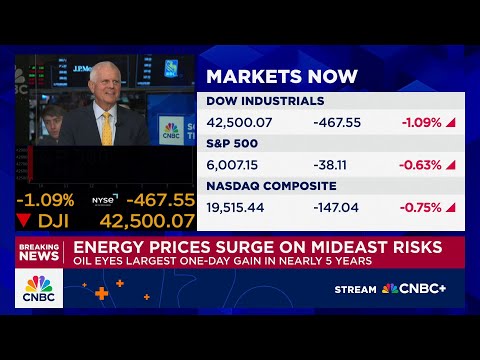
Ongoing volatility will impact equity markets for the year, says Citi's Scott Chronert
CNBC Television· 2025-06-13 14:18
Closer look at the markets here and reaction to the geopolitical news overnight. S&P's down 610 of 1%. Scott Croner joins us, Cityroup US equity strategist.He's here at Post 9. He raised his year-end S&P target to 6,300 this week from 5800. So kind of catching up with the market here, I guess, as we continue to make new highs, although a step back today.Does this how do you think that what happened overnight impacts the US equity market if at all. Yeah, Sarah. So, I I the way we've been talking about it is ...
Citigroup Digital Transformation Strategy Profile 2025: Innovation Programs, Tech Strategies, Product Launches and Partnerships
GlobeNewswire News Room· 2025-06-13 08:06
Core Insights - The report titled "Enterprise Tech Ecosystem Series - Citigroup Inc. 2025" provides a comprehensive overview of Citigroup's technology activities, focusing on digital transformation strategies, innovation programs, and technology initiatives [1][4]. Company Overview - Citigroup Inc. is a diversified financial services provider operating through five reportable segments: Services, Markets, Banking, Wealth, and US Personal Banking (USPB) [2]. - The Services segment includes Treasury and Trade Solutions (TTS) and Securities Services, while the Markets segment offers sales and trading services across various asset classes [2]. - Banking encompasses investment banking and corporate lending, and Wealth includes services tailored for ultra-high net worth individuals and affluent clients [3]. Technology Activities - The report details Citigroup's digital transformation strategies and innovation programs, highlighting the company's focus on technology initiatives [4][6]. - Key insights include an overview of technology initiatives, partnerships, product launches, and the estimated ICT budgets and major ICT contracts [6]. - The report also provides insights into Citigroup's tech operations, strategies, and various technology themes under focus [6]. Investment and Partnerships - The report outlines Citigroup's investment strategies, including acquisitions and partnerships, as well as a network map of these activities [6]. - It emphasizes the importance of innovation programs and accelerators in driving Citigroup's technology initiatives [6]. Key Executives - The report includes information on key executives involved in Citigroup's technology and innovation strategies [6].