
Deutsche Bank AG(DB)

Search documents
德银预测:到2030年全球央行可能会持有大量比特币和黄金储备
Hua Er Jie Jian Wen· 2025-10-10 02:25
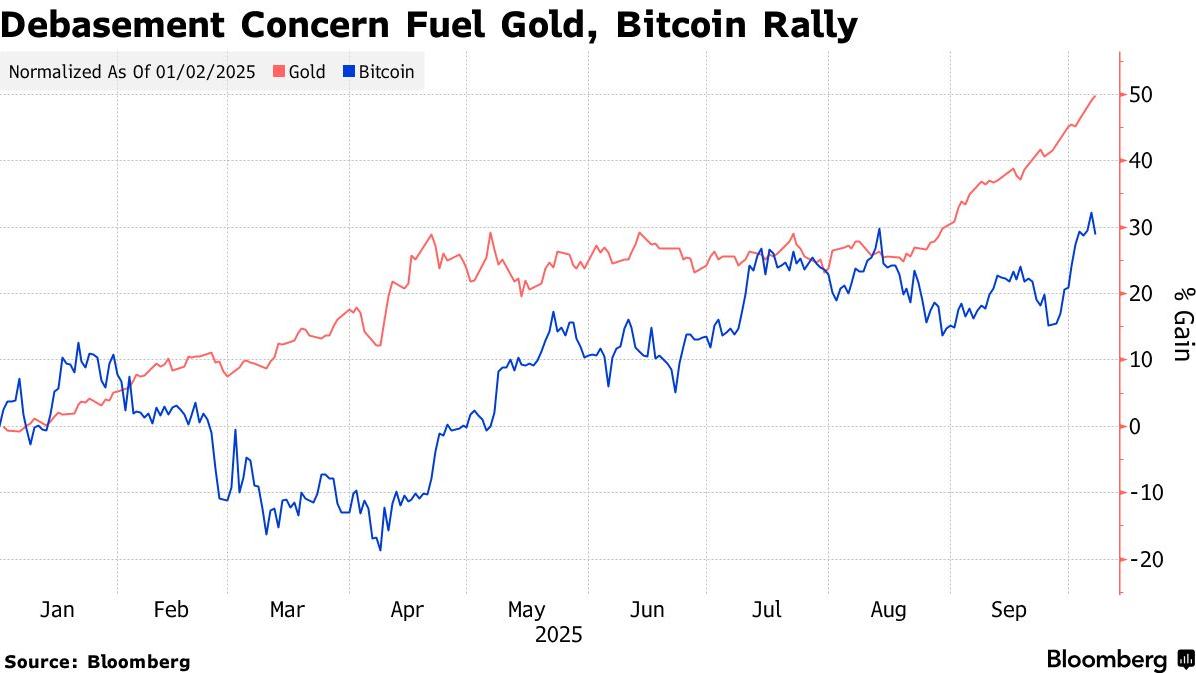
Group 1: Core Insights - The trend of de-dollarization and increased demand for safe-haven assets is leading to a significant shift in traditional central bank reserve allocations, with Bitcoin and gold expected to become important components by 2030 [1] - The report from Deutsche Bank highlights that the share of the US dollar in global reserves has decreased from 60% in 2000 to an estimated 41% by 2025, creating space for alternative reserve assets like gold and Bitcoin [1][2] - Gold's status as a traditional safe-haven asset is being reinforced, with central banks becoming net buyers since 2010, and the total amount of gold held in global reserves exceeding 36,000 tons [2] Group 2: Bitcoin as a Reserve Asset - Bitcoin is gaining attention as a potential reserve asset, drawing parallels to the historical discussions surrounding gold, with analysts suggesting it could become a new "financial safety cornerstone" [3] - Despite the growing interest, the debate around Bitcoin's role in central bank reserve strategies remains contentious, with its performance as an asset prompting wider discussions [3] Group 3: Perspectives on the Dollar - Not all market observers agree with the optimistic outlook for Bitcoin and gold as reserve assets, with some analysts suggesting that stablecoins could unlock new demand for the US dollar, potentially adding $1.4 trillion in demand by 2027 [4] - The Deutsche Bank report maintains a cautious stance, asserting that neither Bitcoin nor gold will completely replace the dollar, but rather serve as complementary tools in central bank reserve strategies [4]

与黄金共舞!德银重磅预测:2030年央行将大举增持比特币
智通财经网· 2025-10-10 00:58
Core Insights - Deutsche Bank's research indicates that central banks may significantly increase their holdings of Bitcoin and gold by 2030 due to rising institutional recognition and a weakening dollar [1] - The report highlights that Bitcoin could become a new "financial safety cornerstone" for central banks, akin to the role gold played in the 20th century [1] Group 1: Market Trends - Global demand for Bitcoin and gold is reaching historical highs, driven by economic uncertainty from U.S. tariff policies and geopolitical risks, prompting investors to hedge against inflation [1] - Gold has surpassed $4,000 per ounce, while Bitcoin's trading price is near its historical peak, reinforcing its status as an institutional "safe-haven tool" [1] - Since the 2008 financial crisis, the proportion of gold in central bank balance sheets has significantly increased, with central banks becoming net buyers of gold since 2010 [1] Group 2: Dollar De-dollarization - The rise in gold prices is closely linked to the de-dollarization process, with the dollar's share in global reserves dropping from 60% in 2000 to an estimated 41% by 2025, benefiting both gold and Bitcoin [5] - In June, net inflows into gold ETFs and Bitcoin ETFs reached $5 billion and $4.7 billion, respectively, both setting monthly records [5] Group 3: Contrasting Views - There are opposing views, such as those from JPMorgan analysts, who suggest that stablecoins may create new demand for dollars, potentially leading to an additional $1.4 trillion in dollar demand by 2027 [5] - Deutsche Bank's economist, Marianne Laubrey, argues that both Bitcoin and gold cannot fully replace the dollar and should serve as a "supplement" to sovereign currencies within central bank reserves [5] - Laubrey notes that as volatility decreases and regulatory support from countries like the U.S. and China increases, market confidence in digital assets is strengthening [5]

X @Watcher.Guru
Watcher.Guru· 2025-10-09 18:14
Market Trends & Predictions - Deutsche Bank predicts central banks may hold significant amounts of Bitcoin and gold by 2030 [1] - The predicted holdings are valued at $1.5 trillion [1]
NineDot Energy Announces $175 Million Corporate Debt Facility from Deutsche Bank
Businesswire· 2025-10-09 14:35
Core Insights - NineDot Energy has completed a $175 million revolving debt financing from Deutsche Bank, highlighting the significance of battery energy storage in enhancing the sustainability of the New York electric grid [1] Company Summary - NineDot Energy is recognized as the leading developer of community-scale battery energy storage systems (BESS) in the New York City metro area [1] - The financing from Deutsche Bank underscores NineDot's leadership position in the energy storage sector [1] Industry Summary - The transaction emphasizes the growing importance of battery energy storage systems in the transition towards a cleaner and more sustainable electric grid in New York [1]

近五分之一Z世代“非常担心”AI会抢走饭碗
财富FORTUNE· 2025-10-09 13:05
Core Insights - A recent survey by Deutsche Bank Research indicates that nearly one-fifth of Generation Z workers are concerned that artificial intelligence (AI) will take their jobs within the next two years, highlighting a significant generational divide in job security anxiety [2][3] - The survey, conducted across six countries, found that 24% of respondents aged 18-34 rated their job loss concerns at 8 or above on a scale of 0-10, compared to only 10% of those aged 55 and above [2][3] - The overall concern about job loss due to AI increases from 18% for the next two years to 22% when considering a five-year timeline, indicating a growing perception of AI as a long-term threat to job security [2][3] Generational and Regional Differences - The survey results reveal generational and regional disparities in AI application and trust, reflecting a strong demand for AI training and self-improvement among workers [3] - Younger individuals feel a higher risk of job loss due to AI, particularly in sectors like software engineering and customer service, where entry-level job openings have sharply decreased [3][4] - In contrast, only 10% of respondents aged 55 and above believe AI will significantly threaten their employment in the next two years, likely due to their experience and adaptability [4] Regional AI Usage and Employment Trends - The usage rate of AI in the workplace is higher in the U.S. (56%) compared to Europe (average of 52%), with notable differences in AI application across countries [5] - The youth unemployment rate in the U.S. has surged, contrasting with declining rates in the Eurozone and the UK, suggesting that the impact of AI on youth employment may not be uniform globally [5] - The analysis indicates that the U.S. labor market is characterized by low turnover rates, which have increased the time it takes for young job seekers to find new employment [5] Training and Trust Issues - The research highlights a lack of adequate corporate training, with only about 25% of respondents in Europe and nearly one-third in the U.S. having received AI-related training [6] - There is a trend of self-directed learning among employees to bridge skill gaps, although trust in AI remains low, with about one-third of frequent users expressing skepticism about AI-generated information, especially in sensitive areas like healthcare and personal finance [7]

Deutsche Bank and Jeffrey Epstein’s ghost
Yahoo Finance· 2025-10-08 14:44
From 2013 to 2018, Deutsche Bank opened more than 40 accounts for the financier—after JPMorgan Chase had severed its ties with Epstein, New York Department of Financial Services investigators found and the two civil complaints claim. For the next five years, the bank processed millions in allegedly suspicious transactions tied to Epstein’s web of trusts, including payments to women described as “tuition fees” and large cash withdrawals structured to avoid reporting requirements. When New York regulators fin ...
Top Stock Pick Report: A Q3 For the Record Books
Schaeffers Investment Research· 2025-10-07 16:25
Core Insights - The third quarter performance of the selected stocks was strong, with 14 out of 18 stocks finishing in positive territory, and 12 of those achieving double-digit gains [2][3] - Notably, four stocks have doubled in value year-to-date, while 13 stocks have recorded double-digit gains [2] - The report provides a ranking of the 18 stocks based on their year-to-date returns and offers insights into their outlook for the fourth quarter [2] Stock Performance Summary - **Beam Therapeutics (BEAM)**: Q3 gain of 42.68%, YTD return of 4.03% [3] - **Bloom Energy (BE)**: Exceptional Q3 gain of 253.55%, YTD return of 309.14% [3] - **Boeing (BA)**: Q3 gain of 3.01%, YTD return of 23.12% [3] - **Carvana (CVNA)**: Q3 gain of 11.95%, YTD return of 90.70% [3] - **CF Industries (CF)**: Q3 loss of 2.50%, YTD return of 6.03% [3] - **Coinbase Global (COIN)**: Q3 loss of 3.71%, YTD return of 50.98% [3] - **Dell Technologies (DELL)**: Q3 gain of 15.64%, YTD return of 26.09% [3] - **Deutsche Bank (DB)**: Q3 gain of 20.94%, YTD return of 108.91% [3] - **Ezcorp (EZPW)**: Q3 gain of 37.18%, YTD return of 49.39% [3] - **LendingClub (LC)**: Q3 gain of 26.27%, YTD return of -6.38% [3] - **Nebius Group (NBIS)**: Q3 gain of 102.91%, YTD return of 356.10% [3] - **Opera (OPRA)**: Q3 gain of 9.21%, YTD return of -2.85% [3] - **Rocket Lab (RKLB)**: Q3 gain of 33.94%, YTD return of 108.99% [3] - **Roku (ROKU)**: Q3 gain of 13.93%, YTD return of 39.22% [3] - **Sea (SE)**: Q3 gain of 11.75%, YTD return of 73.99% [3] - **SEI Investments (SEIC)**: Q3 loss of 5.58%, YTD return of 3.18% [3] - **SoFi Technologies (SOFI)**: Q3 gain of 45.09%, YTD return of 65.62% [3] - **STMicroelectronics NV (STM)**: Q3 loss of 7.07%, YTD return of 16.54% [3] - **Total Gain**: Cumulative YTD return of 1322.80% across all stocks [3] Notable Stock Insights - **Nebius Group NV (NBIS)**: Strong performance in the AI sector, with 10% of the stock's float sold short [3] - **Bloom Energy Inc (BE)**: Benefiting from the data center boom, with a significant Q3 gain [4] - **Rocket Lab Corp (RKLB)**: Showing bullish potential despite a recent stock sale [5] - **Deutsche Bank AG (DB)**: A solid performer in the banking sector, demonstrating value investing characteristics [5] - **Carvana Co (CVNA)**: Positive momentum following earnings, with decreasing short interest [6] - **Sea Limited (SE)**: Consistent performance with three consecutive profitable quarters [6] - **SoFi Technologies (SOFI)**: Testing support levels, with potential for further gains [7] - **Coinbase Global Inc (COIN)**: Continues to face skepticism from analysts despite its crypto focus [8] - **Ezcorp Inc (EZPW)**: Positive bounce off its 200-day moving average, indicating potential growth [8] - **Roku Inc (ROKU)**: Reinventing itself after being oversold [9] - **Dell Technologies Inc (DELL)**: Monitoring external factors like chip imports and tariffs [9] - **Boeing Co (BA)**: Currently in a channel of higher highs, indicating potential for recovery [9] - **STMicroelectronics NV (STM)**: Struggling to recover from a post-earnings gap [10] - **CF Industries (CF)**: Upcoming earnings report to be closely watched [10] - **Beam Therapeutics Inc (BEAM)**: Trading at its highest level since March, showing signs of recovery [10] - **SEI Investments Co (SEIC)**: Facing downward pressure, testing its 200-day moving average [10] - **Opera Ltd (OPRA)**: Struggling to capitalize on previous positive ratings [11] - **LendingClub Corp (LC)**: Despite being the worst performer, still showing resilience with a recent quarterly gain [11] Market Sentiment - Several stocks, including BEAM, COIN, DELL, NBIS, ROKU, and STM, have high Relative Strength Indexes, indicating potential overbought conditions [12] - Despite the strong performance, there are still bullish cases to be made for all 18 stocks listed [12]






德意志银行、美国银行分别将AMD目标价上调至200美元、250美元
Ge Long Hui A P P· 2025-10-07 11:33
格隆汇10月7日|德意志银行将AMD目标价从150美元上调至200美元。美国银行将AMD目标价从200美 元上调至250美元。 ...


Swift, Big Banks Are Building a Blockchain Network That Could Transform Global Money Transfers—And Leave Outdated Systems Behind
Yahoo Finance· 2025-10-06 16:31
Core Insights - Swift, a Belgium-based network, is collaborating with over 30 major banks to develop a blockchain-based infrastructure aimed at making international payments instantaneous and integrating traditional banking with digital currencies [1][2]. Group 1: Initiative Overview - The initiative focuses on creating a shared digital ledger for real-time, 24/7 cross-border payments, enhancing compatibility with stablecoins, tokenized bank deposits, and central bank digital currencies [2]. - The current international money transfer process is slow and costly, with wire transfers taking days and incurring multiple fees [3]. Group 2: Technological Advancements - The blockchain overhaul aims to enable instant cross-border payments, which is expected to reduce costs associated with the current multi-day settlement process [4]. - The consortium includes major banks such as JPMorgan Chase, HSBC, Deutsche Bank, and others from the Middle East and Africa [5]. Group 3: Market Context - The announcement coincides with the rising significance of stablecoins, which are projected to reach up to $4 trillion in circulation by 2030, facilitating $100 trillion in trade annually [5].


现货黄金向上触及3930美元/盎司,年内累涨50%;半导体股普涨;德银称长期持有AI是最佳策略【美股盘前】
Mei Ri Jing Ji Xin Wen· 2025-10-06 10:32
Group 1 - Major stock index futures are showing positive movements, with Dow futures up 0.12%, S&P 500 futures up 0.28%, and Nasdaq futures up 0.47% [1] - Spot gold has reached $3,940 per ounce, marking a daily increase of 1.38% and a year-to-date increase of over 50%, setting a new historical high [2] - Gold stocks are experiencing a pre-market surge, with Harmony Gold up nearly 4% and Coeur Mining up over 2% [3] Group 2 - Semiconductor stocks are also seeing pre-market gains, with Micron Technology up nearly 4%, TSMC up nearly 1%, and Intel up over 0.5% [4] - AMD has increased by over 1% in pre-market trading, following Jefferies raising its target price from $160 to $170 [5] - Firefly Aerospace has announced an agreement to acquire national security technology company SciTec for approximately $855 million, with the stock price of Firefly rising over 16% in pre-market trading [6] Group 3 - OPEC+ has agreed to increase oil production by 137,000 barrels per day starting in November, with the next meeting scheduled for November 2 [7] - Neuralink, a brain-computer interface company, has submitted its first peer-reviewed paper containing human data, marking a significant milestone for the company [8] - Deutsche Bank's latest research suggests that holding AI investments long-term is the best strategy, as discussions around an "AI bubble" have cooled down [9]


