
Deutsche Bank AG(DB)

Search documents
“坚定看空!”华尔街发布重大警告!
券商中国· 2025-08-14 01:22
Core Viewpoint - Multiple Wall Street institutions have issued warnings about a potential correction in the U.S. stock market, with UBS taking a notably bearish stance on the U.S. economy, dollar, and equities [2][4]. Group 1: Economic Outlook - UBS predicts a sharp slowdown in U.S. GDP growth from 2.0% in Q2 to 0.9% by Q4, significantly below the consensus estimate of 1% [4]. - Deutsche Bank warns that tariff increases and tightened immigration policies will negatively impact the U.S. economy, raising inflation while weakening growth, with limited room for future rate cuts by the Federal Reserve [10][11]. Group 2: Stock Market Predictions - Stifel analysts forecast a potential 14% decline in the S&P 500 index by the end of 2025, with a target of 5500 points [6]. - UBS sets a year-end target for the MSCI global index at 960 points, with a warning of significant downside risks in the near term [4]. Group 3: Market Sentiment and Risks - There is a growing concern about retail investor enthusiasm, with retail trading accounting for about 20% of total options trading activity, surpassing levels seen during the "meme stock" frenzy in 2021 [7][8]. - The share of stocks in household financial assets has surged to 36%, the highest level recorded since the 1950s, indicating potential market overheating [7]. Group 4: Inflation and Monetary Policy - Deutsche Bank anticipates that core CPI inflation may rise by approximately 0.5 percentage points due to tariff impacts, which is significantly higher than market consensus [10][11]. - The bank suggests that the current nominal neutral interest rate should be viewed closer to 2.5% rather than 2%, indicating limited room for rate cuts by the Federal Reserve [11].





德意志银行二季度增持英伟达、Meta、谷歌C、德银、特斯拉
Jin Rong Jie· 2025-08-12 22:33
Group 1 - Deutsche Bank established long positions in iShares S&P Small-Cap 600 Growth ETF in Q2 [1] - Increased holdings in Nvidia, Meta Platforms, Google Class C, Deutsche Bank, and Tesla [1] - Cleared positions in SPDR Euro Stoxx 50 ETF and iShares Convertible Bond ETF [1] Group 2 - Reduced holdings in UnitedHealth, Berkshire Hathaway Class B, Merck, and Amgen [1] - Major positions include Microsoft, Nvidia, Apple, Google Class A, and Amazon [1]





X @Bloomberg
Bloomberg· 2025-08-12 18:50
Deutsche Bank is hiring former salespeople from Goldman Sachs and Bank of America as part of the bank’s effort to expand in emerging markets https://t.co/FQumrG7YuC ...
预期美国滞胀且美联储降息空间有限,德银建议做空十年期美债
Hua Er Jie Jian Wen· 2025-08-12 00:53
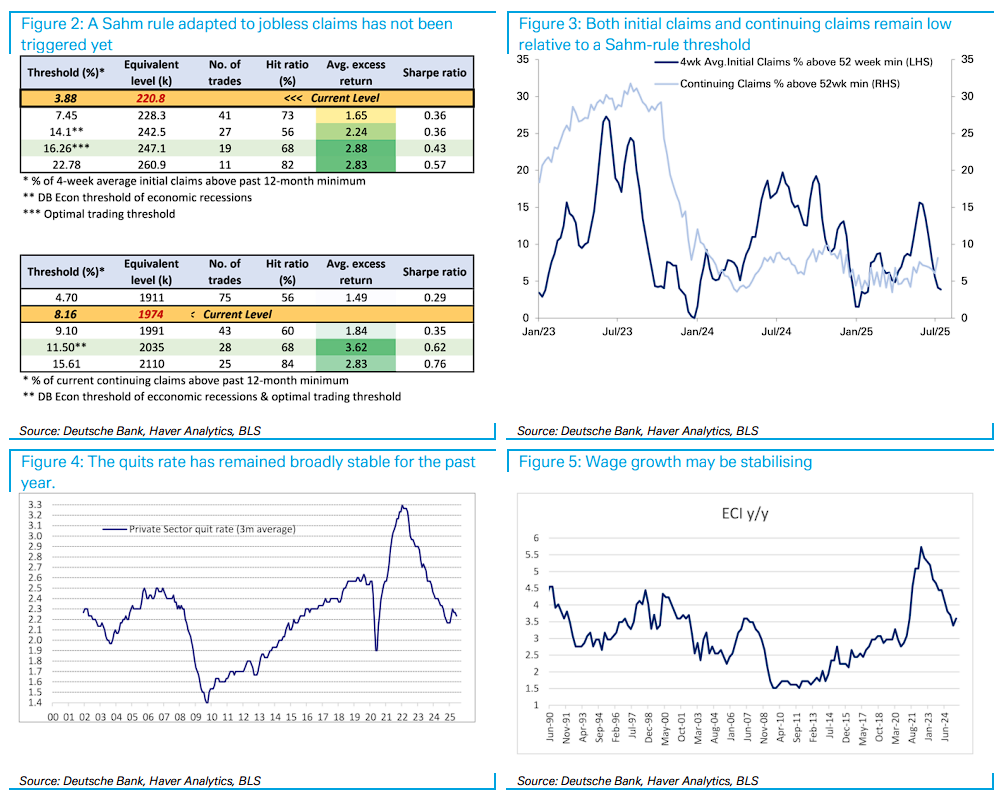
Core Viewpoint - Deutsche Bank's strategist team believes that the U.S. economy is facing stagflation risks due to supply-side shocks, recommending short positions on 10-year U.S. Treasuries [1] Economic Impact of Tariffs and Immigration Policies - The bank expects core CPI inflation to rise by approximately 0.5 percentage points in the coming months due to tariff impacts, significantly above market consensus [2] - Tariff policies are likened to a combination of VAT increases and negative supply shocks, with tariffs impacting low-income households more than high-income groups, leading to a mild negative effect on overall demand [4] - Stricter immigration policies further exacerbate labor market supply shocks, potentially lowering the non-farm employment growth equilibrium to a range of 50,000 to 100,000 jobs [4] Labor Market Analysis - Despite recent weak employment data, Deutsche Bank believes initial expectations have not materially changed, with the latest non-farm employment growth slightly below the equilibrium range [5] - The bank notes that the unemployment claims data has not triggered the Sam Rule, and wage growth remains resilient, consistent with interpretations of negative supply shocks [5] Inflation Risks and Interest Rates - Deutsche Bank's analysis indicates significant upside risks to inflation, with core CPI month-on-month growth expected to be in the range of 0.3% to 0.4% [11] - The current market pricing of the terminal rate at around 3% is considered low compared to a neutral real rate close to 2%, suggesting that the market may be underpricing future inflation [11] Investment Strategy - Deutsche Bank recommends shorting 10-year U.S. Treasuries, with a target yield of 4.60% and a stop-loss at 4.05%, citing technical and seasonal factors supporting this strategy [12] - For investors looking to hedge spread risks, the bank suggests going long on 10-year SOFR with a target of 4.10% and a stop-loss at 3.55% [12]
预期“美国滞胀”且美联储降息空间有限,德银建议:做空十年期美债
Hua Er Jie Jian Wen· 2025-08-12 00:36
Core Viewpoint - Deutsche Bank strategists believe the U.S. economy is facing stagflation risks due to supply-side shocks, recommending short positions on 10-year U.S. Treasuries [1][7]. Economic Impact of Tariffs and Immigration Policies - The report indicates that tariff increases and tightened immigration policies will negatively impact the U.S. economy, raising inflation while weakening economic growth, but not leading to a recession [1][4]. - Tariffs are expected to raise core CPI inflation by approximately 0.5 percentage points in the coming months, significantly above market consensus [1][8]. - The tightening of immigration policies is projected to lower the non-farm employment growth equilibrium to a range of 50,000 to 100,000 jobs, although wage growth remains resilient [4][5]. Labor Market Analysis - Despite recent weak employment data, Deutsche Bank maintains that initial expectations have not materially changed, attributing fluctuations to seasonal factors [5]. - The unemployment claims data has not triggered the Sam Rule, and the turnover rate has remained stable over the past year, aligning with the interpretation of negative supply shocks [5]. Inflation Outlook - The structural changes in supply and demand are expected to push inflation higher while weakening economic growth, without leading to a recession [7]. - The current market pricing of the terminal rate is around 3%, with actual rates significantly below neutral levels, indicating potential upward pressure on inflation [9]. Investment Strategy - Deutsche Bank suggests a short position on 10-year U.S. Treasuries, with a target yield of 4.60% and a stop-loss at 4.05%, supported by technical and seasonal factors [10]. - For investors looking to hedge against spread risks, the recommendation includes going long on 10-year SOFR with a target of 4.10% and a stop-loss at 3.55% [10].
华尔街上演“人机对决”:人类交易员“谨慎悲观”,量化基金“猛踩油门”
Hua Er Jie Jian Wen· 2025-08-11 07:17
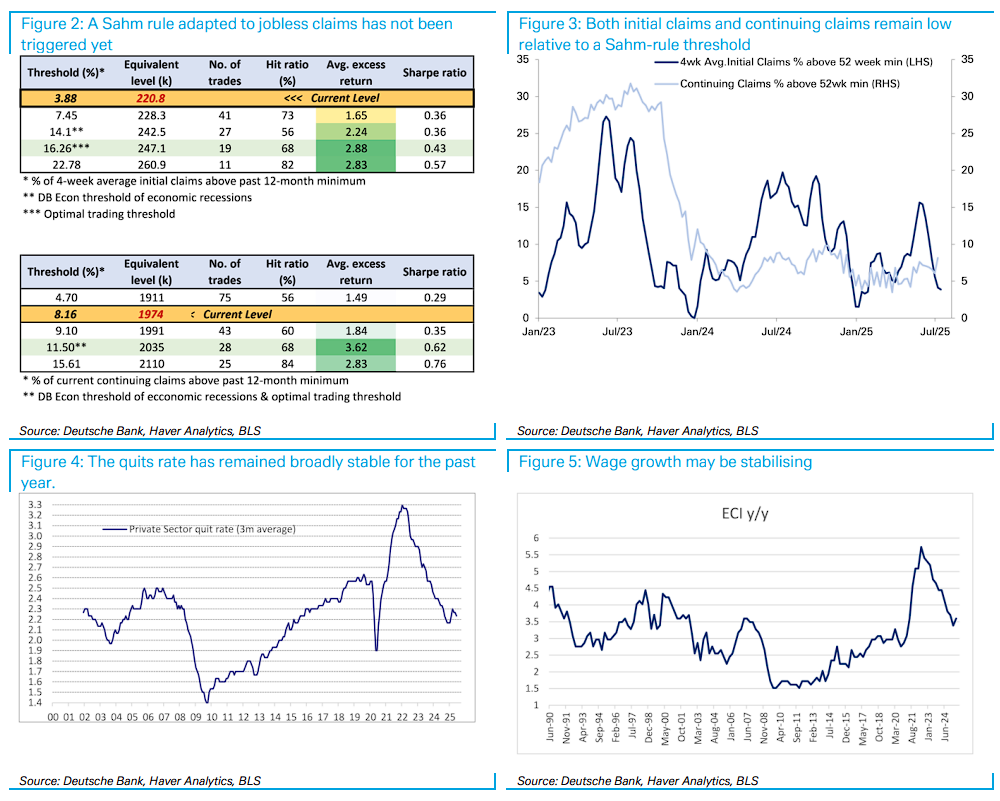
Core Viewpoint - A significant divergence in market outlook is occurring on Wall Street, characterized by a contrast between algorithm-driven quantitative funds and cautious human traders [1] Group 1: Market Dynamics - Systematic strategy funds have increased their long positions in stocks to the highest level since early 2020, driven by strong market momentum, with the S&P 500 rebounding nearly 30% from its April low [1][2] - In contrast, subjective fund managers have reduced their stock exposure from "neutral" to "moderately underweight" due to ongoing concerns about global trade, corporate earnings, and economic growth [1][2] - The aggressive buying by quantitative funds has led to extreme positioning, with commodity trading advisors (CTAs) holding $50 billion in long positions in U.S. stocks, placing their risk exposure in the 92nd percentile historically [2][3] Group 2: Investor Sentiment - Human traders are hesitant to buy expensive stocks at historical highs, with some hoping for a market pullback to justify new purchases [2][3] - Analysts believe that the current "human vs. machine" stalemate will not last long, with potential for increased market volatility if subjective traders begin to sell due to weak economic or earnings data [4] - The cautious positioning of human traders may act as a safety net for the market, potentially preventing a larger sell-off when a correction occurs [5]
美股牛市共识破裂!计算机驱动型基金强势做多,人类交易员转向防守
智通财经网· 2025-08-11 00:28
Core Viewpoint - There is a significant divergence in market outlook between human traders and computer-driven quantitative investors, with the latter showing unprecedented bullish sentiment since the onset of the COVID-19 pandemic [1][2]. Group 1: Divergence in Trading Strategies - Computer-driven quantitative investors utilize systematic strategies based on momentum and volatility signals, while discretionary fund managers rely on economic and earnings trends for their decisions [1]. - The current level of divergence between discretionary and systematic stock allocation strategies is rare and historically does not last long [2]. Group 2: Market Sentiment and Predictions - Professional investors have reduced their stock holdings from "neutral" to "modestly underweight" due to ongoing uncertainties in global trade, corporate earnings, and economic growth [4]. - Despite the S&P 500 reaching record highs, many investors are hesitant to buy stocks at these levels, anticipating a potential sell-off as a buying opportunity [4]. Group 3: Technical vs. Fundamental Analysis - Trend-following algorithmic funds have aggressively increased their positions as the S&P 500 rebounded nearly 30% from its April lows, reaching the highest level of long positions since January 2020 [4]. - The S&P 500 has experienced its longest period of calm in two years, currently trading within a narrow range [4]. Group 4: Volatility and Market Dynamics - The Chicago Board Options Exchange Volatility Index (VIX) recently closed at 15.15, near its lowest level since February, indicating low implied volatility in the market [5]. - There is a higher likelihood of mean-reversion sell-offs when systemic crowding occurs, as noted by alternative investment executives [5]. Group 5: Potential for Market Corrections - Historical patterns show that computer-driven strategies can lead to collective buying, but if discretionary traders begin to sell due to economic concerns, volatility may increase, prompting algorithmic strategies to also exit positions [6]. - Systematic funds, particularly Commodity Trading Advisors (CTAs), are at risk of triggering significant market reversals if they start to liquidate extreme positions [7]. Group 6: Opportunities for Discretionary Managers - Any market pullback caused by systematic selling could create buying opportunities for discretionary fund managers who missed out on the year's gains, potentially preventing larger market declines [9].
Vatee万腾:华尔街多家巨头同步预警美股回调 美股会掉头向下吗?
Sou Hu Cai Jing· 2025-08-05 10:23
Group 1 - Major financial institutions like Morgan Stanley, Deutsche Bank, and Evercore ISI have issued warnings about the current valuation of the U.S. stock market, suggesting a potential significant correction is imminent [1][3][4] - The S&P 500 index has risen over 20% since its low in April, driven by trends such as artificial intelligence, declining inflation expectations, and bets on Federal Reserve rate cuts, but recent economic data raises concerns [3][4] - Morgan Stanley's chief strategist Mike Wilson predicts a possible decline of up to 10% in the S&P 500 index due to rapid market gains, while Evercore ISI suggests a more aggressive correction of 15% [3][4] Group 2 - Deutsche Bank highlights that the stock market's nearly one-sided rise over the past three months indicates a short-term adjustment is imminent, with investor confidence and positioning levels nearing extremes [4] - The current valuation increase is not supported by broad earnings growth, as significant capital has flowed into a few tech-heavy stocks, creating structural vulnerabilities in the market [4] - Some analysts believe the upcoming correction may be more of a technical adjustment rather than a trend reversal, but market sentiment often shifts when investors are least vigilant [4][5] Group 3 - The market is pricing in at least one rate cut from the Federal Reserve this year, contingent on a "moderate slowdown" in the economy rather than a sudden halt [5] - If employment or consumer data continues to deteriorate without action from the Federal Reserve, the market may reassess the likelihood of a "soft landing," which could lead to volatility [5] - Vatee suggests that the next few trading weeks will be crucial in determining the sustainability of the current bull market, urging investors to focus on fundamentals and prepare for potential fluctuations [5]

华尔街齐声示警:标普500或将下跌10%至15%
华尔街见闻· 2025-08-05 10:21
Core Viewpoint - Analysts from major Wall Street firms are warning clients to prepare for a potential pullback in the U.S. stock market due to high valuations clashing with weakening economic data [1][4]. Group 1: Market Predictions - Morgan Stanley's strategist Mike Wilson predicts a potential adjustment of up to 10% in the S&P 500 index this quarter, citing tariffs impacting consumer and corporate finances [4]. - Evercore's Julian Emanuel forecasts a possible decline of up to 15% [4]. - Deutsche Bank's analyst team, led by Parag Thatte, notes that the market has risen for three consecutive months, indicating that a pullback is overdue [4]. Group 2: Economic Concerns - Recent data shows rising inflation in the U.S., alongside slowing job growth and consumer spending, raising concerns about the economic outlook [6]. - Historically, the S&P 500 index has performed poorly in August and September, averaging a decline of 0.7% during these months over the past 30 years, while other months average a gain of 1.1% [6]. - The S&P 500's 14-day Relative Strength Index (RSI) recently surpassed 76, indicating overbought conditions, which is above the 70 threshold considered "overheated" by technical analysts [6]. Group 3: Market Sentiment and Strategy - Despite the short-term bearish sentiment, analysts maintain a "buy on the dip" stance, emphasizing the long-term bullish trend of the market [7]. - Evercore's Emanuel advises clients to hold positions, particularly in companies benefiting from the AI boom [7]. - Deutsche Bank's Thatte highlights that historically, the S&P 500 experiences a small pullback of about 3% every 1.5 to 2 months and a larger pullback of over 5% every 3 to 4 months [7]. Group 4: Market Reactions - Following these warnings, traders appear to be accepting the advice to buy on dips, as evidenced by the S&P 500 and Nasdaq 100 indices both rising over 1% after a previous decline [8].

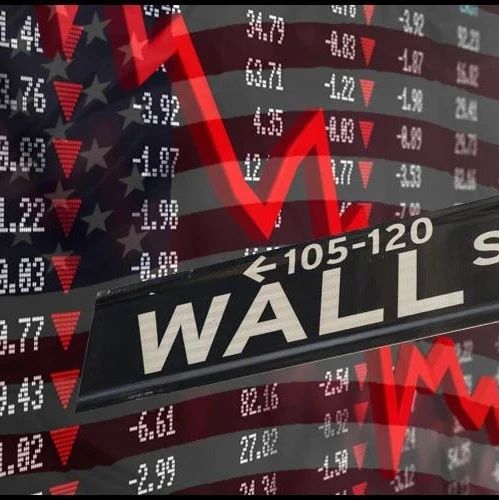
【微特稿·投资与消费】多家国际金融机构警示美股下跌风险
Xin Hua She· 2025-08-05 09:13
Group 1 - Major international financial institutions, including Morgan Stanley, Deutsche Bank, and Evercore ISI, have warned clients to prepare for a potential decline in U.S. stock prices due to deteriorating economic data [1] - The S&P 500 index has rebounded sharply since its low in April, even reaching new highs, but analysts believe a slight pullback is overdue [1] - Morgan Stanley's analyst Mike Wilson predicts that the S&P 500 index could correct by as much as 10% this quarter due to the impact of U.S. tariff policies on consumers and corporate balance sheets [1] - Evercore ISI analyst Julian Emanuel anticipates a potential decline of 15% in the S&P 500 index [1] - Options trading indicates a heightened expectation of a stock market downturn, with the cost of hedging against a significant drop becoming increasingly expensive [1] Group 2 - Vanguard Group warned that the investor enthusiasm for AI stocks in the U.S. market in 2024 may have overstretched the short-term development potential of AI technology, leading to correction risks for related companies' stock prices [2] - Even if AI technology does lead to transformative changes, the leading companies may still face stock price corrections, although the timing of such corrections remains uncertain, potentially starting as late as 2025 [2]