
Deutsche Bank AG(DB)

Search documents
加拿大4月大规模抛售美元资产--一个值得重视的“去美元样本”
Hua Er Jie Jian Wen· 2025-06-27 07:38
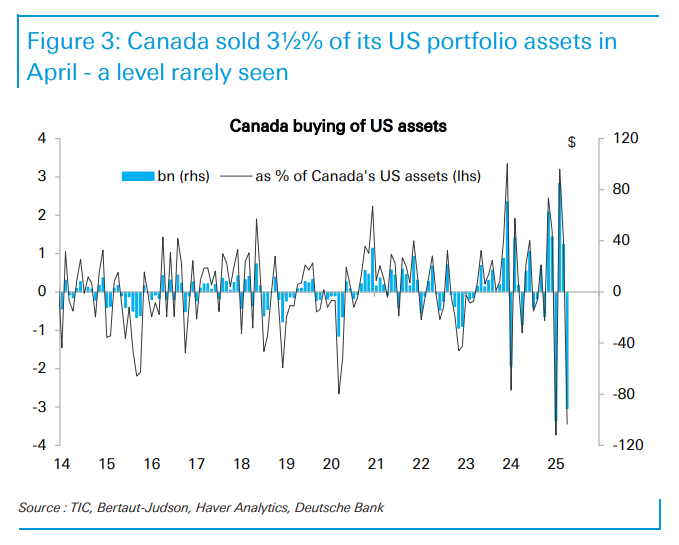
Core Insights - Canada made a significant divestment of $90 billion in U.S. assets in April, representing 3.5% of its total U.S. asset holdings, which is historically rare [1][4] - Deutsche Bank suggests that if this divestment is linked to tariff threats, it may signal a trend for other countries to follow suit, potentially accelerating the process of "de-dollarization" globally [3][10] Group 1: Canadian Asset Divestment - The divestment was primarily focused on fixed income products, with notable reductions in equities as well [4] - The scale of this asset reduction is unprecedented in the last decade, indicating a sudden and concentrated decision by Canadian investors [4][6] - The uncertainty index for Canada rose significantly in February and March, coinciding with the onset of tariff threats from the U.S. [8] Group 2: Global Implications - The divestment by Canada was offset by significant buying from the UK, suggesting a broader trend of capital reallocation within Europe [9] - If Canada's actions are indicative of a wider trend, more countries may reduce their U.S. asset holdings in the future, posing potential downward pressure on the U.S. dollar [9][10] - The overall TIC data for April did not show any unusual foreign purchases of U.S. assets, despite market volatility, indicating a complex interplay of factors affecting the dollar [10]


贝森特正在密谋一步大棋
华尔街见闻· 2025-06-27 03:47
Core Viewpoint - The "Pennsylvania Plan" proposed by Deutsche Bank aims to address the increasing U.S. deficit by reallocating U.S. Treasury ownership from foreign to domestic investors, thereby reducing reliance on foreign capital and financing the deficit through domestic resources [1][2][3]. Group 1: Economic Context - The U.S. is facing a "twin deficit" dilemma, characterized by both fiscal deficits and trade deficits, which complicates the economic landscape [5][6]. - The U.S. has a significantly negative net foreign asset position, leading to a heavy dependence on foreign funding, which constrains its sovereign independence [6][7]. Group 2: Pennsylvania Plan Strategies - The core strategy of the "Pennsylvania Plan" is to facilitate a historic transfer of U.S. Treasury holdings from foreign to domestic investors [9][10]. - The plan includes two main strategies: reducing dependence on foreign buyers and increasing domestic absorption of Treasury risks [10][11]. Group 3: Reducing Foreign Dependence - Foreign investors currently hold a record amount of U.S. sovereign risk, but demand is declining due to geopolitical shifts and increasing fiscal deficits [11][12]. - A proposed solution is to shorten the duration of foreign investors' exposure by using dollar stablecoins backed by short-term U.S. Treasuries to attract foreign capital [12]. Group 4: Increasing Domestic Absorption - The U.S. private sector has a strong balance sheet and high cash holdings, indicating potential to absorb sovereign credit risk [13]. - Policy measures may include regulatory exemptions, tax incentives, and the issuance of special bonds to encourage domestic purchases of long-term Treasuries [13]. - If incentives are insufficient, mandatory purchases of long-term Treasuries may be implemented, such as pushing retirement plans to absorb more government debt [13]. Group 5: Market Implications - The "Pennsylvania Plan" may not fundamentally resolve the twin deficit issue but could provide the U.S. government with more time by mobilizing domestic savings [14][18]. - The strategy may lead to higher Treasury yields and erosion of Federal Reserve independence, as domestic savings are pushed towards long-term fixed-income assets [15][16]. - A weaker dollar could help rebalance the U.S. external deficit, which may not necessarily be a negative outcome economically [17].

密集发声!多家外资机构力挺中国资产
Xin Lang Cai Jing· 2025-06-23 01:32
Group 1 - Multiple foreign institutions have raised their growth forecasts for the Chinese economy, indicating a strong bullish sentiment towards Chinese assets [1][3] - Goldman Sachs maintains an "overweight" stance on the Chinese stock market, citing a stronger RMB against the USD and improved corporate earnings outlook [1] - Morgan Stanley has adjusted its target for Chinese stock indices upward, predicting a 5% increase for the MSCI China Index, Hang Seng Index, and Hang Seng China Enterprises Index, and a 3% increase for the CSI 300 Index by June 2026 [1] Group 2 - UBS's China equity strategy head noted increased interest in Chinese stocks among investors during recent roadshows in Europe and Asia, with a shift from underweight to neutral or even overweight positions [1][2] - Despite global uncertainties, investors recognize the relative attractiveness of Chinese stocks, although there remains a cautious stance towards emerging markets overall [2] - China's economic resilience is highlighted by strong domestic demand and significant growth in high-tech manufacturing, with retail sales growth reaching 6.4% year-on-year in May [2] Group 3 - Morgan Stanley has revised its GDP growth forecasts for China, increasing them to 4.5% and 4.2% for the next two years, while Deutsche Bank has raised its 2025 GDP growth prediction by 0.2 percentage points to 4.7% [3] - Goldman Sachs has also upgraded its GDP growth forecasts for Q2 and the second half of the year, along with a 0.6 percentage point increase for 2025 [3]


每日机构分析:6月19日
Xin Hua Cai Jing· 2025-06-19 11:49
Group 1 - DBS Bank reports a significant decline in Asian demand for US dollars, with Asian countries holding substantial US assets seeing their currencies perform strongly against the dollar [1] - The return of funds to Singapore has led to a substantial decrease in short-term Singapore dollar interest rates [1] - The Bridgewater Associates notes that the slowdown in US consumer spending is affecting multiple sectors, including real estate, with signs of weakness in tourism, entertainment, and dining services [2] Group 2 - SEB Research predicts that the European Central Bank (ECB) will pause interest rate cuts in July, with two potential cuts in September and December, lowering the deposit rate from 2.00% to 1.50% [1] - Deutsche Bank strategists highlight a new stablecoin regulatory bill approved by the US Senate, which could strengthen the dollar's dominance in the global digital economy [2] - Allspring analysts indicate that the Federal Reserve is currently adopting a "wait-and-see" approach, with potential rate cuts in September if inflation continues to decline towards the 2.0% target [3]
大摩:德银(DB.US)私人银行业务或成被低估的“盈利引擎” 上调目标价至29.5欧元
智通财经网· 2025-06-17 08:24
Group 1 - Morgan Stanley raised Deutsche Bank's (DB.US) European stock target price from €29.2 to €29.5 while maintaining an "Overweight" rating, highlighting the undervalued growth potential of its private banking business [1] - Deutsche Bank's private banking segment consists of wealth management and retail banking, with retail banking expected to achieve breakeven in 2024 and an ROE projected to rise to 4% by 2025 and 10% by 2028, while wealth management's ROE is stable around 20% with an average annual PBT growth of approximately 6% [1] - The completion of the "Unity project" (Postbank integration plan) marks a turning point for Deutsche Bank, with expected improvements in retail banking profitability through branch network optimization, digital channel promotion, and cost structure adjustments [1] Group 2 - Despite the investment banking segment accounting for 45% of Deutsche Bank's PBT and facing uncertain short-term prospects, the improvement in private banking profitability is expected to offset some of this pressure, with private banking's contribution to group profits projected to rise from 26% in 2024 to 30% by 2027 [2] - Deutsche Bank recently raised its CET1 capital target from 13% to 13.5%-14%, aiming to secure regulatory approval for a second round of stock buybacks estimated at €250 million [2] - The report emphasizes that while the capital target increase may exert short-term pressure on the stock price, the enhancement in profitability will drive valuation recovery [2]
6月16日电,德意志银行将西门子能源目标价从95欧元上调至100欧元。
news flash· 2025-06-16 06:48
智通财经6月16日电,德意志银行将西门子能源目标价从95欧元上调至100欧元。 ...
德商银行:日本超长期国债市场处境艰难
news flash· 2025-06-16 06:37
Core Insights - The Japanese ultra-long-term government bond market is facing significant challenges as inflation and interest rate expectations rise steadily [1] - The Japanese Ministry of Finance is considering shifting government bond supply from ultra-long-term bonds to short-term bonds, which may only provide temporary relief [1] - The fundamental issue of rising yields on ultra-long-term Japanese government bonds remains unresolved, leading to a decrease in demand from long-term investors [1] Summary by Categories Market Conditions - The market is experiencing increasing expectations regarding inflation and interest rates set by the Bank of Japan [1] - Long-term investors, typically the largest buyers of long-term bonds, are reducing their demand due to the current market conditions [1] Government Actions - The Japanese Ministry of Finance is contemplating a shift in bond supply strategy, moving from ultra-long-term bonds to short-term bonds [1] - This strategy may only provide a temporary solution to the challenges faced by the ultra-long-term bond market [1] Investor Behavior - There is a notable decline in demand from long-term investors, which is a critical factor affecting the ultra-long-term bond market [1]
全球支付变革!基金香港子公司积极行动
Zhong Guo Ji Jin Bao· 2025-06-15 14:02
Group 1 - The core focus of the news is the recent establishment of a regulatory framework for stablecoins in Hong Kong, marking a significant step in the global financial landscape [1][3]. - The Hong Kong Monetary Authority (HKMA) has initiated a pilot program for the digital Hong Kong dollar (e-HKD+), collaborating with various financial institutions to explore the role of tokenized currencies in cross-border transactions [2][3]. - The second phase of the e-HKD+ pilot program emphasizes three themes: settlement of tokenized assets, programmability, and offline payments, with a specific focus on the interaction between new digital currencies and money market funds (MMFs) [3]. Group 2 - The Hong Kong Legislative Council passed the Stablecoin Ordinance, making Hong Kong the first jurisdiction to establish a comprehensive regulatory framework for fiat-backed stablecoins, effective from May 30, 2024 [3][4]. - The Stablecoin Ordinance introduces a licensing system for stablecoin issuers and allows the HKMA to facilitate the application of blockchain technology in the financial sector [4]. - Several participants, including JD Coin Chain Technology (Hong Kong) and Standard Chartered Bank (Hong Kong), are set to engage in sandbox testing for stablecoin issuance, focusing on cross-border payments and retail applications [4]. Group 3 - Ant International has signed a strategic cooperation memorandum with Deutsche Bank to develop innovative solutions in global treasury management and cross-border payments, including tokenized deposits and stablecoins [5]. - Ant International plans to apply for stablecoin licenses in Singapore and Hong Kong, as well as seek permission in Luxembourg to enhance its blockchain operations [6].

摩根大通上调“最坏情况概率”至17%:霍尔木兹海峡关闭,油价将升至120美元
Hua Er Jie Jian Wen· 2025-06-15 02:58
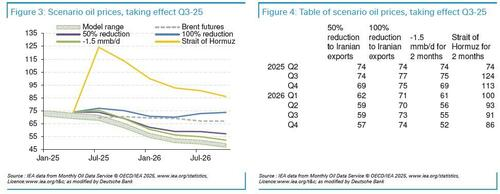
Group 1 - The geopolitical situation in the Middle East is escalating, with oil prices at risk of significant increases due to recent airstrikes on Iranian oil facilities by Israel [1] - Morgan Stanley's commodity analyst Natasha Kaneva has raised the probability of a "worst-case scenario" from 7% to 17%, indicating a higher likelihood of oil price surges if the Strait of Hormuz is closed [1][2] - The current geopolitical premium on oil prices is $10 above the fair value of $66 per barrel, suggesting potential for further price increases [1] Group 2 - The Strait of Hormuz, which accounts for 20% of global oil supply, is under scrutiny, with analysts noting that sustained high energy prices could reignite inflation, countering recent trends of declining consumer prices in the U.S. [2] - Deutsche Bank's energy analyst Hsueh outlined three potential supply disruption scenarios that could push Brent crude prices above $100 per barrel, with a forecasted reduction of Iranian oil exports by 400,000 barrels per day by year-end [2][3] - Market pricing currently reflects only moderate risk scenarios, indicating that the potential for a closure of the Strait of Hormuz is not fully accounted for in oil futures [4] Group 3 - The market appears unprepared for extreme scenarios, with potential for significant oil price volatility if conflicts escalate [6] - Gold is showing potential as a safe-haven asset amid rising tensions, while commodity trading advisors are closely monitoring opportunities for oil price breakouts [6]

欧洲银行“画风突变” 摒弃“军火钱”顾虑转投国防热潮
智通财经网· 2025-06-12 12:41
Core Viewpoint - European banks are shifting their stance towards collaboration with defense manufacturers, moving from a previous reluctance to a proactive engagement in financing defense projects, reflecting a broader trend of rearmament in response to geopolitical threats [1][2][3] Group 1: Shift in Banking Policies - Major European banks, including BNP Paribas, Commerzbank, Deutsche Bank, and Societe Generale, are now emphasizing their partnerships with defense companies, marking a significant change from their previous focus on sustainability [1][3] - Deutsche Bank announced a €1 billion ($1.2 billion) financing initiative for defense-related enterprises, highlighting its commitment to enhancing European security [1] - ING's CEO indicated a fundamental shift in mindset regarding credit applications from defense industries, signaling a welcoming approach [2] Group 2: Government-Driven Initiatives - The rearmament plans in Europe are primarily government-led, necessitating strong relationships between banks and national governments [5] - The European Banking Federation has established a special task force to facilitate collaboration between banks and defense companies, indicating a coordinated effort to support the defense sector [5] - The European Commission is preparing proposals to address various challenges faced by the defense industry, including financing issues [5] Group 3: Financial Opportunities and Challenges - European banks are expected to benefit from the anticipated surge in defense spending, with significant investments planned for military equipment and infrastructure [3][6] - While large defense companies typically have access to financing, smaller firms often face challenges, creating opportunities for banks to provide support through guarantees and trade financing [6] - The asset management divisions of banks are also entering the defense sector, potentially introducing hundreds of billions of euros into defense projects [6] Group 4: Future Outlook - The extent of profits that banks can derive from the expected defense boom remains uncertain, with many initiatives still in the planning stages [6] - The European defense sector is viewed as a high-quality business opportunity, with substantial funds anticipated to flow into it [7]


