
JP MORGAN CHASE(JPM)

Search documents
摩根大通展望2026年中国股票:聚焦“反内卷”政策执行、AI基础设施变现等四大主题
Zheng Quan Shi Bao Wang· 2025-11-27 07:52
Core Viewpoint - Morgan Stanley's China equity strategy team maintains a constructive outlook on the CSI 300 index, projecting a target level of 5200 points by the end of 2026 [1] Investment Themes - The four major investment themes for 2026 include the implementation of "anti-involution" policies, growth in domestic and international AI infrastructure/monetization, favorable macroeconomic conditions in developed markets benefiting overseas sales, and a K-shaped consumption recovery, along with potential new real estate policies [1] Stock Selection - The team has identified IT and healthcare A-shares that can capitalize on China's innovation opportunities, using metrics such as market capitalization, average daily trading volume, and overseas revenue [1] - A shift from value stocks to growth stocks is expected by early 2026 [1] Sector Focus - The team has selected leading A-share companies in sectors such as automotive, battery materials, lithium, photovoltaics, cement, chemicals, coal, steel, dairy, hog farming, liquor, and logistics, which are likely to benefit from the "anti-involution" trend [1] - The transition from price/scale competition to quality competition is seen as a long-term adjustment over a decade [1]

JPMorganChase Announces Intention to Build a New Three-Million Sq Ft Landmark Tower in London
Businesswire· 2025-11-27 06:00
LONDON--(BUSINESS WIRE)--JPMorganChase is proud to announce its intention to build a new three-million square feet tower in London. This transformative project would enable additional capacity for the firm to grow by creating a world-class workplace for up to 12,000 employees, further strengthening London's position as a global financial hub. The plans are subject to a continuing positive business environment in the UK and the receipt of the necessary approvals and agreements at a national and. ...


2026 年全球经济展望:有意识的再耦合-Global Economic Outlook 2026_ A conscious recoupling. Tue Nov 25 2025
2025-11-27 05:43
Summary of J.P. Morgan's Global Economic Outlook 2026: A Conscious Recoupling Industry Overview - The report focuses on the global economic outlook, particularly the impact of trade wars, labor markets, and fiscal policies on GDP growth and inflation trends. Key Points and Arguments Global Economic Growth - Global GDP growth is projected to be resilient, with an estimated increase of 2.3% in 2025, driven by strong capital expenditure (capex) in technology sectors despite a backdrop of trade war concerns [5][7][10] - A modest growth boost is expected from technology investments, particularly in AI, although productivity gains from these investments may take time to materialize [5][14][25] Labor Market Dynamics - Weak labor demand is eroding purchasing power, especially in the U.S., where private sector labor income growth is slowing amid rising inflation [5][19] - There is a projected 35% risk of the U.S. sliding into recession next year due to elevated downside risks interacting with depressed business sentiment [5][30] - The juxtaposition of strong business spending and weak hiring is unprecedented, indicating a potential shift in labor market dynamics [11][14] Inflation Trends - Global core inflation has remained sticky at around 3% for two years, influenced by tight labor markets and elevated wage inflation [5][24] - The expected rebound in labor demand amidst weak supply is likely to sustain inflationary pressures, with U.S. core inflation forecasted to remain above 3% in the first half of 2026 [5][58] Fiscal Policy and Economic Support - Front-loaded fiscal stimulus, particularly in the U.S. and China, is expected to boost global GDP growth in the first half of 2026 [5][21] - The fiscal easing implemented this year is projected to support growth but may lead to entrenched structural deficits, particularly in the U.S. [21][24] Trade War Impacts - The trade war has created imbalances, with tariff avoidance and new technologies contributing to capex strength, but business caution remains a significant drag on hiring [5][43] - The report notes a less disruptive trade war than initially anticipated, with tariff rates settling at levels significantly higher than earlier forecasts [46][54] Consumer Behavior and Spending - Consumer spending is expected to slow, particularly in the U.S., with a projected growth rate of around 1% in the fourth quarter of 2025 [20][19] - Households are in a strong position to smooth spending despite downward pressure on real labor income, but rising job security concerns could disrupt this [19][30] Future Scenarios - The report outlines various scenarios for the future, maintaining a 35% probability of recession, particularly in the U.S., while also highlighting the risks of sticky inflation and potential political influences on monetary policy [30][32] - The outlook suggests that the global economy has reached a critical juncture, with the potential for labor demand to recouple with GDP gains if supportive conditions persist [15][25] Other Important Insights - The report emphasizes the importance of business sentiment in navigating policy shocks and the unusual decoupling of capex growth from labor market performance [10][69] - It highlights the need for careful monitoring of consumer behavior and business sentiment as indicators of future economic resilience [19][30] This comprehensive analysis provides a detailed view of the current economic landscape and potential future developments, emphasizing the interconnectedness of global markets, labor dynamics, and fiscal policies.
2026 年全球外汇展望:看空美元,看多贝塔资产-Global FX Outlook 2026_ Bearish Dollar, Bullish Beta. Tue Nov 25 2025
2025-11-27 05:43
Summary of Global FX Outlook 2026 Company and Industry - **Company**: J.P. Morgan - **Industry**: Foreign Exchange (FX) Market Key Points and Arguments 1. FX Outlook for 2026 - The outlook is bearish on the dollar in the first half of 2026 due to Fed asymmetries, twin deficits, and global recovery, but weakness is constrained by US resiliency [6][37][38] - Expected currency levels include EUR/USD at 1.20, USD/JPY at 164, and USD/CNY at 7.05 [6] 2. Drivers of FX Returns in 2025 - DM FX returns were influenced by external and fiscal balances, while global FX/EM returns were primarily driven by carry [5][8] - Liberation Day marked a significant weakening of the dollar, leading to a pro-risk environment characterized by strong performance in global/EM carry trades [5][10] 3. Lessons from 2025 - The dollar's strength was short-lived, with key risks materializing earlier than expected, leading to a shift from bullish to bearish sentiment [4][10] - Fiscal differentiation played a crucial role, with the Euro's rise linked to positive German fiscal developments [14] 4. Macro Landscape for 2026 - The macro environment is characterized by synchronized central bank inactivity, ongoing fiscal policy focus, and the impact of AI adoption [6][12] - The US policy mix remains a source of FX risk, with a focus on fiscal policy rather than tariffs [6][12] 5. AI and Market Dynamics - AI is expected to influence markets through financial and macro channels, potentially supporting US growth but also reviving de-dollarization discussions [29] - The macro effects of AI are still developing, with job displacement not yet materializing significantly in labor market data [29] 6. Fiscal Policy and Tariff Volatility - Fiscal policy surprises are anticipated, particularly in the US, with potential for stimulus surprises due to mid-term elections [28] - Tariff volatility is expected to decrease in 2026, although some tactical volatility may arise from IEEPA rulings [60][67] 7. Dollar's Carry Appeal - The dollar's nominal carry appeal remains high despite Fed easing, influencing asset owners' FX hedging decisions [50] - The dollar's performance is expected to be influenced by various macro scenarios, including potential Fed hikes in 2027 [49][50] 8. Risks and Scenarios for the Dollar - The dollar could weaken if US growth moderates sharply or if the Fed's reaction function turns dovish amid political pressures [48][39] - Conversely, a stronger US growth scenario could lead to a bullish outlook for the dollar [48][58] 9. Conclusion on FX Trends - The FX landscape heading into 2026 is marked by lower dispersion across style factors, indicating less conviction on differentiating currency returns [30] - High-yielding currencies are expected to perform better in a procyclical growth environment, while low-yielders may lag [6][37] Other Important Content - The relationship between equities and FX is complex, with significant implications for the AI equity-USD link in the upcoming year [15] - The evolving dollar smile indicates that US-RoW relative cyclical dynamics are becoming more influential on the dollar's performance [15]
2026 年美国经济展望:迷雾中的前景-2026 US Economic Outlook_ Through a glass, darkly. Mon Nov 17 2025
2025-11-27 05:43
Summary of J.P. Morgan's 2026 US Economic Outlook Industry Overview - The report focuses on the US economy, particularly the implications of government policy, labor market dynamics, inflation, and the impact of artificial intelligence (AI) on productivity and investment. Key Points and Arguments Economic Growth and Inflation - Real GDP growth is projected at **1.8%** for 2026, consistent with the previous year, with core PCE inflation expected at **2.7%** [4][8] - The Federal Reserve is anticipated to cut rates in December and January, with a potential increase of **50 basis points** in the first half of 2027 as labor market conditions tighten and inflation remains above target [4][11] Labor Market Dynamics - Unemployment is expected to rise slightly to **4.5%** early next year, with a gradual tightening anticipated later in the year [4][8] - The labor market is experiencing a slowdown in both supply and demand, with gross hiring cooling and increased layoff activity raising concerns about net job growth [6][8] - Breakeven payrolls could fall below **50,000** per month due to immigration cuts and an aging population [4][6] Business Investment and AI - Business investment is projected to grow moderately, supported by ongoing AI capital expenditures, although overall growth is not expected to be exceptionally strong [4][8] - AI-related capital expenditures are expected to slow from **69%** growth in 2025 to **33%** in 2026 [44][46] - Despite the enthusiasm for AI, productivity growth remains subdued, with nonfarm productivity growth expected to stabilize around **1.5%** [29][30] Trade and Tariff Implications - The static tariff rate has increased to **16.5%**, translating to an annual tax of over **$500 billion** on imported goods, although actual tariff collections are lower at about **$390 billion** [14][16] - The Supreme Court's decision on IEEPA tariffs could create policy uncertainty, impacting future tariff collections and overall trade dynamics [18][20] Residential Investment Outlook - Residential investment is expected to stagnate, with a projected contraction of **1.6%** in 2026 due to a persistent supply shortage and high mortgage rates [63][64] - Existing home sales are likely to remain weak, closely tied to mortgage rate fluctuations [64][65] Fiscal Policy and Deficit Projections - The federal deficit is projected to remain stable, expanding slightly from **5.9%** of GDP in FY25 to **6.2%** in FY26, with tariff revenues offsetting tax cuts from the OBBBA [24][25] - The OBBBA is expected to provide modest fiscal support, with tax changes benefiting households in the first half of 2026 [4][7] Risks and Uncertainties - Risks include the potential for a recession, with a one-in-three chance due to labor market weaknesses not being arrested by supportive measures [12][8] - Upside risks exist if AI leads to quicker productivity gains than anticipated, but financial market leveraging could also lead to a reset of expectations [12][8] Additional Important Insights - The report emphasizes the ongoing challenges in the labor market, including the impact of immigration policies and the potential for increased deportations to further constrain labor supply [66][70] - The interplay between trade policy, inflation, and business investment remains a critical area of focus, with tariffs contributing to business uncertainty and investment hesitance [80][81]
2026 年外汇展望报告:看空美元,看多贝塔资产-FX 2026 Outlook Presentation_ Bearish Dollar, Bullish Beta. Tue Nov 25 2025
2025-11-27 05:43
Summary of Key Points from the Conference Call Industry Overview - The conference call focuses on the **Global FX (Foreign Exchange) Market** outlook for 2026, emphasizing a **bearish dollar** and a **bullish beta** environment. Core Insights and Arguments 1. **Bearish Dollar Outlook**: The dollar is expected to have a bearish bias in the first half of 2026 due to factors such as Federal Reserve asymmetries, twin deficits, and a global recovery, although its weakness may be constrained by US economic resilience [6][8][17]. 2. **Currency Predictions**: Key currency forecasts include EUR/USD at 1.20, USD/JPY at 164, and USD/CNY at 7.05 [6][8]. 3. **Global Economic Recovery**: The macroeconomic landscape in 2026 is characterized by procyclicality, synchronized central bank inactivity, and a focus on fiscal policy and AI adoption impacts [6][8][36]. 4. **High Beta/Yielding Currencies**: Preference is given to high beta and yielding currencies, with expectations that DM (Developed Markets) high-yielders like NOK and AUD will benefit from growth pick-up [6][8][36]. 5. **FX Carry Trades**: FX carry trades are anticipated to perform well amid low volatility and central bank inactivity, with a focus on carry-efficient hedges for risk markets [6][8][36]. 6. **US Policy Risks**: US policy remains a significant source of FX risk, with a shift in focus from tariffs to fiscal policy and the Fed's framework [6][8][64]. 7. **AI Impact**: The adoption of AI is expected to influence FX markets, with carry trades linked to AI commodity exporters like AUD and CLP [6][8][52]. 8. **Fiscal Differentiation**: Fiscal differentiation is highlighted as a critical factor, with CHF showing the best fiscal metrics among reserve currencies [49][132]. Additional Important Insights 1. **Historical Context**: The dollar's performance has historically correlated with net foreign direct investment (FDI) rather than net equity inflows, indicating a complex relationship between currency strength and investment flows [54][90]. 2. **Market Sentiment**: FX volatility is expected to remain subdued, but historical patterns suggest limited further downside from current low levels [44][46]. 3. **Trade Recommendations**: Specific trade recommendations include maintaining USD shorts, buying AUD/USD, and various options strategies involving EUR/GBP and NOK/JPY [9][8][17]. 4. **Growth Forecasts**: The growth forecasts for 2026 are skewed to the upside, driven by the lagged effects of prior global monetary easing and easier financial conditions [18][19]. 5. **Structural Issues**: The US faces unresolved macro issues, such as the divergence between resilient GDP growth and a softening labor market [30][32]. This summary encapsulates the key points discussed in the conference call, providing a comprehensive overview of the anticipated trends and risks in the FX market for 2026.
2026 年全球固定收益市场展望:多主题交织的交易-利差、跨市场宏观风险与前端估值-Global Fixed Income Markets 2026 Outlook_ Trading a mixed bag of themes_ carry, cross-market macro risks and front-end valuations
2025-11-27 05:43
Summary of J.P. Morgan Global Fixed Income Markets 2026 Outlook Industry Overview - **Industry**: Global Fixed Income Markets - **Company**: J.P. Morgan Securities plc Key Themes and Core Views - **Baseline Macro View**: Growth is expected to run at or above potential across most developed markets (DM), with inflation declining but remaining sticky above target in several jurisdictions [8][18] - **Central Bank Actions**: - Most DM central banks are expected to either maintain current rates or conclude easing cycles in the first half of 2026. - The Federal Reserve (Fed) is anticipated to cut rates by 50 basis points (bp) and the Bank of England (BoE) by 75 bp, while the Bank of Japan (BoJ) is expected to hike by 50 bp by the third quarter of 2026 [8][18] - **Yield Forecasts**: - 10-Year U.S. Treasuries (UST) forecasted at 4.35%, 10-Year Bunds at 2.75%, and 10-Year Gilts at 4.75% by the fourth quarter of 2026 [8][18][21] - **Market Risks**: The U.S. presents the widest risk distribution due to personnel and fiscal dominance issues, adding uncertainty to the Fed's outlook [8][18] Trading Recommendations - **Treasuries Strategy**: - A recommendation for a 50:50 weighted 2s/5s/10s belly-cheapening fly, anticipating cheapening in the 5-Year sector as the Fed goes on hold in the second half of 2026 [8][18] - **Cross-Market Divergences**: - Suggested buying payers on 5-Year SOFR rates funded by selling payers on 5-Year EUR rates and buying calls on June 2026 SONIA vs SOFR [8][18] - **Euro Area Strategy**: - Expectation for 10-Year Bund yields to remain range-bound, with a forecast of 2.65% by mid-2026 and 2.75% by year-end [9][19] - **UK Strategy**: - Anticipation of the BoE easing by 25 bp in December and two more cuts in the first half of 2026, targeting a Bank Rate of 3.25% [10][18] - **Scandinavian Markets**: - Both Riksbank and Norges Bank expected to stay on hold, with a recommendation for Jun26/Dec26 SEK FRA curve flattener as a carry trade [11][18] - **U.S. Market Dynamics**: - Expectation for yields to remain range-bound initially, with a rebound anticipated once the Fed goes on hold in spring 2026 [13][18] Additional Insights - **Inflation and Economic Resilience**: Despite inflation being stickier than expected, DM growth has shown surprising resilience, with recent data indicating disconnects between consumer sentiment and capital expenditure [22][18] - **Market Volatility**: Increased volatility is expected in the second half of 2026, particularly in France as the 2027 presidential election approaches [19][18] - **Interest Rate Forecasts**: - Detailed interest rate forecasts for various countries, including the U.S., UK, Euro area, Japan, and Australia, with specific rates and changes outlined for 2026 [16][21] This summary encapsulates the key points from the J.P. Morgan Global Fixed Income Markets 2026 Outlook, highlighting the anticipated economic conditions, central bank actions, trading strategies, and potential risks in the market.
小摩反驳“AI泡沫论”,预测明年标普500有望涨20%至8200点
Sou Hu Cai Jing· 2025-11-27 05:32
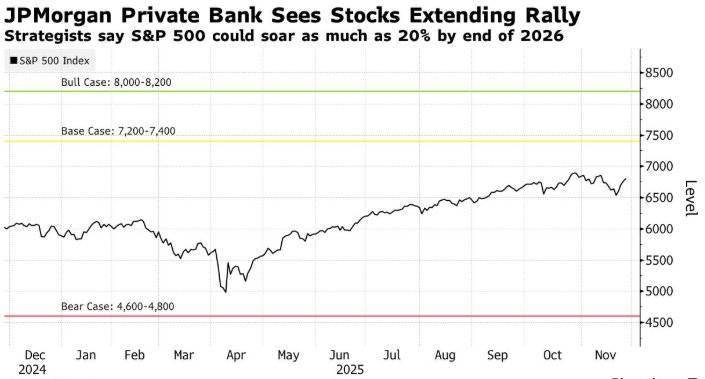
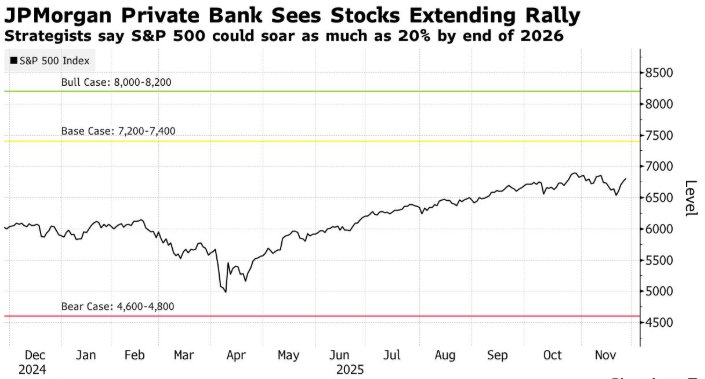
Core Viewpoint - JPMorgan Private Bank predicts that the S&P 500 index is expected to continue its strong return trend into 2026, with a forecasted rise to 7,400 points next year, representing a 9% increase from current levels, and potentially reaching 8,200 points, indicating a 20% increase by year-end [1][4]. Group 1: Market Predictions - The S&P 500 index has risen 16% this year and at least 23% in the previous two years [1]. - JPMorgan's investment strategy leaders view the recent market volatility, which saw the S&P 500 drop by up to 5% from its October record high, as a sign that the market is not in a typical bubble state [4]. - Analysts from Deutsche Bank and Morgan Stanley also project strong growth for the S&P 500, with estimates of 8,000 points by 2026, reflecting an 18% increase, and 7,800 points in one year, respectively [6]. Group 2: Investment Focus Areas - Technology and utilities are identified as key investment sectors due to their expected benefits from AI advancements [4]. - Healthcare, industrials, and financial sectors are also anticipated to perform well due to market expansion, regulatory easing, and M&A activities [4]. - The company suggests including buffers like infrastructure, tangible assets, and gold in investment portfolios to hedge against inflation [5]. Group 3: Market Dynamics and Risks - The company acknowledges potential risks, including a scenario where the S&P 500 could drop to approximately 4,600 points, a 32% decline, if AI themes and the economy falter [6]. - Despite the risks, the current strong corporate earnings and economic performance support a positive outlook for continued profit-driven growth in the S&P 500 [6].
小摩反驳“AI泡沫论”,预测明年标普500有望涨20%至8200点!
Zhi Tong Cai Jing· 2025-11-27 05:05
Manoukian表示:"我们坚信,我们正处于一种更为结构性的转变之中,公共市场与私人市场的差异正变 得越来越小。如果想要以主题化的方式进行投资,避免涉足私人市场,那实际上就是将自己与人工智能 生态系统中最具活力和创新性的领域隔离开来。" 小摩乐观的预测一出,却恰逢华尔街因有关人工智能的种种担忧以及经济疲软的迹象而人心惶惶之际。 过去四天里,美股上涨了4%。这一涨势平息了那些警告称股市即将出现全面回调的看空者们的言论, 而如今,美股多头的乐观情绪又开始高涨起来。 对于小摩私人银行投资策略美国负责人Jacob Manoukian和全球投资策略的联合负责人Stephen Parker而 言,近期导致标普500指数从10月的纪录高位下跌多达5%的市场动荡,证实了市场并未处于通常与泡沫 相关的那种狂热状态之中。 Parker在周二的一次采访中表示:"我们的许多客户目前手头都有大量现金。对于这些客户而言,我们 与他们进行的为期12至18个月的交流内容是,这是一次绝佳的机会。我们将其视为一个买入良机,同时 我们也明白这并不一定就是最低点。" 该行认为,在2026年,技术和公用事业将是重点投资领域,因为这两类行业将受益于人 ...
摩根大通预计美联储12月将降息
Sou Hu Cai Jing· 2025-11-27 04:50
摩根大通经济学家预计美联储下个月将降息,改变了之前认为降息将推迟到明年1月份的预测。摩根大 通当地时间11月26日发文表示,来自关键美联储官员,尤其是美国纽约联邦储备银行行长约翰·威廉姆 斯,支持短期内降息的言论,促使他们重新评估降息路径。摩根大通此前曾预测美联储12月份将维持利 率不变。 ...