
KUAISHOU(KSHTY)

Search documents
快手-W(01024.HK):可灵商业化持续推进 首次宣派特别股息
Ge Long Hui· 2025-08-29 18:53
Core Insights - The company reported a revenue of 35.05 billion yuan in Q2 2025, representing a year-over-year increase of 13.1%, and an adjusted net profit of 5.62 billion yuan, up 20.1% year-over-year [1] - The company declared its first special dividend of 0.46 HKD per share, totaling approximately 2 billion HKD, enhancing shareholder returns [1] - Daily Active Users (DAU) reached a record high of 409 million, with a year-over-year growth of 3.4%, while Monthly Active Users (MAU) reached 715 million, up 3.3% year-over-year [1] Revenue and Profitability - The company's gross margin was 55.7%, a decrease of 0.4 percentage points year-over-year, while the adjusted net profit margin increased by 0.9 percentage points to 16.0% [1] - Online marketing revenue was 19.8 billion yuan, reflecting a year-over-year increase of 12.8% [2] User Engagement and Growth Strategies - The average daily usage time per user reached 126.8 minutes, with total user usage time increasing by 7.5% year-over-year [1] - The company implemented strategies to optimize user acquisition costs and improve overall ROI through high-quality user growth, flow distribution optimization, and enhanced community interaction [1] E-commerce Performance - E-commerce Gross Merchandise Volume (GMV) was 358.9 billion yuan, up 17.6% year-over-year, with active buyers reaching 134 million [1] - Short video e-commerce GMV grew by over 30% year-over-year, with improved matching efficiency between target audiences and core products [1] AI and Advertising Innovations - The company’s AI-driven advertising solutions saw a significant increase, with the Universal Auto X (UAX) solution accounting for 65% of external circulation consumption [2] - The revenue from the company's AI product, 可灵AI, exceeded 250 million yuan, exploring various application scenarios including advertising and interactive gaming [2][3] Future Projections - The company expects total revenue for 2025-2027 to be 142.42 billion, 156.00 billion, and 170.10 billion yuan respectively, with projected non-GAAP net profits of 20.77 billion, 23.92 billion, and 27.69 billion yuan [3]

快手将发力小游戏等内容变现赛道,预计未来一年分账破亿
Bei Jing Shang Bao· 2025-08-29 13:27
Core Insights - Kuaishou Technology's founder and CEO Cheng Yixiao revealed significant data at the 2025 Kuaishou Light Creator Conference, indicating a robust growth in creator engagement and monetization on the platform [1] Group 1: Creator Engagement - Over 91 million creators have been consistently active on Kuaishou for three consecutive years [1] - The number of creators with over 10,000 followers has seen a more than 100% year-on-year increase in submission volume [1] Group 2: Monetization and Revenue - In the past year, 26 million creators on Kuaishou have generated income, with nearly a 12% year-on-year increase in the number of creators earning over 1,000 yuan per month [1] - The platform's creators publish an average of over 6.6 million commercial content pieces daily, attracting over 320 million user views and generating commercial revenue for 3.7 million creators [1] - Kuaishou aims to enhance monetization pathways, particularly in short dramas and mini-games, with expectations of generating billion-level revenue sharing for creators in the coming year [1]
快手“快·来耍”落地成都:火锅节成文旅消费新引擎
Zhong Guo Xin Wen Wang· 2025-08-29 11:18
Core Insights - The "Kuaishou Hot Pot Festival" has been launched in Chengdu as part of the 2025 Chengdu Food Capital initiative, aiming to activate consumer potential and promote hot pot culture [2][4][5] Group 1: Event Highlights - The festival features the "Chengdu Hot Pot Shake," a dance designed specifically for Chengdu, integrating local cultural elements, which has gained significant online popularity [4] - A mobile cultural bus themed "Chuanliu Bus" showcases local influencers and performances, serving as a moving cultural ambassador for the city [5] - The festival includes various activities such as a hot pot banquet and live performances, combining online streaming with offline interactions to enhance cultural engagement [5][8] Group 2: Policy Alignment and Economic Impact - The event aligns with the Central Committee's emphasis on boosting consumption, particularly in the service sector, during the peak summer tourism season [7][8] - The festival has successfully increased foot traffic and hot pot orders in participating restaurants, positively impacting related industries such as retail and transportation [8] - Kuaishou's integration of food, cultural tourism, and short video content has effectively attracted national attention to Chengdu's hot pot culture, facilitating the conversion of online traffic to offline consumption [7][8] Group 3: Ongoing Collaboration and Future Prospects - The hot pot festival is part of a series of events by Kuaishou in Chengdu, aimed at enhancing the city's cultural tourism and consumer engagement [10] - Upcoming events include collaborations with popular IPs and a creator conference, further solidifying the partnership between Kuaishou and Chengdu [10] - The ongoing collaboration is expected to explore deeper integration of short video content with cultural tourism and consumption, contributing to Chengdu's goal of becoming an international consumption center [10]

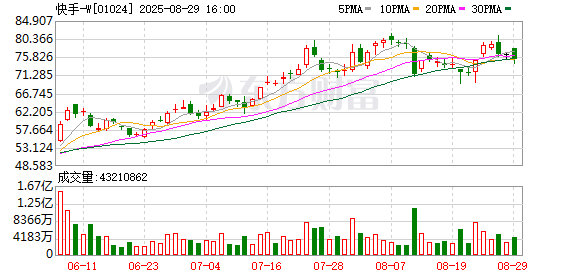
快手盖坤:全球AI视频创作者规模预计已破1亿
Xin Lang Ke Ji· 2025-08-29 07:55
Core Insights - AI has become a driving force for traffic and commercial monetization, with the global scale of AI video creators expected to exceed 100 million [1] - Compared to six months ago, the playback volume of AI content on Kuaishou increased by 321% in July [1] - New AI videos are consistently becoming viral hits on Kuaishou every day [1]
快手王剑伟:发力小游戏等内容变现赛道 预计未来一年分账破亿
Xin Lang Ke Ji· 2025-08-29 07:40
Group 1 - The core viewpoint of the article is that Kuaishou is focusing on enhancing monetization opportunities for creators, particularly in short dramas and mini-games, with an expectation of generating significant revenue for creators in the coming year [1] - Kuaishou's e-commerce ecosystem, valued at trillions, provides a more efficient operational environment for creators, offering diverse monetization models that expand their revenue potential [1] - Data indicates that Kuaishou creators publish an average of over 6.6 million commercial content pieces daily, attracting more than 320 million users and generating commercial benefits for 3.7 million creators [1]
快手董事长程一笑:过去一年,在快手月收入过千元的创作者同比增长近12%
Mei Ri Jing Ji Xin Wen· 2025-08-29 07:17
Core Insights - Kuaishou's creator ecosystem is expanding, with over 91 million creators continuously producing content for three consecutive years [1] - The number of creators with over 10,000 followers has increased their submission volume by over 100% year-on-year, while the number of professional live streamers has grown by over 8% [1] - In the past year, 26 million creators on Kuaishou have generated income, with those earning over 1,000 yuan per month increasing by nearly 12% year-on-year [1] Financial Performance - In Q2 of this year, Kuaishou's total revenue reached 35 billion yuan, representing a year-on-year growth of 13.1% [1] - Adjusted net profit increased by 20.1% year-on-year to 5.6 billion yuan [1] - As of Q2 this year, Kuaishou's daily active users reached 409 million, with total user engagement time growing by 7.2% year-on-year [1]
程一笑:过去一年2600万创作者在快手获得收入
Xin Lang Ke Ji· 2025-08-29 06:54
Core Insights - Kuaishou's creator ecosystem is expanding, with over 91 million creators continuously posting content for three consecutive years [1] - The number of creators with over 10,000 followers has seen a year-on-year increase of over 100% [1] - In the past year, 26 million creators on Kuaishou generated income, with those earning over 1,000 yuan per month increasing by nearly 12% year-on-year [1] Group 1 - Kuaishou aims to ensure that long-term creators and quality content receive good traffic, establishing a strong flow direction for the platform [1] - The integration of short video and live streaming, along with public and private domain linkage, has provided creators with more traffic increments and stronger private domain stickiness [1] - Kuaishou's official data indicates that dual-format creators (short video and live streaming) achieve traffic efficiency 4-10 times higher than single-format creators [1]
快手CEO程一笑:过去一年有2600万创作者在快手获得收入
Xin Lang Cai Jing· 2025-08-29 06:51
Core Insights - Kuaishou's creator ecosystem is continuously expanding, with over 91 million creators actively posting content for three consecutive years [1] - The number of creators with over 10,000 followers has seen a year-on-year increase of over 100% in submission volume [1] - The thriving content ecosystem has provided more monetization opportunities for creators, with 26 million creators earning income on Kuaishou over the past year [1] - The number of creators earning over 1,000 per month has increased by nearly 12% year-on-year [1]
快手侵权被爱优腾连番起诉“爆金币”,为什么放不下二创的流量生意?
Tai Mei Ti A P P· 2025-08-29 02:07
Core Viewpoint - Kuaishou faces significant legal challenges due to copyright infringement, with recent court rulings resulting in substantial compensation payments totaling 1.57 billion yuan, highlighting the platform's struggles in content copyright management [1][3][20]. Group 1: Legal Challenges and Financial Impact - Kuaishou has been ordered to pay 60 million yuan and 29.1 million yuan for unauthorized distribution of Tencent Video's content, with additional claims for 60 million yuan related to another series [1][2]. - The platform has faced multiple lawsuits, including a 30 million yuan compensation for unauthorized streaming of the popular series "Kuang Biao" and over 24 million yuan for unauthorized content related to the Chinese Super League [2][3]. - The cumulative financial impact of these copyright disputes has reached 1.57 billion yuan, reflecting a strong judicial stance on copyright protection [3]. Group 2: Content Creation and User Engagement - Kuaishou's reliance on user-generated content (UGC) and secondary creation (二创) is critical for user engagement and monetization, as it helps extend user retention and diversify revenue streams [3][4][19]. - The platform's content primarily consists of three categories: content repurposing, secondary creation, and automated dramas, with secondary creation being particularly prevalent [4][16]. - Despite Kuaishou's community guidelines against copyright infringement, many creators continue to produce content that lacks proper authorization, often leading to legal repercussions [6][14]. Group 3: Industry Dynamics and Competition - The rise of secondary creation content poses challenges for long-video platforms, as it diverts potential viewership and revenue away from original content creators [20][21]. - Major long-video platforms have united to resist unauthorized content, labeling it as "soft piracy" and emphasizing the need for stricter copyright enforcement [21][26]. - Kuaishou's limited partnerships for authorized secondary creation content contrast with competitors like Douyin, which have established more comprehensive agreements to regulate content creation [28][31].

快手-W(01024):可灵商业化持续推进,首次宣派特别股息
Huaan Securities· 2025-08-28 08:11
[Table_StockNameRptType] 快手-W(01024) 港股公司点评 可灵商业化持续推进,首次宣派特别股息 | 投资评级:买入(维持) [Table_Rank] | | --- | | 报告日期: 2025-08-28 | | [Table_BaseData] 收盘价(港元) | 76.00 | | --- | --- | | 近 12 个月最高/最低(港元)81.65/37.75 | | | 总股本(百万股) | 4,316 | | 流通股本(百万股) | 3,588 | | 流通股比例(%) | 100.00 | | 总市值(亿港元) | 3,280 | | 流通市值(亿港元) | 2,727 | [公司价格与恒生指数走势比较 Table_Chart] -16% 15% 46% 77% 108% 8/24 11/24 2/25 5/25 快手-W 恒生指数 [Table_Author] 分析师:金荣 执业证书号:S0010521080002 邮箱:jinrong@hazq.com [Table_CompanyReport] 相关报告 1.快手 25Q1 业绩点评:可灵商业化进 程加速,业 ...