LI AUTO(LI)

Search documents
美股指数涨跌不一,AI巨头唱独角戏,亚马逊、英伟达市值各增千亿美元
Feng Huang Wang· 2025-11-03 22:46
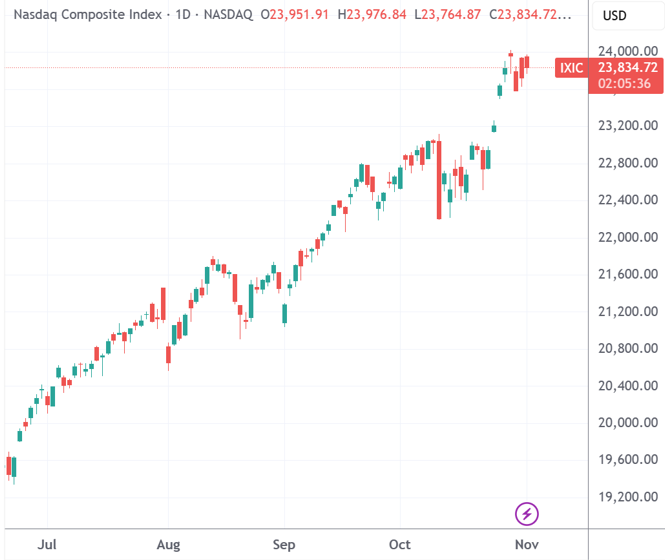
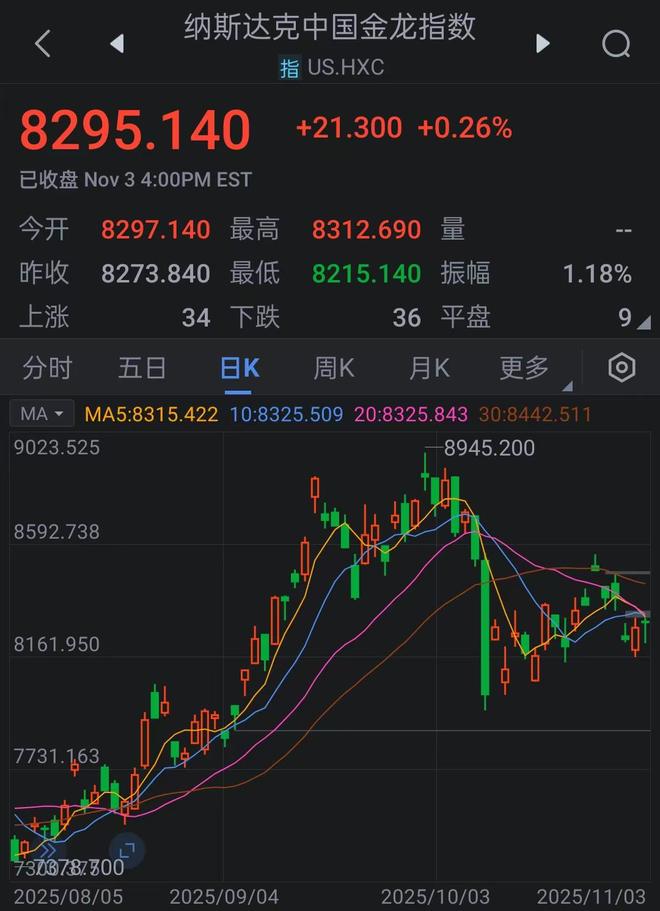
Core Points - The market shows signs of concern despite a strong start to November, traditionally known as a strong month for US stocks, with the S&P 500 index rising by 0.17% and the Nasdaq Composite by 0.46%, while the Dow Jones Industrial Average fell by 0.48% [1] - Amazon AWS announced a $38 billion computing power contract with OpenAI, marking a significant partnership within the "Big Seven" tech companies [2] - Microsoft signed a $9.7 billion computing power contract with Australian cloud service provider IREN, and Lambda also secured a multi-billion dollar contract with Microsoft [5] - Nvidia's stock rose over 2%, contributing to a market capitalization increase of over $100 billion, driven by news of chip exports to the UAE [5] - Google issued $17.5 billion in bonds in the US market, following a €6.5 billion issuance in Europe, receiving approximately $90 billion in orders [5] - Despite the S&P 500 index reaching new highs, over 400 stocks in the index declined during the trading session, indicating a divergence between index performance and market breadth [5] - Historical data shows November has been the best-performing month for US stocks over the past 30 years, with an average gain of 2.6% when the S&P 500 is up over 10% year-to-date [6][7] Company Performance - Amazon's market capitalization increased by $104.5 billion, equivalent to approximately ¥743.7 billion, following the announcement of its contract with OpenAI [2] - Nvidia's stock rose by 2.17%, while other major tech stocks like Apple and Microsoft saw slight declines [8] - Tesla's stock increased by 2.59%, while other companies like Meta and Berkshire Hathaway experienced declines [8] - Chinese concept stocks showed mixed performance, with the Nasdaq Golden Dragon China Index rising by 0.26% [9] Other Industry News - The US electric vehicle market faced a significant drop in sales due to the expiration of federal purchase subsidies, with Hyundai reporting an 80% drop in sales for its Ioniq 5 and 71% for the Ioniq 9 [10] - Kimberly-Clark's stock fell by 14.57% after announcing a $48.7 billion acquisition of Kenvue, while Kenvue's stock rose by 12.32% [11] - Tesla's sales in Europe continued to decline, with a reported 89% drop in Sweden and 86% in Denmark, although there was slight growth in France [12] - Berkshire Hathaway's third-quarter report indicated a $1.2 billion decrease in the value of its Apple holdings, suggesting potential further reductions in its stake [13]





热门中概股周一涨跌不一
Xin Lang Cai Jing· 2025-11-03 21:08
Core Viewpoint - The performance of popular Chinese concept stocks showed mixed results, with the Nasdaq Golden Dragon China Index increasing by 0.26% [1] Group 1: Stock Performance - Alibaba experienced a decline of over 1% [1] - Ctrip saw an increase of over 1% [1] - Tencent Music rose by over 3% [1] - Futu Holdings dropped by over 2% [1] - Li Auto fell by over 1% [1] - NIO increased by over 2% [1]


时报观察 打破“零召回” 造车新势力应以担当赢取信任
Zheng Quan Shi Bao· 2025-11-03 17:44
Core Insights - The record of "zero recalls" among new car manufacturers has been broken, with Li Auto announcing a recall of 11,411 units of the Li MEGA 2024 model due to insufficient coolant corrosion resistance, posing safety risks [1] - In 2024, China implemented 233 vehicle recalls involving 11.237 million vehicles, a 67% year-on-year increase, with 89 recalls for new energy vehicles affecting 4.491 million units, marking a 180.1% increase [1] - The shift towards recalls among new car manufacturers indicates a move away from "invisible handling" of defects, driven by stricter regulations and increasing sales [1] Industry Trends - The trend of collective recalls among new car manufacturers is emerging, as seen with Xiaomi recalling 116,900 units of the SU7 standard version and XPeng recalling 47,490 units of the P7+ due to safety concerns [2] - New car manufacturers are encouraged to abandon the pursuit of a "zero recall" image and adopt a more transparent approach to recalls, similar to established European and American car companies [2] - Emphasizing recalls as a new starting point for reducing safety risks can help build long-term consumer trust, especially as market dynamics change [2]

零跑八连冠 理想降四成 长城前十月销量完成率不足三成 车企年末冲刺各显神通
Guo Ji Jin Rong Bao· 2025-11-03 15:50
Group 1: New Energy Vehicle Sales Performance - In October, Li Auto's sales dropped to 32,000 units, a nearly 40% year-on-year decline, following a recall of over 10,000 units of the 2024 Li MEGA model due to safety concerns [2] - NIO delivered 40,400 vehicles in October, marking a 92.59% year-on-year increase, with the new ES8 contributing significantly to this growth [2] - Xpeng Motors achieved a record high of 42,000 deliveries in October, with a cumulative total of 355,000 units from January to October, reflecting a 190% year-on-year growth [2] - Leap Motor led the new energy vehicle segment with 71,000 deliveries in October, a remarkable 84% increase compared to the same month last year [1] Group 2: Traditional Automakers' Performance - BYD sold 442,000 new energy vehicles in October, showing an 11.5% month-on-month increase, although the growth rate is slowing [3] - Geely achieved sales of 307,100 vehicles in October, with a 12% month-on-month increase and a 35% year-on-year increase, marking its first month surpassing 300,000 units [4] - Chery Group reported total sales of 281,000 vehicles in October, with new energy vehicle sales exceeding 110,000 units, a historical high with a 54.7% year-on-year growth [4] Group 3: Market Trends and Future Outlook - Leap Motor's chairman expressed confidence in significant sales growth in 2026, with a strategic plan in place for the next five years [1] - The automotive industry is entering a competitive phase as companies prepare for the final two months of the year, with many aiming to meet their annual sales targets [5] - Changan Automobile reported total sales of 278,000 vehicles in October, with new energy vehicle sales reaching 119,000 units, a 36% year-on-year increase [5]




安全是汽车业的生命线
第一财经· 2025-11-03 15:14
Core Viewpoint - The article discusses the recall of 11,411 units of the Li Auto MEGA 2024 model due to a fire incident, emphasizing the importance of safety in the automotive industry, particularly for electric vehicles [2][4]. Group 1: Incident Overview - Li Auto announced a recall starting November 7, 2025, for MEGA 2024 models produced between February 18, 2024, and December 27, 2024, totaling 11,411 vehicles [2]. - A fire incident occurred on October 23, where a Li Auto MEGA spontaneously ignited during normal operation, leading to a total loss of the vehicle [2]. - The company identified that the coolant used in the affected vehicles had insufficient anti-corrosion properties, which could lead to battery overheating and other failures under specific conditions [2]. Group 2: Safety Concerns - The incident serves as a reminder of the critical nature of safety in the automotive industry, especially as electric vehicles become more prevalent [4]. - There is a growing concern regarding the frequency of safety issues in the electric vehicle sector, with other companies like Xiaomi also facing scrutiny for safety-related problems [4]. Group 3: Industry Challenges - Several key issues were identified that contribute to safety lapses in the automotive industry: - A lack of respect for safety among some electric vehicle manufacturers, who often prioritize comfort and performance over basic safety requirements [5]. - The recall system in China is seen as needing improvement, with many recalls initiated only after regulatory intervention [5]. - Cross-industry entrants into the automotive market may lack the inherent safety culture traditionally found in established automotive companies [5]. - Consumer protection mechanisms require modernization to better safeguard consumer rights in the face of automotive failures [5]. Group 4: Regulatory and Market Response - The Chinese government has been proactive in establishing safety regulations, as seen with the recent draft for mandatory safety standards for hidden car door handles [6]. - There is a need for regulatory frameworks to keep pace with rapid technological advancements in the automotive sector, ensuring consumer rights are protected effectively [6]. - The article advocates for enhanced market self-regulation and the establishment of mechanisms for consumer rights protection, including collective litigation and evidence-sharing systems [7].
10月新势力销量爆发:零跑首破7万辆,小米稳超4万辆,理想猛跌38%
2 1 Shi Ji Jing Ji Bao Dao· 2025-11-03 14:40
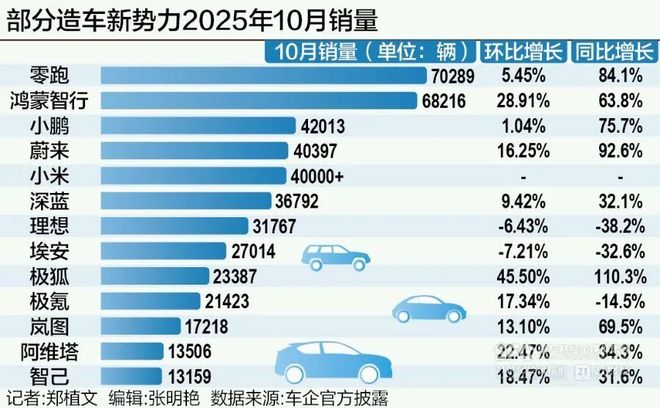
Core Insights - The new energy vehicle market is experiencing a significant recovery, with most brands reporting both year-on-year and month-on-month sales growth during October, traditionally a peak sales season [1][3]. Sales Performance - Leading the sales chart, Leap Motor achieved a record monthly delivery of 70,289 units, marking an 84.1% increase year-on-year and a 5.45% month-on-month growth [2][6]. - Homtruck followed closely with 68,216 units delivered, reflecting a 63.8% year-on-year increase and a substantial 28.91% month-on-month growth [2][7]. - Xiaopeng and Xiaomi both maintained monthly deliveries above 40,000 units, with Xiaopeng achieving 42,013 units (75.7% year-on-year growth) and Xiaomi exceeding 40,000 units [4][8]. - NIO delivered 40,397 units, a 92.6% increase year-on-year, with its sub-brand contributing significantly to this growth [8][9]. - In contrast, Li Auto faced challenges, delivering 31,767 units, which represented a 38.2% year-on-year decline [7]. Market Dynamics - The market is undergoing structural adjustments, with traditional leaders like "Wei Xiaoli" being challenged by new entrants like Leap Motor, which is adopting a "technology for all" strategy [6][12]. - The second-tier brands, such as Extreme Fox and Lantu, are showing significant growth, with Extreme Fox's deliveries soaring by 110.3% year-on-year [4][11]. - The competitive landscape is shifting, with brands needing to focus on technology development, supply chain management, and cost optimization to maintain their market positions [12]. Strategic Initiatives - Leap Motor's success is attributed to its effective implementation of the LEAP 3.5 technology architecture, allowing for cost control while maintaining product performance [6]. - Li Auto is currently facing a transition period, adjusting its annual sales target downwards due to competitive pressures and production challenges [7]. - Xiaopeng's growth is supported by its product iteration strategy and the introduction of self-developed technology, such as the Turing chip [8]. - NIO's multi-brand strategy is beginning to show results, expanding its consumer base and enhancing its battery swap network [9]. Future Outlook - The competitive environment is expected to intensify as the penetration rate of new energy vehicles continues to rise, posing challenges for brands that have not achieved scalable profitability or lack core technological advantages [12].
10月新势力销量爆发:零跑首破7万辆,小米稳超4万辆,理想猛跌38%
21世纪经济报道· 2025-11-03 14:29
Core Viewpoint - The new energy vehicle market is experiencing a structural adjustment, with traditional leaders being challenged by emerging players like Leap Motor, while established brands like Li Auto face declining sales [3][6][7]. Sales Performance - In October, several new car manufacturers reported impressive sales figures, with most brands achieving both year-on-year and month-on-month growth, indicating a recovery in market demand [1]. - Leap Motor led the sales with 70,289 units, marking an 84.1% year-on-year increase and a historical high [5][6]. - Other notable performers included Hongmeng Zhixing with 68,216 units (63.8% year-on-year growth), NIO with 40,397 units (92.6% year-on-year growth), and Xiaopeng with 42,013 units (75.7% year-on-year growth) [2][5][8][9]. Market Dynamics - The traditional market structure represented by "Wei Xia Li" is being disrupted, with Leap Motor's "technology for all" strategy showing strong momentum [3][6]. - Li Auto experienced a decline in sales, delivering 31,767 units, a 38.2% year-on-year drop, and has revised its annual sales target downwards [7]. - The competitive landscape is intensifying, with brands like Extreme Fox and Lantu showing significant growth, with year-on-year increases of 110.3% and 69.5%, respectively [5][11]. Strategic Insights - Leap Motor's success is attributed to its effective "technology for all" strategy, which includes cost control and a strong global presence, having entered over 30 countries [6]. - Li Auto's challenges stem from increased competition in the extended-range vehicle market and a recent recall affecting its brand image [7]. - Xiaopeng's growth is driven by precise product iteration and the introduction of self-developed technology, while Xiaomi faces production capacity constraints despite high demand [8][9]. Emerging Trends - The second-tier brands are leveraging differentiated strategies and product positioning to achieve rapid growth, as seen with Extreme Fox's successful entry into the entry-level electric vehicle market [11]. - The market is evolving towards a focus on comprehensive strengths, including technology development, supply chain management, and cost optimization, rather than relying solely on product advantages [12][13].

“安全是无价的”:理想主动召回背后的价值观抉择
经济观察报· 2025-11-03 14:09
Core Viewpoint - The article emphasizes that recalls are not inherently negative actions but rather a proactive way for companies to take responsibility, especially in the context of the electric vehicle industry [1][23]. Group 1: Incident Overview - On October 31, Li Auto announced a voluntary recall of certain Li MEGA 2024 models following a fire incident in Shanghai [2][7]. - The fire incident occurred on October 23, and fortunately, there were no casualties [7]. - Li Auto's proactive approach to the recall is highlighted, as they acted swiftly upon identifying potential risks [3][11]. Group 2: Company Response and Decision-Making - Li Auto's CEO, Li Xiang, stated that the recall was initiated due to identified safety risks, emphasizing the importance of prioritizing safety over costs [4][9]. - The decision to recall was made quickly after internal discussions, with a focus on aligning actions with the company's values regarding safety [9][19]. - The company has a policy that any costs related to safety do not require approval, reflecting their commitment to user safety [9][19]. Group 3: Technical Findings and Actions - An internal investigation revealed that a specific batch of vehicles had inadequate corrosion resistance in the coolant, which could lead to safety hazards [8][15]. - Li Auto plans to replace the coolant, battery, and motor controller for the affected 11,411 vehicles, with a repair time of approximately one working day per vehicle [15]. - The company is enhancing its quality control measures and will implement stricter testing standards for chemical materials to prevent similar issues in the future [16]. Group 4: Safety Commitment and Strategic Importance - Li Auto's commitment to safety is not new; they have been focusing on safety since their inception, with rigorous testing standards that exceed industry norms [18][19]. - The MEGA model was designed with safety as a core principle, achieving high safety ratings in various tests [19]. - The company aims to communicate effectively with users to address concerns and reinforce their commitment to safety during the recall process [20][21].
Li Auto ($LI) | XPeng ($XPEV) | NIO ($NIO) | Zeekr Intelligent Technology ($ZK)
Youtube· 2025-11-03 13:50
Group 1: Company Deliveries - Lee Auto delivered 32,000 vehicles in October, totaling 1,460,000 deliveries, with strong demand for the Lei 6, which has over 70,000 orders [1] - Xpang achieved a record delivery of 42,000 smart EVs in October, representing a 76% year-over-year increase, and has delivered 355,000 vehicles in the first 10 months of 2025, up 190% from the previous year [2] - NEO delivered a record 40,000 vehicles in October, a 92% year-over-year increase, with cumulative deliveries reaching just over 913,000 vehicles [3] - Zeer Intelligent Technology delivered 61,000 vehicles in October, marking a 9% year-over-year increase and a 20% month-over-month increase [3] Group 2: Market Expansion - The company is accelerating global expansion with new stores opening, operating over 550 retail locations and 3,500 supercharging stations across China [2] - The total vehicle deliveries included 21,000 Zeer vehicles and 40,000 Lincoln and Co. vehicles, supported by a growing user base of over 2.15 million [4]
从理想MEGA到小米SU7:召回为何难解车主心头之惑?
Di Yi Cai Jing· 2025-11-03 13:32
Core Viewpoint - Recent recall events in the automotive industry highlight the varying responses of companies to safety issues, with Li Auto and Xiaomi facing public scrutiny for their handling of recalls following safety incidents [2][3][4] Group 1: Recall Events - Li Auto recalled over 10,000 units of the 2024 MEGA model on October 31, while Xiaomi recalled over 110,000 units of the Xiaomi SU7 standard version on September 19 [2] - Li Auto's recall was initiated proactively one week after a fire incident, whereas Xiaomi's recall occurred nearly six months later, following an investigation [2][3] Group 2: Public Perception and Response - Both companies faced criticism for downplaying the severity of the issues, with Li Auto's proactive recall failing to fully alleviate customer concerns [3] - Xiaomi's recall was described as an "OTA recall," which blurred the seriousness of the situation and led to negative public sentiment [3][4] Group 3: Consumer Expectations - The market exhibits a "zero tolerance" attitude towards automotive safety risks, with consumers demanding immediate action from companies upon discovering safety issues [4] - There is a call for companies to establish robust internal accident analysis systems to shift from reactive to proactive safety management [4] Group 4: Regulatory Actions - Regulatory bodies are emphasizing the need for improved transparency and accountability in the automotive industry, with plans to enhance oversight of new energy vehicles [5] - The National Market Supervision Administration is working on innovative recall regulations and safety reporting systems to ensure consumer safety [5]