LI AUTO(LI)

Search documents
发现安全隐患,车企都应第一时间主动召回
第一财经· 2025-11-03 13:12
Core Viewpoint - The article discusses two significant recall events in the automotive industry involving Li Auto and Xiaomi, highlighting the differences in their responses to safety incidents and the implications for consumer trust and corporate responsibility [3][4][5]. Group 1: Recall Events - On October 31, Li Auto recalled over 10,000 units of the 2024 MEGA model due to insufficient corrosion resistance in the coolant [3]. - Xiaomi recalled over 110,000 units of the Xiaomi SU7 standard version electric vehicle on September 19, following safety concerns related to the vehicle's auxiliary driving system [4]. - The recalls were triggered by serious safety incidents, with Li Auto's proactive recall occurring a week after an accident, while Xiaomi's recall was a reactive measure taken nearly six months later [3][4]. Group 2: Public Perception and Corporate Responsibility - Both companies faced criticism for downplaying the severity of the issues, with Li Auto's proactive recall failing to fully alleviate consumer concerns due to prior reports of insulation faults in the 2024 models [4][5]. - Xiaomi's characterization of the recall as an "OTA recall" blurred the seriousness of the situation, leading to significant backlash and questioning of their commitment to safety [5]. - The article emphasizes the market's zero-tolerance attitude towards automotive safety risks, urging companies to act swiftly and transparently in addressing safety issues [5]. Group 3: Regulatory and Industry Implications - There are calls for Xiaomi to initiate a proactive recall to eliminate safety hazards, reflecting a growing demand for accountability in the industry [7]. - Regulatory bodies are taking steps to enhance oversight of the electric vehicle sector, including the establishment of a more transparent recall system and the implementation of new safety reporting requirements [7]. - The article advocates for a shift in corporate safety management from reactive to proactive measures, emphasizing the importance of consumer safety and corporate social responsibility in the evolving automotive landscape [6][7].


2025Q3业绩综述:乘用车/零部件略有承压,商用车/摩托车表现更佳
Soochow Securities· 2025-11-03 12:54
Group 1: Overall Market Performance - The automotive sector is at a crossroads, with electric vehicle (EV) benefits waning and smart vehicle technology in its early stages[2] - The overall performance of the passenger vehicle sector in Q3 2025 was below expectations, primarily due to a slowdown in industry growth and intensified competition[3] - The passenger vehicle industry saw a year-on-year growth of only 3% in retail sales, while exports grew by 23%[27] Group 2: Segment-Specific Insights - Heavy-duty trucks experienced a significant year-on-year sales increase of 58.1%, with domestic sales up 64.5% and exports up 22.9% in Q3 2025[5] - The bus segment saw strong performance, with leading companies like Yutong exceeding expectations due to rapid sales growth and improved profit margins[6] - Motorcycle exports showed robust growth, with large-displacement motorcycle exports reaching 146,000 units, a year-on-year increase of 57.4%[7] Group 3: Financial Metrics - The average selling price (ASP) for vehicles remained stable in Q3 2025, with some companies like BYD implementing price increases[3] - The overall net profit margin for the heavy-duty truck sector improved, with major players like China National Heavy Duty Truck Group reporting a 21% increase in net profit[8] - The motorcycle industry saw a year-on-year profit increase of 21%, despite a 10% decline in revenue quarter-on-quarter[7] Group 4: Risks and Challenges - Risks include potential escalations in trade wars, slower-than-expected global economic recovery, and geopolitical uncertainties[2] - The automotive industry faces challenges from regulatory pressures and a lack of significant price reductions among manufacturers[3]




一财社论:安全是汽车业的生死符
Di Yi Cai Jing· 2025-11-03 12:53
Core Viewpoint - The proactive recall by Li Auto reflects a commitment to corporate reputation and basic business ethics, emphasizing the importance of safety in the automotive industry [1][2][6] Group 1: Incident Overview - Li Auto announced a recall of 11,411 units of the 2024 MEGA model due to a fire incident that occurred on October 23, 2023, which resulted in the vehicle being completely destroyed [1] - The fire was attributed to insufficient corrosion resistance of the coolant used in the vehicles, which could lead to battery overheating and potential failure [1] Group 2: Industry Implications - The incident serves as a warning to all automotive manufacturers about the critical importance of safety, especially in the rapidly growing electric vehicle sector [2] - There is a noted trend of increasing safety issues within the new energy vehicle market, with other companies like Xiaomi also facing scrutiny over safety concerns [2] Group 3: Regulatory and Systemic Issues - The current recall system in China is seen as needing improvement, as many recalls are initiated only after regulatory intervention rather than voluntary action by companies [3] - The automotive industry is experiencing challenges due to cross-industry entrants lacking a strong safety culture, which can compromise overall safety standards [3] Group 4: Consumer Protection and Legal Framework - There is a call for enhanced consumer rights protection mechanisms to ensure that consumers are not passive recipients of safety risks, especially in the context of intelligent connected new energy vehicles [3][5] - The need for a more robust legal framework, including collective litigation and compensation mechanisms, is emphasized to better protect consumer interests [5]
造车新势力格局生变:零跑持续领跑,第二梯队加速突围
2 1 Shi Ji Jing Ji Bao Dao· 2025-11-03 12:45
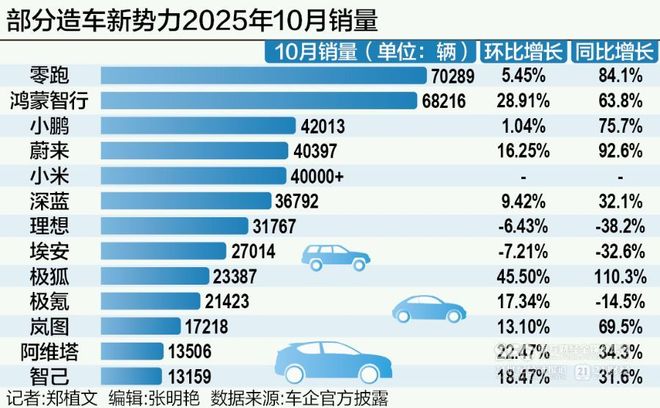
Core Viewpoint - The new energy vehicle market is experiencing significant growth, with most brands reporting both year-on-year and month-on-month sales increases, indicating a recovery in market demand [2] Group 1: Sales Performance - Leap Motor leads the market with a record monthly delivery of 70,289 units, achieving a year-on-year growth of 84.1% [2][4] - Hongmeng Zhixing follows closely with 68,216 units delivered, marking a month-on-month increase of 28.91% and a year-on-year increase of 63.8% [2] - Xiaopeng and Xiaomi both maintain over 40,000 units in monthly deliveries, while NIO joins the "40,000 club" for the first time with 40,397 units, reflecting a year-on-year growth of 92.6% [2][6] - Second-tier brands like Jihu and Lantu show significant growth, with year-on-year increases of 110.3% and 69.5%, respectively [2][8] Group 2: Market Dynamics - The traditional market structure represented by "Wei Xiaoli" is being disrupted, with Leap Motor's "technology for all" strategy gaining momentum [2][9] - Li Auto faces challenges with a month-on-month decline of 6.4% and a year-on-year drop of 38.2%, adjusting its annual sales target down from 700,000 to 640,000 units [3][4] - The competitive landscape is shifting, with brands needing to focus on technology development, supply chain management, and cost optimization to maintain their positions [9] Group 3: Strategic Insights - Leap Motor's strategy includes a price reduction for its B10 model to around 120,000 yuan, targeting mainstream consumers effectively [3] - Xiaopeng's growth is attributed to its precise product iteration strategy, with new models like MONA M03 and P7+ successfully penetrating the market [5] - NIO's multi-brand strategy is beginning to show results, with its sub-brand contributing significantly to overall sales [6] Group 4: Second-Tier Brands - Jihu's explosive growth in October, with 23,387 units delivered, is driven by the launch of its A0-class model, which offers competitive pricing and features [7] - Other second-tier brands like Zeekr, Avita, and Zhiji also report steady month-on-month growth, indicating a robust competitive response [7][8]


This Inexpensive Tesla Rival Is Quietly Gaining Ground — Key Ranking Suggests A Major Breakout Could Be Imminent - Tesla (NASDAQ:TSLA), Li Auto (NASDAQ:LI)
Benzinga· 2025-11-03 12:17
Core Insights - Li Auto Inc. is gaining attention as a value play in the electric vehicle market, competing with giants like Tesla [1] - The company has recently entered the top 10th percentile of value-ranked stocks, indicating strong fundamentals despite a global EV slowdown [2] Company Fundamentals - Li Auto's value ranking has improved from 89.48 percentile to 90.78, reflecting growing investor confidence in its undervalued assets [2] - The company's business model is validated by consistent revenue growth and an expanding delivery network across China [3] - Earnings per share have increased by 25% year-over-year, driven by successful models like the L9 and L7, which cater to affluent buyers [4] Market Performance - Li Auto's market capitalization is approximately $20.762 billion, with a forward P/E ratio of 15.291, significantly lower than Tesla's 188.679 [4] - The stock closed at $20.85 per share, up 1.76% on Friday, and saw a 29% rise in premarket trading on Monday [6] - Year-to-date, the stock is down 13.20%, and down 15.42% over the past year [6] Additional Rankings - The company's momentum score is 15.46, indicating short-term price consolidation, while its growth score is at 53.47 percentile, showing sustained earnings and revenue expansion [5]
发现安全隐患车企应第一时间主动召回
Di Yi Cai Jing· 2025-11-03 12:16
Core Insights - The automotive industry has recently witnessed two significant recall events involving Li Auto and Xiaomi, both triggered by safety incidents, highlighting the industry's response to safety concerns [1][2] - Li Auto initiated a proactive recall of over 10,000 units of the 2024 MEGA model shortly after a safety incident, while Xiaomi's recall of over 110,000 units of the SU7 occurred nearly six months later, following an investigation [1][2] - The contrasting approaches to recalls have led to public criticism, with both companies facing scrutiny for their handling of safety issues [1][2] Group 1: Recall Events - Li Auto recalled over 10,000 units of the 2024 MEGA model due to insufficient corrosion resistance in the coolant, which raised concerns among vehicle owners [1] - Xiaomi's recall involved over 110,000 units of the SU7 standard version, with the recall linked to auxiliary driving safety issues, although it was not explicitly stated as a response to a specific incident [2] Group 2: Public Perception and Response - Li Auto's proactive recall did not fully alleviate consumer concerns, as there were prior reports of insulation faults in some 2024 models, leading to skepticism about the company's transparency [1] - Xiaomi's characterization of the recall as an "OTA recall" blurred the seriousness of the situation, resulting in negative public sentiment and backlash against the company [2] - The incidents underscore a growing market expectation for automotive companies to act swiftly and decisively in addressing safety hazards, reflecting a zero-tolerance attitude towards automotive safety risks [2]
汽车智能化月报系列(二十九):小马智行和文远知行冲击港股上市,均胜电子再获50亿元-20251103
Guoxin Securities· 2025-11-03 11:59
Investment Rating - The report maintains an "Outperform" rating for the automotive intelligence sector [6]. Core Insights - The automotive intelligence industry is experiencing significant advancements, with companies like Xiaoma Zhixing and Wenyuan Zhixing preparing for their IPOs in Hong Kong, and Junsheng Electronics securing a global order worth 5 billion yuan [1]. - The penetration rates of advanced driver-assistance systems (ADAS) and related technologies are on the rise, indicating a robust growth trajectory for the sector [3][4]. Summary by Sections Industry News - Tesla's Robotaxi service is set to expand to 8 to 10 regions by the end of the year [1]. - Xiaoma Zhixing and Wenyuan Zhixing are initiating their IPO process, targeting a listing on November 6 [1]. - Stellantis collaborates with Nvidia, Uber, and Foxconn to accelerate its Robotaxi strategy [1]. - Hesai Technology continues its strategic partnership with Xiaomi Automotive through 2026-2027 [1]. - Junsheng Electronics has received a new global order worth 5 billion yuan in automotive intelligence [1]. - Youjia Innovation's unmanned vehicle has begun operations in Huaqiangbei, marking a new phase in smart logistics [1]. - Jiushi Intelligent has completed a $100 million Series B4 financing led by Ant Group [1]. High-Frequency Core Data Updates - The penetration rate of 8 million pixel cameras in passenger vehicles is projected to reach 67.8% by August 2025, up 10 percentage points year-on-year [2]. - Nvidia's chip penetration in passenger vehicle driving domains has increased to 33.2%, a year-on-year rise of 18 percentage points [2]. - The market share of LiDAR in passenger vehicles is expected to reach 10.4% by August 2025, reflecting a year-on-year increase of 4.3 percentage points [2]. Smart Driving - The penetration rate of passenger vehicles equipped with L2 or higher functions reached 33.3% in August, an increase of 18 percentage points year-on-year [3]. - The penetration rates for front-view cameras, forward millimeter-wave radars, and LiDAR are 67.8%, 57.5%, and 10.4%, respectively, showing significant growth [3]. - The driving domain controller penetration rate is 33.2%, up 17.5 percentage points year-on-year [3]. Investment Recommendations - Recommended companies include XPeng Motors, Leap Motor, and Geely for complete vehicles, while Xiaoma Zhixing and Wenyuan Zhixing are recommended for L4 technologies [4]. - For components, Hesai Technology is recommended for data acquisition, while companies like Horizon Robotics and Junsheng Electronics are suggested for data processing [4]. Key Company Earnings Forecast and Investment Ratings - XPeng Motors: Outperform, with a projected EPS of -3.03 yuan for 2024 [5]. - Xingyu Co., Ltd.: Outperform, with a projected EPS of 4.93 yuan for 2024 [5]. - Horizon Robotics: Outperform, with a projected EPS of 0.18 yuan for 2024 [5].


2025Q3业绩综述:乘用车、零部件略有承压,商用车、摩托车表现更佳
Soochow Securities· 2025-11-03 11:58
Group 1: Overall Market Performance - The overall performance of the passenger car sector in Q3 2025 was below expectations, primarily due to a slowdown in industry growth and intensified competition across all price segments[3] - The passenger car industry saw a year-on-year growth rate of only 3% in retail sales, 23% in exports, and 13% in wholesale during Q3 2025, indicating a significant deceleration compared to previous quarters[27] - The inventory levels in the industry remain healthy, with a controlled increase in stock despite the overall market pressures[27] Group 2: Segment-Specific Insights - Heavy-duty trucks experienced a strong performance in Q3 2025, with wholesale, domestic, and export sales increasing by 58.1%, 64.5%, and 22.9% year-on-year, respectively[5] - The bus sector also performed well, with leading companies like Yutong achieving significant revenue growth, driven by robust demand from both domestic and international markets[6] - The motorcycle segment saw a 57.4% increase in large-displacement motorcycle exports, while domestic sales faced pressure, declining by 9.3% year-on-year[7] Group 3: Financial Metrics and Adjustments - The average selling price (ASP) for vehicles remained stable in Q3 2025, with some companies like BYD implementing price increases starting in July[3] - The gross profit margins for many companies showed slight recovery, attributed to stable sales and limited discounting in the market[3] - Several companies, including Great Wall Motors and Changan, reported a decline in net profit due to foreign exchange losses and inventory adjustments[4]


汽车图谱|“银十”旺季成色足,吉利、奇瑞新能源车销量创新高
Xin Jing Bao· 2025-11-03 11:42
Group 1 - The Chinese automotive market continued its strong growth momentum in October, with 14 out of 18 surveyed automakers reporting both year-on-year and month-on-month sales increases [2][5] - SAIC Motor Corporation led the sales chart with approximately 454,000 vehicles sold in October, marking a year-on-year increase of 12.96%. BYD followed closely with 441,700 vehicles sold, achieving over 11% month-on-month growth [5][6] - New energy vehicle sales saw significant growth, with Geely and Chery achieving breakthroughs in multi-brand operations and transitions to new energy. Geely's sales exceeded 300,000 vehicles for the first time in October, while Chery's sales grew by 3.3% year-on-year, with over 110,000 new energy vehicles sold [2][5] Group 2 - New energy vehicle brands under traditional automakers, such as Deep Blue, Lantu, and Zhiji, also experienced strong sales growth in October [3] - The China Automobile Dealers Association reported an increase in the automotive consumption index for October 2025, indicating a slight rise in the market for November. Factors contributing to this include the arrival of government subsidies and promotional activities during the Guangzhou Auto Show [3] - The market is expected to maintain an upward trend in November, driven by increased consumer demand due to government incentives and promotional efforts from dealers [3]



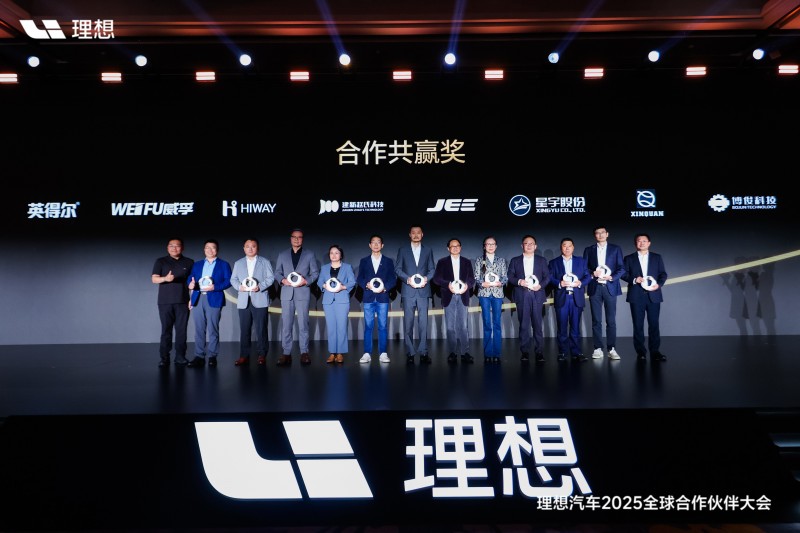
价值共创 共赢未来 | 英得尔荣获理想汽车“合作共赢奖”
Cai Fu Zai Xian· 2025-11-03 10:39
Core Insights - The 2025 Global Partner Conference of Li Auto was held in Changzhou, Jiangsu, where Indel was awarded the "Cooperation and Win-Win Award" for its innovative R&D capabilities and strategic collaboration [1] - The partnership between Indel and Li Auto has been marked by mutual trust and value creation over the past five years [1][5] Group 1: Product Innovation - The Li Auto L9, featuring "refrigerator, color TV, and large sofa," has redefined family travel experiences and set a benchmark for exceeding user expectations [3] - Indel's jointly developed smart dual-use refrigerator, as the first pre-installed drawer-style refrigerator in passenger vehicles, has gained significant attention since its launch, catering to various family scenarios [3] Group 2: Strategic Collaboration - Since their partnership began in 2021, Indel and Li Auto have maintained a philosophy of mutual trust and win-win cooperation, witnessing the evolution of car refrigerators from a highlight feature to an essential component of high-quality travel [5] - Both teams have closely collaborated to continuously optimize key indicators such as NVH, cooling performance, and spatial layout, enhancing user experience [5] - Indel's commitment to a "zero-defect" quality culture and rapid response mechanisms ensures high-quality and stable product delivery [5] Group 3: Future Outlook - The award received is seen as a significant milestone in the strategic collaboration and deep partnership between Indel and Li Auto [7] - Indel aims to cherish this honor and continue working with Li Auto to explore more comfortable solutions for home scenarios, enhancing the travel experience for families [7]