LI AUTO(LI)

Search documents
汽车周报:L3智驾车型许可发放,继续看好智能化、中高端和二手车市场-20251222
Shenwan Hongyuan Securities· 2025-12-22 06:15
Investment Rating - The report maintains a positive outlook on the automotive industry, particularly focusing on companies with advantages in smart technology and the second-hand car market [1][3]. Core Insights - The Ministry of Industry and Information Technology has officially licensed L3 autonomous driving models from Changan and BAIC, indicating a significant step towards commercialization in this sector [1][4]. - The report highlights the potential for new energy vehicle companies such as XPeng, NIO, and Li Auto, as well as tier 1 suppliers like Desay SV and Jingwei Hirain, to benefit from advancements in smart technology [1][3]. - The report suggests that the current market conditions favor the recovery of second-hand car companies and the overall profitability of dealers, recommending companies like Uxin [1][3]. - Given the uncertainty in overall industry demand for the coming year, the report advises focusing on companies with strong performance support and relatively low valuations, such as Yinlun, Shuanghuan, and Jifeng [1][3]. - The report also notes the potential breakthroughs from state-owned enterprise reforms, particularly with SAIC and Dongfeng, suggesting continued attention to these developments [1][3]. Industry Updates - According to the China Passenger Car Association, the average daily retail sales of passenger cars in the second week of December were 67,000 units, a year-on-year decrease of 17% but a month-on-month increase of 9% [3][52]. - The automotive industry’s total transaction value for the week was 491.613 billion yuan, with a week-on-week increase of 4.82% [3][10]. - The automotive industry index closed at 7654.14 points, down 0.10% for the week, which is a smaller decline compared to the Shanghai and Shenzhen 300 index [3][10]. Market Performance - A total of 164 automotive stocks rose while 105 fell during the week, with Zhejiang Shibao, Haon Automotive, and *ST Weidi showing the largest gains of 44.1%, 28.4%, and 24.2% respectively [3][15]. - The report indicates that the automotive sector's price-to-earnings ratio stands at 28.44, ranking 18th among all primary industries [3][12]. Key Events - The report emphasizes the approval of L3 autonomous driving models as a pivotal moment for the industry, marking the transition from testing to commercial application [4][6]. - Companies like XPeng and Li Auto have also received L3 road testing licenses, further indicating the momentum in the autonomous driving sector [4][30].




车企在激烈厮杀中告别2025 未来竞争将更残酷
Xin Lang Cai Jing· 2025-12-22 05:13
Core Viewpoint - The competitive landscape of the Chinese automotive market is rapidly changing, with significant shifts expected by 2025, as highlighted by the comments from Xiaopeng Motors' CEO, He Xiaopeng [1] Group 1: Market Dynamics - The leading position among new energy vehicle manufacturers has shifted from Li Auto to Leap Motor, indicating a change in competitive dynamics [1] - BYD, the current leader among domestic automakers, is facing increasing competition from SAIC Group and Geely [1] Group 2: Pricing Strategies - A price war characterized by "limited-time fixed prices" intensified in the first half of 2025 but abruptly ceased in the second half, leading to a collective call from automakers to initiate a "value war" [1] - The reduction of purchase tax subsidies for new energy vehicles is expected to intensify competition among automakers [1] Group 3: Future Outlook - The chairman of Lantu Motors, Lu Fang, indicated that the automotive industry may soon witness a decisive confrontation between fuel vehicles and new energy vehicles [1]


理想汽车调整供应链架构,近千人并入制造部门
Zhong Guo Jing Ying Bao· 2025-12-22 04:07
【理想汽车合并"同类项":近千人并入新部门】12月19日,《中国经营报》记者获悉,理想汽车近期对 供应链相关部门进行了组织架构调整和合并,将原来智能汽车群组下属的一级部门"零部件集群"并 入"制造",统一由理想汽车副总裁李斌管理,李斌向总裁马东辉汇报,原零部件部门负责人罗屏已离 职。此次合并前,零部件集群将近千人。合并后,整个大的制造部门目前在职员工已经超过了1万名, 是智能汽车群组里人数最多的一级部门,占总人数的1/3。(中经记者 陈燕南 北京报道) ...


理想汽车:近日,理想汽车与中国国际航空达成“航空+车企”跨界创新合作
Xin Lang Cai Jing· 2025-12-22 04:03
近日,理想 汽车 与中国国际航空达成"航空+车企"跨界创新合作。作为国航"出行生态"领域的重要合作 伙伴,双方将共同探索航空服务与汽车出行的融合,为用户提供创新的价值体验。 ...

理想汽车合并“同类项”:近千人并入新部门
Zhong Guo Jing Ying Bao· 2025-12-22 03:33
12月19日,《中国经营报》记者获悉,理想汽车近期对供应链相关部门进行了组织架构调整和合并,将 原来智能汽车群组下属的一级部门"零部件集群"并入"制造",统一由理想汽车副总裁李斌管理,李斌向 总裁马东辉汇报,原零部件部门负责人罗屏已离职。此次合并前,零部件集群将近千人。合并后,整个 大的制造部门目前在职员工已经超过了1万名,是智能汽车群组里人数最多的一级部门,占总人数的 1/3。 (编辑:张硕 审核:童海华 校对:颜京宁) 中经记者 陈燕南 北京报道 ...
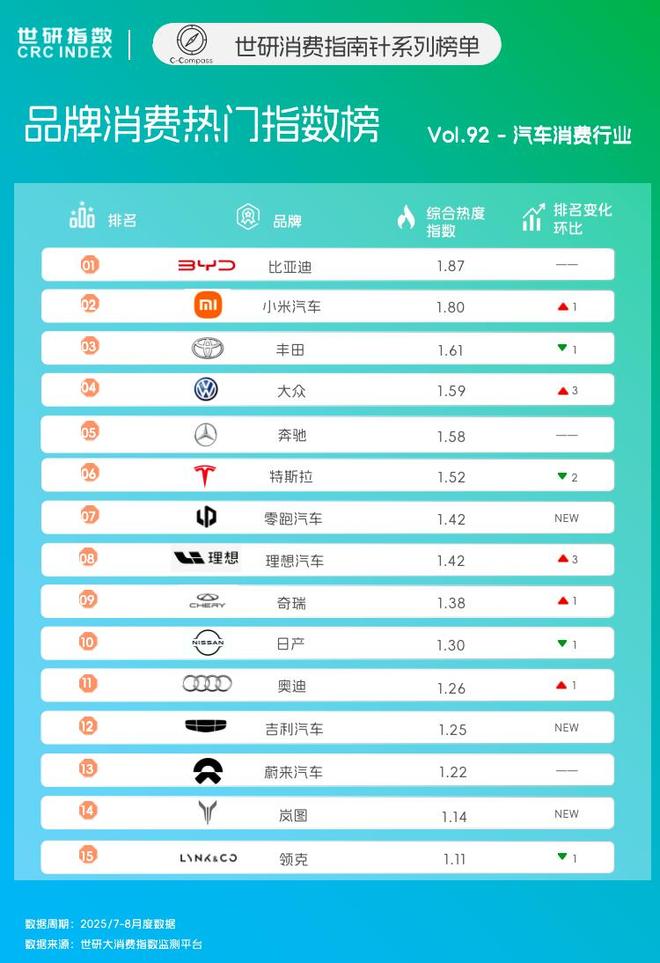
汽车市场两极竞速,智驾进入信任时代|世研消费指数品牌榜Vol.92
3 6 Ke· 2025-12-22 02:42
Core Insights - The current electric vehicle market is exhibiting a significant "dumbbell-shaped" differentiation pattern, with high-end markets leveraging ecological connectivity and advanced driving technologies to create competitive advantages, while entry-level markets are experiencing a "technology democratization" wave focused on extreme cost-performance ratios [1][3] Group 1: Market Dynamics - The high-end market (priced between 250,000 to 450,000 yuan) is characterized by leading brands focusing on differentiated strategies to build competitive moats, either through user ecosystems or advanced driving technologies [3] - Entry-level brands like Leap Motor and Geely are reshaping brand value through technology democratization, with Leap Motor's B01 model featuring standard lidar at a price of 89,800 yuan [3][4] Group 2: Competitive Landscape - The competition in intelligent driving is shifting from hardware accumulation to a dual-driven model of "AI large models + responsibility assurance," emphasizing user trust as a key competitive factor [5] - Tesla's Grok4 and BYD's "Tianshen Eye" are examples of advanced intelligent driving systems that have moved beyond basic path planning to include risk prediction and human-like decision-making [5] Group 3: Consumer Behavior - Consumers are increasingly willing to pay for either extreme experiences or extreme cost-effectiveness, while mid-range electric vehicles (priced between 150,000 to 200,000 yuan) are facing growth challenges due to a lack of distinct branding [4] - The trend indicates that brands must possess both advanced AI technology and clear accountability mechanisms to gain user trust and establish sustainable competitive barriers in the intelligent driving sector [5]


车企在激烈厮杀中告别2025,未来竞争更残酷
3 6 Ke· 2025-12-22 00:13
Core Insights - The competitive landscape of the Chinese automotive market is rapidly changing, with new players emerging and established leaders facing challenges [1][2] - The shift from a price war to a "value war" is evident, as companies seek to differentiate themselves amid increasing competition [1][5] - The upcoming reduction in purchase tax for new energy vehicles (NEVs) is expected to intensify competition between fuel and electric vehicles [8][9] Group 1: Market Dynamics - The title of "top car manufacturer" in China is becoming less stable, with BYD narrowly maintaining its lead over SAIC Group in revenue [1] - BYD's sales have been declining in 2025, with monthly sales from July to November showing significant year-on-year decreases [2] - Leap Motor has emerged as the new leader among new car manufacturers, surpassing Li Auto in delivery volumes [3] Group 2: Competitive Strategies - The automotive industry is transitioning from a focus on price competition to a focus on product value and differentiation [5][7] - Companies are increasingly recognizing the need for ecosystem collaboration to meet market demands and enhance competitiveness [7] - The "反内卷" (anti-involution) movement emphasizes the importance of healthy competition and sustainable business practices [6][7] Group 3: Future Outlook - The reduction of NEV purchase tax starting January 1, 2026, is anticipated to shift the market dynamics, potentially leading to a resurgence of fuel vehicle sales [8][10] - Industry leaders predict a "survival of the fittest" phase in the automotive sector, with a clearer competitive landscape emerging over the next five to ten years [10][11] - The competition is expected to become more intense, with a potential widening gap between leading and lagging companies as the market evolves [10]

挥别2025,北京正稳步迈进“五万亿之城”!
Bei Jing Ri Bao Ke Hu Duan· 2025-12-21 22:38
Economic Overview - Beijing's economy is steadily progressing towards becoming a "five trillion yuan city," with stable operations and positive growth trends [2] - The city's industrial structure is continuously upgrading towards high-end sectors, with notable growth in new energy vehicles, integrated circuits, 5G smartphones, and lithium-ion batteries [4][6] Industrial Growth - From January to November, the total output value of industrial enterprises above designated size exceeded 2.5 trillion yuan, with a year-on-year growth of 5.2% [7] - The production of complete vehicles reached 1.335 million units, a year-on-year increase of 27.6%, with new energy vehicles accounting for 624,000 units, a growth of 150% [9] - Key products such as integrated circuits and 5G smartphones saw production increases of 17.4% and 34.3% respectively, while wind turbine generators and lithium-ion batteries experienced growth rates of 37% and 100% [9] Technological Innovation - Beijing is witnessing a surge in "global firsts" in technology, including the world's first diabetes peripheral neuropathy patch and a general embodied intelligence platform for humanoid robots [6] - The city has a total of 201 AI model registrations, accounting for 30% of the national total, with significant daily usage across various institutions [9] Cultural and Tourism Integration - The integration of culture, commerce, and tourism is driving significant consumer engagement, with events like the WTT China Grand Slam and various concerts attracting millions [10][12] - The service consumption growth rate related to cultural and tourism integration reached 4.8% in the first eleven months, reflecting a recovery in consumer confidence [16] Infrastructure and Urban Development - Significant investments in infrastructure are underway, including the construction of smart logistics centers and urban transportation improvements, with fixed asset investment growth at 5.8% [19][24] - The city is enhancing its public services, including healthcare and education, with new facilities and schools being established to meet the needs of residents [21][25]

工信部进一步对隐藏式门把手做出限制!小米等品牌获L3级自动驾驶测试牌照!红旗HS6 PHEV、欧拉5、智趣烈马上市!丨一周大事件
电动车公社· 2025-12-21 16:04
New Car Launches - Hongqi HS6 PHEV launched with a price range of 178,800 to 228,800 yuan, featuring a family design style and dimensions of 4925/1970/1740mm [3][4][6] - Ora 5 launched with a price range of 99,800 to 133,800 yuan, offering five models and a limited-time trade-in subsidy of 8,000 yuan [15][16][18] - Ford Mustang Mach-E launched with a price range of 229,800 to 282,800 yuan, available in both pure electric and range-extended versions [24][25][27] Company Developments - BYD's 15 millionth new energy vehicle rolled off the production line, achieving this milestone in 17 years, with the last 5 million produced in just 13 months [65][66][70] - Honda plans to suspend or reduce production at its factories in Japan and China due to semiconductor shortages [71][72][75] - Lantu Motors and CATL signed a ten-year deepening cooperation agreement to advance battery technology [76][77] - GAC Group announced the establishment of a new business unit combining its high-end brand Haobo and mass-market brand Aion for better resource synergy [80][81] - Li Auto is establishing an AI R&D center in Silicon Valley, focusing on smart driving technology [82][85] Industry News - The Ministry of Industry and Information Technology (MIIT) has issued new regulations limiting hidden door handles in vehicles, effective from January 1, 2027 [98][99][102] - The European Union has decided to relax its 2035 ban on internal combustion engines, allowing plug-in hybrid vehicles to continue being sold [103][105][107] - Japan plans to impose a weight-based tax on electric vehicles starting May 2028, with tax rates increasing based on vehicle weight [108][110][112]



10 Best EV Stocks to Buy Heading into 2026
Insider Monkey· 2025-12-21 14:44
Industry Overview - The global rise of electric vehicles (EVs) has slowed, impacting employment, industry planning, and climate targets, with road transportation contributing about one-fifth of global carbon dioxide emissions [2] - Adoption of EVs is crucial for achieving net-zero emissions, but momentum has waned due to reduced government incentives, high EV costs, lagging charging infrastructure, and fading policy support [2] - In Europe, lawmakers are reconsidering a strict 2035 ban on new combustion-engine vehicles, acknowledging that the transition to zero-emission transportation will take longer than expected [2] Sales and Market Performance - Global sales of EVs and plug-in hybrids increased by 26% in 2024, down from 34% the previous year, with China accounting for almost two-thirds of the 17.6 million EVs sold globally [3] - In the United States, EV sales rose by 12% in the first three quarters of 2025 despite subsidy withdrawals, while sales in Europe increased by 26% from January to October 2025, although still below emissions standards requirements [3] - All-electric vehicles were approximately 30% more expensive than similar gasoline vehicles in Europe and 27% more costly in the United States in 2024 [3] Industry Adjustments - The slowdown in EV adoption has led legacy automakers to reduce their anticipated 2030 EV sales by over 5 million units to 21.7 million [4] - Lawmakers have delayed penalties for environmental violations and allowed the continued sale of combustion-engine and hybrid vehicles, risking a postponed transition to decarbonization and urban air pollution reductions [4] - Employment in the EV sector is affected as EV production requires fewer workers compared to traditional vehicle manufacturing [4] Investment Opportunities - A list of the 10 best EV stocks to buy heading into 2026 has been compiled, focusing on stocks with analyst upside potential of over 20% as of December 17 [7] - The methodology involved analyzing ETFs and online rankings to identify promising EV stocks, with a focus on hedge fund holdings to enhance investment performance [8] Company Highlights - **Blue Bird Corporation (NASDAQ:BLBD)**: Analysts' upside potential is 24.83%, with 31 hedge fund holders. The company reported Q1 net revenue of $409 million, a 17% year-on-year increase, and a 64% rise in adjusted EBITDA to $68 million [9][11] - **Li Auto Inc. (NASDAQ:LI)**: Analysts' upside potential is 29.47%, with 14 hedge fund holders. The company faced a 36% revenue drop in the last quarter, attributed to higher operating costs and a decline in total deliveries [14][15]