
Luckin Coffee(LKNCY)

Search documents
Carlyle and Boyu emerge as frontrunners to buy Starbucks China
Yahoo Finance· 2025-10-17 11:07
Core Insights - Carlyle and Boyu Capital are leading bidders for a majority stake in Starbucks' operations in mainland China, with the business valued at $4 billion excluding royalties [1][2] - Starbucks is reviewing offers from five bidders, with a decision expected by the end of October 2025 [2] - The total transaction value, including partner investment and future royalties, is projected to exceed $10 billion [3] Group 1: Bidding Process - Five companies submitted binding proposals in early October 2025 [1] - Bidders may form a consortium, with Starbucks potentially retaining up to 49% ownership [4] - The evaluation criteria for bidders include their ability to improve the supply chain and maintain local partnerships, which may favor Chinese firms [4] Group 2: Financial Performance - Starbucks' China division has faced challenges from lower-priced competitors like Luckin Coffee, leading to price reductions on some beverages [2] - For Q3 FY25, Starbucks reported net earnings of $558.3 million, a 47% decline compared to the same period in FY24 [5] - As of June 2025, Starbucks operated 7,828 stores in mainland China, while Luckin Coffee had approximately 26,000 outlets [5] Group 3: Market Context - The divestment comes amid declining revenue for Starbucks in China, attributed to weaker same-store sales [4] - The interest in the sale process reflects confidence in the long-term growth potential of Starbucks in the Chinese market [3]



Starbucks Brews A Turnaround, But Investors Want A Stronger Roast: CEO Says 'The Stock Will...' - Starbucks (NASDAQ:SBUX)
Benzinga· 2025-10-16 10:03
Core Viewpoint - Starbucks is facing significant challenges under CEO Brian Niccol, including increased competition and declining stock performance since his appointment, prompting a major turnaround initiative [1][3][8]. Group 1: Business Challenges - Upon taking over, Niccol inherited issues such as growing competition and a shift in consumer preferences towards cheaper beverages, resulting in a 25% decline in stock value since the previous CEO [1]. - The company's stock has underperformed compared to broader market trends, indicating ongoing investor skepticism about the effectiveness of the turnaround strategy [3][8]. Group 2: Turnaround Initiatives - The "Back to Starbucks" initiative aims to enhance customer experience and restore the brand's status as a preferred social space, involving significant policy changes, layoffs, and store closures [2]. - Key components of the initiative include the introduction of protein add-on options and the "Green Apron Service" to improve customer service, which have shown promising early results [4]. Group 3: Market Performance and Future Outlook - Starbucks' China operations, which account for approximately $3 billion in annual sales (8% of total sales), are under pressure from local competitors like Luckin Coffee, leading to stalled growth despite having over 7,500 stores in the region [6][7]. - Since Niccol's appointment, shares have decreased by about 9%, with a year-to-date decline exceeding 10%, as investors await evidence of a successful turnaround similar to his previous role at Chipotle [8]. - The company is set to report fiscal fourth-quarter earnings on October 29, with analysts projecting earnings per share of 57 cents on revenue of $9.37 billion [9].

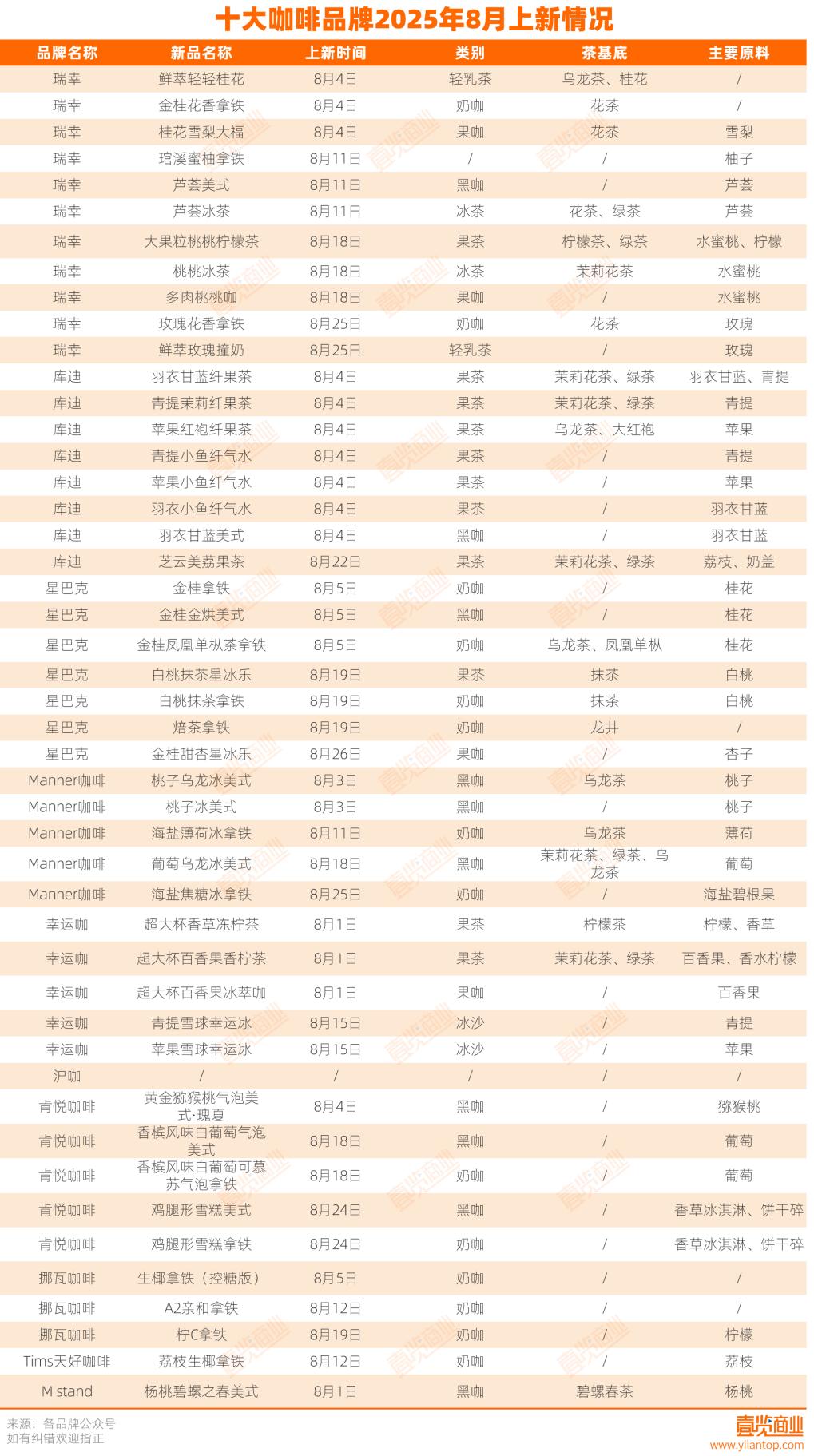
8月46款新品茶基底占大头,咖啡加速向茶饮靠拢
3 6 Ke· 2025-10-15 00:41
Core Insights - In August, the top 10 coffee brands in China launched a total of 46 new products, averaging 1.5 new products per day [1] Brand Performance - Luckin Coffee led the market with 11 new products, covering the entire month with offerings like "Fresh Brew Lightly Sweetened Osmanthus" and "Fresh Brew Rose Milk" [4] - Kudidi Coffee followed with 8 new products, focusing on fruit tea [4] - Starbucks introduced 7 new products, primarily milk coffee, centered around white peach and osmanthus flavors [4] - Manner Coffee, Lucky Coffee, and Kenyue Coffee each launched 5 new products, while brands like Nova Coffee and Tims only released 1-3 new products [4] Product Trends - The new products were released in two main waves: the first at the beginning of August and the second around the Qixi Festival [6] - Milk coffee remained the most popular category with 14 new products, showcasing a trend towards floral and fruity combinations [7] - Fruit tea emerged as a significant category with 11 new products, indicating coffee brands' efforts to attract tea drinkers [11] - Black coffee saw 10 new products, mainly from Manner and Kenyue Coffee, integrating tea and fruit elements [11] - The introduction of fruit coffee products, such as Luckin's "Rose Latte," highlighted the potential for category expansion [11] Ingredient Insights - Floral tea bases dominated with a 31% share, featuring jasmine and osmanthus, enhancing the overall flavor profile [15] - Green tea and oolong tea followed with 24% and 21% shares respectively, emphasizing freshness and richness [15] - Lesser-used tea bases like lemon tea and matcha played a role in product differentiation [16] - Seasonal fruit ingredients like green grapes and peaches were prominently featured, aligning with summer-to-autumn transitions [16] Market Dynamics - The coffee market is evolving towards a multi-dimensional innovation approach, focusing on ingredients, seasonal relevance, and emotional connections [18] - The trend indicates a shift from single-category launches to a more integrated strategy that enhances consumer engagement and brand loyalty [18]
Third Space获投资;八马茶业通过上市聆讯;复朗集团总裁将辞任
Sou Hu Cai Jing· 2025-10-14 14:41
Investment Dynamics - Yonghui Supermarket has established a new trading company in Beijing with a registered capital of 10 million yuan, focusing on food internet sales, telecommunications, and internet information services, which could create additional revenue streams for the company in the long term [3] - Third Space, a luxury gym in London, secured a £75 million bank loan from OakNorth, following a previous loan of £38.5 million in June 2023, indicating investor confidence in the gym's growth potential amid increasing consumer health demands [5] - Guizhou Southern Dairy announced the suspension of its listing application on the Beijing Stock Exchange due to the need for supplementary audit matters, with projected 2024 revenue of 1.817 billion yuan and net profit of 209 million yuan, ranking 20th among 36 listed dairy companies [7] - Eight Horse Tea has passed the listing hearing at the Hong Kong Stock Exchange, aiming for a main board listing with projected revenues of 1.818 billion yuan, 2.122 billion yuan, and 2.143 billion yuan from 2022 to 2024, showing growth rates of 16.8% and 1.0% for 2023 and 2024 respectively [10][11] - Haidilao has opened a budget conveyor sushi restaurant in Hangzhou, indicating its strategy to diversify into the sushi market, leveraging its supply chain to create a differentiated product offering [13] Brand Dynamics - Luckin Coffee has launched a venue leasing cooperation across 39 cities, focusing on school locations, which is expected to enhance brand coverage in a rapidly growing coffee market [19] - LOEWE and Swiss sports brand On have collaborated to launch a limited edition Cloudsolo sneaker, which is anticipated to generate high-margin revenue for LOEWE while attracting high-net-worth customers for On [16] Personnel Dynamics - Cargill appointed Andrew MacPherson as the new CEO of Teys, coinciding with Cargill's acquisition of Teys, which is expected to enhance operational capabilities and market reach [22][23] - China Resources Beer announced a management reshuffle, appointing Jin Hanquan as executive director and president, which aims to strengthen leadership amid increasing competition in the premium beer segment [26] - The global luxury fashion group, Richemont, announced the resignation of its CEO and CFO, Chen Jiyu, who will leave on October 27, 2025, raising questions about the future leadership and performance of the group [28]



镜识科技获融资;乐事品牌重塑;万科董事长辞职
Sou Hu Cai Jing· 2025-10-14 04:35
Financing Dynamics - JingShi Technology completed several tens of millions in Series A financing, led by Ivy Capital, focusing on technology R&D and accelerating the mass production of consumer and industrial robots [3] - Future Intelligence announced the completion of a billion-level Series A financing led by Ant Group, marking its third round of financing this year, with funds aimed at expanding AI hardware products, promoting its overseas brand, and investing in frontier technologies [5] - Pernod Ricard invested approximately 100 million CAD (about 51 million RMB) in its Hiram Walker distillery in Ontario, Canada, with an additional 15 million CAD expected this year to enhance production capacity [8] - Suntory Holdings completed a strategic investment in startup Mokaburu, which innovatively combines coffee beans and cocoa butter to create a new coffee experience [10] Brand Dynamics - BIRKENSTOCK launched the CARE ESSENTIALS care series, adhering to high German quality standards and using natural materials to enhance foot comfort [13] - Luckin Coffee collaborated with Honor of Kings to launch a new product, "Pain Mask Sour Horn Americano," featuring Yunnan sour horn juice and 100% Arabica coffee beans [16] - Lay's initiated its largest brand overhaul in nearly a century, redesigning packaging to emphasize the journey of potatoes from farm to bag and removing artificial flavors and colors in the U.S. market [22] Personnel Dynamics - Wahaha Group appointed Xu Simin as General Manager, following the resignation of Zong Fuli, with expectations for stability in operations [25] - Vanke Enterprises announced the resignation of Chairman Xin Jie, with Huang Liping elected as the new chairman, indicating no substantial impact on short-term operations [28]

9块9成过去时,咖啡价格战卷到2块9
36氪· 2025-10-13 10:13
Core Viewpoint - The coffee industry is undergoing a significant price war, leading to a drastic reduction in coffee prices and reshaping consumer expectations and market dynamics [4][5][6]. Price War Dynamics - Two years ago, brands like Luckin and Kudi set coffee prices at 9.9 yuan, but new tea brands like Guming and Cha Baidao have pushed prices down to the 4 yuan range [6][10]. - Major players including Starbucks have also joined the price reduction trend, with Starbucks reducing prices on several products by an average of 5 yuan, marking a significant shift in their pricing strategy [6][8]. - The competition has evolved into a full-scale industry battle, with various brands engaging in aggressive promotions and price cuts [7][8]. Consumer Behavior and Market Impact - The introduction of low-priced coffee has become the norm, with consumers able to purchase coffee for as low as 0.5 yuan through delivery platforms [7][18]. - The price war has led to a redefinition of coffee's value, with high-end brands struggling to maintain profitability and some even resorting to selling their businesses [8][23]. - The coffee market has seen a significant increase in the number of stores, but also a high rate of closures, with over 50,000 coffee shops exiting the market in the past year [23]. Brand Strategies and Responses - Guming has launched aggressive pricing strategies, offering coffee at 4.9 yuan, significantly undercutting competitors like Luckin and Kudi [11][12]. - Other tea brands, such as Cha Baidao, are also entering the low-price coffee market, indicating a trend where tea brands are diversifying into coffee to capture new market segments [12][13]. - Luckin and Kudi have responded to the price war by introducing their own low-priced coffee options, with Luckin offering promotions that bring prices down to as low as 2.9 yuan [14][18]. Industry Outlook - The coffee industry is becoming increasingly segmented, with a variety of price points catering to different consumer preferences [24]. - The long-term sustainability of the coffee market will depend on the development of supply chains and the ability of companies to adapt to changing consumer demands [24].

中国餐饮:FMD专家呼吁:补贴正常化导致销售业绩差异;价格竞争依然激烈-China Restaurants_ FMD expert call takeaways_ Divergent sales performance amid subsidy normalization; price competition still...
2025-10-13 01:00
Summary of Key Points from the Expert Call on China's Freshly Made Drink (FMD) Market Industry Overview - The discussion focused on the freshly made drink (FMD) market in China, particularly the performance of brands like Luckin, Cotti, and Chagee in Guangdong province [1][2]. Core Insights Sales Performance - **Cotti**: Experienced a 50% sequential drop in delivery volume due to normalization of platform subsidies, particularly from JD [1][7]. Current daily order volume is approximately 350 cups, down from around 500 cups in May-June [9]. - **Luckin**: Saw sequential order volume growth in Q3, supported by participation in the Pin Hao Fan channel since July, despite a decline in average selling price (ASP) to RMB 10-11 per cup from approximately RMB 13 last year [1][8]. - **Chagee**: Maintained a stable daily volume of around 600 cups, with a net profit margin of 10%-15% [1][10]. Profitability Trends - **Cotti**: Net profit margin dropped significantly to below 15% from 25% when volumes were higher [9]. - **Luckin**: Net profit margin declined to 8%-10% from 10%-12% in June due to a higher delivery mix [1][8]. - **Chagee**: Profitability remained stable as the brand did not engage in subsidy activities [1][10]. Brand Comments - **Luckin**: Noted for its strong digital operation capabilities, including flexible discounting and precise ingredient preparation, contributing to its better performance compared to Cotti [1][8]. - **Cotti**: Faces challenges due to low customer loyalty and lack of hit products, with an estimated 10% of its stores operating at a loss, potentially leading to closures [1][9]. - **Chagee**: Experiencing pressure from declining product momentum and increased competition, but plans to keep stores open as long as they remain profitable [1][10]. Additional Insights - **Subsidy Trends**: The normalization of subsidies has impacted profitability across brands, with JD's per order profit declining to levels similar to Ele.me due to reduced subsidies [1][7]. - **Market Competition**: Intense price competition persists, but the expert believes current prices may be at the bottom, with no further declines expected as the off-peak season approaches [1][13]. - **Future Store Openings**: The expert expressed reluctance to open new stores due to intensified competition, preferring to consider Mixue stores if opportunities arise [1][12]. Conclusion - The FMD market in China is experiencing divergent performance among key players, influenced by subsidy normalization, competitive pressures, and brand-specific operational efficiencies. The expert's insights highlight the need for brands to adapt to changing market dynamics to maintain profitability and market share [1].
一周新消费NO.330|孙颖莎成为 OPPO 全球合作伙伴;郑钦文成为霸王茶姬首位全球品牌代言人
新消费智库· 2025-10-12 13:04
New Product Launches - Luckin Coffee collaborates with "Tom and Jerry" to launch "Milk Skin Latte," inspired by traditional Inner Mongolian dairy products, featuring a rich milk flavor and a pudding-like texture [6][4] - Heytea introduces "Sauce-flavored White Tofu Crushed Silver," combining Yunnan sweet soy sauce with butter for a unique taste experience [6][4] - Qiaqia partners with Dairy Dragon to launch "Growth Nuts," featuring cartoon packaging and added lutein and probiotics [6][4] - Yanjinpuzi collaborates with Nongshim to create "Spicy Kimchi Chips," utilizing a non-fried baking process and optimized for reduced fat, salt, and sugar [7][4] - Dongpeng Special Drink teams up with Wrigley's to launch a sugar-free gum flavored like Dongpeng Special Drink [6][4] - Let Tea launches "Guava Oil Kumquat Jasmine Tea," a new product emphasizing health with no sugar and added probiotics [11][8] - Yuanqi Forest releases a new 1.8L iced tea, priced around 8 yuan, expanding its product sizes [11][8] Industry Events - Sun Yingsha becomes a global partner for OPPO, unveiling the special edition "Chasing Light Red" for the Find X9 series [15][13] - General Mills announces the closure of factories and a restructuring plan costing approximately $82 million, aimed at enhancing supply chain competitiveness [16][12] - Pang Donglai reports sales of 681 million yuan over the National Day holiday, with the Times Square store leading at 188 million yuan [16][12] - UNDEFEATED SPORT launches a themed event in Anaya, promoting its fall/winter collection through interactive sports challenges [16][12] - RIMOWA introduces a new seasonal limited edition in ballet pink, enhancing its Essential series [19][17] - LG Life Health appoints a new CEO, Lee Sun-joo, who has extensive experience in the beauty industry [20][18] - Mengniu Dairy continues its stock buyback strategy, repurchasing shares on multiple occasions in October [20][18] - Zheng Qinwen becomes the first global brand ambassador for Bawang Tea [20][18] - Three Squirrels receives approval for its H-share listing, aiming to issue up to 81.5 million shares [23][21] Investment and Acquisitions - M Stand acquires RAC BAR, marking its entry into multi-brand development [25][24] - Mixue Ice Cream invests 285.6 million yuan in Fulu Beer, gaining a 51% stake to enter the fresh beer market [25][24] - Zhou Dasheng acquires German high-end audio brand MBL, preserving jobs and production facilities [25][24] - Froneri, the parent company of Häagen-Dazs in the U.S., secures 36 billion yuan in new funding to strengthen its asset holding [25][24] - Pernod Ricard invests over 50 million yuan in a Canadian distillery, reaffirming its commitment to the region [28][26] - Jianming Industrial acquires enzyme producer HJ Youtel, enhancing its capabilities in various sectors [30][29] Food Industry Developments - Central Park Coffee Co. announces the opening of a Friends-themed café in New York, offering immersive experiences for fans [31][30] - Meituan's Happy Monkey brand opens its first northern store in Yanjiao, Hebei [33][32] - Asahi Foods launches a new nursing food brand, focusing on enjoyable eating experiences for the elderly [33][32] - a2 Milk becomes the first official milk partner of the Australian Open [33][32] - Wangwang introduces "Wangzai Vegetable and Fruit Milk," made with 100% imported milk and various fruit and vegetable juices [35][34] - JD.com kicks off its 11.11 fresh food sales event, offering significant discounts [35][34] - Xiangpiaopiao announces Sun Yingsha as its brand ambassador, promoting its health-focused product line [35][34] - Baili Foods plans to list on the Beijing Stock Exchange, aiming to issue up to 54 million shares [38][36] - Vitasoy is launching new flavors to adapt to emerging tea drink trends and competitive pricing [38][36] - Shuanghui's premium light food brand Jian Song releases new products, emphasizing health and nutrition [38][36]


9块9成过去时,咖啡价格战卷到2块9
凤凰网财经· 2025-10-12 12:36
Core Viewpoint - The coffee industry is experiencing a significant price war, with prices dropping to as low as 2.9 yuan, leading to intense competition among brands and a redefinition of coffee's market value [3][4][18]. Group 1: Price War Dynamics - Two years ago, brands like Luckin Coffee and Kudi initiated a price war, setting coffee prices at 9.9 yuan, which has now evolved into a new phase where brands like Guming and Cha Baidao are offering coffee for 4 yuan and above [3][5][6]. - In 2025, a second wave of price competition was ignited by new tea brands, with Guming launching a campaign offering coffee starting at 4.9 yuan, effectively halving the previous price point [6][7]. - The price war has led to a situation where high-end brands like Starbucks have also reduced prices, with average reductions of around 5 yuan per product [3][4][18]. Group 2: Impact on Brands - The aggressive pricing strategies have forced traditional coffee brands to adapt, with Luckin Coffee and Kudi responding to the new low-price entrants by launching their own promotions, such as 5.9 yuan coffee [10][12]. - The entry of new players like Lucky Coffee, which offers coffee as low as 2.9 yuan, has further intensified the competition, leading to a significant increase in order volumes for some stores [15][16]. - The overall market has seen a decline, with over 50,000 coffee shops closing in the past year, indicating that the price war is unsustainable for many players [18][19]. Group 3: Consumer Behavior and Market Trends - Consumer expectations for coffee pricing have shifted dramatically, with many now viewing 4 yuan as a reasonable price point for coffee [6][10]. - The blurring lines between coffee and tea products have led to increased competition, with brands like Cha Baidao also entering the low-price coffee market [8][12]. - The industry is becoming increasingly segmented, with different price points catering to diverse consumer preferences, highlighting the need for brands to innovate and invest in their supply chains to remain competitive [19].

商贸零售周报:边走边看,等待机会-20251012
SINOLINK SECURITIES· 2025-10-12 11:00
Investment Rating - The report suggests a cautious approach, indicating a "wait and see" strategy for investment opportunities in the current market environment [2][11]. Core Insights - The report highlights the impact of renewed US-China trade tensions on the Hong Kong and Chinese concept stocks, suggesting that major players like Alibaba are experiencing short-term profit-taking sentiment, which is seen as a healthy correction before further advancements in technology narratives [3][16]. - The cryptocurrency market is under significant short-term pressure, with high leverage and potential for systemic failures due to crowded trading conditions, indicating a lack of new narratives to drive growth [3][16]. - The report emphasizes the importance of monitoring distressed or oversold stocks, particularly in the context of potential regulatory changes affecting cross-border internet brokerages and the recent implementation of new regulations in the online lending sector [3][16]. Industry Tracking Summary 1. Education - The Chinese education index fell by 3.14%, underperforming compared to major indices, with notable stock movements including NetEase Youdao rising by 11.55% and TAL Education declining by 9.94% [5][12]. 2. Luxury Goods and Gambling - The S&P Global Luxury Goods Index decreased by 4.42%, with major players like Melco Resorts and MGM China experiencing significant declines of 11.13% and 9.33%, respectively [21][22]. 3. Coffee and Tea - The coffee sector remains robust, with high growth potential, while the tea segment is facing pressure due to increased competition and seasonal effects [5][32]. 4. E-commerce - The e-commerce sector is experiencing a slowdown, with the Hang Seng Internet Technology Index dropping by 5.82%, and major companies like Alibaba and JD.com seeing significant declines in stock prices [39][40]. 5. Streaming Platforms - The media sector, particularly streaming services, is under pressure, with the Hang Seng Media Index down by 4.6%, while Netflix and Tencent Music showed some resilience [45][46]. 6. Virtual Assets and Internet Brokerages - The global cryptocurrency market capitalization fell by 10.4%, with Bitcoin and Ethereum prices decreasing by 7.4% and 1.4%, respectively, indicating ongoing volatility in the sector [49][54].

